P0741 on a 4R100 means the PCM commanded the torque converter clutch on and the converter kept slipping anyway. The ATSG 4R100 code chart describes it as an excessive amount of TCC slippage during normal operation, with erratic or no converter clutch operation and a flashing O/D OFF lamp. That's a mechanical-performance code, not a circuit code. The solenoid can measure perfect on a meter and the truck will still set it.
On a 7.3L or V10 truck that tows, P0741 is not a code to clear and forget. A slipping converter clutch turns torque into heat, and the 4R100 has a documented history of repeat converter failures traced to the oil circuit around the converter. Specs and code definitions below come from the ATSG 4R100 manual, monitor logic from Ford's OBD system summary, and the hydraulic case history from Sonnax and Transmission Digest. Full list under Sources.
How the 4R100 applies the converter clutch
The converter clutch on a 4R100 is applied and released by oil, and the PCM only controls that oil through one solenoid in the solenoid pack. Per ATSG, the PCM may command the TCC on in any forward gear except Manual 1st, once operating conditions allow it. What matters for diagnosis is that there are two different TCC systems in this transmission family.
- PWM (modulated) units. ATSG says that starting with 1999 production, Ford added a pulse width modulated TCC strategy for V10 gas trucks and all diesels, for a smoother converter clutch apply. These units use a PWM TCC solenoid that ramps the clutch on.
- Non-PWM (on/off) units. All other gas applications kept an on/off TCC solenoid.
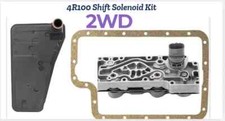
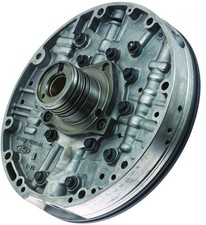
ATSG lists different solenoid packs and pump assemblies for the two versions. On the PWM pump cover the rear of the converter clutch valve bore was enlarged about .070 inch, a .036 inch orifice and an air bleed were added to the TCC solenoid signal passage, a bushing and valve were added to the end of the converter clutch control valve train, and the converter release orifice used in the non-PWM cover was deleted. ATSG states none of those parts interchange between versions. A pump or solenoid pack from the wrong version is a built-in P0741, so confirm which one the truck has before you order either.
Electrically the circuit is simple. ATSG's solenoid body pinout shows pin 1 as solenoid power (VPWR) and pin 4 as the converter clutch solenoid ground, switched by the PCM. The PCM pin for that ground is 54 on gas and California diesel calibrations and 28 on 49-state diesels.
How Ford's monitor sets P0741
Ford's 2004 OBD System Operation Summary lays out the torque converter clutch check in its general transmission outputs section. That document was written for Ford's 2004 diesel trucks, so treat it as the logic Ford used for its electronically controlled automatics of that era rather than a 4R100-specific calibration. It separates the TCC faults cleanly:
| Item | Ford TCC check |
|---|---|
| Electrical DTCs | P0740 open circuit, P0742 short to ground, P0744 short to power |
| Mechanical DTC | P0741 TCC mechanical functional |
| When it runs | Electrical: continuous. Mechanical: during lockup |
| Sensor that must be OK | TSS (turbine shaft speed) |
| Monitoring duration | 5 lock-up events |
| Entry conditions | Steady throttle, positive drive torque, not shifting, TCC commanded on, fluid temp up to 275 F |
| Malfunction threshold | Slip across the converter above 100 rpm, or on some applications a speed ratio below 0.93 |
Slip is engine speed minus turbine speed, so a bad turbine shaft speed signal can fake a slipping converter. That's why Ford requires a working TSS before the test runs: fix any P0715 or P0717 first. The code also needs repeat failures under steady positive torque, so you reproduce it on a steady cruise or light pull, not in the bay.
P0741 vs P0743 vs P1744
The ATSG 4R100 code chart lists three TCC codes you'll see on these trucks, and each one sends you somewhere different:
| Code | ATSG description | Symptom per ATSG | Where it points |
|---|---|---|---|
| P0741 | Excessive TCC slippage during normal operation | Erratic or no converter clutch operation, flashes TCIL | Clutch can't hold: low apply pressure, release circuit, converter |
| P0743 | TCC solenoid circuit failure | Short circuit: engine stalls in D or 2 at idle with brake applied. Open circuit: TCC never engages | Wiring, connector, solenoid coil, PCM driver |
| P1744 | TCC solenoid mechanical failure detected | Harsh shift, may flash TCIL | Solenoid or TCC valve not doing what it's told |
P0741 by itself, with no circuit code, says the electrical side passed and the clutch still slipped. P0741 alongside P1744 is common on a hydraulic problem, and it's the pair Sonnax documented on a repeat-failure truck (more on that below). If P0743 is in the list, fix the circuit before you think about anything inside the transmission.
Step 1: Confirm the slip on live data
Put engine rpm, turbine shaft speed (TSS), output shaft speed, commanded gear, TCC command or duty cycle, and transmission fluid temperature on screen. Drive in 3rd and 4th at a steady 45 to 60 mph with light throttle.
- Slip that stays above about 100 rpm with the TCC fully commanded: that's what Ford's threshold catches. The clutch isn't getting enough apply pressure or can't hold.
- Slip that drops, then climbs as throttle increases: classic pressure-limited apply. The clutch locks at light load and loses grip as engine torque rises.
- Turbine speed that jumps around while engine rpm is steady: suspect the TSS signal before the converter. See the P0715 guide linked below.
Watch fluid temperature during the drive. A truck that runs much hotter than normal on a steady cruise is often slipping the converter clutch, and Sonnax's case truck came back with overheated fluid each time its converter failed.
Step 2: Rule out the solenoid and its circuit
With the key off, test across the solenoid body pins with a meter. ATSG's values:
| Solenoid | Pins | Resistance (ATSG) |
|---|---|---|
| TCC solenoid, on/off | 1 and 4 | 20-30 ohms |
| TCC solenoid, PWM | 1 and 4 | 10-20 ohms |
| EPC solenoid | 11 and 12 | 3.0-5.0 ohms |
| TFT sensor at 159-194 F | 7 and 8 | 5k-2.7k ohms |
The resistance tells you which version you have as well as whether the coil is good. A 25 ohm reading on a truck you thought was PWM means someone may have installed the wrong pack. Check each pin to the case for shorts, then measure from the PCM end at pin 54 or 28 to prove the harness. ATSG notes the solenoids are not serviced individually. If the TCC solenoid is bad, the whole solenoid pack gets replaced.
Don't skip EPC: Ford's summary notes line pressure is tested only indirectly, through the clutches it feeds, so low EPC can surface as a converter clutch fault.
Step 3: Check the hydraulics around the converter
This is where most 4R100 P0741 trucks are really fixed. Bob Warnke of Sonnax documented a 2000 7.3L diesel with a 4R100 that went through four converters, with complaints of a long, soft TCC apply and overheated fluid and converter codes 1728 and 1744. His conclusion was that there was not enough pressure at the TCC piston to control slip as engine torque increased. The converter wasn't the root cause. It was the victim.
Warnke explains why the 4R100 is sensitive to this. On the modulated TCC circuit, oil from the TCC regulator valve goes to the converter apply side without a restriction, and release oil exhausts past the turbine hub without an orifice. Any restriction in that release path slows the exhaust and softens the apply. Changing orifice sizes trades piston pressure against cooler flow, so it's not a free fix. He lists the likely causes, most to least likely:
- The external cooler bypass check ball stuck open or leaking. It's outside the transmission, a ball, seat and spring that opens at about 60 psi of cooler head pressure to keep lube flowing past a restricted cooler.
- Poor pump volume. A worn pump can't supply the converter, cooler and apply circuits at once.
- Modified pump orifices from an earlier repair.
His test is to measure cooler flow and cooler head pressure together, and if you can't measure flow, at least measure head pressure. Know what normal looks like on this unit. On an E4OD, cooler flow in 3rd runs about 1.2 to 1.4 gpm before lockup and climbs to about 1.8 to 2.0 gpm when the TCC is commanded. The 4R100 goes the other way. Flow drops during TCC apply and is higher before lockup. Units with restricted converters showed little flow change at lockup and head pressure that didn't rise to normal.
On PWM units, look at the TCC control plunger valve in the pump. Sonnax explains that a plunger valve and coil spring cushion the TCC control valve, using regulated converter pressure as a variable hydraulic spring to set how fast the clutch applies. The plunger oscillates constantly and wears its sleeve, and the leak that results causes premature or bumpy TCC apply, shudder and TCC cycling. Sonnax's replacement valve and sleeve, kit 36424-08K, fits PWM units only.
Step 4: Look at the converter and its endplay
When the pressures and flows are right and the clutch still slips, the converter is next. Ed Lee, writing in Transmission Digest's converter tech column, explains that 4R100 converter charge and release oil travels between the stator support and turbine shaft, around the front stator bushing, and out through three slots between the turbine shaft and turbine hub. Unlike the E4OD hub, the 4R100 hub with a bearing has no lube passages that bypass the bearing, so the bearing itself restricts flow.
Lee gives a minimum converter endplay of about .035 to .040 inch for enough release oil. Too much endplay risks bearing damage from impact. Too little speeds up clutch wear. He also notes that a restricted exhaust from in front of the clutch makes the apply slower and softer, which reads as slip to the PCM. A converter built to E4OD habits isn't automatically right for this unit, so ask the builder how they handle endplay and release flow.
Fluid and the fix
ATSG calls for MERCON-type fluid in all 4R100 transmissions and says to set level at normal operating temperature, 150 to 170 F, engine idling in Park. Motorcraft MERCON V (XT-5-QMC quarts) is approved for transmissions previously serviced with MERCON. Burnt fluid means the slip has been making heat for a while, so service it and inspect the cooler and lines, since a restricted cooler is half of the bypass problem Warnke described.
Preventing a repeat
Fix it in order: TSS and circuit codes first, then fluid, then cooler flow, head pressure and the bypass check ball, then the pump and (on PWM units) the plunger valve, and the converter last. After any converter replacement, measure cooler flow and head pressure before the truck leaves, so a stuck bypass or tired pump doesn't burn the new unit. Keep the pump and solenoid pack matched to the version the truck came with, and replace the cooler after a converter failure, since debris raises head pressure and opens the bypass.
Shop the part for this fix: Sonnax 4R100 TCC control plunger valve kit
Sonnax 36424-08K valve and sleeve for the 4R100 TCC control plunger, the wear point behind bumpy apply, shudder and TCC cycling on PWM units. PWM units only, so confirm your version first.
See the Sonnax 36424-08K kit at CoreTransmissionPartsNeed parts for this job?
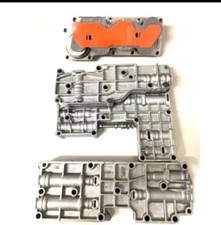
Our 4R100 parts page has solenoid packs, pumps, valve bodies and master rebuild kits, with checkout on site. Confirm model year, engine, and PWM or non-PWM TCC before you order a pump or solenoid pack.
Shop 4R100 parts →FAQ
What does P0741 mean on a 4R100?
P0741 means the PCM commanded the torque converter clutch on and still saw too much slip between engine speed and turbine speed. ATSG describes it as excessive TCC slippage during normal operation, with erratic or no converter clutch operation and a flashing O/D OFF lamp. It is a performance code, so the solenoid can test fine and the code still sets.
How much converter slip sets P0741?
Ford's OBD system summary lists a mechanical TCC threshold of more than 100 rpm of slip across the converter, or on some applications a speed ratio below 0.93. The test runs only during lockup at steady throttle with positive torque, and it needs five lock-up events. The turbine shaft speed sensor has to be working for the test to run.
Can a bad TCC solenoid cause P0741 on a 4R100?
Yes, but check it with a meter first. ATSG lists 20-30 ohms for the on/off TCC solenoid and 10-20 ohms for the PWM solenoid, measured across solenoid body pins 1 and 4. A circuit fault usually sets P0743 instead, and the solenoid is serviced only as part of the solenoid pack.
Why does a 4R100 keep failing torque converters?
Sonnax documented a 2000 7.3L truck that went through four converters because there was not enough pressure at the TCC piston as engine torque increased. The most likely causes were a stuck or leaking external cooler bypass check ball, poor pump volume, and modified pump orifices. Measure cooler flow and head pressure before installing another converter.
Related guides
- 4R100 TCC Lockup Explained
- 4R100 Torque Converter Shudder
- 4R100 P0715: Input Turbine Speed Sensor Causes & Fix
- 4R100 Shift Solenoid Symptoms
- 4R100 Pump Failure Symptoms
Sources
- ATSG (Automatic Transmission Service Group), Ford 4R100 technical service manual (2003). Backs the P0741, P0743 and P1744 code chart descriptions and symptoms, TCC apply in any forward gear except Manual 1st, the 1999 PWM vs non-PWM change and its pump cover and solenoid pack differences, solenoid body pinout and PCM pins 54/28, the TCC, EPC and TFT resistance values, and the MERCON fluid and 150-170 F level check. ATSG 4R100 manual (PDF)
- Ford Motor Company, 2004 OBD System Operation Summary (revision August 7, 2003), Comprehensive Component Monitor, Transmission Outputs, "Torque Converter Clutch Check Operation" and the EPC note. Backs the P0740/P0741/P0742/P0744 split, 5 lock-up events, TSS requirement, entry conditions, and the 100 rpm slip or 0.93 speed ratio threshold. Ford OBD summary (archive.org PDF)
- Sonnax, Bob Warnke, "4R100 Repeated Converter Failure" (June 22, 2006). Backs the four-converter 7.3L case, codes 1728 and 1744, insufficient TCC piston pressure, the unrestricted modulated TCC circuit, the external bypass check ball opening at about 60 psi, the ranked causes, and the E4OD vs 4R100 cooler flow comparison. sonnax.com
- Transmission Digest, Ed Lee, "4R100 Flow Issues" (May 2006). Backs the converter release oil path, the turbine hub bearing restriction, the .035-.040 inch minimum endplay, and the effect of restricted exhaust on apply feel. transmissiondigest.com
- Sonnax, TCC Control Plunger Valve Kit 36424-08K product page. Backs how the plunger valve cushions the TCC control valve, sleeve wear causing bumpy apply, shudder and TCC cycling, and the PWM-only fitment. sonnax.com
- Motorcraft (Ford), MERCON V Automatic Transmission Fluid product details. Backs part number XT-5-QMC and its use in transmissions previously serviced with MERCON. fcsdchemicalsandlubricants.com