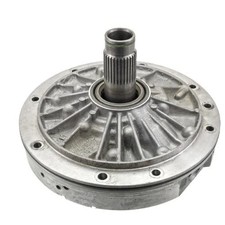
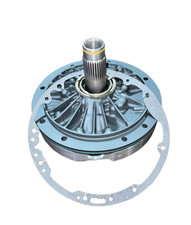
Pump failure on the Ford 4R100 gets blamed for nearly every drivability complaint this transmission produces, and the blame is only sometimes correct. The 4R100 pump does two jobs at once: it builds the line pressure that holds every clutch and band applied, and it meters the converter-charge oil that keeps the torque converter clutch from dragging on the cover. Ford changed the pump casting twice over this unit's production run, changed the stator-support bushing design for PTO applications, and left behind a well-documented pressure-regulator wear point that mimics a bad gear set without the gears themselves being worn at all. This guide covers what Sonnax's technical documentation and Transmission Digest's trade coverage actually say fails, how to tell a gear-wear problem from a converter-flow problem, and which casting you need when the pump gets replaced.
Symptoms That Point to the Pump
Low or inconsistent line pressure from a worn pump shows up as a cluster of complaints rather than one clean symptom: delayed or soft engagement into Drive or Reverse, slipping under load that does not isolate to a single gear, and -- because the pump also supplies converter-charge oil -- a torque converter that shudders or fails prematurely from clutch drag that has nothing to do with the converter itself. Sonnax's own product documentation for the 4R100 pump gear set is specific about the confirming evidence: it ties worn inner-to-outer gear clearance to diagnostic codes 62, 628 and 1744, along with low line pressure, excess pump noise, and repeated converter failure as the pattern that shows up together when the gears themselves are the problem.
A whine or growl from the front of the case that tracks engine RPM is worth noting on a road test, but it is not proof by itself. The only way to separate a genuinely worn pump from a pressure-regulator problem, a converter-flow restriction, or a bad sensor is to test it -- on the bench with a vacuum gauge, or on the vehicle with a mechanical line pressure gauge -- rather than diagnose from feel.
What Actually Kills This Pump
Gear Wear and the Casting History
Ford changed the 4R100/E4OD pump casting twice. Sonnax's parts documentation identifies the E9 and F1 castings used before 1995 as a design that "suffered from low pump output" even when new, due to an 11-lobe outer gear design. Ford superseded that with the F5 casting in 1995 and the F8 casting in 1998, both using a revised 10-lobe outer gear with more capacity. Sonnax's direct-replacement pump gear set (part 36438A-03) is a drop-in fit for F5 and F8 castings specifically -- it is not designed to correct the earlier E9/F1 design's output limitation, which is why Sonnax's own guidance is to replace an E9 or F1 pump with an F5-or-later unit rather than just swap gears in the old housing. Once the gears themselves wear beyond spec in any casting, pressure and volume drop together, which is what produces the code pattern and symptom cluster above.
Pressure Regulator Boost Sleeve Wear
This is the wear point that gets misdiagnosed as "the pump" most often, because it lives inside the pump housing but has nothing to do with the gear set. The pressure regulator boost valve rides in a sleeve inside the pump body, and Sonnax's product line for this bore -- part numbers 36424-01K (O-ring style) and 36424-03K (factory-style, no O-ring, aluminum-alloy sleeve) -- exists specifically because severe wear of that boost sleeve lets EPC and reverse-boost oil leak past it. The symptom set is soft shifts, delayed reverse, and low line rise, which overlaps heavily with gear wear symptoms but has a completely different fix: a bore-specific regulator or boost valve kit rather than a gear set or full pump replacement. For a housing with more advanced bore wear, Sonnax also offers an oversized line-to-lube regulator valve kit (36424-16K) that requires reaming the bore with Sonnax's own tooling (kit F-36424-TL16C) rather than a drop-in part.
Converter-Charge Flow Through the Stator Support Bushing
The pump's second job -- supplying converter-charge and clutch-release oil to the torque converter -- runs through a different wear path that a Transmission Digest piece by retired Sonnax technical specialist Ed Lee lays out in detail. On a 4R100 converter, that oil passes between the stator support and the turbine shaft, through cavities around the front stator bushing, then out through three slots between the turbine shaft and the turbine hub. Lee's article is specific that converter endplay is critical here: a minimum of 0.035 to 0.040 inch is needed to let enough clutch-release oil through to keep the lockup clutch from dragging on the cover, but too much endplay creates an impact-related bearing failure instead. Too little endplay drags the clutch and overheats it; too much destroys the bearing. Some converter shops address restricted flow by milling bypass slots across the bearing-support surface or in the cover, which Lee notes works but requires care not to undercut the bearing's support in the process. The point for diagnosis: a converter that shudders or runs hot because of restricted charge flow can look exactly like a pump that is not building enough volume, when the pump itself is fine and the restriction is in the converter's own stator-bushing clearance.
Pump Identification: PWM vs. On/Off, PTO vs. Non-PTO
Getting the wrong pump variant is its own failure mode, and it happens often enough that Transmission Digest ran a dedicated identification piece by technical editor Mike Riley. In 1998, Ford standardized on a common pump body and cover casting marked F81P to cover three pump-assembly types: the E4OD, the 4R100 with on-off lockup, and the 4R100 with PWM lockup. PTO-equipped 4R100 models initially used a bearing in the stator-support bore for the input shaft, but Ford reverted that to a traditional bushing almost immediately, which narrowed the real distinction down to lockup type. The original PWM pump part number was F81Z-7A103CA, later superseded to 8C3Z-7A103C; the on-off pump, part XC3Z-7A103EA, has since been discontinued by Ford, and Riley's piece notes an E4OD pump can substitute for it by changing the stator support. Identification in the field comes down to two checks: compare the stator support's sealing-ring position (the E4OD's coast-clutch-drum sealing rings sit toward the pump cover; every 4R100 variant is reversed, with the bushing or bearing journal forward, to handle PTO loading on the coast-clutch drum), and check the TCC valve bore end-plug depth -- a PWM end plug sits recessed only about a quarter inch from the pump-cover face because it is a long sleeve containing a valve, where an E4OD or non-PWM 4R100 end plug sits more than an inch deep.
The ATSG 4R100 manual lists the same split with Ford service part numbers: non-PWM pump F81Z-7A103-AA for the cast iron coast clutch drum, non-PWM F81Z-7A103-BA for the stamped steel drum, and PWM F81Z-7A103-CA (stamped steel drum). ATSG also documents what is different inside the PWM cover. The rear of the converter clutch valve bore is opened up about .070 inch for a larger valve land, a bushing and valve are added to the end of the valve train, a .036 inch orifice and an air bleed are added to the TCC solenoid signal passage, and the .070 inch converter release orifice in the non-PWM cover is left out. ATSG states plainly that none of these parts interchange between versions, and the solenoid pack has to match the pump (F81Z-7G391-BA non-PWM, F81Z-7G391-AB PWM).
Diagnosing a Suspected Pump Failure
Rule out the cheap causes first. Low or badly degraded fluid produces some of the same delayed-engagement and slip symptoms as pump wear and costs nothing to check. Once fluid is confirmed good, a vacuum test is the fastest way to separate a boost-sleeve problem from a gear-wear problem without pulling the pump apart blind. Sonnax's own installation documentation for the 4R100/E4OD pressure regulator kit specifies vacuum testing at the port indicated with the OE valve in place, holding a recommended minimum of 18 in-Hg -- a bore that will not hold that reading points to boost-sleeve or bore wear rather than the gear set.
If the vacuum test passes but line pressure is still low on a road test, pull the pump and check the casting stamp before assuming the gears are shot. An E9 or F1 casting was a known low-output design from new, per Sonnax, so weak pressure on one of those castings may simply mean it is time to upgrade to an F5 or F8 housing rather than chase a "repair" on a design with an inherent ceiling.
Pump volume also shows up as a converter problem. In Sonnax's "4R100 Repeated Converter Failure" case, a 2000 7.3L diesel went through four converters with codes 1728 and 1744 because there wasn't enough pressure at the TCC piston. Bob Warnke ranks the causes as a leaking or stuck external cooler bypass check ball first, poor pump volume second, and modified pump orifices third. His test is cooler flow and head pressure measured together. If a truck with a pump complaint is also eating converters, check those numbers before you blame the converter builder.
A Related Wear Point: The Converter Thrust Washer
Separate from the pump itself, Sonnax also documents a specific wear point in the torque converter that produces similar symptoms on 6-stud 4R100 and 5R110W converters: the thrust washer between the turbine hub and the piston (Sonnax part FD-WP-17A, a 3.970 in. OD by 2.728 in. ID by 0.060 in. thick plastic washer). It is a rebuild-time wear item rather than a pump component, but because it sits in the same converter-charge circuit the stator-bushing clearance feeds, excessive wear here can produce the same shudder and flow complaints that get blamed on the pump. Anyone tearing down a converter for pump-related symptoms should inspect it rather than reassemble on a worn original.
Shop the 4R100 remanufactured pump assembly →
Replacement: Casting and Fluid Matter as Much as the Part
- Match the casting generation. Do not install an E9 or F1 pump as a "fix" for an F5 or F8 unit's low pressure -- Sonnax's own guidance is the opposite direction: replace an early E9/F1 pump with an F5-or-later casting. The 36438A-03 gear set is built for F5/F8 housings only.
- Match PWM to PWM, PTO to PTO. Per Transmission Digest's identification guide, swapping a non-PWM pump onto a PWM-equipped lockup circuit (or the reverse) will not control the torque converter clutch correctly. Confirm the TCC valve end-plug depth and the stator-support sealing-ring orientation before the pump goes in, not after.
- Check the fluid spec on the dipstick, not from memory. The 4R100 predates Ford's current Motorcraft automatic transmission fluid chart, which only covers transmissions back to 2007 models. Ford's own chart is explicit that "the fluids listed... are unique fluids and MUST be used in applications recommending that particular fluid. Use of any other fluid may cause reduced functionality or transmission damage." Because the 4R100 is not on that current chart, confirm the exact fluid called for on the dipstick handle or in the owner's manual for the specific build year rather than assuming it carries over from a newer platform. For reference, the ATSG 4R100 manual calls for Motorcraft MERCON multi-purpose fluid or an equivalent MERCON fluid, with level set on the dipstick at 150 to 170 F, engine idling in Park.
FAQ
What are the first symptoms of a failing 4R100 pump?
The earliest signs are usually a delayed or soft engagement into Drive or Reverse, slipping under load that is not tied to a single gear, a torque converter that shudders or fails prematurely from low converter-charge flow, and sometimes a whine from the front of the case. Sonnax's own technical documentation ties worn pump gears to diagnostic codes 62, 628 and 1744 along with low line pressure and repeated converter failure, which is a more reliable confirmation than diagnosing by feel alone.
What actually causes a 4R100 pump to fail?
Two separate wear points get blamed on "the pump" and only one of them is the gear set itself. Sonnax documents wear between the inner and outer pump gears that drops pressure and volume over time, and a second, more common failure in the pressure regulator boost sleeve that causes soft shifts and delayed reverse without the gears being worn at all. A third path is a restricted stator-support bushing that starves the torque converter of charge oil, which looks like a pump problem but is a converter-flow problem.
How do I identify the correct replacement pump for a 4R100?
Start with the casting stamp on the pump body. Ford used E9 or F1 castings before 1995, which Sonnax identifies as a known low-output design, then moved to the F5 casting in 1995 and the F8 casting in 1998 -- both of which support the direct-replacement 36438A-03 pump gear set. Beyond the casting, Transmission Digest's identification guide notes you also need to match PWM versus on-off lockup (check the TCC valve bore end-plug depth) and PTO versus non-PTO stator support, since Ford produced different pump variants for each combination starting with the 1998 F81P casting update.
Can a 4R100 pump be vacuum tested before replacement?
Yes, and it is the right first step before condemning the pump outright. Sonnax's own installation documentation for the 4R100/E4OD pressure regulator kit specifies a recommended minimum vacuum reading of 18 in-Hg at the designated test port with the OE valve in place. A bore that will not hold vacuum points to boost-sleeve or bore wear rather than a bad gear set, which changes which kit or part you actually need.
Does 4R100 pump wear always mean a full rebuild?
No. A worn pressure regulator boost sleeve can often be addressed with a bore-specific repair kit without touching the gear set, and a worn gear set on an F5 or F8 casting can take a direct-replacement gear kit without a full pump housing swap. A full rebuild becomes the right call when the gear housing itself is scored or oversized from running worn gears too long, or when pump wear has already taken out the torque converter or burned clutch packs downstream.
Related 4R100 guides
Sources
- Sonnax — "4514 Pump Gear Set" (part 36438A-03) product documentation. Backs the pump gear wear mechanism, diagnostic codes 62, 628 and 1744, the E9/F1 (pre-1995) versus F5 (1995) and F8 (1998) casting history, the 11-lobe-to-10-lobe outer gear change, and the drop-in F5/F8-only fitment of the gear set. sonnax.com
- Sonnax — Installation instructions for the 4R100/E4OD oversized line-to-lube pressure regulator valve kit (part 36424-16K). Backs the pressure-regulator boost-sleeve wear mechanism, the soft-shift/delayed-reverse/low-line-rise symptom set, F1/F5/F8/E9 pump-casting fitment, and the recommended minimum 18 in-Hg vacuum test spec with the OE valve in place. cdn.transend.us (Sonnax/TransEnd, PDF)
- Sonnax — "4366 Thrust Washer" (part FD-WP-17A) product documentation. Backs the converter turbine-hub/piston thrust washer wear point on 4R100 and 5R110W 6-stud torque converters and its dimensions. sonnax.com
- Transmission Digest — "4R100 Flow Issues," Ed Lee (Sonnax TASC Force), May 1, 2006. Backs the converter-charge/clutch-release oil flow path through the front stator-support bushing and turbine hub, the 0.035-0.040 in. converter endplay specification, and the bearing-related flow restriction and failure tradeoffs. transmissiondigest.com
- Transmission Digest — "E4OD/4R100 Component Upgrade: Mix and match is not an option," Mike Riley, Technical Editor, September 1, 2014. Backs the 1998 F81P common pump casting, OEM pump part numbers (F81Z-7A103BA, F81Z-7A103CA/8C3Z-7A103C, XC3Z-7A103EA), and the PWM-versus-on-off and PTO-versus-non-PTO pump identification procedure. transmissiondigest.com
- Ford Motor Company / Motorcraft — Automatic Transmission Fluid Chart (FCSD Chemicals & Lubricants). Backs Ford's official caution against substituting fluid outside the specification listed for a given transmission, cited here to support checking the dipstick/owner's manual directly since the 4R100 predates this chart's covered model years. fcsdchemicalsandlubricants.com (PDF)
- ATSG (Automatic Transmission Service Group) — Ford 4R100 technical service manual (2003). Backs the PWM and non-PWM pump assembly part numbers by coast clutch drum type, the PWM pump cover changes (.070 in. larger valve bore, added bushing and valve, .036 in. orifice and air bleed, omitted .070 in. release orifice), the non-interchangeability note and matching solenoid pack numbers, and the MERCON fluid and 150-170 F level check. ATSG 4R100 manual (PDF)
- Sonnax — "4R100 Repeated Converter Failure," Bob Warnke, June 22, 2006. Backs the four-converter 2000 7.3L case, codes 1728 and 1744, insufficient TCC piston pressure, the ranked causes (cooler bypass check ball, pump volume, modified pump orifices) and the cooler flow and head pressure test. sonnax.com