A 4R100 on the bench can look a lot like the E4OD it replaced, and a 1999 unit can look a lot like a 2003. That's where the trouble starts. Ford built this transmission with three different pump assemblies, three different coast clutch drums, two solenoid packs, and separate PTO and non-PTO valve bodies. Per ATSG, none of those interchange between versions. Order the wrong one and you find out when the unit comes back with a lockup complaint or a burned coast clutch.
This guide is how I identify a 4R100 before I order a single part. It covers the ID tag and how to decode it, the case and sensor tells that separate a 4R100 from an E4OD, the PWM vs on/off lockup split, the coast clutch drum versions, PTO vs non-PTO hydraulics, and the converter differences. Specs and part numbers are from the ATSG 4R100 manual, Transmission Digest and Sonnax (full list under Sources).
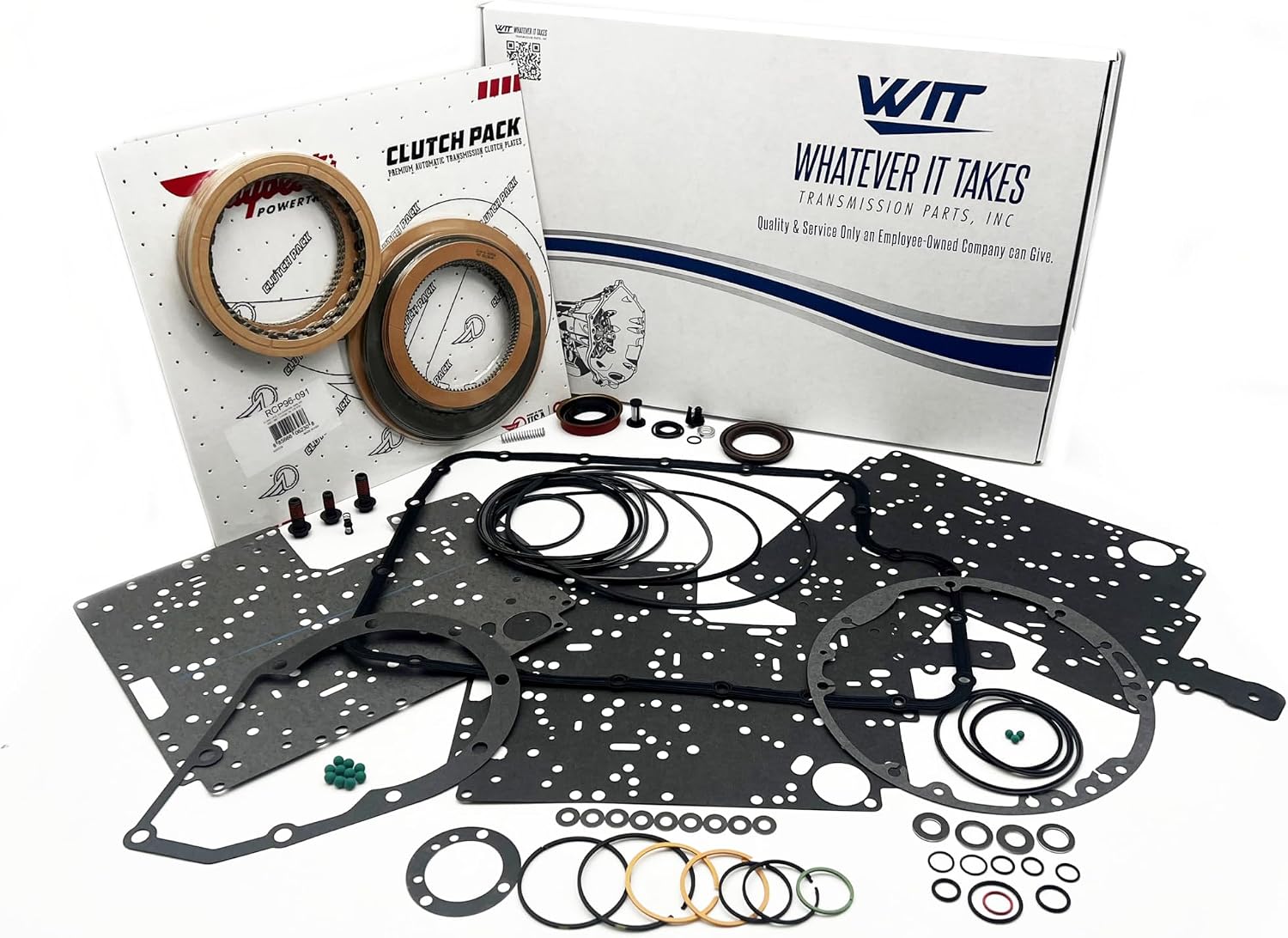
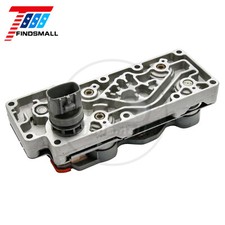
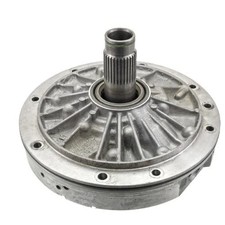
Why the ID matters so much on this unit
The 4R100 is Ford's update of the E4OD. ATSG's manual dates it to the 1999 model year, in F-250 through F-550 Super Duty trucks, E-150 through E-450 vans, and the Expedition, Navigator and Excursion with the 5.4L, 6.8L and 7.3L engines. The castings are marked F81P, which Transmission Digest says denotes 1998. That's why you see "1998-up" on a lot of 4R100 parts.
Inside that one model name, Ford split the unit several ways:
- Lockup type. A PWM (pulse width modulated) torque converter clutch for the V-10 gas engine and all diesels, and an on/off TCC for the other gas engines. Each has its own pump and solenoid pack.
- PTO or non-PTO. The PTO case has a cast-in window on the left side, and the valve body, both spacer plates and the lower valve body are different.
- Coast clutch drum. Cast iron or stamped steel, and the stamped drum comes in PTO and non-PTO versions. The drum you have decides which plates and which stator support you need.
ATSG's line on all of these is blunt: the parts do not interchange from model to model. Transmission Digest's Mike Riley titled his write-up on it "Mix and match is not an option." So the first job on any 4R100 is working out which one is on the bench.
Step 1: Read the ID tag
Start with the tag on the case. In ATSG's identification figure it sits on the side of the case toward the rear, above the pan rail, near the range sensor and manual lever. It carries four lines of information, plus a barcode:
| Line | What it is | ATSG example |
|---|---|---|
| 1 | Assembly part number, prefix and suffix | XW4P-AC |
| 2 | Transmission model | RJL-B |
| 3 | Serial number | 004361 |
| 4 | Build date (year, month, day) | BD-9C17 |
The build date is the line most people misread. After the "BD-" you get one digit for the year, one letter for the month, then the day. ATSG's decode:
| Year digit | Month letters |
|---|---|
| 9 = 1999 0 = 2000 1 = 2001 2 = 2002 3 = 2003 | A = Jan, B = Feb, C = Mar, D = Apr, E = May, F = Jun, G = Jul, H = Aug, J = Sep, K = Oct, L = Nov, M = Dec (no I) |
So BD-9C17 is a unit built on March 17, 1999. Note that the letter I is skipped, so September is J, not I. Keep the build date. Several of the running changes below depend on it, and it matters more than the model year of the truck if the unit has been swapped.
If the tag is missing or painted over, don't guess. Use the physical checks below. A unit out of a salvage yard often has the wrong year written on it in paint marker, and the hardware doesn't lie.
Step 2: 4R100 or E4OD? The outside tells
Swaps between these two are common, so confirm you actually have a 4R100 before you pick parts by year.
- Digital transmission range sensor. The 4R100 uses a 12-pin digital transmission range (DTR) sensor. ATSG's pin chart shows pins for the neutral start circuit, backup lamps, starter relay and the TR1, TR2, TR3A and TR4 signals from the PCM. The sensor bolts down with two bolts at 71-88 in-lb, set with alignment tool 307-351 or an equivalent.
- Input speed sensor. Transmission Digest notes the E4OD had no input speed sensor, while the 4R100 did. ATSG lists both the turbine shaft speed (TSS) and output shaft speed (OSS) sensors as model dependent, so check the case for both bosses and whether they are fitted. Both sensor bolts torque to 8-10 N·m.
- PTO window. A cast-in opening with a cover on the left side of the case. ATSG says PTO was available only on Super Duty F-Series trucks of 8,500 lb GVW and up with the 6.8L gas or 7.3L diesel. If you see the window, it's a 4R100, and it's a PTO unit with PTO-specific hydraulics.
- Manual shift lever. ATSG shows two levers: the PTO version is stamped F81P-AA (Ford part F81Z-7A256-AA), and the non-PTO version is stamped F75P-BB (F7UZ-7A256-BB). They are model sensitive, so move the old lever to the replacement unit or match the stamping.
- Bottom pan. Twenty pan bolts, torqued to 10-12 ft-lb per ATSG. The pan itself doesn't tell you much. There are shallow 2WD and deep 4WD versions, and filters differ with them.
If the case turns out to be an E4OD, or it's a 4R100 with E4OD-era parts inside, two Sonnax listings help sort the internals. The pump gear set 36438A-03 page says E4OD pumps built before 1995 were E9 or F1 castings with an 11-lobe outer gear and low output, replaced by the 10-lobe F5 casting in 1995 and F8 in 1998. The gear set fits all 4R100 pumps but only F5 and F8 E4OD pumps. The remanufactured solenoid block 36424B-RRP is listed for both late 1995-98 E4ODs and non-PWM 1998-later 4R100s, which is why an on/off 4R100 and a late E4OD can share a block while a PWM unit cannot. Our E4OD identification guide covers E4OD tags, valve body castings and year ranges.
Step 3: PWM or on/off lockup
This is the ID that causes the most comebacks. Beginning with 1999 production, ATSG says Ford offered two converter clutch strategies. PWM for V-10 gas and all diesel engines, on/off for all other gas engines. Each needs its own pump and its own solenoid pack. The ATSG part numbers:
| Part | Ford number |
|---|---|
| Non-PWM pump, cast iron coast clutch drum | F81Z-7A103-AA |
| Non-PWM pump, stamped steel coast clutch drum | F81Z-7A103-BA |
| PWM pump, stamped steel coast clutch drum | F81Z-7A103-CA |
| Non-PWM solenoid pack | F81Z-7G391-BA |
| PWM solenoid pack | F81Z-7G391-AB |
Transmission Digest adds that the PWM pump was later superseded to 8C3Z-7A103C, and the on/off pump XC3Z-7A103EA has been discontinued by Ford. Parts listings don't always carry the updates, so check the number, not just the description.
The bench test: TCC solenoid resistance
The fastest way to tell the two apart with the pan on is an ohmmeter on the solenoid pack connector. ATSG's resistance chart (ignition off, DVOM on ohms):
| Solenoid | Pins | Resistance |
|---|---|---|
| TCC, on/off | 1 and 4 | 20-30 ohms |
| TCC, PWM | 1 and 4 | 10-20 ohms |
| Shift solenoid A (1) | 1 and 3 | 20-30 ohms |
| Shift solenoid B (2) | 1 and 2 | 20-30 ohms |
| Coast clutch solenoid | 1 and 5 | 20-30 ohms |
| EPC solenoid | 11 and 12 | 3.0-5.0 ohms |
A TCC circuit in the 10-20 ohm range means a PWM pack. In the 20-30 ohm range it's on/off. The solenoids aren't serviced individually, so ATSG says replace the whole solenoid assembly, and it has to be the right one.
The pump cover tell
With the pump out, look at the converter clutch control valve. Per ATSG, the PWM pump has the rear of that valve bore enlarged about .070 in., a bushing and extra valve at the end of the train, a .036 in. orifice and air bleed in the TCC signal passage, and no converter release orifice (the non-PWM cover has a .070 in. release orifice). Transmission Digest gives the quick visual version: on an E4OD or non-PWM 4R100 the end plug sits more than an inch in from the pump cover outside diameter. On a PWM 4R100 it's recessed only about a quarter inch, with a long sleeve holding the valve.
Step 4: Which coast clutch drum
ATSG shows three coast clutch housings, and the housing decides the plates:
| Drum | Used with | Coast steels | Overdrive frictions |
|---|---|---|---|
| Cast iron (same as E4OD) | 5.4L and 6.8L without PTO | 60 tooth | 64 tooth |
| Stamped steel, non-PTO | 5.4L and 6.8L without PTO | 32 tooth | 32 tooth |
| Stamped steel, PTO | 6.8L and 7.3L with PTO | 32 tooth | 32 tooth |
Transmission Digest lists the stamped drum part numbers. The original non-PTO drum is YC3Z-7G387AA, updated to a bearing design, 1C3Z-7G387AA, which drops the thrust washer. The original PTO drum is YC3Z-7G387BA with a ball bearing, updated to 1C3Z-7G387BA with a modified inner race and an oil dam. The PTO drum bearing is a Koyo 6912 C3, which ATSG notes you can get from a local bearing supply house.
The drum also changes the stator support. ATSG says the sealing ring locations on the pump stator shaft moved with the drum, which makes the stator support model sensitive. Transmission Digest's way to spot it: on an E4OD stator support the coast clutch drum sealing rings sit toward the pump cover, with the bushing journal away from the cover. The 4R100 is the opposite, with the journal forward, to suit the PTO drum. If you're building a unit from mixed cores, check the drum, the plates and the stator support together.
Step 5: PTO vs non-PTO hydraulics
Adding the PTO option changed more than the case. ATSG lists these changes for the PTO version:
- Valve body to case spacer plate. An added hole feeds line pressure to the 3-4 shift valve.
- Main valve body. An added upper passage feeds line to the 3-4 shift valve. An added lower passage exhausts the coast clutch circuit, and the spring side of the 3-4 shift valve is separated from the low/reverse circuit.
- Lower valve body and its spacer plate. Each has an added passage or hole to match the new exhaust.
All 4R100 cases, PTO and non-PTO, also got a dam that separates rear lube and adds central lube. Both spacer plates got a hole that feeds solenoid regulator oil to central lube. Again, ATSG says none of these parts interchange between PTO and non-PTO units. A PTO valve body bolted to a non-PTO case, or the other way around, is a shift complaint you built yourself.
PTO trucks also have an electrical requirement that burns clutches if it's missing. ATSG says battery voltage must reach PCM pin 4 (gas) or pin 66 (diesel) when the PTO is engaged, so the PCM raises EPC pressure to about 55 psi. Without that signal the coast clutch "will be smoked in a short period of time." If a PTO truck comes in with a burned coast clutch, check that wire before you rebuild it.
Step 6: Checkballs and valve body year
ATSG's case checkball chart calls for eight 5/16 in. rubber checkballs in a 4R100 case (CB1, CB6, CB7, CB8, CB9, CB14, BS1 and BS3) plus the EPC ball and spring. ATRA's E4OD/4R100 checkball chart explains why the year matters: in 1996 Ford added CB15 and CB16 and moved BS6 from the case to the lower valve body, and some later models dropped BS6 entirely. Sonnax's valve body layout marks its low/reverse modulator and solenoid regulator valve kits as fitting "'96-later" units. If you're swapping in a used valve body, it has to match the case year and the PTO/non-PTO version.
Step 7: The converter
We don't sell converters, but you still need to know which one belongs with the unit. Sonnax's Ed Lee lays out the tells. All three Ford converters (E4OD, 4R100, 5R110W) share the pilot diameter, flexplate bolt circle, height, 31 input splines and stator splines, so they can look like they interchange. Inside they don't. The 4R100 cover is grooved inside to hold a clutch, while the E4OD cover is smooth. The 4R100 turbine piloting bore is 2.955 in. against 2.765 in. on the E4OD. Sonnax lists the pilot-to-pad dimension as 1.000 in. on both E4OD and 4R100, and .800 in. on the 5R110W. When you seat the converter, ATSG says to lay a straightedge across the front of the case and make sure there's a gap between it and the converter pilot face.
The quick ID checklist
| Check | What it tells you |
|---|---|
| ID tag build date (BD-) | Year and month built |
| PTO window on left side of case | PTO unit: PTO valve body, spacer plates and drum |
| 12-pin DTR sensor, TSS boss | 4R100, not an early E4OD |
| TCC solenoid 10-20 ohms (pins 1-4) | PWM lockup: PWM pump and pack |
| TCC solenoid 20-30 ohms (pins 1-4) | On/off lockup: non-PWM pump and pack |
| Coast drum cast or stamped | Coast steel and OD friction tooth count, stator support |
| Manual lever stamping F81P-AA or F75P-BB | PTO or non-PTO lever |
One more note while you're under the truck. ATSG specifies Motorcraft MERCON (XT-2-QDX) or an equivalent MERCON fluid for all 4R100s, with the level checked on the dipstick at 150-170°F, engine idling in park. That part number is long gone from the shelf, so check the current Motorcraft fluid chart for what Ford supersedes it to before you fill.
Shop the part for this fix: 4R100 PWM solenoid block with filter and gasket (1998-2004)
If your ohmmeter reads 10-20 ohms across the TCC pins, you have a PWM unit and need a PWM pack. This one includes the filter and pan gasket so the job is done in one pan drop.
See the PWM solenoid block at CoreTransmissionPartsNeed parts for this job?
Our 4R100 parts page carries master rebuild kits, solenoid packs, pumps and valve bodies, with checkout on site. Have the tag build date, the lockup type and PTO or non-PTO in hand when you order. Those three answers pick the right part.
FAQ
How do I read the build date on a 4R100 ID tag?
The build date is the line starting with BD-. The first digit is the year (9 = 1999, 0 = 2000, 1 = 2001, 2 = 2002, 3 = 2003), the letter is the month (A = January through M = December, with no I), and the last two digits are the day. BD-9C17 is March 17, 1999.
How can I tell a 4R100 from an E4OD?
The 4R100 uses a 12-pin digital transmission range sensor and has an input (turbine shaft) speed sensor, which the E4OD did not. A PTO window on the left side of the case is 4R100-only. Inside, the 4R100 converter cover is grooved for a clutch and the stator support seal rings are reversed compared with the E4OD.
How do I know if my 4R100 is PWM or on/off lockup?
Per ATSG, PWM lockup was used with the V-10 gas engine and all diesels, and on/off with the other gas engines. With an ohmmeter across pins 1 and 4 of the solenoid pack connector, a PWM TCC solenoid reads 10-20 ohms and an on/off solenoid reads 20-30 ohms. The pump and solenoid pack must match the lockup type.
Do PTO and non-PTO 4R100 parts interchange?
No. ATSG says the PTO case, valve body to case spacer plate, main valve body, lower valve body and lower spacer plate are all different, and none of them interchange with the non-PTO parts. The coast clutch drum and manual shift lever are also PTO-specific.
Which coast clutch drum does my 4R100 have?
There are three: a cast iron drum carried over from the E4OD and a stamped steel drum for 5.4L and 6.8L units without PTO, and a stamped steel PTO drum for 6.8L and 7.3L units with PTO. The cast drum uses 60-tooth coast steels and 64-tooth overdrive frictions, while both stamped drums use 32-tooth parts.
Related guides
- 4R100 vs E4OD: The Differences
- E4OD Identification Guide
- 4L80E vs 4R100
- 5R110W vs 4R100
- 4R100 Shift Solenoid Symptoms
- Ford 4R100 Problems and Service
Sources
- ATSG (Automatic Transmission Service Group), Ford 4R100 technical service manual (2003). Backs the vehicle applications, the ID tag layout and build date code, PTO requirements and the pin 4/pin 66 EPC signal, the 12-pin DTR sensor, the solenoid resistance chart, PWM vs non-PWM pump and solenoid pack part numbers, the three coast clutch drums and plate tooth counts, PTO vs non-PTO hydraulic changes, case checkball locations, the manual lever stampings and the external torque specs. ATSG manual (PDF)
- Transmission Digest, Mike Riley, "E4OD/4R100 Component Upgrade: Mix and match is not an option" (September 2014). Backs the F81P casting mark, the superseded pump numbers, the TCC valve end-plug depth check, the stamped coast clutch drum part numbers and updates, the stator support seal ring orientation, and the E4OD having no input speed sensor. transmissiondigest.com
- ATRA, "E4OD/4R100 Check Ball Identification and Symptom Chart" (2005). Backs the 1996 checkball changes (CB15 and CB16 added, BS6 moved to the lower valve body, later dropped on some models). atracom (PDF)
- Sonnax, Ed Lee, "Identifying Converter Components: 6 Key Features to Understand in Ford E4OD, 4R100 & 5R110W." Backs the grooved 4R100 cover, the 2.955 in. vs 2.765 in. turbine bore, the pilot-to-pad dimensions and the shared converter dimensions. sonnax.com
- Sonnax, "Ford E4OD, 4R100 Valve Body Layout." Backs the '96-later fitment on the low/reverse modulator and solenoid regulator valve kits. sonnax.com
- Sonnax, Pump Gear Set 36438A-03. Backs the pre-1995 E9/F1 E4OD pump castings with 11-lobe outer gears and low output, the F5 (1995) and F8 (1998) 10-lobe castings, and the gear set fitting all 4R100 pumps but only F5/F8 E4OD pumps. sonnax.com
- Sonnax, Remanufactured Solenoid Block 36424B-RRP. Backs the shared fitment for late 1995-98 E4OD and 1998-later non-PWM 4R100 units. sonnax.com