A 4R100 that drives fine forward but won't back up, or backs up only after a long pause and a bang, is one of the easier complaints on this unit to narrow down on the lift, if you know which clutches make reverse. Reverse shares every one of its apply elements with a forward gear. So before anything comes apart, a road test and a pressure gauge can usually tell you whether you're chasing the direct clutch, the low/reverse clutch, or the valve body that feeds them both.
This guide covers the reverse power flow, the road-test logic that separates the two clutches, the line pressure specs, and the known valve body and case leaks that cause a slip or no reverse. It finishes with the rebuild points that keep it from coming back. Specs are from the ATSG 4R100 manual. The checkball and valve body failures are from ATRA, Transmission Digest and Sonnax (full list under Sources).
What applies in reverse
Per ATSG's component and solenoid application chart for the 4R100, reverse (ratio 2.18:1) applies three friction elements and one one-way clutch:
| Element | Reverse | Where else it works |
|---|---|---|
| Direct clutch | ON | OD-3rd and OD-4th |
| Low/reverse clutch | ON | Manual 1st |
| Coast clutch | ON | Manual 1st, Manual 2nd, 3rd with O/D cancelled |
| Overdrive roller clutch | Holding | Every gear except 4th |
The shift solenoids sit in their park/neutral state in reverse (SSA on, SSB off, coast clutch solenoid off, TCC off), and the EPC solenoid keeps modulating line pressure. The solenoid states matter less here than the hydraulics. Reverse is a manual valve range: oil for the low/reverse and direct clutches comes through the manual valve and the checkballs, not through a shift valve the PCM chooses.
Look at the right-hand column. Nothing in reverse is unique to reverse. That's the whole diagnostic trick. Because the coast clutch works alongside the overdrive roller clutch in reverse, the roller clutch can still carry the overdrive planetary if the coast clutch is weak. The two elements that can actually cost you reverse are the direct clutch and the low/reverse clutch.
Step 1: Check the fluid and the linkage
Do the cheap checks first. Low fluid often shows up first as a delayed or slipping reverse, because reverse runs the highest line pressure of any range (see the chart below). Check the level hot in park with the engine running. Then check that the lever puts the manual valve fully into the reverse detent. A stretched cable or a bent linkage bracket can stop the manual valve partway between R and N. That gives you a delayed or slipping reverse that looks like a clutch problem. Put the shifter in R, go under the truck and confirm the outer lever is sitting in the reverse detent. If the column indicator and the detent don't agree, fix the adjustment before you condemn anything inside.
Step 2: Use the forward gears to split the problem
Since each reverse element also works in a forward range, road-test the truck and write down what it does in these two conditions:
- Manual 1 engine braking. Put the lever in 1 at 15-20 mph and lift off the throttle. Per ATSG, Manual 1st applies the forward, coast and low/reverse clutches. If the truck pulls down hard with engine braking, the low/reverse clutch is holding. If it freewheels in Manual 1 like it does in D1, the low/reverse clutch or its feed is the problem, and reverse is probably slipping for the same reason.
- 3rd and 4th gear. The direct clutch applies in 3rd and 4th. A truck that slips on the 2-3 shift or flares into 3rd, and also slips in reverse, has a direct clutch or direct clutch feed problem. That usually means burned direct plates or a leak between the case and the center support.
Put the two together:
| Manual 1 engine braking | 3rd and 4th gear | Most likely cause of no/slipping reverse |
|---|---|---|
| Good | Slips or flares | Direct clutch or its feed (center support seals, case leak) |
| None | Good | Low/reverse clutch, its piston, or the L/R modulator valve |
| None | Good (1996-98, fresh rebuild) | Misplaced BS1 checkball (see below) |
| Good | Good | Manual valve bore leak, linkage, or low fluid |
| None | Slips | Low line pressure: pump, manual valve bore, or several worn clutches |
Step 3: Line pressure test
Put a 300 psi gauge on the line pressure tap on the side of the case. ATSG's line pressure chart for the 4R100:
| Range | Idle | Stall |
|---|---|---|
| P, N | 50-65 psi | — |
| R | 70-100 psi | 220-240 psi |
| OD, M2 | 50-65 psi | 136-156 psi |
| M1 | 70-115 psi | 175-210 psi |
ATSG's rules for the test: check every range at idle first, and if pressure is low at idle, do not run a stall test. Never hold wide open throttle for more than 5 seconds in any range. On PTO trucks, turn the PTO off, and if the PTO unit covers the pressure port, remove it and fit the PTO cover and gasket first.
Reading the gauge:
- Low in R and M1 only, normal in D and M2. That's the signature of a leak in the circuit only those two ranges use. Sonnax lists "low line pressure in Reverse & manual low" as a symptom of a worn manual valve bore. The steel manual valve moving in the aluminum bore wears and scores it. The same wear causes delayed reverse, reverse slip and low/reverse clutch failure.
- Low in every range. Look at the pump, the pressure regulator and the filter before you blame the reverse circuit.
- Normal pressure but reverse still slips. The pressure is getting to the tap but not to the clutch. Think clutch piston seals, the center support feed, or burned plates.
The valve body causes
The BS1 checkball
This one catches rebuilders and valve body swappers. Transmission Digest reported that on 1996-98 E4OD and 4R100 units, slipping or no reverse and/or no engine braking in Manual 1 or 2 can come from a misplaced BS1 checkball. On earlier E4ODs, misplaced BS1 and BS6 checkballs can do the same thing. The ATRA E4OD/4R100 checkball chart explains why the checkballs matter by year. In 1996 Ford added CB15 and CB16 and moved BS6 from the case to the lower valve body. Some later models dropped BS6 completely. So a checkball layout copied from an older book, or from a different year of valve body, can end up wrong.
If reverse quit right after a valve body job or an overhaul and the unit also has no Manual 1 engine braking, pull the valve body and check the checkball locations against the book for that exact year before you tear the unit down again.
Delayed reverse with a bang
A slow, hard engagement into reverse is often a timing problem between the two reverse clutches. Transmission Digest's June 2003 Tech/Talk covered the 1989-95 E4OD version: a weak low/reverse modulating valve spring lets the direct clutch apply before the low/reverse clutch, and the fix on those years was a spring with double the tension. TD warns that the spring change is for 1989-95 units only, because the circuit changed in 1996. On 1996-up units (the 4R100 era), ATRA explains CB15's job: it sits in the L/R modulator valve exhaust, and when you select reverse it seats and lets the low/reverse clutch apply first, "BAM." Leave it out and the L/R clutch still applies, just not as quickly, and you may get a bang from park to reverse.
Other causes of a delayed reverse
Transmission Digest's January 2002 Tech/Talk item on E4OD delayed reverse lists more causes to rule out before you change valves or springs: a loose tension plate on the tail of the spacer plate (where the ID notches are), a leak in the low/reverse, direct or coast clutch circuit, excessive clearance in any of those three packs, a malfunctioning manual lever position sensor, low line pressure and low fluid. That lines up with ATRA's E4OD/4R100 quick reference flowchart, which lists the separator reinforcing plate, coast clutch, low/reverse or direct clutch, and the valve bodies when line pressure is low only in R. For the 1989-95 E4OD version of this job, including the CB12/BS5 and case-mounted BS6 checkballs, see our E4OD no reverse guide.
A worn L/R modulator
Sonnax lists wear at the low/reverse modulator plunger valve sleeve bore, caused by constant oscillation, as a cause of burnt low/reverse clutches and no engine braking in D1. Its heavy-duty sleeve kit (36947-09K) is a two-stage valve that raises L/R clutch pressure to near double the OE valve. That's worth knowing on a truck that tows and keeps burning L/R plates.
The hard-part causes
Direct clutch feed leak at the center support
The direct clutch gets its oil through the center support. Sonnax's intermediate and direct clutch feed seal kit (36424-24K) lists delayed reverse, burned direct clutch and direct clutch failure among its symptoms. The cause is clearance and movement between the case and the center support that lets apply oil leak off. A unit that burned its direct plates once will do it again with new plates and the same leak. Seal the feed or it's a comeback.
Reverse clutch piston and plates
The low/reverse clutch piston lives in the back of the case, under the low roller clutch inner race. Per ATSG, the piston uses inner and outer lip seals. Install new ones with the lips facing the way the manual shows, lube them with Trans-Jel, and work the piston into the case with a rotating motion so you don't roll a lip. The return spring assembly is compressed with the inner race using two threaded rods (5/16"-24 by 3 inches, made from bolts with the heads cut off). Position the lube hole in the race at 5 o'clock. Torque the five inner race bolts to 24-34 N·m (18-25 ft-lb) in a criss-cross pattern.
The pack goes in with the wave plate on top of the piston first, then a steel, alternating steels and frictions up to the backing plate and snap ring. ATSG notes that the plate count is model-specific (the manual illustrates 6 frictions and 6 steels), and no stack-up clearance check is required on the reverse clutch. That makes it easy to mix up plate counts between a gas and a diesel pack, so count what came out.
Putting it back together
- New lip seals on the reverse piston, lips facing the right way, and a new lube orifice plug in the case per ATSG.
- Inner race bolts at 18-25 ft-lb, criss-cross.
- Seal the case-to-center support feed on any unit that burned direct plates.
- Check the manual valve bore for wear. If it's scored, ream it and fit an oversized manual valve.
- Checkballs in the right places for the model year, BS1 included.
- Recheck line pressure in R and M1 after the rebuild and compare to the chart above.
Shop the part for this fix: Sonnax oversized manual valve kit 36947-13K
If line pressure is low only in R and M1, or reverse is delayed and slipping on a high-mileage valve body, the worn manual valve bore is the usual suspect. This kit lets you ream the bore and fit a larger, more stable valve (reaming tool required).
See the Sonnax manual valve kit at CoreTransmissionPartsNeed parts for this job?
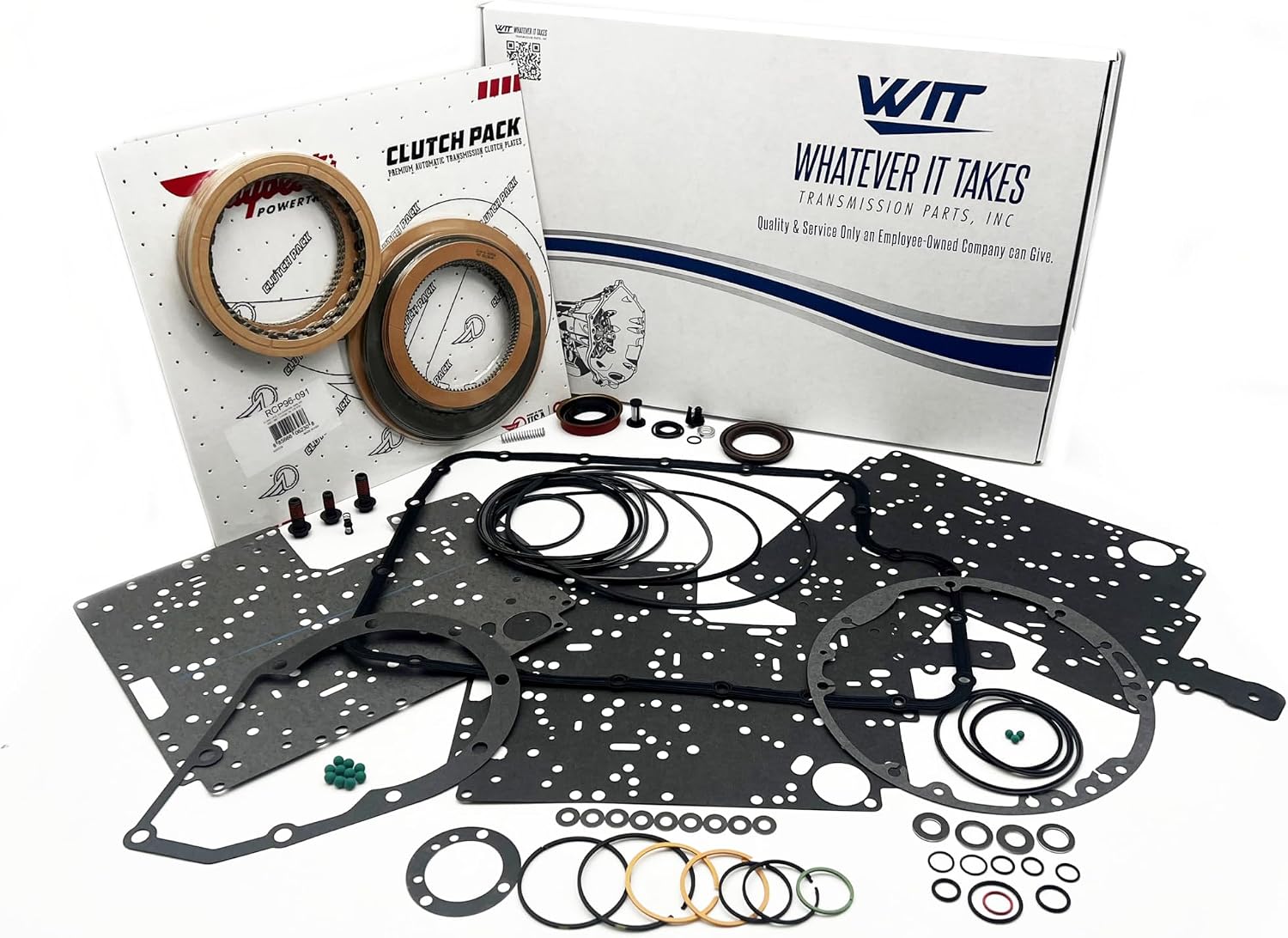
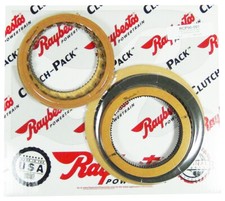
Our parts shop carries 4R100 master rebuild kits, Raybestos clutch packs and valve bodies, with checkout on site. Before you order, confirm model year, gas or diesel, and 2WD or 4WD. Plate counts and valve body layouts change across those.
FAQ
What clutches are applied in reverse on a 4R100?
Per the ATSG application chart, reverse applies the direct clutch, the low/reverse clutch and the coast clutch, with the overdrive roller clutch holding. The direct clutch also works in 3rd and 4th, and the low/reverse clutch also works in Manual 1st. That overlap is what you use to figure out which one has failed.
Why does my 4R100 have no reverse but drives forward fine?
Usually because the failed element is one that only works in a gear the driver doesn't use much. If Manual 1 has no engine braking, the low/reverse clutch or its feed is the likely cause. If 3rd and 4th slip, look at the direct clutch. Low fluid, linkage that doesn't reach the reverse detent, and a worn manual valve bore are the other common causes.
What should 4R100 line pressure be in reverse?
ATSG specifies 70-100 psi in reverse at idle and 220-240 psi at stall. If reverse and Manual 1 read low while Drive is normal, suspect a leak in the reverse/manual low circuit, like a worn manual valve bore. If idle pressure is low, don't do the stall test.
Can a valve body cause no reverse on a 4R100?
Yes. Transmission Digest reported that a misplaced BS1 checkball on 1996-98 E4OD and 4R100 units can cause slipping or no reverse and no engine braking in Manual 1 or 2. A worn manual valve bore lowers line pressure in reverse and manual low, and a worn low/reverse modulator valve can burn the low/reverse clutch.
Why does my 4R100 bang into reverse after a delay?
Usually because the direct clutch applies before the low/reverse clutch. On 1989-95 E4ODs, a weak low/reverse modulating valve spring was a known cause. On 1996-up units, a missing CB15 checkball slows the low/reverse clutch apply and can cause a bang from park to reverse.
Related guides
- 4R100 Slipping: Causes, Codes and the Fix
- 4R100 Harsh Shift Causes and Fix
- 4R100 Valve Body Problems: Symptoms and Testing
- 4R100 Valve Body Wear and the Fix
- 4R100 Limp Mode Causes and Fix
- E4OD No Reverse: Diagnosis and Fix
Sources
- ATSG (Automatic Transmission Service Group), Ford 4R100 technical service manual (2003). Backs the component and solenoid application chart (reverse elements and 2.18 ratio), the line pressure specification chart and test cautions, reverse piston lip seal and inner race installation, the 18-25 ft-lb inner race bolt torque, the reverse clutch pack order and no-clearance-check note. ATSG manual (PDF)
- ATRA, "E4OD/4R100 Check Ball Identification and Symptom Chart" (2005). Backs the 1996 checkball changes (CB15, CB16, BS6 moved), CB15's role in applying the L/R clutch first in reverse, and the bang into reverse when it is left out. atracom (PDF)
- Transmission Digest, Tech/Talk, November 2001 issue. Backs the misplaced BS1 checkball (1996-98) and BS1/BS6 (earlier E4OD) causing slipping or no reverse and no engine braking in Manual 1 or 2. transmissiondigest.com
- Transmission Digest, Tech/Talk, June 2003 issue, "Ford E4OD: Delayed Reverse." Backs the weak low/reverse modulating valve spring letting the direct clutch apply before the L/R clutch on 1989-95 units, and the double-tension spring fix. transmissiondigest.com
- Sonnax, "Oversized Manual Valve Kit 36947-13K." Backs the manual valve bore wear causing delayed reverse, reverse slip, L/R clutch failure and low line pressure in reverse and manual low. sonnax.com
- Sonnax, "Intermediate & Direct Clutch Feed Seal Kit 36424-24K" and "Heavy Duty Low/Reverse Modulator Sleeve Kit 36947-09K." Back the case-to-center support leak causing delayed reverse and burned direct clutches, and the L/R modulator wear and pressure behavior. sonnax.com (36424-24K) and sonnax.com (36947-09K)
- Transmission Digest, Transmission Tech/Talk, January 2002 issue, "E4OD: Delayed Reverse." Backs the list of other delayed reverse causes (loose spacer plate tension plate, circuit leak, excess pack clearance, MLP sensor, low line pressure, low fluid). transmissiondigest.com
- ATRA, "Quick Reference E4OD/4R100" (2009). Backs the "low only in R" line pressure flowchart items (separator reinforcing plate, coast clutch, low/reverse or direct clutch, valve bodies). ATRA quick reference (PDF)