When a customer says their Super Duty or Excursion is "in limp mode," the 4R100 is usually doing one specific thing: it launches from a stop in a high gear, won't downshift, and the O/D OFF light on the shifter may be flashing. That isn't a program the PCM runs so much as the way the hydraulics were designed to fail. Take away the shift solenoids' power and the valve body puts the truck in 4th in Drive and 2nd in the manual ranges, and the EPC solenoid drops to maximum line pressure. The truck still moves, but it's hard on the unit.
The good news is that the list of things that cause it is short, and most of them are electrical. This guide walks the failsafe logic, the codes that point you at the cause, the power and ground checks, the solenoid tests, and the few hard-part failures that look like limp mode on the road. Specs and code descriptions are from the ATSG 4R100 manual. The wiring and field cases are from Transmission Digest and Sonnax (full list under Sources).
How the 4R100 fails safe
The 4R100 uses two on/off shift solenoids, A and B, to pick the gear. Per ATSG's shift solenoid application chart, in Drive:
| Gear | Shift solenoid A | Shift solenoid B |
|---|---|---|
| 1st | ON | OFF |
| 2nd | ON | ON |
| 3rd | OFF | ON |
| 4th | OFF | OFF |
Look at the bottom row. Both solenoids off is 4th gear. If the solenoids lose their power feed, the PCM loses its ground side, or the solenoid body's internal circuit opens, the valve body sees both solenoids off and the truck sits in 4th in Drive. The same chart shows Manual 1 with both solenoids off as 2nd gear, and ATSG's trouble charts show Manual 2 always giving 2nd. So with no solenoid control, the driver gets 4th in D and 2nd in either manual position. Moving the lever to 2 is how the truck gets home: a 2nd-gear start is a lot easier on it than a 4th-gear start.
The EPC solenoid makes it worse. The PCM controls line pressure by varying current to it, and zero current means maximum EPC and maximum line pressure. ATSG's code chart describes an open EPC circuit as "maximum EPC pressure, harsh engagements and shifts." A truck that has lost solenoid power usually bangs into gear as well as starting in 4th. The converter clutch solenoid is also dead in that state, so there's no lockup.
That line pressure behavior is by design, not a side effect. In a January 2003 Transmission Digest column, Wayne Colonna points out that when Chrysler's 41TE introduced a limp-in mode that put the unit in 2nd gear, Ford's strategy on the E4OD, the 4R100's predecessor, was to raise line pressure through FMEM (Failure Mode Effect Management) instead of selecting one specific gear. ATRA's E4OD/4R100 quick reference lists the result from the driver's seat: Park, Reverse and Neutral work normally, D gives 4th, and both 2 and 1 give 2nd. For the E4OD version of this diagnosis, including the forced-shift test and the #17 fuse, see our E4OD limp mode guide.
One solenoid stuck tells you which one
Not every "limp" truck has lost both solenoids. ATSG's shift solenoid trouble chart shows what the driver gets in Drive when one solenoid is stuck, gear by gear as the PCM commands 1st through 4th:
- SSA always off: 4th, 3rd, 3rd, 4th. Starts in 4th, and 3rd is the best it does.
- SSA always on: 1st, 2nd, 2nd, 1st. Never gets past 2nd, and drops to 1st when the PCM asks for 4th.
- SSB always off: 1st, 1st, 4th, 4th. Holds 1st, then jumps to 4th.
- SSB always on: 2nd, 2nd, 3rd, 3rd. Starts in 2nd, no 1st, no 4th.
Write down what gears the truck actually uses on a test drive and match it to that list. It will tell you which solenoid circuit to test before you've picked up a meter.
Step 1: Pull codes and watch the O/D OFF light
On this unit the transmission control indicator lamp (TCIL) is the O/D OFF light on the end of the shifter, and it flashes for a lot of transmission codes. ATSG's code chart is the map:
- P0750 and P0755, SSA and SSB circuit failure. ATSG: "Improper gear selection depending on failure mode and transmission range selector position." These are your first stop on a truck stuck in one gear.
- P0731, P0732, P0733, 1-2, 2-3 and 3-4 shift errors. ATSG blames "SSA, SSB, or internal transmission components." In other words, the gear ratio didn't match the command, and it may or may not be the solenoid.
- P1746, EPC open. Maximum EPC, harsh engagements and shifts, may flash TCIL.
- P1747, EPC shorted. This is the one that feels most like a true limp mode. ATSG: "Shorted circuit causes minimum EPC pressure, limits engine torque with partial fuel shut off and heavy misfire. Flashing TCIL." The PCM cuts power on purpose to keep low line pressure from burning clutches.
- P0715 and P0720, insufficient TSS or OSS input. ATSG: "Set DTC, Flash TCIL and Flash MIL." P0717 and P0722 (intermittent TSS and OSS) flash the TCIL; the noisy-signal codes just set a code.
- P0500, insufficient or intermittent vehicle speed input from VSS/ABS. ATSG lists harsh engagements, firm shifts, an abnormal shift pattern, unexpected closed-throttle downshifts and odd TCC operation, and it may flash the TCIL. On these trucks that signal traditionally comes from the rear anti-lock sensor in the differential.
- P0741, TCC slippage. Flash TCIL, erratic or no converter clutch.
- P1783, fluid over 270°F. Slight increase in EPC, may flash TCIL. Fix the heat problem first.
Don't assume a speed sensor code means a bad sensor. In a Transmission Digest case ("Diagnosing Electrical Signals"), a 2004 F-550 6.8L with a 4R100 came in flashing the TCIL with P0717. The sensor and circuit were proven good on a lab scope, but the turbine speed signal is read off teeth on the coast clutch drum, and that drum had stopped turning. The transmission had failed inside. Our 4R100 speed sensor guide covers the resistance specs and the scope test.
No codes and still stuck in 4th? That points toward lost power, since a PCM that has lost its own feed, or a solenoid feed that's gone, can't always report it the normal way.
Step 2: Check the power feeds and fuses
ATSG's solenoid connector chart shows two vehicle power (VPWR) feeds into the solenoid body, one for the shift, TCC and coast clutch solenoids and one for the EPC solenoid, both from PCM pins 71 and 97. The PCM switches each solenoid on by grounding it. So with the key on, you should have battery voltage on the VPWR pins at the harness side of the case connector with it unplugged. No voltage there and every solenoid is off at once: 4th in D, full line pressure, no lockup.
The overdrive switch wire that blows the fuse
Transmission Digest published a safety alert, written by Ed Lee of Deltrans, on Ford TSB 92-22-5 (Oct. 21, 1992). The wire from the column-mounted overdrive cancel button can be routed so it rubs a steering column cover screw and shorts, blowing the #17 fuse. The TSB covered 1992 Bronco, F Super Duty and F-150/350, but the article warns that any E4OD or 4R100 truck with the O/D cancel button on the column shifter can do it. The symptoms it lists read like a limp-mode complaint: early shifts, loss of power and poor acceleration, 3-4 shift cycling, a TCIL that cycles on and off or doesn't work, dead rear anti-lock brakes, lost tachometer and fuel gauge, and self-test codes you can't read (solid tone only).
The article flags a real hazard on 1995 and later drive-by-wire trucks: the throttle control is powered through the same circuit, so when the fuse blows "the vehicle's engine immediately returns to idle." The fixes it gives are extra heat-shrink on the wire near the shift lever pivot, or the replacement lever F2TZ-7210-F with a longer pigtail. If a truck keeps blowing that fuse, pull the column covers and look before you replace anything in the transmission.
Other circuits that change the shift schedule
- Idle validation switch (7.3L diesel). ATSG says the IVS is fed through fuse 19, along with the transmission control switch. If that feed is lost, "the engine will immediately return to idle and stay there until feed voltage is restored." That's an engine limp, not a transmission one, but it gets written up as "transmission won't go."
- 4X4 Low fuse. Per ATSG, if the 4X4 LOW indicator fuse blows, the transmission uses the 4X4 Low shift schedule no matter where the transfer case lever is. Ed Lee's Transmission Digest note on code 47/633 describes the switch-side version of the same fault: early shifts in 2WD and 4X4 High and late shifts in 4X4 Low, with a light blue/black signal wire and a gang plug behind the dash, right of the column, that can lose contact. His advice: don't waste time on fuses for that one, check the switch, the gang plug and the circuit panel.
- PTO input. On PTO trucks, ATSG says voltage at the PCM's PTO pin makes the PCM raise EPC to about 55 psi, block 4th and run a very firm, early schedule. A switch stuck on gives you a truck that never gets overdrive. ATSG also notes that after a battery disconnect the PCM needs a 7-mile drive above 50 mph before it remembers it can run a PTO.
Step 3: Test the solenoid body
If power is present at the case connector, measure the solenoids through the case connector with it unplugged. ATSG's resistance chart:
| Solenoid | Pins | Resistance |
|---|---|---|
| Shift solenoid B (2) | 1 and 2 | 20-30 ohms |
| Shift solenoid A (1) | 1 and 3 | 20-30 ohms |
| TCC solenoid, on/off | 1 and 4 | 20-30 ohms |
| TCC solenoid, PWM | 1 and 4 | 10-20 ohms |
| Coast clutch solenoid | 1 and 5 | 20-30 ohms |
| EPC solenoid | 11 and 12 | 3.0-5.0 ohms |
An open reading on every solenoid that shares pin 1 means the common feed is open inside the solenoid body. That's a classic failure. Sonnax remanufactures these blocks with an integrated printed circuit board in place of the OE circuit assembly, which it says "eliminates fatigue failures common to the ribbon cable inside the OE circuit assembly." A cracked ribbon cable can be intermittent, reading good cold on the bench and opening hot on the road. If the truck only goes into 4th-gear failsafe after it warms up, wiggle-test the connector and harness hot, and don't trust one cold ohm reading.
Resistance in range doesn't prove a solenoid moves. If the codes point at shift errors (P0731-P0733) instead of circuit failures, command the solenoids with a scan tool and listen for them, then move on to the hydraulics.
Step 4: When it's hydraulic, not electrical
A truck that won't take 4th, or drops out of it, can look like limp mode too. Transmission Digest ran a case by Joe Cangelosi on a 4R100 with a P0734 gear ratio error in 4th that had already destroyed its overdrive clutches once. The electrical side checked out. The cause turned out to be a worn manual valve bore that was dumping pump pressure to the pan. Cangelosi explains that the 4R100's clutch pistons are so large that by 4th the leak was more than the pump could make up. He also points out that the unit is completely non-synchronous: once a clutch applies on an upshift, it stays on. A leak anywhere in a feed circuit shows up in the highest gear first.
That's why a truck with burned clutches often arrives "in limp mode." The PCM sees a ratio error, sets a shift-error code and flashes the O/D OFF light. No amount of electrical work fixes it. Air check the circuits and look hard at the manual valve bore on any valve body that's been in a hot, high-mileage unit.
Torque specs for the job
Per ATSG, all valve body bolts and nuts (accumulator body, main control body, solenoid body and reinforcing plate) torque to 9-11 N·m (80-100 in-lb). The solenoid body uses 9 bolts and 1 nut. Bolt lengths vary, so follow the bolt location chart. Overtightened bodies warp and cross-leak, and that's the next comeback.
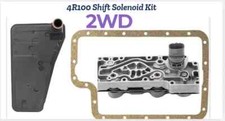
Shop the part for this fix: 4R100 PWM solenoid pack (1998-up)
If the solenoids share an open common feed, a shift solenoid reads out of the 20-30 ohm range, or the truck drops into 4th-gear failsafe when it gets hot, the solenoid pack is the part. Match PWM or non-PWM to your truck; they aren't interchangeable.
See the 4R100 solenoid pack at CoreTransmissionPartsNeed parts for this job?
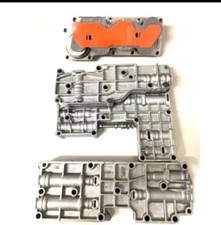
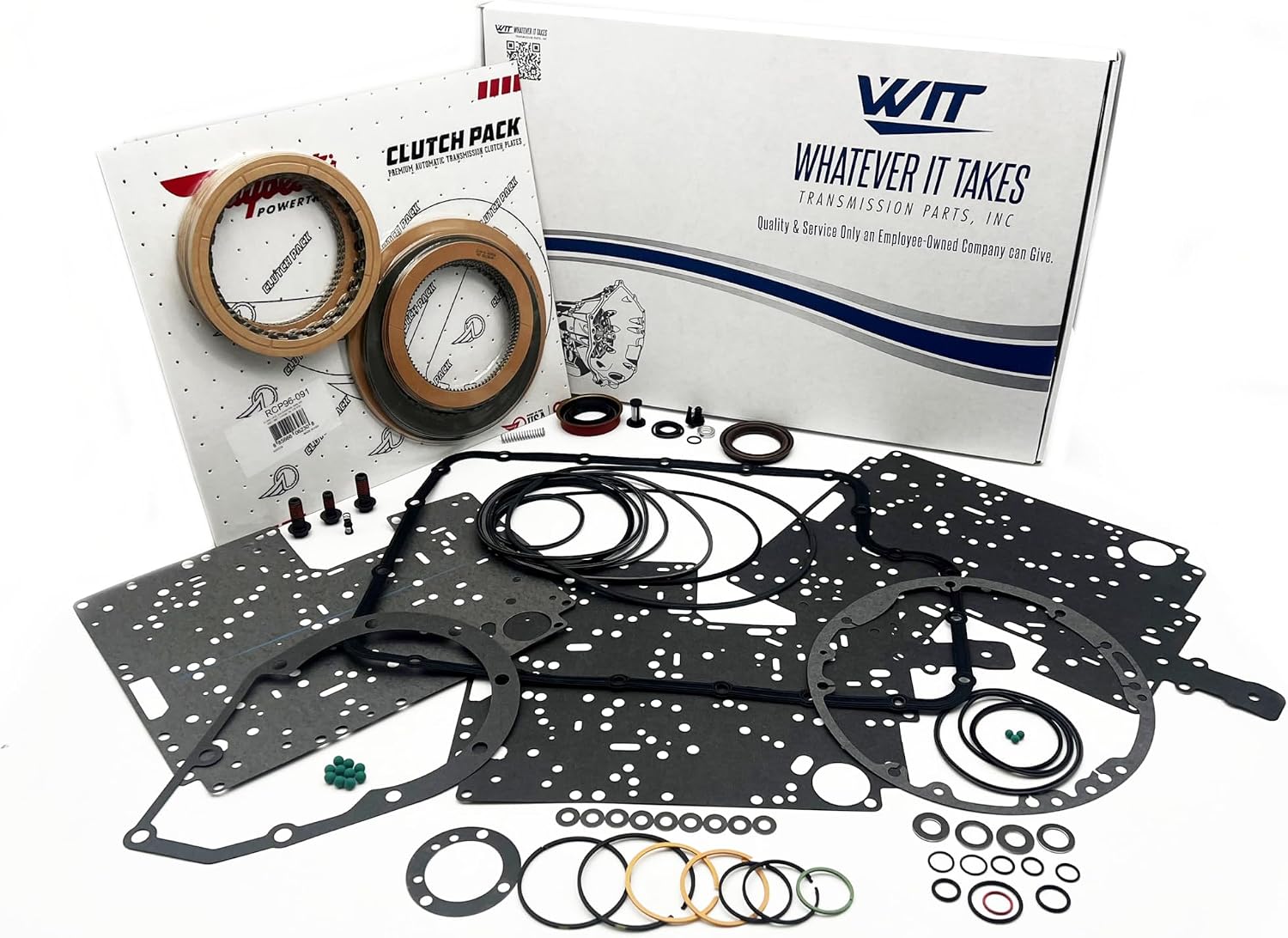
Our parts shop carries 4R100 solenoid packs, valve bodies and master rebuild kits, with checkout on site. Before you order, confirm PWM or non-PWM, model year and 2WD or 4WD.
FAQ
Why is my 4R100 stuck in 4th gear?
With both shift solenoids off, the 4R100 valve body gives 4th gear in Drive. A blown fuse, an open solenoid power feed, a broken harness or an open circuit inside the solenoid body will all do it. Check for P0750 and P0755, then check for battery voltage at the solenoid power pins.
What does a flashing O/D OFF light mean on a 4R100?
The O/D OFF light is the transmission control indicator lamp, and the PCM flashes it when it sets many transmission codes. ATSG lists it for speed sensor faults (P0715, P0717, P0720, P0722), TCC slippage (P0741), EPC circuit faults (P1746, P1747) and fluid over 270°F (P1783). Pull the codes before replacing anything.
Can a blown fuse put a 4R100 in limp mode?
Yes. Ford TSB 92-22-5 covers an overdrive switch wire that shorts on a steering column cover screw and blows the #17 fuse, causing early shifts, 3-4 cycling and loss of power. A blown 4X4 Low indicator fuse also forces the 4X4 Low shift schedule, and on the 7.3L a lost idle validation switch feed holds the engine at idle.
Is it safe to drive a 4R100 in limp mode?
Only far enough to get it off the road or to the shop. In failsafe the truck starts in 4th in Drive at maximum line pressure with no converter lockup, which loads the clutches and builds heat. Put the lever in 2 for a 2nd-gear start and keep the trip short.
Related guides
- 4R100 Shift Solenoid Symptoms, Codes and Replacement
- 4R100 Harsh Shift Causes and Fix
- 4R100 Won't Shift Into Overdrive: Causes and Fix
- 4R100 Slipping: Causes, Codes and the Fix
- 4R100 Valve Body Problems: Symptoms and Testing
- E4OD Limp Mode Causes and Fix
Sources
- ATSG (Automatic Transmission Service Group), Ford 4R100 technical service manual (2003). Backs the shift solenoid application chart and the shift solenoid trouble chart (gears obtained with each solenoid stuck on or off); the P0715-P0755, P1746, P1747, P1783 descriptions and symptoms; the VPWR feeds and PCM pins 71 and 97; the solenoid resistance chart; the IVS on fuse 19; the 4X4 Low fuse behavior; the PTO strategy and 7-mile relearn; and valve body torque. ATSG manual (PDF)
- Ed Lee (Deltrans), Transmission Digest, "E4OD/4R100 Safety Alert." Backs Ford TSB 92-22-5, the overdrive switch wire shorting on a column cover screw and blowing the #17 fuse, the symptom list, the 1995-up return-to-idle hazard and the F2TZ-7210-F lever fix. transmissiondigest.com
- Ed Lee, Transmission Digest, "Code 47/633 in E4OD/4R100." Backs the early/late shift schedule from a 4X4 Low signal fault, the light blue/black signal wire and the gang plug location. transmissiondigest.com
- Joe Cangelosi, Transmission Digest, "The 4R100 with a Mysterious No 3-4 Shift." Backs the P0734 case, the worn manual valve bore exhausting pump pressure, and the non-synchronous clutch application. transmissiondigest.com
- Sonnax, "Remanufactured Solenoid Block 36424D-RRP." Backs the 1998-later PWM application and the ribbon cable fatigue failures in the OE circuit assembly. sonnax.com
- Transmission Digest, "Diagnosing Electrical Signals." Backs the 2004 F-550 6.8L 4R100 P0717 case, the scope test of the TSS circuit, and the turbine speed signal coming from the coast clutch drum. transmissiondigest.com
- Wayne Colonna, Transmission Digest, "Even Failsafe Is Subject to Change" (January 2003). Backs Ford's E4OD strategy of raising line pressure through FMEM rather than placing the transmission in one specific gear, compared with the 41TE's 2nd-gear limp-in. transmissiondigest.com
- ATRA (Automatic Transmission Rebuilders Association), "Quick Reference E4OD/4R100" (2009). Backs the manual gear ranges in failsafe: Park, Reverse and Neutral normal, 4th in D, 2nd in 2 and 1. ATRA quick reference (PDF)