"It's in limp mode" is the most common way an E4OD shows up on a tow truck, and it almost always means the same thing: the truck launches in a high gear, won't downshift, bangs into gear, and never locks the converter. The driver may have noticed the overdrive light flashing on the end of the shifter first. What makes the E4OD different from most later units is that there's no dedicated limp program behind that behavior. Most of it is simply what the hydraulics do when the solenoids go dead.
That matters for diagnosis. When the computer loses control of the solenoids, the valve body falls back to a fixed set of gears, and the cause is usually on the electrical side: a blown fuse, a bad case connector, a range or 4x4 input the computer doesn't trust, or a solenoid pack with a broken internal circuit. This guide walks through the failsafe behavior, how to tell true failsafe from a single stuck solenoid, the power and connector checks, the forced-shift test that splits inside from outside, and the hydraulic problems that fake it. The charts and connector test come from ATRA's E4OD/4R100 quick reference, the EPC failure modes from the ATSG 4R100 manual (the 4R100 is the updated E4OD), and the fuse, wiring and field cases from Transmission Digest. Full list under Sources.
What the E4OD does when it fails safe
ATRA's overview explains the layout in one paragraph: the E4OD uses two main solenoids to control shifting, those solenoids get power whenever the key is on, and the computer supplies the ground to energize them. A separate EPC (electronic pressure control) solenoid controls mainline pressure. So the computer never feeds power to a shift solenoid. It only closes the ground. Lose the feed, the ground path, or the solenoid circuit, and the valve body sees both shift solenoids off.
Both off is 4th gear in Drive. ATRA's solenoid sequence chart shows 1st as solenoid 1 on and 2 off, 2nd as both on, 3rd as solenoid 1 off and 2 on, and 4th as both off. ATRA's failsafe table lays out what the driver gets:
| Selector position | P | R | N | D (or 3) | 2 | 1 |
|---|---|---|---|---|---|---|
| Gear in failsafe | Park | Reverse | Neutral | 4th | 2nd | 2nd |
Park, Reverse and Neutral still work because they're set by the manual valve, not the solenoids. That's why the truck "still drives," just badly: a 4th-gear launch in Drive, and a 2nd-gear launch if the driver pulls the lever to 2 or 1. Tell the customer to use 2 to get it to the shop. A 2nd-gear start is far easier on the clutches and converter than a 4th-gear start.
Line pressure goes the wrong way at the same time. In a 2003 Transmission Digest column, Wayne Colonna notes that when the 41TE was introduced with a true limp-in gear, Ford's strategy on the E4OD was to raise line pressure through FMEM (Failure Mode Effect Management) rather than put the transmission in one specific gear. The hardware backs that up: ATSG's code chart says an open EPC circuit causes maximum EPC pressure with harsh engagements and shifts. With the solenoid feed gone, the EPC solenoid isn't being driven either, so a truck in failsafe usually slams into Drive and Reverse as well as starting in 4th. The converter clutch solenoid is also dead, so there's no lockup.
True failsafe or one stuck solenoid?
Not every "limp" E4OD has lost everything. ATRA's charts show what you get when a single shift solenoid sticks. This is the gear the truck actually runs as the computer commands 1st, 2nd, 3rd and 4th:
| Condition | In D (commanded 1-2-3-4) | In 2 | In 1 |
|---|---|---|---|
| Both solenoids dead (failsafe) | 4-4-4-4 | 2 | 2 |
| Solenoid 1 always off | 4-3-3-4 | 2 | 2 |
| Solenoid 1 always on | 1-2-2-1 | 2 | 1-2-2-1 |
| Solenoid 2 always off | 1-1-4-4 | 2 | 1-1-2-2 |
| Solenoid 2 always on | 2-2-3-3 | 2 | 2 |
Road test it and write down which gears it uses. If Drive is 4th and only 4th, you're looking for something that killed both solenoids at once: feed, fuse, connector, or the common circuit inside the solenoid body. If it gets 3rd and 4th, you're looking at solenoid 1's circuit. If it shifts 1st straight to 4th, look at solenoid 2. That one road test tells you where to put the meter before the pan comes off.
Step 1: Codes, and what "no codes" means
1989-95 E4OD trucks run EEC-IV. Pull the key-on engine-off codes, the continuous memory codes, and the engine-running test. Intermittent connector and harness faults often live only in continuous memory, so don't skip it. 1996-97 trucks are OBD-II, and the generic shift solenoid circuit codes are P0750 (solenoid 1/A) and P0755 (solenoid 2/B). ATSG's 4R100 chart describes those two as "improper gear selection depending on failure mode and transmission range selector position," which is exactly the table above.
Pay attention when the self-test won't talk. The fuse fault in the next step is on Ford's own symptom list for being "unable to read self-test codes (solid tone only)." A truck stuck in 4th that won't give you codes has a power problem until proven otherwise.
Step 2: Check the fuses and power feeds
The overdrive cancel wire and the #17 fuse
Transmission Digest ran a safety alert by Ed Lee of Deltrans on Ford TSB 92-22-5, issued October 21, 1992. The bulletin lists 1992 Bronco, F Super Duty and F-150/350, but Lee says any truck with an E4OD or 4R100 and an overdrive cancel button on a column shifter can do it. The O/D switch wire can be routed where it contacts a steering column cover screw, short, and blow the #17 fuse. The symptoms the bulletin lists read like a limp-mode ticket:
- Early shifts, loss of power and poor acceleration
- 3-4 shift cycling
- Transmission control light cycling on and off, or dead; transmission control switch dead
- Rear anti-lock brake (RABS) electronics inoperative with the dash light on
- Tachometer and fuel gauge dead
- Self-test codes can't be read (solid tone only)
That list is the tell. A dead tach, fuel gauge and RABS light on a truck that "went into limp mode" isn't a transmission failure. Lee adds a warning for 1995 and later trucks with drive-by-wire throttle control: early versions took their power through the PCM on the #17 fuse, later ones through the #19 fuse, which also feeds the late O/D cancel switch. When that feed is lost, "the vehicle's engine immediately returns to idle." The most common short point is near the shift lever pivot. The fix is to pull the lever and add heat-shrink tubing over the wire where it can rub, or isolate it from the column. If the truck keeps blowing the fuse, pull the column covers before anything else.
Solenoid power at the case
With the fuses good, check the feed at the transmission. ATRA's connector chart, viewed from the terminal side, puts solenoid power (B+) on terminal F. Unplug the case connector and, key on, check for battery voltage at F on the harness side. No voltage there means every solenoid is off at once, which is textbook failsafe.
| Terminal | Function | Terminal | Function |
|---|---|---|---|
| A | Not used | G | TFT sensor (+) |
| B | Coast clutch solenoid | H | TFT sensor (-) |
| C | TCC solenoid (-) | J | Not used |
| D | Shift solenoid 1 | K | Not used |
| E | Shift solenoid 2 | L | EPC solenoid (-) |
| F | Solenoid power (B+) | M | EPC solenoid (B+) |
The 4x4 Low input (code 47/633)
Some "limp" complaints are really a wrong shift schedule. In another Transmission Digest note, Ed Lee covers code 47/633 on the E4OD/4R100: a 4x4 low range signal reaching the computer when it shouldn't. Ford used the same harness on 2WD and 4WD trucks, so the code can show up on a 2WD. Per Ford's trouble tree as Lee describes it, a low range switch failed on gives early shifts in 2WD and 4x4 High, and a switch failed off gives late shifts in 4x4 Low. His advice is not to waste time on fuses for this one, since the switch is fed straight off the ignition switch. Check the light blue/black signal wire for shorts, and the gang plug at the back of the dash, right of the column, where a loose connection causes early shifts along with a flickering tach or fuel gauge.
Step 3: Look hard at the case connector
In Transmission Digest's "Top 10 Problems at Installation," Jim Stokes says the E4OD/4R100 family has more connector trouble than any other unit he deals with: corrosion, loose pin fit, fretting, and a lock tab that breaks easily. A loose connector that opens terminal F on a bump puts the truck in failsafe for a few seconds and then lets it back out, which feels like a transmission that comes and goes. Unplug both halves, check for green corrosion and pushed-back pins, and make sure the lock tab clicks and holds. A new solenoid pack plugged into a bad harness half sets the same codes again.
The range input matters as much as the solenoids. In Randy Peterson's Transmission Digest case, a 1992 Bronco E4OD came in with sudden downshifts, harsh upshifts and then no upshifts at all. A previous shop had blamed the computer. The real fault was the manual lever position (MLP) sensor wiring: three backed-out pins, bare wires, and two wires in the wrong positions. If the computer doesn't know where the lever is, it commands the wrong solenoid states.
Step 4: Force the shifts to split inside from outside
ATRA's quick reference shows how to shift an E4OD by hand. Unplug the case connector, feed terminal F from the battery through a 10-amp fuse, and ground the shift solenoid terminals yourself:
- 1st: ground D (solenoid 1) only
- 2nd: ground D and E (both solenoids)
- 3rd: ground E (solenoid 2) only
- 4th: ground neither
Have a helper drive while you handle the jumpers. If the truck shifts correctly by hand, the transmission is fine and the fault is upstream: computer, inputs, harness or fuse. If it won't make a gear with the correct solenoid grounded, the problem is inside the pan. Keep the test short and the throttle light: with the EPC unplugged the truck is at maximum line pressure.
If it fails inside, measure the solenoids. ATSG lists 20-30 ohms for the shift and coast clutch solenoids on the later solenoid body and 3.0-5.0 ohms for the EPC solenoid. An open on every solenoid that shares the power pin means the common feed inside the solenoid body is broken. Warm it up before you trust a good reading: intermittent internal circuits often open only when hot, and that's the truck that goes into failsafe 20 minutes into a drive.
Step 5: When it looks like limp mode but it's hydraulic
ATRA's solenoid feed diagram shows every solenoid (shift 1, shift 2, TCC and coast clutch) fed from one source, the solenoid regulator valve, which also feeds the 4-3-2 manual timing valve on 1994-95 units. Sonnax says all solenoid feed oil and intermediate lube oil passes through that valve, and when the bore wears, solenoid feed oil leaks to exhaust. Its symptom list for the oversized valve (36947-14) is 2nd and 3rd gear starts, TCC cycling, TCC slip and reduced lube from the center support.
That's the one that fools people. A truck that starts in 2nd or 3rd only when hot, with no circuit codes, a solenoid pack that ohms good, and a clean forced-shift test cold, has low solenoid feed pressure. The solenoids are working; there just isn't enough oil behind them to stroke the shift valves. A new pack won't fix it. The repair is the valve body bore or a replacement valve body for the correct year.
Burned clutches also land trucks "in limp mode." If the computer commands a gear and doesn't see the speed change it expects, it sets a shift error code and may flash the light. ATSG's 4R100 chart blames those shift errors on the solenoids "or internal transmission components." If the circuits test good and it still won't hold a gear, it's time for a pressure gauge and an air check, not another solenoid.
How to work a limp-mode E4OD, in order
- Road test and log the gears. 4th only in D means failsafe; anything else points at one solenoid.
- Pull all codes, including continuous memory. No codes and a solid tone points at power.
- Check the dash. Dead tach, fuel gauge or RABS light means the #17 fuse and the O/D cancel wire.
- Check B+ at terminal F, key on, harness side.
- Inspect the case connector and the MLP sensor wiring. On 2WD trucks with early shifts, check the 4x4 low circuit.
- Force the shifts with a fused 10-amp feed. Shifts by hand means outside; won't shift means inside.
- Ohm the solenoids hot and cold. Open common feed means the solenoid pack.
- Circuits good and still starting in 2nd or 3rd hot means solenoid regulator valve bore or clutches.
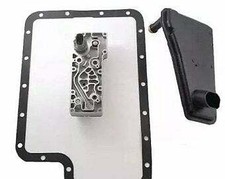
Shop the part for this fix: 4R100/E4OD shift solenoid block pack, 1995-97
When the forced-shift test fails inside the pan and the solenoids read open or drop out hot, this is the replacement block for 1995-97 E4OD trucks. Match the year first: 1989-94 packs are different.
See the solenoid block pack at CoreTransmissionPartsNeed parts for this job?
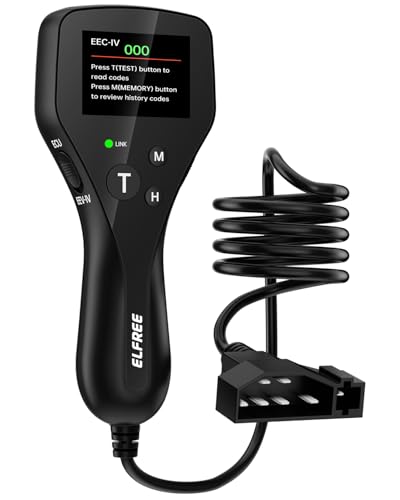
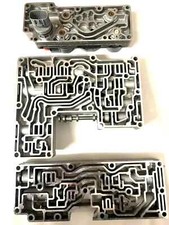
Our E4OD parts page has an EEC-IV code reader for 1989-95 trucks, solenoid kits and valve bodies by year, and master rebuild kits for when the clutches are already gone, with checkout on site. Confirm the model year before you order: 1989-94 and 1995-later solenoid packs don't interchange.
FAQ
Why is my E4OD stuck in 4th gear?
With both shift solenoids off, the E4OD valve body gives 4th gear in Drive and 2nd in 2 and 1. The solenoids get power with the key on and the computer grounds them, so a blown fuse, a lost power feed at case connector terminal F, a bad connector or an open circuit inside the solenoid body will all put it there. Check fuses and power before buying a solenoid pack.
Does the E4OD have a limp mode?
Not a dedicated limp gear like some later units. Transmission Digest notes Ford's E4OD strategy was to raise line pressure through FMEM rather than pick one gear. When the solenoids lose control, the hydraulics default to 4th in Drive and 2nd in the manual ranges, and an unpowered EPC solenoid means maximum line pressure.
Can a blown fuse put an E4OD in limp mode?
Yes. Ford TSB 92-22-5 covers an overdrive cancel wire that shorts on a steering column cover screw and blows the #17 fuse. Listed symptoms include early shifts, loss of power, 3-4 cycling, dead RABS, tachometer and fuel gauge, and self-test codes that give only a solid tone.
How do I test if the problem is the E4OD or the computer?
Use ATRA's forced-shift test. Unplug the case connector, feed terminal F through a 10-amp fuse, and ground D for 1st, D and E for 2nd, E for 3rd, and neither for 4th. If it shifts correctly by hand, the transmission is fine and the fault is the computer, its inputs or the wiring.
Related guides
- E4OD Shift Solenoid Symptoms and Replacement
- E4OD Harsh Shift Causes and Fix
- E4OD Won't Shift Into Overdrive: Causes and Fix
- E4OD Common Problems and Fixes
- E4OD Speed Sensor Symptoms: Where the Signal Really Comes From
- 4R100 Limp Mode Causes and Fix
Sources
- ATRA (Automatic Transmission Rebuilders Association), "Quick Reference E4OD/4R100" (2009). Backs the solenoids powered with the key on and grounded by the computer, the EPC solenoid controlling mainline pressure, the solenoid sequence chart, the solenoid 1 and 2 always-on and always-off charts, the manual gear ranges in failsafe (4th in D, 2nd in 2 and 1), the A-M case connector terminal chart with solenoid power on F, the forced-shift procedure with a 10-amp fused feed, and the solenoid feed diagram through the solenoid regulator valve and the 1994-95 4-3-2 manual timing valve. ATRA quick reference (PDF)
- ATSG (Automatic Transmission Service Group), Ford 4R100 technical service manual (2003). Backs the 4R100 as the updated E4OD, the open EPC circuit causing maximum EPC pressure with harsh engagements and shifts, the P0750/P0755 "improper gear selection" description, shift error codes attributed to the solenoids or internal components, and the solenoid resistance values (20-30 ohms shift and coast clutch, 3.0-5.0 ohms EPC). ATSG manual (PDF)
- Wayne Colonna, Transmission Digest, "Even Failsafe Is Subject to Change" (January 2003). Backs Ford's E4OD strategy of elevating line pressure through FMEM rather than placing the transmission in one specific gear. transmissiondigest.com
- Ed Lee (Deltrans), Transmission Digest, "E4OD/4R100 Safety Alert" (February 2003). Backs Ford TSB 92-22-5 (Oct. 21, 1992), the O/D cancel wire shorting on a column cover screw and blowing the #17 fuse, the bulletin's symptom list, the 1995-later drive-by-wire power through the #17 and #19 fuses with the engine returning to idle, the short near the shift lever pivot, and the heat-shrink fix. transmissiondigest.com
- Ed Lee (Deltrans), Transmission Digest, "Code 47/633 in E4OD/4R100" (October 2002). Backs the 4x4 low range signal causing early or late shift schedules, the code appearing on 2WD trucks, the low range switch fed from the ignition switch, the light blue/black signal wire and the gang plug location. transmissiondigest.com
- Transmission Digest, Jim Stokes, "Top 10 Problems at Installation, Part 2," and Randy Peterson, "Sometimes I Wonder, 'What Were They Thinking?'" Back the E4OD/4R100 case connector corrosion, pin fit, fretting and broken lock tab problems, and the 1992 Bronco E4OD erratic shift case traced to backed-out and mis-pinned MLP sensor wiring. Stokes · Peterson
- Sonnax, "Oversized Solenoid Regulator Valve 36947-14." Backs all solenoid feed and intermediate lube oil passing through the solenoid regulator valve, bore wear leaking solenoid feed oil to exhaust, and the 2nd and 3rd gear starts, TCC cycling, TCC slip and reduced center support lube symptoms. sonnax.com