The E4OD went behind nearly every heavy Ford from the 1989 model year until the 4R100 took over at the end of the 1990s: F-250 and F-350 pickups, Broncos, Econolines, the 5.8L, 7.5L and 7.3L trucks that towed everything. Those trucks are now twenty-five to thirty-five years old, and the same handful of problems keeps rolling in. Some are hard-part failures that have a known root cause. Some are electrical faults that look like a transmission problem and are not. If you know which is which, you save the customer a rebuild or you save yourself a comeback.
This guide walks through the six complaints I see most on E4OD units, what actually causes each one, how to confirm it, and the fix. The technical details come from Sonnax's E4OD symptom index, the ATSG 4R100 manual (the 4R100 is the updated E4OD and shares its late solenoid body), and Transmission Digest. The full list is under Sources.
First: which E4OD do you have?
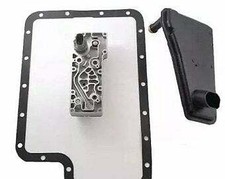
The E4OD had a mid-production split, and it changes which parts and which test specs apply. Sonnax lists two different remanufactured solenoid blocks: 36424A-RRP for 1989-1994 units and 36424B-RRP for 1995-1998 E4OD and 1998-later 4R100. In other words, a late E4OD shares its solenoid body design with the 4R100, which is why the ATSG 4R100 resistance specs below apply to it. Several of the valve and cooler parts in this guide are also year-specific, so note the model year and look at the solenoid body before you order anything.
The other split is the diagnostic system. Trucks through 1995 run EEC-IV and give you two- and three-digit codes (the 47, 62 and 628 in this article). OBD-II trucks from 1996 give you P-codes like P1744. The same fault can show up under either numbering.
Problem 1: Burnt overdrive section or no 4th gear
This is the E4OD failure that costs the most money and comes back the most often. The truck comes in with no overdrive, burnt fluid and friction material in the pan. On teardown the overdrive planet is blue, the thrust washers are cooked, and sometimes the planet has come apart.
The obvious read is towing heat. The real cause is usually oil starvation. Sonnax's E4OD symptom index ties OD planetary failure to a melted front lube/drainback valve, which restricts the lube feed circuit in the stator. The OE valve distorts from heat, the lube feed to the overdrive section drops, and the planet runs dry. Put a new OE-style valve back in and you have reset the clock, nothing more. The fix Sonnax lists is the melt-proof aluminum front lube/drainback valve kit, 36425-01K.
The second cause of lost overdrive is mechanical. Sonnax lists "OD piston retaining ring popout" against no 4th and OD loss on the E4OD. The early open-end ring behind the overdrive piston return spring has no lock, and spring force pulls it out of its groove over time. The fix is the Sure Lock spiral snap ring, 36744-01, which locks its tabs in place.
If the unit has no 4th but the overdrive clutches look fine, check the valve body. Sonnax lists the 3-4 accumulator control valve kit 36948-09K for no 4th and soft shifts caused by a worn bore.
Fix: an overhaul with the aluminum front lube valve and the locking snap ring installed, plus a cooler and line flush so debris from the burnt section does not go straight into the new parts. On a truck that tows, the front lube valve is not optional.
Problem 2: TCC slip, shudder and codes 62, 628, 1744
The E4OD brought a new kind of converter clutch complaint to the trade. In a Sonnax technical article, Ed Lee describes TCC clutch crowding: the converter clutch drags when it should be released, and for years it was misdiagnosed as off-idle hesitation, engine stumble or a lean condition. The root cause he gives is that low pump volume at low rpm could not supply enough converter charge/TCC release oil to hold the clutch off the cover. That oil flows from the pump through the stator support and turbine shaft and on to the lube circuit, which ties TCC behavior directly to pump and cooler flow.
That is why codes 62 and 628 (EEC-IV) and 1744 (OBD-II) on an E4OD are so often a pump and valve problem, not only a converter problem. Sonnax's E4OD index lists these parts against codes 62, 628 and 1744:
- Line-to-lube pressure regulator valve 36424-04K (and the oversized 36424-16K for worn bores). Sonnax lists it for codes 62/628/1744, high line pressure, engine stall or stumble on engagement in Reverse, and an overheated converter, on F1, F5, F8 and E9 pump castings.
- Pump gear set 36438A-03 or oversized set 36438AX-01K. Worn gears mean low volume at idle, which is exactly the flow shortage Lee describes.
- Cooler bypass valve kit 36605-02K for 1997-later units. A sticking bypass or a relaxed spring opens early, drops TCC apply pressure and cuts cooler flow. Sonnax lists TCC slip, soft TCC apply and overheating as the symptoms, and the rebuilt assembly holds a 70-75 psi cracking pressure.
- Oversized solenoid regulator valve 36947-14, listed for TCC cycling and TCC slip as well as 2nd and 3rd gear starts.
Fix: before you replace a converter for a 628, check the cooler flow and pump. A new converter on a unit with a worn line-to-lube valve or weak pump will set the same code again.
Problem 3: Solenoid pack codes and erratic shifting
The E4OD solenoid body carries both shift solenoids, the coast clutch solenoid, the TCC solenoid and the EPC solenoid, plus the fluid temperature sensor. When it acts up you get erratic shifts, harsh shifts from a failed EPC circuit, no engine braking, or a solenoid circuit code.
Test the pack before you condemn it. For the 1995-later solenoid body, ATSG gives these values, measured with the key off and a meter on ohms at the solenoid body connector:
| Solenoid | Connector pins | Resistance |
|---|---|---|
| Shift solenoid 1 | 1 and 3 | 20-30 ohms |
| Shift solenoid 2 | 1 and 2 | 20-30 ohms |
| Coast clutch solenoid | 1 and 5 | 20-30 ohms |
| TCC solenoid (on/off) | 1 and 4 | 20-30 ohms |
| EPC solenoid | 11 and 12 | 3.0-5.0 ohms |
| TFT sensor | 7 and 8 | Varies with temperature, see the ATSG chart |
These are the late-body numbers. On a 1989-1994 unit with the early block, get the specs for that block before you judge a reading.
Know the failsafe pattern before you blame a single solenoid. ATRA's E4OD/4R100 quick reference says the two shift solenoids get power whenever the key is on and the computer supplies the ground, and that in failsafe the unit gives 4th in D and 2nd in both the 2 and 1 positions. A truck that only has those gears has lost solenoid control as a whole, which points to the feed, the connector or the PCM, not to one solenoid. ATRA's failure charts show a single stuck solenoid swaps pairs of gears instead: shift solenoid 1 stuck off gives 4-3-3-4 in overdrive, and shift solenoid 2 stuck on gives 2-2-3-3. Our E4OD shift solenoid symptoms guide has the full charts and ATRA's forced-shift test.
If the pack measures good and you still have circuit codes, look at the connector. In Transmission Digest's installation problems series, Jim Stokes says E4OD/4R100 units have the most connector problems of any unit he covers: corrosion, loose pin fit, fretting, seized connectors and a lock tab that is easy to break, which causes poor contact, codes and poor shifting. He describes solenoid pack pins eaten away in as little as four weeks on one truck, and says a broken harness lock tab is the thing people miss when codes come back after a pack replacement.
Fix: replace the solenoid pack only if it fails the resistance test. Clean or repair the connector, replace a broken lock tab, and make sure the harness is fully latched.
Problem 4: Early shifts with code 47/633
The truck upshifts too early in 2WD and 4-high, and it may shift late in 4-low. Sometimes the tach or fuel gauge flickers too. Writing in Transmission Digest, Ed Lee says code 47 (EEC-IV) or 633 is usually your first clue: the computer is getting a 4x4 low range signal when it should not, and it switches to the low-range shift schedule.
The causes he lists:
- A low range switch that has failed closed gives early shifts. A switch that has failed open gives late shifts in low range.
- A loose connection at the gang plug behind the dash, to the right of the steering column, or at the printed circuit connections. That one tends to come with the gauge flicker.
- The signal wire, light blue with a black tracer.
Two traps. Ford used the same harness in 2WD and 4WD trucks, so a 2WD truck can still have this circuit. And pulling fuses will not isolate it, because the low range switch is powered directly from the ignition switch.
Fix: test the low range switch and the light blue/black wire, and clean and reseat the dash gang plug. No transmission work needed.
Problem 5: Early shifts, power loss and dead gauges together
This one is easy to misdiagnose as a transmission or engine failure. In a Transmission Digest safety alert, Ed Lee describes E4OD/4R100 trucks with a column-mounted overdrive cancel button that came in with early shifts, power loss, poor acceleration, 3-4 shift cycling, a dead transmission control light and loss of instrumentation.
The cause: the overdrive switch wire can be routed where it rubs on a steering column cover mounting screw near the shift lever pivot. Road vibration wears through the insulation, the wire shorts, and it blows fuse 17. Lee warns that on trucks where fuse 17 also powers the electronic throttle control, the engine drops to idle when it blows, which can strand a truck in traffic or on a railroad crossing.
Fix: find the chafe, protect the wire with heat-shrink tubing and reroute it. Lee also lists replacement shift lever F2TZ-7210-F, which has a longer pigtail for rerouting. If fuse 17 is blown on one of these trucks, do not just replace it and send the truck out.
Problem 6: Soft shifts, harsh shifts and delayed Reverse
High-mileage E4OD valve bodies and pumps wear in the same spots. Sonnax's E4OD index gives the pattern:
- Delayed Reverse: the boost valve kit (36424-01K or 36424-03K) for pump boost sleeve wear, and the oversized manual valve kit 36947-13K for a worn manual valve bore.
- Soft shifts: the line pressure modulator plunger valve kits (36948-03K, 36948-05K, 96948-01K, 96948-05K). The performance-rated accumulator spring kit 36948-18K is listed for long, soft shifts in towing and heavy-duty use.
- 2nd or 3rd gear starts: the oversized solenoid regulator valve 36947-14.
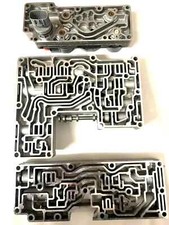
The steel valves rarely look worn. The aluminum bores are what wear. That is why a vacuum test is the right way to check an E4OD valve body. Our E4OD rebuild wear points guide covers vacuum testing, the center support and the rest of the bench work in detail.
Fix: a valve body repaired at the worn bores, or a replacement valve body for the correct model year. A shift kit will not seal a worn bore.
Rear bushing wear is inherited from the C6. The E4OD grew out of the Ford C6, and some of its back-half wear came along with it. Sonnax lists its one-piece rear case bushing 36008B for all C6 units and for early '89-'94 E4ODs (the early case with three lube grooves to the front and none to the back), and ties the OE two-bushing design to premature wear and bushing failure from poor lubrication and too much load for the bearing area. On an early truck that comes in with a tailshaft leak and a worn bushing, check the output shaft journal and replace the bushing during the rebuild; a new seal alone will not stay dry. For more on the parent unit, see our Ford C6 common problems guide.
A diagnostic order that saves time
- Check the fluid hot. The E4OD family runs MERCON-type ATF. ATSG's 4R100 procedure checks level at 150-170 F with the engine idling in Park. Burnt fluid with friction material means the unit is already damaged.
- Pull codes. On EEC-IV trucks, codes 47, 62 and 628 point straight at Problems 4 and 2. On OBD-II trucks look for P1744 and solenoid circuit codes.
- Check fuse 17 and the OD cancel wiring if the truck has early shifts along with power loss or dead gauges.
- Ohm the solenoid pack and inspect the connector before you order a pack.
- Check cooler flow and line pressure before you replace a converter for a TCC code.
- If it comes apart, install the aluminum front lube valve and a locking OD snap ring, and vacuum test the pump and valve body.
Shop the part for this fix: Sonnax front lube/drainback valve kit 36425-01K
The melt-proof aluminum valve Sonnax lists for E4OD and 4R100 overdrive planetary failure. If the overdrive section has already burnt, install this one during the rebuild.
See the front lube/drainback valve kit at CoreTransmissionPartsNeed parts for this job?
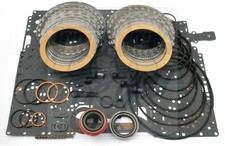
Our E4OD parts page has solenoid kits, valve bodies, pumps, clutch modules and master rebuild kits, with checkout on site. E4OD parts are year-specific, so confirm the model year and whether you have the early or late solenoid body before you order. For 1989-1995 trucks, an EEC-IV code reader pulls the two- and three-digit codes covered above.
FAQ
What is the most common E4OD failure?
A burnt overdrive section is the one that comes back most often. Sonnax traces E4OD overdrive planetary failure to a melted front lube/drainback valve that restricts the lube feed circuit in the stator, and sells a melt-proof aluminum valve (36425-01K) as the fix. Loss of overdrive from the OD piston retaining ring walking out of its groove is the other big one.
What do E4OD codes 62, 628 and 1744 mean?
Code 62 and 628 are EEC-IV converter clutch codes, and 1744 is the OBD-II torque converter clutch code. On an E4OD they commonly trace to the pump and cooler circuit rather than the converter alone: Sonnax lists a worn line-to-lube pressure regulator valve and worn pump gears for these codes, and on 1997-later units a weak cooler bypass valve that should hold 70-75 psi cracking pressure.
Why does my E4OD shift early or lose overdrive and throttle all at once?
Early shifts with code 47/633 usually mean the computer is seeing a false 4x4 low signal from a failed low range switch or a loose connection at the dash gang plug. If early shifts come with power loss, dead gauges and 3-4 cycling, check fuse 17: Transmission Digest documented the column overdrive cancel switch wire shorting on a steering column cover screw and blowing it.
How do I test an E4OD solenoid pack?
With the key off, measure across the solenoid body connector with a meter on ohms. On the 1995-later solenoid body that the 4R100 shares, ATSG lists 20-30 ohms for both shift solenoids, the coast clutch solenoid and the on/off TCC solenoid, and 3.0-5.0 ohms for the EPC solenoid. Also inspect the connector for corrosion and a broken lock tab, which cause circuit codes even with a good pack.
Related guides
- E4OD Slipping: Causes and Fix
- E4OD Rebuild Guide: Known Wear Points and Upgrades
- 4R100 vs E4OD: Differences
- E4OD Shift Solenoid Symptoms and Replacement
- 4R100 Shift Solenoid Symptoms
- E4OD Torque Converter Lockup Shudder Fix
- 4R100 Torque Converter Shudder
- 4R100 Delayed Engagement: Causes and Fix
Sources
- Sonnax, Ford E4OD transmission unit page and symptom index. Backs the 1989-1994 (36424A-RRP) and 1995-1998 E4OD/1998-later 4R100 (36424B-RRP) solenoid block split, the front lube/drainback valve 36425-01K for OD planetary failure, the Sure Lock snap ring 36744-01 for OD piston retaining ring popout, the 3-4 accumulator control valve kit 36948-09K for no 4th, the parts listed for codes 62/628/1744, the cooler bypass valve kit 36605-02K for 1997-later units, the solenoid regulator valve 36947-14, and the delayed Reverse and soft shift parts. sonnax.com
- Sonnax, Ed Lee, "4R100 Flow Issues" (2006). Backs the E4OD TCC clutch crowding history, its early misdiagnosis as engine driveability problems, and the root cause of low pump volume at low rpm starving converter charge/TCC release oil. sonnax.com
- ATSG (Automatic Transmission Service Group), Ford 4R100 technical service manual (2003). Backs the 4R100 being the updated E4OD, the solenoid body pin assignments and resistance values (20-30 ohms shift, coast clutch and on/off TCC solenoids, 3.0-5.0 ohms EPC), the key-off test method, and the MERCON fluid check at 150-170 F. ATSG manual (PDF)
- Transmission Digest, Ed Lee, "Code 47/633 in E4OD/4R100" (October 2002). Backs the early shift/late low-range shift symptoms, the false 4x4 low signal cause, the failed-open versus failed-closed switch behavior, the gang plug and light blue/black wire, the shared 2WD/4WD harness, and the note that pulling fuses does not isolate the circuit. transmissiondigest.com
- Transmission Digest, Ed Lee, "E4OD/4R100 Safety Alert" (February 2003). Backs the OD cancel switch wire shorting on a steering column cover screw, the blown fuse 17 and its symptoms, the throttle control warning, and replacement lever F2TZ-7210-F. transmissiondigest.com
- Transmission Digest, Jim Stokes, "Top 10 Problems at Installation, Part 2" (August 2012). Backs E4OD/4R100 units having the most connector problems, the fragile lock tab, pin corrosion in four weeks, and broken lock tabs causing codes after solenoid pack replacement. transmissiondigest.com
- ATRA (Automatic Transmission Rebuilders Association), "Quick Reference E4OD/4R100" (2009). Backs the shift solenoids being powered with the key on and grounded by the computer, the failsafe ranges (4th in D, 2nd in 2 and 1), and the shift solenoid 1 always-off (4-3-3-4) and shift solenoid 2 always-on (2-2-3-3) failure patterns. ATRA quick reference (PDF)
- Sonnax, Rear Case Bushing 36008B. Backs the single-piece replacement for the OE two-bushing rear case design on C6 and '89-'94 E4OD units (three grooves to the front, none to the back), the premature wear and inadequate lubrication failure mode, and the T36008A install tool. sonnax.com