An E4OD that takes off in 4th, tops out in 2nd, or bangs straight from 1st to 4th gets a solenoid pack thrown at it more often than any other part. Sometimes that is the right call. Just as often the pack was fine and the real problem was a cracked connector lock tab, a worn solenoid regulator valve bore, or a range sensor feeding the computer bad information. On a thirty-year-old Ford truck, every one of those is common.
This guide covers which gear you get when each solenoid sticks, what mimics a bad pack, and how to test and replace it. The charts and forced-shift test come from ATRA's E4OD/4R100 quick reference, specs and codes from the ATSG 4R100 manual (the 4R100 is the updated E4OD), and pack and valve details from Sonnax. Sources are at the bottom.
How the E4OD uses two solenoids for four gears
Per ATRA, the E4OD uses two main shift solenoids that get power whenever the key is on, and the computer supplies the ground to energize them. A separate EPC solenoid controls line pressure. The feed is shared; the PCM switches each solenoid's ground side.
Here is ATRA's solenoid sequence chart for the D (overdrive) range:
| Commanded gear | Shift solenoid 1 (A) | Shift solenoid 2 (B) | Coast clutch solenoid |
|---|---|---|---|
| 1st | ON | OFF | OFF |
| 2nd | ON | ON | OFF |
| 3rd | OFF | ON | OFF |
| 4th | OFF | OFF | OFF |
With overdrive cancelled, and in manual 2 and 1, ATRA shows the coast clutch solenoid on, which is what gives you engine braking.
Two things follow from that chart. First, 4th is both solenoids off. Lose power to the pack, and the valve body goes to 4th in D. Second, each solenoid is used in two gears, so one stuck solenoid never ruins just one gear. It swaps pairs of gears, and that pattern tells you which solenoid it is.
Failsafe looks like a dead solenoid, but it is not
When the PCM sees a serious electrical fault it stops driving the solenoids. ATRA's failsafe table shows what the driver gets:
| Selector | P | R | N | D or 3 | 2 | 1 |
|---|---|---|---|---|---|---|
| Gear in failsafe | Park | Reverse | Neutral | 4th | 2nd | 2nd |
A truck with only 4th in D and only 2nd in 2 and 1 is in failsafe. That points to the electrical side, such as a lost feed or a bad connector, not to one solenoid.
E4OD shift solenoid symptoms by failure
ATRA's failure charts show the gear you actually get when the PCM commands 1-2-3-4 with one solenoid stuck. The manual 1 column is the useful part. It is the quick road test that separates the four failures.
| Failure | Actual gears in OD (commanded 1-2-3-4) | In manual 2 | In manual 1 | What the driver feels |
|---|---|---|---|---|
| SS1 always OFF | 4-3-3-4 | 2-2-2-2 | 2-2-2-2 | Soft, lazy launch in 4th, then 3rd. No 1st anywhere, even in manual 1. |
| SS1 always ON | 1-2-2-1 | 2-2-2-2 | 1-2-2-1 | Normal launch, tops out in 2nd, then drops to 1st when the PCM wants overdrive. Big engine flare at cruise. |
| SS2 always OFF | 1-1-4-4 | 2-2-2-2 | 1-1-2-2 | Holds 1st, then jumps straight to 4th. Engine lugs after the shift. |
| SS2 always ON | 2-2-3-3 | 2-2-2-2 | 2-2-2-2 | 2nd-gear starts, no overdrive, high rpm on the highway. |
"Stuck" can be electrical, which usually sets a code, or mechanical: a solenoid that measures fine but will not move. The mechanical kind fools people, and so does the hydraulic problem below.
The valve that mimics a bad solenoid
A shift solenoid does not make its own pressure. It exhausts or holds oil that comes from the solenoid regulator valve. ATRA's solenoid feed diagram shows pump oil going through the solenoid regulator valve and then out to all four solenoids: TCC, SS1, SS2 and the coast clutch solenoid. On 1994 and 1995 units, the same circuit also feeds the 4-3-2 manual timing valve.
If that feed is low, the solenoids can be electrically perfect and still fail to move their shift valves. Sonnax lists its oversized solenoid regulator valve, 36947-14, for 2nd and 3rd gear starts and for TCC cycling and slip. Per Sonnax, all solenoid feed oil and intermediate lube oil pass through that valve. The wear is different by year:
- 1995 and earlier: a three-spool steel valve that wears the aluminum bore, leaving too much clearance when the fluid is hot.
- 1996 and later: a two-spool anodized aluminum valve whose anodized layer can flake, which leads to early wear.
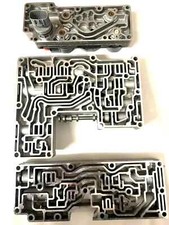
The bench tell: a truck that starts in 2nd or 3rd only when hot, with a pack that ohms good and no circuit codes, is a solenoid regulator valve bore until proven otherwise. A new pack will not fix it. The fix is a valve body repair at that bore, or a replacement valve body for the right year. Sonnax's E4OD valve body ID guide splits the castings three ways: 1989 (E9 main body), 1990-95 (F0 or F1 main body, E9 accumulator body), and 1996-98 (F6 on both).
Other things that look like a solenoid failure
The case connector
In Transmission Digest, Jim Stokes says the E4OD/4R100 family has more connector problems than any other unit he covers: corrosion, loose pin fit, fretting, and a lock tab that breaks easily. His warning is the comeback. A shop sees a circuit code, installs a new pack, and the code returns because the harness-side tab was broken all along. On one truck, the pack pins corroded away in four weeks.
Ribbon cable fatigue inside the pack
When the pack really is bad, the coils are not always the problem. Sonnax built its remanufactured blocks around a printed circuit board to eliminate "fatigue failures common to the ribbon cable inside the OE circuit assembly." A cracked ribbon tends to set intermittent codes with heat and vibration, so a pack can pass a cold ohm test and still fail on the road. Flex the internal wiring gently while you watch the meter.
The manual lever position sensor
In a Transmission Digest case, Randy Peterson worked on a 1992 Bronco E4OD with sudden downshifts, harsh upshifts and then no upshifts. A previous shop had blamed the computer. The real fault was a manual lever position (MLP) sensor code: three backed-out pins, bare wires, and two wires in the wrong positions. If the PCM does not know where the lever is, it commands the wrong solenoid states, and that feels like a bad pack.
How to test it before you buy a pack
1. Pull the codes
Trucks through 1995 run EEC-IV and give you three-digit service codes. Pull both the on-demand and continuous-memory codes, since intermittent connector and ribbon faults often show up only in continuous memory. On 1996-97 OBD-II trucks, the generic shift solenoid circuit codes are P0750 (solenoid A) and P0755 (solenoid B). ATSG's code chart for the 4R100, the E4OD's OBD-II successor, also lists P1714 and P1715 for SSA and SSB mechanical failures, and P0781-P0783 for 1-2, 2-3 and 3-4 shift errors "because of SSA, SSB, or internal transmission components." That last wording matters. A shift error code means the PCM did not see the expected speed change, and that can be a clutch as easily as a solenoid.
2. Look at the connector
Before you drop the pan, unplug the case connector and inspect both halves. Check that the lock tab clicks and holds, look for green corrosion, and check for pushed-back or loose pins. A broken tab is a harness repair, not a pack.
3. Ohm the pack
ATSG's test is key off, meter on ohms, at the solenoid body connector. Pin 1 is the shared power feed. For the late (1995 and later) solenoid body:
| Component | Pins | Spec |
|---|---|---|
| Shift solenoid 1 (A) | 1 and 3 | 20-30 ohms |
| Shift solenoid 2 (B) | 1 and 2 | 20-30 ohms |
| Coast clutch solenoid | 1 and 5 | 20-30 ohms |
| TCC solenoid (on/off) | 1 and 4 | 20-30 ohms |
| EPC solenoid | 11 and 12 | 3.0-5.0 ohms |
ATRA's diagram shows the same pin pairs on the solenoids. For the TFT sensor, ATRA gives 37K-16K ohms at 59-104°F and 5K-2.7K ohms at 159-194°F. On a 1989-94 unit with the early block, get that block's specs before you judge a reading.
4. Watch the signal, then force the shift
ATRA letters the transmission connector A through M. On that chart, F is solenoid power (B+), D is shift solenoid 1, E is shift solenoid 2, C is the TCC solenoid ground, B is the coast clutch solenoid, L and M are EPC, and G and H are the TFT sensor. With the harness still connected, backprobe the terminals with a signal monitor and road test. The LEDs should follow the sequence chart above.
To split inside from outside, ATRA shows how to force the shifts: feed terminal F from the battery through a 10-amp fuse, then ground D for 1st, D and E for 2nd, E alone for 3rd, and neither for 4th. If it shifts right by hand, the fault is the PCM, its inputs or the harness. If it will not make a gear with the right solenoid grounded, the problem is inside: the solenoid, the solenoid regulator valve, a shift valve or a clutch. Have a helper drive while you watch the jumpers.
Replacing the pack
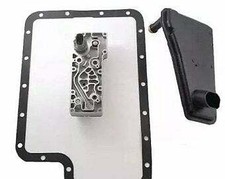
ATSG is clear that the solenoids are not serviced individually. You replace the whole assembly. Match the year. Sonnax lists 36424A-RRP for 1989-94 units and 36424B-RRP for late E4OD 1995-98 (the same block the 4R100 non-PWM uses). The early and late blocks are not interchangeable. The remanufactured versions use a new integrated circuit board in place of the OE ribbon cable, soldered connections, 100% tested solenoids, new Viton O-rings and a rebuilt EPC solenoid.
The job, from ATSG's procedure:
- Drain and drop the pan and remove the filter.
- Remove the solenoid body retaining nut and the 9 bolts. Lift the body with a small twist to free the connector O-ring from the case bore.
- Pull the solenoid screen from the spacer plate by rotating and lifting straight up. Clean or replace it. A plugged screen starves the solenoids no matter how new they are.
- Install the screen and rotate it clockwise to lock. Fit a new O-ring on the solenoid case connector, lube it with Trans-Jel, and install the solenoid body.
- Run the 9 bolts and 1 nut in by hand, then torque to 9-11 N·m (80-100 in-lb). That is inch-pounds. It is easy to strip or warp something here.
- Install a new filter and pan gasket and refill with MERCON-type fluid. Our E4OD filter and pan service guide covers the pan side of the job step by step.
Shop the part for this fix: E4OD shift solenoid block, 1995-97
A replacement solenoid block for the late E4OD solenoid body. Confirm your unit is 1995 or later before you order. 1989-94 units take the early block.
See the solenoid block at CoreTransmissionPartsNeed parts for this job?
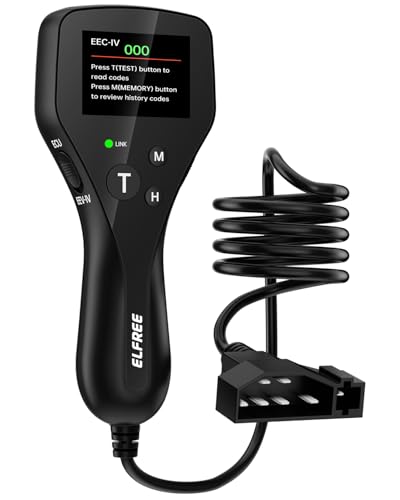
Our E4OD parts page has solenoid kits, valve bodies by year, filter kits and rebuild kits, with checkout on site. For 1989-1995 trucks, an EEC-IV code reader gets you the three-digit codes you need before you buy anything.
FAQ
What are the symptoms of a bad E4OD shift solenoid?
It depends on which solenoid and how it failed. Per ATRA's failure charts, shift solenoid 1 stuck off gives a 4th-gear launch and no 1st, solenoid 1 stuck on tops out in 2nd, solenoid 2 stuck off shifts 1st straight to 4th, and solenoid 2 stuck on gives 2nd-gear starts and no overdrive. A truck with only 4th in D and 2nd in the manual ranges is in failsafe, which usually points to a feed or connector problem.
How do I test an E4OD solenoid pack?
With the key off, measure at the solenoid body connector. On the 1995-later body, ATSG lists 20-30 ohms for shift solenoid 1 (pins 1 and 3), shift solenoid 2 (pins 1 and 2), the coast clutch solenoid and the on/off TCC solenoid, and 3.0-5.0 ohms for the EPC solenoid. If the pack ohms good, backprobe the connector with a signal monitor, or force the shifts with a fused 10-amp feed as shown in ATRA's quick reference.
Can I replace just one E4OD shift solenoid?
No. ATSG states that the solenoids are not serviced individually, and the whole solenoid body is replaced as an assembly. Match the year: Sonnax lists 36424A-RRP for 1989-94 units and 36424B-RRP for 1995-98 E4OD, and the two are not interchangeable.
Why does my E4OD start in 2nd or 3rd gear when it is hot?
If the pack ohms good and there are no circuit codes, suspect the solenoid regulator valve, which feeds oil to all the solenoids. Sonnax lists its oversized valve 36947-14 for 2nd and 3rd gear starts, and notes that the 1995-and-earlier steel valve wears its bore and leaves excess clearance when hot. A new solenoid pack will not fix a worn bore.
Related guides
- E4OD Common Problems and Fixes
- E4OD Filter and Pan Service Guide
- E4OD Rebuild Guide: Known Wear Points and Upgrades
- 4R100 Shift Solenoid Symptoms, Codes and Replacement
- 4R100 vs E4OD: Differences
- E4OD Won't Shift Into Overdrive: Causes and Fix
- E4OD Limp Mode Causes and Fix
Sources
- ATRA (Automatic Transmission Rebuilders Association), "Quick Reference E4OD/4R100" (2009). Backs the two main shift solenoids powered with the key on and grounded by the computer, the solenoid sequence chart for P/R/N, D, D with overdrive cancelled and manual ranges, the SS1/SS2 always-on and always-off failure charts, the failsafe gear ranges (4th in D, 2nd in 2 and 1), the solenoid feed diagram through the solenoid regulator valve (and the 4-3-2 manual timing valve on 1994-1995 only), the TFT resistance table, the A-M transmission connector terminal ID, the signal monitor check and the forced-shift procedure with a 10-amp fused feed. ATRA quick reference (PDF)
- ATSG (Automatic Transmission Service Group), Ford 4R100 technical service manual (2003). Backs the 4R100 as the updated E4OD, solenoids not serviced individually, the solenoid body pin assignments and resistance values, the P0750/P0755, P1714/P1715 and P0781-P0783 descriptions, the solenoid body removal (9 bolts and 1 nut, connector O-ring in the case bore), the solenoid screen in the spacer plate, and the 9-11 N·m (80-100 in-lb) torque. ATSG manual (PDF)
- Sonnax, remanufactured solenoid blocks 36424A-RRP and 36424B-RRP. Backs the 1989-94 (36424A-RRP) and late E4OD 1995-98 / 4R100 non-PWM (36424B-RRP) fitment split, and the printed circuit board that eliminates ribbon cable fatigue failures in the OE circuit assembly, plus the soldered connections, tested solenoids, Viton O-rings and rebuilt EPC solenoid. 36424A-RRP · 36424B-RRP
- Sonnax, "Oversized Solenoid Regulator Valve 36947-14." Backs 2nd and 3rd gear starts and TCC cycling/slip from solenoid regulator valve wear, all solenoid feed and intermediate lube oil passing through the valve, the 1995-and-earlier three-spool steel valve wearing the bore when hot, and the 1996-later two-spool anodized aluminum valve flaking. sonnax.com
- Sonnax, "Ford E4OD Valve Body Identification." Backs the 1989 (E9), 1990-95 (F0/F1 main, E9 accumulator) and 1996-98 (F6) casting identification. sonnax.com
- Transmission Digest, Jim Stokes, "Top 10 Problems at Installation, Part 2" (August 2012), and Randy Peterson, "Sometimes I Wonder, 'What Were They Thinking?'" (February 2013). Back the E4OD/4R100 connector corrosion, pin fit and broken lock tab problems with repeat codes after pack replacement, the pins corroded in four weeks, and the 1992 Bronco E4OD erratic shift case traced to backed-out and mis-pinned MLP sensor wiring. Stokes · Peterson