A filter and pan service is the cheapest job you will ever do on an E4OD, and it is also the one I see botched most often. The fluid gets changed, the truck goes out, and two weeks later it comes back with a whine, a late engagement or a pan rail weeping fluid onto the crossmember. Almost every one of those comebacks traces to three things: the wrong filter for the pan, the old filter seal left stuck in the pump, or pan bolts cranked down like lug nuts. This guide walks the job the way it should be done, with the specs from ATSG and Ford, and what to read in the pan while you have it off.
The E4OD is Ford's electronic four-speed behind the 5.8L, 7.5L and 7.3L diesel in F-Series trucks, Broncos and Econoline vans. ATSG describes the later 4R100 as an updated version of the E4OD, and the bottom pan, filter and 20-bolt pan pattern carry over, so the 4R100 service procedure applies directly. Sources are listed at the bottom.

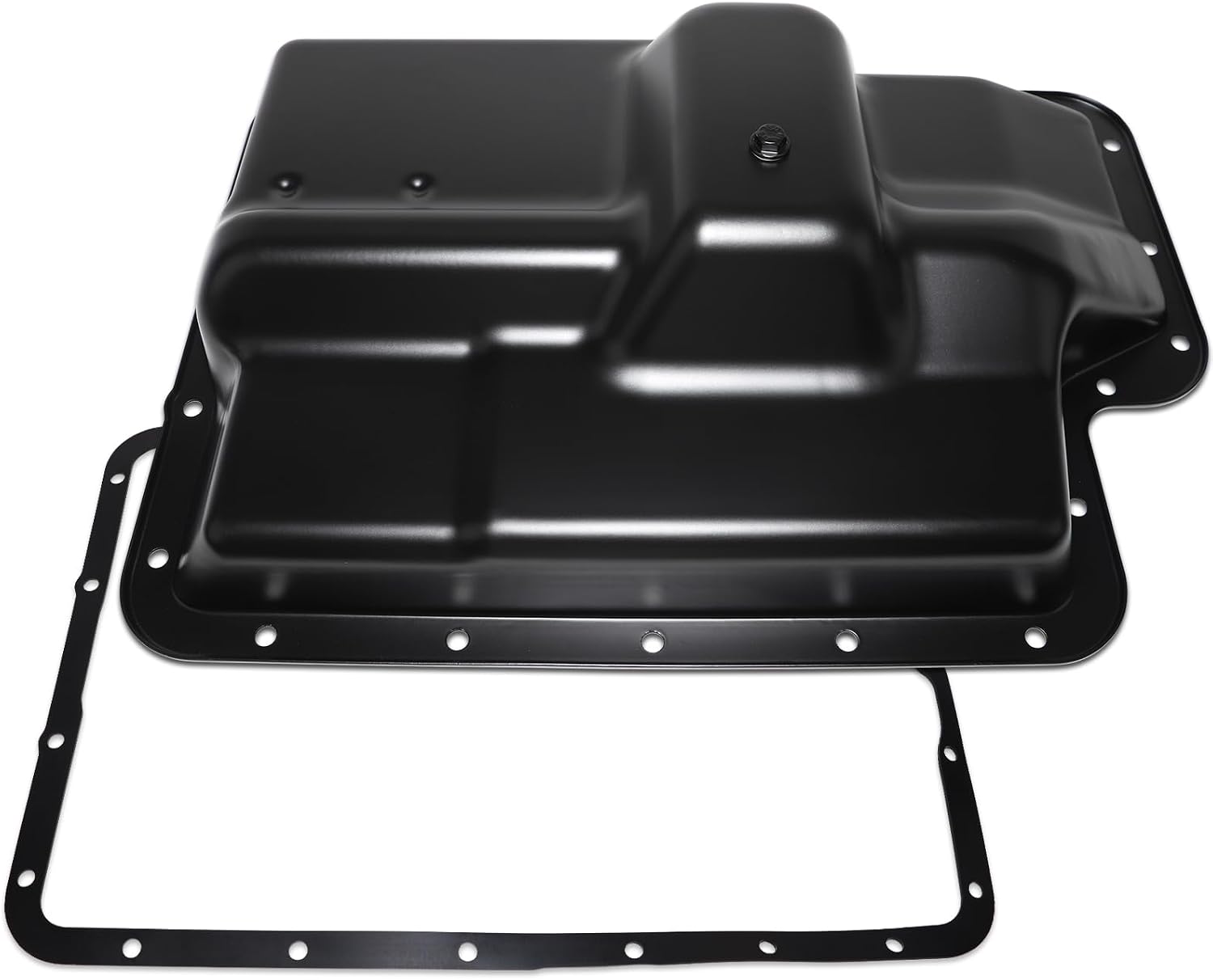

What is actually under the pan
Drop the pan on an E4OD and you are looking at most of the transmission's brain. Per ATSG's 4R100 manual, the solenoid body is bolted to the case inside the bottom pan, and it carries shift solenoid 1, shift solenoid 2, the coast clutch solenoid, the TCC solenoid, the EPC solenoid and the transmission fluid temperature (TFT) sensor. Above it sit the main upper and lower valve bodies (14 bolts and two nuts) and the accumulator valve body (11 bolts and two nuts). The filter plugs into a bore in the oil pump.
That layout matters for two reasons. First, everything you do in there is next to the parts that actually control the shifts, so keep it clean: lint from a shop rag in a solenoid or valve bore is a real problem. Second, a pan service does not reach every screen. ATSG shows a separate solenoid screen assembly that locks into the spacer plate under the solenoid body. A new pan filter does nothing for a plugged solenoid screen. If the unit had a shift or EPC complaint before the service, a filter change is not the fix, and the E4OD common problems guide is the place to start.
Do not loosen valve body or solenoid body bolts during a routine pan service. There is no reason to, and ATSG's spec for all of them is only 9-11 N·m (80-100 in-lb). It is easy to strip or over-torque one while reaching around.
Shallow pan or deep pan: get the right filter
The E4OD came with two pan depths, and each gets its own filter. Raybestos, which makes filters for the rebuild trade, catalogs them separately:
| Application | Pan | Filter pickup | OE numbers (per Raybestos) |
|---|---|---|---|
| E4OD/4R100 2WD, 1988-2005 | Shallow | Short pickup | E9TZ-7A098-A, F6TZ-7A098-AB, YC3Z-7A098-AA (gaskets E9TZ-7A191-A, F6TZ-7A191-A) |
| E4OD/4R100 4WD, 1988-2005 | Deep | Long pickup | E9TZ-7A098-B, F6TZ-7A098-BB, YC3Z-7A098-BA |
A short-neck filter in a deep pan sits with its inlet up high, and on a hard stop, a steep grade or a turn with the fluid sloshed to one side, the pump sucks air. A long-neck filter in a shallow pan can bottom out against the pan and restrict the inlet. Either way you get the same symptoms: whine, low line pressure, soft or late engagement. The rule on the bench is simple. Before you open the new box, set the old filter next to it and compare the pickup length. Do not go by what the parts lookup says about the truck. These trucks are thirty years old, and pans, filters and whole transmissions have been swapped more than once.
If the truck has an aftermarket deep sump pan, use the filter and any spacer the pan maker specifies. The stock filter can sit too high in a deeper pan.
The job, step by step
1. Drain and drop the pan
Warm the fluid with a short drive so contaminants are in suspension, but not so hot that it burns you. If the pan has a drain plug, use it. If it does not, loosen all 20 bolts, remove the ones on one end, and let the pan tip down slowly so the fluid comes out over one corner into a wide drain pan. Plan for six to eight quarts on a stock pan. Hold the pan level when it comes off, because there is still fluid in it and the debris in that last bit is what you want to look at.
2. Pull the filter and check the pump bore
ATSG's procedure is to remove the bottom pan filter by prying up with a screwdriver. Pry gently against the filter body, not the case or valve body. Then look up into the pump bore with a light. This is the step that makes or breaks the job. The filter seal can stay in the bore when the filter comes out. If it does and you push a new filter with a new seal in on top of it, the new filter will not seat, and the pump pulls air around it. Pick the old seal out with a small pick without scratching the bore.
3. Read the pan and clean it
Covered in detail below. Once you have looked, clean the pan and magnet with solvent, dry it completely, and clean the case rail. Old gasket material and fluid on the rail are what make a new gasket leak.
4. Install the new filter
ATSG says to lubricate the seal on the new filter with a small amount of Trans-Jel and install the filter into the bore in the oil pump. Push it straight up until it is fully seated. A dry seal can roll or cut going in, and a seal that is not fully home leaks air the same way a doubled one does.
5. Gasket and pan bolts
Install a new pan gasket on the case surface, set the pan on it, and run in all twenty bolts. ATSG's spec for the bottom pan bolts is 14-16 N·m (10-12 ft-lb). Tighten in a crisscross pattern and use a torque wrench that reads accurately that low. The stamped steel pan rail bends when bolts are overtightened, and a bent rail leaks no matter what gasket you use. If the rail is already dimpled at the bolt holes, flatten it on a block or replace the pan.
The Raybestos kits use a reusable gasket with metal torque limiters. Those limiters are sleeves at the bolt holes that stop the gasket from being crushed. Install that type dry, with no RTV. Sealant on a molded gasket lets it slide out of position when you torque the pan.
6. Refill and set the level
ATSG and Ford both call for Motorcraft MERCON, XT-2-QDX. That fluid is no longer sold, and Ford's Motorcraft MERCON V page says to use MERCON V in transmissions previously serviced with MERCON. Motorcraft XT-5-QMC is the direct buy. Add about what came out, start the engine, move the shifter through each range, then check. ATSG says to set the level at normal operating temperature, 150-170°F, engine idling in Park. Ford's 1997 F-250 HD/F-350 guide prefers the check after about 20 miles of driving, and allows a check without that drive if it is above 50°F outside. Finish in half-pint steps. The E4OD fluid type and capacity guide covers the full check procedure and the capacity by year and body.
Reading the pan
The pan is the cheapest diagnostic you will ever get on this transmission. Garrett Herning of Hydra-Test USA, writing in ATRA's GEARS magazine, breaks transmission debris into three types that circulate from normal wear: non-metallic material from clutches and bands, non-magnetic metal such as aluminum and brass, and magnetic material from steel parts like bearings and clutch steels. Here is how that plays out on an E4OD pan:
- Fine gray paste on the magnet. Normal steel wear. Clean it and move on.
- A light film of dark friction dust in the corners. Also normal on a unit with miles on it.
- Chunks or flakes of friction material, or a thick black sludge. A clutch pack or band is coming apart. New fluid will not bring it back.
- Brass or bronze glitter. Bushings or thrust washers wearing. Worth noting, and worth a rebuild plan if there is a lot of it.
- Aluminum shavings. Something is rubbing a case, pump or valve body casting. Stop and find it.
- Metal chunks on the magnet, not paste. A hard part has failed, such as a planetary, bearing or roller clutch. Plan the teardown.
Smell the fluid too. Burnt fluid on a unit that also has friction material in the pan is a rebuild, not a service. On a high-mileage unit that has never been serviced and shifts fine, some owners worry that fresh fluid will make it slip. In my experience that "the new fluid killed it" story is almost always a transmission that was already worn out, with the old varnished fluid hiding it for a while. Look at the pan before you promise anybody anything.
How often to do it
Ford's 1997 F-250 Heavy Duty/F-350 owner guide says the E4OD has no 30,000-mile scheduled fluid change, but that the transmission fluid, filter and seal assembly should be changed every 21,000 miles (34,000 km) under any of these: extended high-speed driving in weather at or above 90°F, towing a trailer more than 1,000 miles per trip, 5,000 miles or more per month, continuous operation or extensive idling, or severe dust. The 1996 F-Series guide still listed a 30,000-mile normal-service change for the E4OD. Ford's wording, "filter and seal assembly", is a reminder that the filter is part of the service, not an extra.
Most E4ODs still running are in trucks and vans that tow, idle or work, which puts them in the severe box. I do them at 21,000 miles on anything that pulls a trailer and 30,000 on a light-duty truck, and I pull the pan instead of doing a fluid exchange alone, because the pan is where the information is.
Common mistakes that cause comebacks
- Old filter seal left in the pump bore. Whine, aeration, low pressure. Always look.
- Wrong-length pickup. Match the new filter to the old one, not to the catalog.
- Overtightened pan bolts. 10-12 ft-lb per ATSG. More is not better.
- RTV on a molded gasket. Install it dry on a clean rail.
- Dented pan reused. A pan pushed up into the filter restricts the inlet. Replace it.
- Wrong fluid. MERCON V, not MERCON LV, ULV or Type F. Ford's MERCON V page warns against using it where those are specified, and against using it in transfer cases that were specified for MERCON.
- Overfilling. Too much fluid foams and pushes out the vent. Add a half pint at a time.
Shop the part for this fix: E4OD/4R100 filter kit
A 1989-2005 filter kit that covers E4OD years. Compare the pickup length to your old filter before you install it.
See the filter kit at CoreTransmissionPartsNeed parts for this job?
Our E4OD parts page has the deep-pan filter and gasket kit, replacement 4WD pans, and Motorcraft MERCON V by the case, plus solenoid kits, valve bodies and rebuild kits for units the pan says are past a service. Checkout is on site.
FAQ
Does an E4OD have a 2WD and a 4WD filter?
Yes. Raybestos catalogs a short-pickup filter for the 2WD shallow pan, crossing to F6TZ-7A098-AB, and a separate 4WD deep-pan filter crossing to F6TZ-7A098-BB. The two are not interchangeable, so match the pickup length to the filter you pull out.
What is the torque spec for E4OD pan bolts?
ATSG's 4R100 manual, which covers the same 20-bolt pan, lists all twenty pan bolts at 14-16 N-m, which is 10-12 ft-lb. Use a torque wrench that reads accurately that low and a crisscross pattern, because overtightening bends the pan rail and causes the leak you were trying to fix.
How often should the E4OD filter be changed?
Ford's 1997 F-250 Heavy Duty/F-350 owner guide says the transmission fluid, filter and seal assembly should be changed every 21,000 miles under severe conditions such as towing over 1,000 miles per trip, heavy idling or high-speed driving in 90 F heat. The 1996 guide also listed a 30,000-mile normal-service change for the E4OD.
Why does my E4OD whine or lose line pressure after a filter change?
The most common cause is the old filter seal left stuck in the pump bore, so the new filter never seals and the pump draws air. Other causes are a low fluid level, the wrong-length pickup for the pan, or a dented pan pushing on the filter. Pull the pan and check the bore first.
How much fluid does an E4OD take after a pan and filter change?
Far less than the 15.7 to 16.4 quart full capacity Ford lists, because the converter and cooler stay full. Expect roughly six to eight quarts on a stock pan, then finish the level on the dipstick at 150-170 F in half-pint steps.
Related guides
- E4OD Fluid Type and Capacity
- E4OD Fluid Change Cost
- E4OD Common Problems and Fixes
- E4OD Rebuild Guide: Known Wear Points and Upgrades
- 4R100 vs E4OD: Differences
Sources
- ATSG (Automatic Transmission Service Group), Ford 4R100 technical service manual (2003). Backs the 4R100 as the updated E4OD, the solenoid body inside the bottom pan with SS1, SS2, coast clutch, TCC and EPC solenoids and the TFT sensor, the valve body and accumulator body bolt counts, the separate solenoid screen in the spacer plate, removing the filter by prying up, lubricating the new filter seal with Trans-Jel and installing it into the pump bore, the 20 pan bolts at 14-16 N·m (10-12 ft-lb), valve body bolts at 9-11 N·m (80-100 in-lb), and MERCON XT-2-QDX with the level set at 150-170°F idling in Park. ATSG manual (PDF)
- Ford Motor Company, "1997 F-250 Heavy Duty/F-350 Owner Guide," Automatic Transmission Fluid. Backs no 30,000-mile scheduled change for the E4OD, the fluid, filter and seal assembly change every 21,000 miles under the listed severe conditions, the twice-a-year check, the 150-170°F check after about 20 miles and the above-50°F allowance, and the wrong-fluid warning. Ford owner guide PDF (archived copy)
- Ford Motor Company, "1996 F-150/250/350 Owner Guide," Servicing. Backs the 1996 30,000-mile normal-service change for the E4OD and the 15.7-16.2 qt capacities. Ford owner guide PDF (archived copy)
- Raybestos Powertrain, "E4OD, 4R100 (2WD) Transmission Premium Filter & Gasket Kit," part 997042. Backs the 2WD shallow-pan application for 1988-2005, the OE numbers E9TZ-7A098-A, F6TZ-7A098-AB, YC3Z-7A098-AA and gaskets E9TZ-7A191-A and F6TZ-7A191-A, and the reusable gasket with metal torque limiters. raybestospowertrain.com
- Raybestos Powertrain, "E4OD, 4R100 (4WD) Economy Transmission Filter," part 016044. Backs the separate 4WD deep-pan filter for 1988-2005 and OE numbers E9TZ-7A098-B, F6TZ-7A098-BB and YC3Z-7A098-BA. raybestospowertrain.com
- Garrett Herning, "Solenoids: Flushing and Cleaning," GEARS magazine (ATRA). Backs the three types of transmission debris from normal wear: non-metallic clutch and band material, non-magnetic aluminum and brass, and magnetic steel wear. gearsmagazine.com
- Ford Motorcraft, "MERCON V Automatic Transmission and Power Steering Fluid" product details. Backs MERCON V for transmissions previously serviced with MERCON, part XT-5-QMC, and the warnings against use where MERCON LV, ULV, SP or Type F is recommended and in transfer cases where MERCON was recommended. fcsdchemicalsandlubricants.com