A 4R100 fluid change is cheap insurance on a transmission that sits behind a 7.3L Power Stroke or a V10 and spends its life towing. It is also one of the most commonly half-done services in the shop. The quote that says "trans service, $150" and the one that says $450 are usually not the same job. One drops the pan, swaps the filter and puts back six or seven quarts. The other gets most of the 17-plus quarts replaced, deals with the cooler bypass valve, and sets the level hot on the dipstick.
This post covers what a proper 4R100 service includes, what the parts cost, where the labor goes, and the fluid question that still confuses people: MERCON versus MERCON V. The capacity, fluid call-out and level check come from Ford's 2003 F-250/350/450/550 owner guide. The pan torque, filter install and cooler fitting specs come from the ATSG 4R100 manual. The cooler bypass details come from Transmission Digest and Sonnax. Everything is listed under Sources at the bottom.


Which trucks this covers
The 4R100 is the 1998-and-later update of the E4OD. It went into 1999-2003 Super Duty F-250 through F-550 trucks and the Excursion with the 7.3L Power Stroke, the 5.4L and the 6.8L V10, plus heavy E-Series vans and the 1999-2004 SVT Lightning. On the 2003 Super Duty it shared the lineup with the new 5R110W TorqShift that came with the 6.0L diesel, which is why the 2003 owner guide lists both units side by side. The service below is for the 4R100. If your truck has the TorqShift, the fluid and filters are different, and our 5R110W fluid change cost guide covers that one.
How much fluid it really takes
Ford's 2003 Super Duty owner guide lists the 4R100 at 17.7 quarts (16.7 L) as an approximate dry-fill figure that can vary with cooler size — and the 2002 owner guide prints the identical 16.7 L (17.7 qt) figure with the same footnote: the amount of fluid and the level "should be set by the indication on the dipstick's normal operating range" [1]. In other words, set the final amount on the dipstick, not by counting quarts.
A pan drop does not get you anywhere near 17.7 quarts. The torque converter, the cooler, the lines and the clutch circuits all stay full when the pan comes off. On the lift, a 4R100 pan drain usually gives back somewhere around six to eight quarts, and owners on the Power Stroke forums report similar numbers. So a single pan service replaces well under half the fluid.
There are two ways to get closer to a complete change:
- Repeat drain and fill. Service the pan and filter, refill, drive it to temperature, then drop the pan (or pull fluid out of the cooler return) and refill again. Two rounds gets most of it out.
- Cooler-line exchange after the pan service. With the new filter in and the pan back on, push new fluid through the cooler circuit while pulling old fluid out. Done right, that uses close to the full capacity in one visit. On a 4R100 it only works if the cooler bypass valve is handled correctly, which is covered below.
The fluid: MERCON on the dipstick, MERCON V in the bottle
Here is where 4R100 service gets confusing. When these trucks were new, Ford specified MERCON, not MERCON V. The 2003 owner guide lists Motorcraft MERCON ATF, part XT-2-QDX, for the 4R100, and the ATSG 4R100 manual says the same thing: Motorcraft MERCON XT-2-QDX or an equivalent MERCON fluid in all 4R100 units. That owner guide also warned that MERCON, MERCON V and MERCON SP are not interchangeable, and that dual-usage MERCON/MERCON V fluids were not to be used in a transmission that required MERCON.
That was true in 2003. It is not how you service one today. Straight MERCON is effectively gone from parts counters, and Ford's current guidance is on the Motorcraft MERCON V product page: use it in automatic and manual transmissions and power steering systems previously serviced with MERCON. That is Motorcraft XT-5-QMC in quarts. In practice, a 4R100 gets MERCON V now, from Motorcraft or a fluid carrying a current MERCON V license.
The same Motorcraft page has one line that catches people on these trucks: do not use MERCON V in transfer cases where MERCON was previously recommended. The 2003 Super Duty owner guide lists MERCON for the 4x4 transfer case. So the leftover quarts from the transmission job do not go in the transfer case. Buy the correct transfer case fluid for that one.
Ford's owner guide also says not to use supplemental transmission fluid additives, treatments or cleaning agents. A bottle of shift conditioner is not part of this service.
The filter, the pan and the specs
The 4R100 has one internal filter and no external filter from the factory. It sits under the valve body and plugs into a bore in the pump. The ATSG manual's assembly steps say to lubricate the seal on the new filter with a small amount of Trans-Jel and push it into the pump bore. Two things I check every time on this unit:
- Make sure the old seal came out with the old filter. If it stays in the bore and the new filter goes in on top of it, the filter does not seat and the pump can suck air. That shows up as noise, delayed engagement and low line pressure after a "simple" service.
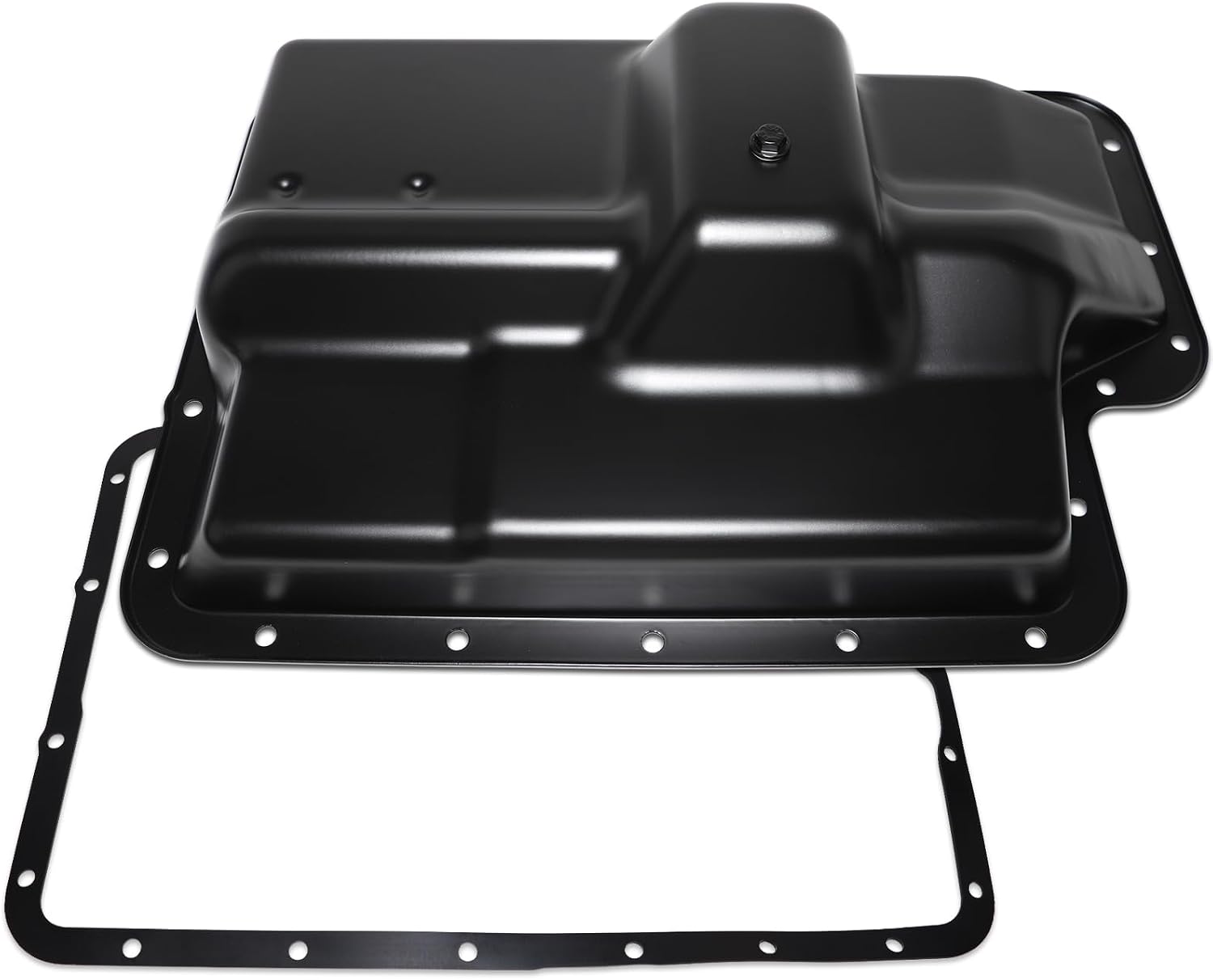
- Match the filter to the pan. 2WD and 4WD trucks, and deep aftermarket pans, use different filter depths. The deep-pan 4WD filter is the F6TZ-7A098-BB style. Put a shallow filter in a deep pan and the pickup can uncover when fluid is low or the truck is on a grade.
The pan uses 20 bolts. ATSG specifies 14-16 N·m (10-12 ft-lb) for the pan-to-case bolts. That is not much. Most 4R100 pan leaks after a service come from over-torqued bolts crushing the gasket or bending the pan flange around the bolt holes, not from bad gaskets. Use an inch-pound or small ft-lb wrench, go in a crisscross pattern, and do not reuse a pan with bent flanges. If the pan has been hammered on rocks or tightened into a wave, replacing it is cheaper than chasing the leak.
While the pan is down: check the solenoid pack
The solenoid pack is bolted to the case inside the pan, so a fluid service is the cheapest time to look at it. The ATSG manual lists what the pack contains: shift solenoid 1, shift solenoid 2, the coast clutch solenoid, the TCC solenoid, the EPC solenoid and the TFT sensor. It is serviced as an assembly, not individual solenoids. ATSG's resistance specs, measured with the ignition off at the case connector:
| Circuit | Case connector pins | Spec |
|---|---|---|
| Shift solenoid 1 | 1 and 3 | 20-30 ohms |
| Shift solenoid 2 | 1 and 2 | 20-30 ohms |
| Coast clutch solenoid | 1 and 5 | 20-30 ohms |
| TCC, on/off type | 1 and 4 | 20-30 ohms |
| TCC, PWM type | 1 and 4 | 10-20 ohms |
| EPC solenoid | 11 and 12 | 3.0-5.0 ohms |
ATSG also notes that some units have an on/off TCC solenoid and some have a PWM one, so know which you have before you order a pack. A good resistance reading does not prove a solenoid is working mechanically, but a bad one on a truck with a shift complaint saves you a lot of guessing. If the pan is full of friction material or the magnet is buried in metal, stop and read our 4R100 common problems and service guide before you pour 18 quarts of new fluid into it.
The cooler bypass valve: the part most services skip
The 4R100 has a cooler bypass valve built into the tube assembly that bolts to the case at the cooler line fittings. ATSG lists it as Ford part F81Z-7H322-AA. The case fittings get 30 N·m (22 ft-lb) at the front "to cooler" fitting and 36 N·m (27 ft-lb) at the rear "from cooler" fitting, with sealing washers on both.
Two things about that valve affect a fluid service:
Know where it is before you flush. In Transmission Digest's article on cooler bypass valves, Mike Steen of Certified Transmission explains that the 4R100's bypass is a mechanical valve in the tube that bolts to the case. Because it bolts to the transmission and is separate from the lines, he says it is not a problem when flushing the cooler lines and cooler: hook up at the lines and the flush goes through the cooler. The trouble is bypass valves built into the lines or the cooler itself, where he warns you can get little if any flushing of the cooler. His advice for those is to flush around the bypass or make a plug to install in its place while you flush. On a truck with an aftermarket cooler or replacement lines, check what is in the circuit before trusting a machine flush.
It wears out. Sonnax's 36605-02K rebuild kit covers 1997-and-later 4R100 and E4OD units with outboard fittings. According to Sonnax, sticking bypass parts, a relaxed spring or a poor ball seat let the valve open too early. That lowers TCC apply pressure, cuts cooler flow, and can show up as TCC slip, soft TCC apply, codes 1783, 1741 and 1744, overheating, and a cooked converter and overdrive section. The correct spring cracks open at 70-75 psi so the unit still gets lube if the cooler is blocked. If the truck has a history of running hot or a TCC complaint, the bypass valve belongs on the list at fluid-service time.
The fill and level check, per Ford
Ford's 2003 owner guide procedure:
- Drive about 20 miles (30 km) or until the transmission is at normal operating temperature, 150-170°F (66-77°C).
- Park on level ground and set the parking brake.
- With your foot on the brake, start the engine and move the shifter through every range, giving each one time to engage.
- Latch it in Park and leave the engine running.
- Pull the dipstick, wipe it clean, seat it fully, pull it again and read it against the hot band.
The dipstick also has a band for fluid at ambient temperature, 50-95°F (10-35°C). Ford warns that if you add fluid based on a cold check, it can overfill once the transmission reaches operating temperature, and that overfill can cause shift and engagement concerns and damage. Add in 1/2 pint (250 ml) steps. If the truck has been towing, running hard in hot weather or sitting in traffic, Ford says to shut it off for about 30 minutes before checking.
A scan tool helps here. Watch the transmission fluid temperature (TFT) PID while you idle and cycle the ranges, and take the dipstick reading once TFT is in the 150-170°F range.
What a 4R100 fluid change costs
Prices change, so treat these as working numbers. Parts at our own on-site prices:
| Item | DIY cost | Notes |
|---|---|---|
| Motorcraft MERCON V, 12-quart case | about $174 | XT-5-QMC; one case covers a pan service with fluid left for the level check |
| Second 12-quart case | about $174 | For a complete exchange or repeat drain and fill |
| Deep-pan filter and gasket kit | about $47 | F6TZ-7A098-BB style; match 2WD or 4WD pan |
| Pan service parts | about $221 | One case plus filter kit |
| Complete service parts | about $395 | Two cases plus filter kit, enough for Ford's 17.7 qt plus purge |
| Optional: replacement 4WD pan with gasket | about $88 | If the flange is bent or the pan is rock-damaged |
At an independent shop, a pan-and-filter service on a 4R100 is commonly quoted somewhere around $200-350, and a complete service with a cooler-circuit exchange around $350-550, depending on the labor rate and fluid markup. Dealers usually run higher.
Either way, get a written estimate that spells out parts and labor before the work starts, since many shops bill a flat rate from a published time guide rather than the clock, and ask for an itemized invoice when it's done. For a 4R100, ask four specific questions:
- What fluid goes in, by name? (MERCON V, not a "universal" multi-vehicle fluid, and not the transfer case.)
- Does the price include a cooler-circuit exchange, and how do you handle the bypass valve?
- Is the pan torqued to spec, or run down with an impact?
- Is the level set hot on the dipstick after cycling the ranges?
How often
The 2003 owner guide points to Ford's separate scheduled maintenance guide for the interval, and like most Ford guides of that era it splits normal and special operating conditions. The same owner guide's transmission temperature gauge has a yellow zone specifically for snowplowing, towing and off-road use. Most 4R100 trucks live in that special-conditions column. My working rule on a truck that tows is fluid and filter every 30,000 miles, sooner if the temperature gauge spends time in the yellow. On a truck that has never had it done and is well past 100,000 miles, check the fluid condition and the pan first. Clean pinkish fluid with a light film on the magnet is a green light. Burnt fluid and a pan full of material means diagnosis before service.
Shop the part for this fix: 4R100 filter and pan gasket kit
The 4R100 filter and pan gasket kit (OEM F6TZ-7A098-BB style) for 1998-2004 units, the core of every 4R100 fluid service. Confirm 2WD or 4WD pan depth before ordering. More 4R100 parts, including the Sonnax cooler bypass valve kit, are at CoreTransmissionParts.
See the filter kit at CoreTransmissionPartsNeed parts for this job?
Our parts shop has the 4R100 deep-pan filter and gasket kit, Motorcraft MERCON V by the case and replacement 4WD pans, plus solenoid packs, valve bodies and master rebuild kits for units that are past a fluid service. Checkout is on site.
FAQ
How much does a 4R100 fluid change cost?
Parts for a pan and filter service run about $221 at our prices: a 12-quart case of Motorcraft MERCON V and a deep-pan filter and gasket kit. A complete service with a second case for a cooler-circuit exchange is about $395 in parts. Independent shops commonly quote around $200-350 for a pan service and $350-550 for a complete service, depending on labor rate and fluid markup.
How many quarts does a 4R100 hold?
Ford's 2003 Super Duty owner guide lists the 4R100 at 17.7 quarts (16.7 L), described as an approximate dry-fill capacity that varies with cooler size. A pan drain only gives back roughly six to eight quarts because the converter, cooler and lines stay full. Set the final level on the dipstick hot, not by counting quarts.
Does the 4R100 use MERCON or MERCON V?
It was originally specified for MERCON, Motorcraft XT-2-QDX, per the 2003 owner guide and the ATSG 4R100 manual. Straight MERCON is effectively gone, and Motorcraft's MERCON V product page says to use MERCON V in transmissions previously serviced with MERCON. Do not put MERCON V in a transfer case that called for MERCON.
What is the torque spec for the 4R100 pan bolts?
The ATSG 4R100 manual lists 14-16 N·m (10-12 ft-lb) for the 20 pan-to-case bolts. Over-tightening crushes the gasket and bends the pan flange, which is the most common cause of a leak after a service. Use a small torque wrench and a crisscross pattern.
Does the 4R100 cooler bypass valve block a cooler flush?
Not on its own. Transmission Digest notes the 4R100 bypass is a mechanical valve in the tube that bolts to the case, separate from the lines, so it is not a problem when flushing the lines and cooler. Bypass valves built into aftermarket lines or coolers are different and should be flushed around or plugged. A worn 4R100 bypass valve can open early, which Sonnax ties to TCC slip and overheating.
Related guides
- Ford 4R100 Common Problems, Service Tips and Rebuild Considerations
- 4R100 Valve Body Problems: Symptoms and Testing
- 4R100 Valve Body Wear: Symptoms and the Bench Fix
- 4R100 vs E4OD: What Changed
- 5R110W vs 4R100 Differences
Sources
- Ford Motor Company, 2002 F-250/350/450/550 Super Duty Owner Guide (archived copy), Maintenance and Specifications. Backs the 4R100 automatic capacity of 16.7 L (17.7 qt) as an approximate dry-fill figure that varies with cooler size, the instruction to set the fluid amount and level by the dipstick's normal operating range, Motorcraft MERCON ATF XT-2-QDX for the automatic transmission and 4x4 transfer case, and driving about 30 km (20 miles) to reach normal operating temperature before checking. archive.org
- Ford Motorcraft, "Motorcraft MERCON V" product details. Backs use of MERCON V in transmissions previously serviced with MERCON, part numbers XT-5-QMC and XT-5-5Q3M, and the warning not to use it in transfer cases where MERCON was previously recommended. fcsdchemicalsandlubricants.com
- ATSG (Automatic Transmission Service Group), Ford 4R100 technical service manual (2003). Backs the MERCON XT-2-QDX fluid requirement, the solenoid pack contents and resistance specs by case connector pin, on/off versus PWM TCC solenoids, the filter seal lubricated and installed into the pump bore, the 20 pan bolts at 14-16 N·m (10-12 ft-lb), the cooler bypass valve part F81Z-7H322-AA, and cooler fitting torque of 30 N·m front and 36 N·m rear. ATSG manual (PDF)
- Mike Steen, Transmission Digest, "Cooler Bypass." Backs the 4R100 bypass being a mechanical valve in the tube bolted to the case and separate from the lines, so it is not a problem when flushing the lines and cooler, and the warning that bypass valves in the lines or cooler can leave little if any flushing of the cooler unless flushed around or plugged. transmissiondigest.com
- Sonnax, "Cooler Bypass Valve Kit 36605-02K." Backs the 1997-later 4R100/E4OD application, the sticking/spring relaxation/poor ball seat failure mode, the resulting loss of TCC apply pressure and cooler flow, the TCC slip, codes 1783, 1741 and 1744 and overheating symptoms, and the 70-75 psi cracking pressure. sonnax.com