An E4OD fluid change is one of the cheaper jobs you can do on an old Ford truck, and one of the easiest to get wrong. These units went behind the 5.8L, 7.5L and 7.3L in F-250 and F-350 pickups, Broncos and Econolines from 1989 through 1997, and most of them have been towing for thirty years. The cost is mostly fluid, because the E4OD holds a lot of it. Where people waste money is buying the wrong fluid, paying for a flush that never reaches the cooler, or over-tightening a 20-bolt pan into a leak.
This guide covers what the job actually costs, how much fluid it takes according to Ford, which fluid to buy now that straight MERCON is gone, the filter and pan specs, and Ford's own fill and check procedure. The specs come from Ford's 1997 F-250 Heavy Duty and F-350 owner guide, the ATSG manual for the 4R100 (the E4OD's direct successor), Motorcraft, Sonnax and Transmission Digest. The full list is under Sources.
What an E4OD fluid change costs
Prices move, so treat these as working numbers. Parts at our own on-site prices:
| Item | DIY cost | Notes |
|---|---|---|
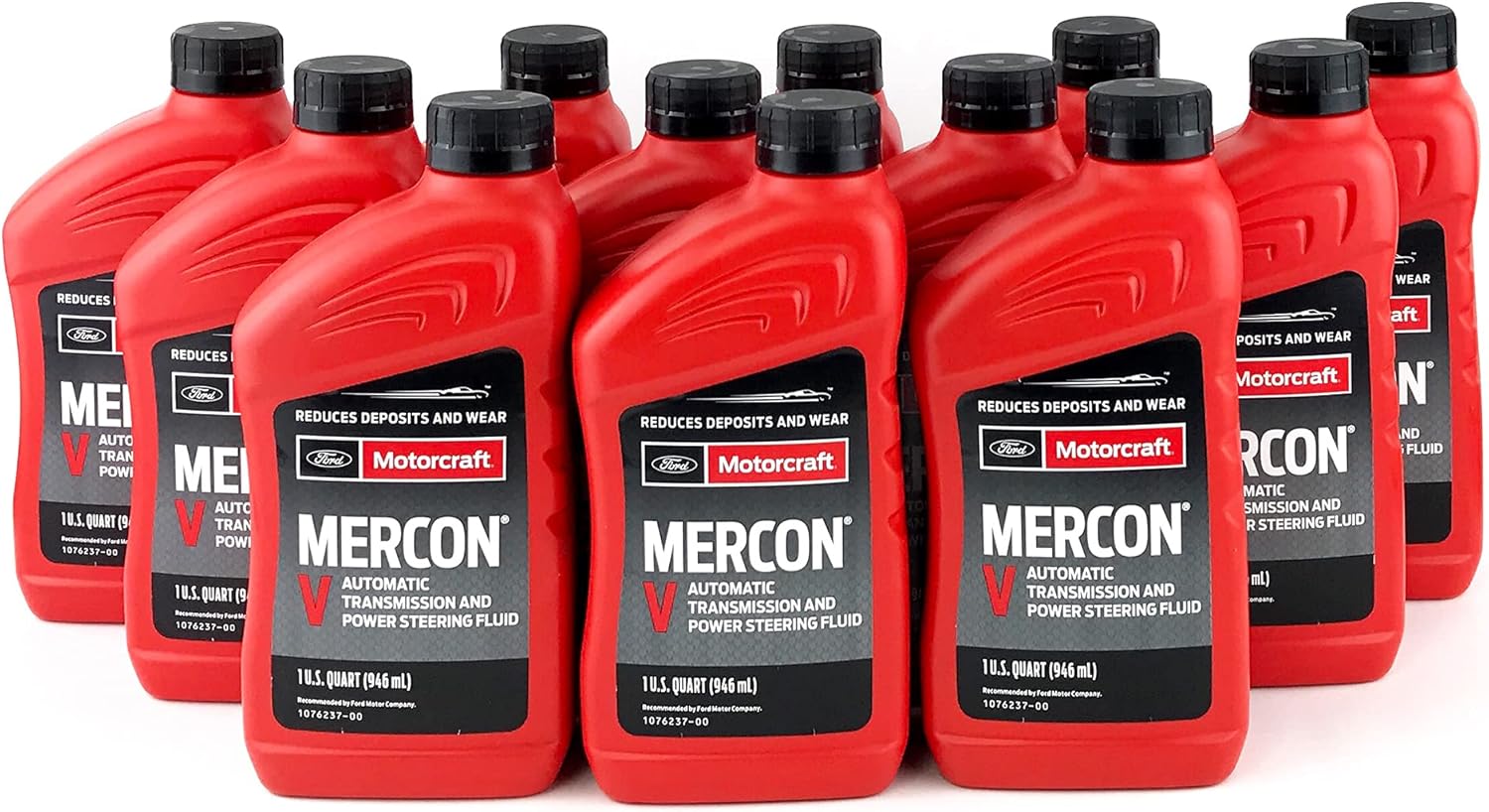
| Motorcraft MERCON V, 12-quart case | about $174 | XT-5-QMC; covers a pan service with quarts left over for topping off |
| Second 12-quart case | about $174 | Only for a full exchange or a second drain and fill |
| Deep-pan filter and gasket kit | about $47 | F6TZ-7A098-BB style; match your pan depth |
| Pan service, parts only | about $221 | One case plus the filter kit |
| Full service, parts only | about $395 | Two cases plus the filter kit, enough for Ford's 15.9-16.4 qt plus purge |
| Replacement cooler, if the fluid came out burnt | about $134 | 1994-95 E4OD cooler; confirm year fitment |
At an independent shop, a pan-and-filter service on an E4OD is commonly quoted in the $200-350 range, and a full service with a cooler-circuit exchange in the $350-550 range, depending on the labor rate and how the shop marks up fluid. Dealers run higher, and plenty of dealers will not touch a 1990s truck anyway.
The Federal Trade Commission's auto repair guidance is the right way to handle any quote: get a written estimate that separates parts and labor, ask how the shop prices labor (many bill flat rate from a published guide, not clock time), and get a repair order that lists each repair, every part and its cost, and the labor charge (the FTC also suggests asking for your old parts back). On an E4OD, ask four specific questions before you hand over the keys:
- What fluid goes in, by name? It should be MERCON V, not a "universal" multi-vehicle ATF.
- Does the price include the cooler circuit, and how do you handle the cooler bypass on 1997 trucks?
- Are the pan bolts torqued to spec, or run down with an impact?
- Is the level set on the dipstick hot, after cycling through the gears?
How much fluid an E4OD holds
Ford's 1997 F-250 Heavy Duty/F-350 owner guide lists the E4OD at 15.9 quarts (15.0 L) in a 4x2 and 16.4 quarts (15.5 L) in a 4x4. Both lines carry the same footnote: always use the automatic transmission fluid dipstick to determine the exact fluid quantity required. That footnote matters more than the number. Cooler size, line length and aftermarket pans all change the real total, and the dipstick is the only thing that tells you when it is right.
A pan drop does not get you anywhere near 16 quarts. The converter, the cooler, the lines and the clutch circuits all stay full when the pan comes off. On the lift, an E4OD pan drain usually gives back somewhere around six to eight quarts on a stock pan. So a single pan service replaces well under half the fluid. That is fine for a healthy unit on a regular schedule. It is not enough if you are trying to get old, dark fluid out of a truck with no service history.
Two ways to get closer to a complete change:
- Repeat drain and fill. Do the pan and filter, refill, drive it to temperature, then drain and refill again. Two rounds gets most of the old fluid out and costs one extra case.
- Cooler-line exchange after the pan service. With the new filter in and the pan back on, push new fluid through the cooler circuit while pulling old fluid out. Done correctly it uses close to the full capacity in one visit.
The fluid: MERCON on the chart, MERCON V in the bottle
When these trucks were new, Ford specified plain MERCON. The lubricant specification chart in the 1997 owner guide lists Motorcraft MERCON Automatic Transmission Fluid, part XT-2-QDX, for the electronic 4-speed automatic (E4OD). The same guide tells you the fluid type is stamped on the dipstick, and to check it before adding anything.
That was right in 1997. It is not how you buy fluid for one today. Straight MERCON has been gone from parts counters for years. Ford's current guidance is on the Motorcraft MERCON V product page: use it in automatic and manual transmissions and power steering systems previously serviced with MERCON. That is Motorcraft XT-5-QMC in quarts or XT-5-5Q3M in a 5-quart jug, or any fluid carrying a current MERCON V license. In practice every E4OD gets MERCON V now.
Two details on the same trucks:
- Power steering. The 1997 owner guide calls for MERCON ATF in the power steering system too, so the leftover MERCON V from this job is the right fluid to top off the steering pump.
- Transfer case. The Motorcraft page also says not to use MERCON V in transfer cases where MERCON was previously recommended. Do not dump the extra quarts into the transfer case on a 4x4. Look up the correct fluid for your transfer case separately.
Skip the bottle of shift conditioner and the "universal" ATF that claims to cover everything from Dexron to Toyota WS. Ford's guide warns that using a transmission fluid other than the one specified could result in malfunction or failure, and an E4OD with thirty years on it does not need an experiment.
Filter, pan and torque specs
The E4OD has one internal filter that plugs into a bore in the pump, under the valve body. There is no factory external spin-on filter. The ATSG 4R100 manual (the 4R100 is ATSG's "updated version of the E4OD" and keeps the same 20-bolt pan) says to lube the seal on the new filter with a small amount of Trans-Jel and push it into the bore. Two things I check every time:
- Make sure the old seal came out with the old filter. On these units the seal often stays behind in the bore. If the new filter goes in on top of the old seal it will not seat, and the pump can suck air. That shows up as whine, delayed engagement and low line pressure right after a "simple" service. Pick the old seal out before installing the new filter.
- Match the filter to the pan. Stock 2WD and 4WD pans and deep aftermarket pans use different filter depths. A shallow filter in a deep pan can uncover its pickup when fluid is low or the truck is on a grade. The deep-pan filter is the F6TZ-7A098-BB style.
ATSG specifies 14-16 N·m (10-12 ft-lb) for all twenty pan-to-case bolts. That is not much. Most E4OD pan leaks after a service come from over-torqued bolts crushing the gasket or bending the pan flange, not from bad gaskets. Use a small torque wrench, go in a crisscross pattern, and do not reuse a pan with bent flanges. Also note the gasket style your pan needs: some pans have flat bolt holes and some have raised dimples, and the wrong gasket style will weep no matter what you torque it to.
The 1997 cooler bypass valve
Late E4OD trucks have a cooler bypass valve in the fitting assembly on the side of the case. Sonnax's 36605-02K cooler bypass valve kit is listed for 1997-and-later E4OD and 4R100 units with outboard fittings. According to Sonnax, sticking bypass parts, a relaxed spring or a poor ball seat let the valve open too early. That drops TCC apply pressure and cooler flow, and it shows up as TCC slip, soft TCC apply, codes 1783, 1741 and 1744, and overheating. The Sonnax spring holds the cracking pressure at 70-75 psi, so the unit still gets lube if the cooler plugs up.
For a flush, Mike Steen of Certified Transmission makes the key point in Transmission Digest: on the 4R100-style design the bypass is a mechanical valve in the tube that bolts to the case, separate from the lines, so it does not stop you from flushing the lines and cooler. Where a bypass is built into the lines or the cooler itself, he says to flush around it or make a plug to install in its place while you flush. Either way, a shop should know where the bypass is on your truck before hooking up a machine. If the truck has a history of running hot or a converter clutch complaint, add the bypass valve kit to the fluid service.
When the fluid comes out burnt
Look at the fluid and the pan before you pour in sixteen quarts of new MERCON V. Clean, red fluid and a light gray film on the magnet mean go ahead. Dark brown fluid that smells burnt, or a pan with friction material in it, changes the job. Burnt fluid on an E4OD usually points to an overdrive section that has been starved of lube, and fresh fluid will not bring it back. Our E4OD common problems guide covers that failure.
If the unit still drives fine but the fluid was burnt, flush the cooler and lines before you refill, and replace the cooler if it will not flow clean. Debris parked in a cooler goes straight back into a fresh filter and valve body.
Fill and level check, per Ford
The procedure from the 1997 owner guide:
- Check at normal operating temperature, 150-170°F (66-77°C), after about 20 miles (30 km) of driving. If the truck has been run hard at high speed, in city traffic in hot weather, or pulling a trailer, shut it off for about 30 minutes to let the fluid cool first.
- Park on level ground. With the engine running and your foot on the brake, move the shifter through every range, giving each one time to engage.
- Latch it in Park, set the parking brake and leave it running. On a 4x4, Ford says the transfer case selector must be in any position other than neutral.
- Wipe the dipstick cap, pull the dipstick, wipe it, seat it fully, and pull it again to read.
- Hot, the level should be in the crosshatched area. If the truck has not been driven and it is above 50°F outside, the level should be between the holes on the dipstick.
- Add in 1/2 pint (0.25 L) steps through the filler tube. Ford says any overfill should be removed by a technician, so sneak up on it.
Ford also warns not to drive the vehicle if the level is below the bottom hole on the dipstick and it is above 50°F outside. After a pan service with only six to eight quarts back in, that is exactly where the level sits until you top it off, so do not pull the truck off the lift short on fluid and plan to "finish it later."
How often
This is where the E4OD surprises people. The 1997 owner guide says that for E4OD transmissions there is no 30,000-mile (48,000 km) scheduled fluid change requirement under normal use. Under severe operating conditions, the guide says the fluid, filter and seal assembly should be changed every 21,000 miles (34,000 km). Ford's severe list is:
- Extended high-speed driving in hot weather, at or above 90°F (30°C)
- Towing a trailer more than 1,000 miles (1,600 km) per trip
- 5,000 miles (8,000 km) or more per month
- Continuous operation or extensive idling, such as delivery service
- Operation in severe dust
Most E4OD trucks still on the road land in at least one of those boxes. My working rule on a truck that tows is fluid and filter every 21,000 miles, which is Ford's own severe number, and sooner if the temperature gauge has spent time high. Ford also says to check the fluid at least twice a year. On a truck with no service history and well over 100,000 miles, check the fluid and the pan first before committing to a full exchange.
Shop the part for this fix: E4OD/4R100 filter and pan gasket kit
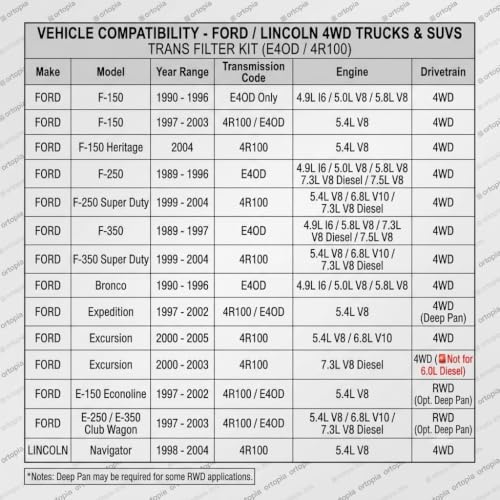
The 1989-2005 filter and pan gasket kit covers E4OD years, and it is the core of every E4OD fluid service. Confirm your pan depth before ordering. The Sonnax 36605-02K cooler bypass kit for 1997 trucks is in the same collection.
See the filter kit at CoreTransmissionPartsNeed parts for this job?
Our E4OD parts page has the deep-pan filter and gasket kit, Motorcraft MERCON V by the case, and E4OD coolers, plus solenoid kits, valve bodies and master rebuild kits for units that are past a fluid service. Checkout is on site.
FAQ
How much does an E4OD fluid change cost?
Parts for a pan and filter service run about $221 at our prices: a 12-quart case of Motorcraft MERCON V and a deep-pan filter and gasket kit. A full service with a second case for a cooler-circuit exchange is about $395 in parts. Independent shops commonly quote around $200-350 for a pan service and $350-550 for a full service, depending on labor rate and fluid markup.
How many quarts does an E4OD hold?
Ford's 1997 F-250 Heavy Duty/F-350 owner guide lists 15.9 quarts (15.0 L) for a 4x2 and 16.4 quarts (15.5 L) for a 4x4, with a note to always use the dipstick to set the exact amount. A pan drain gives back only about six to eight quarts because the converter, cooler and lines stay full.
Does the E4OD take MERCON or MERCON V?
Ford originally specified Motorcraft MERCON ATF, part XT-2-QDX. Straight MERCON is no longer sold, and Motorcraft says to use MERCON V in transmissions previously serviced with MERCON. Do not put MERCON V in a transfer case where MERCON was previously recommended.
How often should E4OD fluid be changed?
Ford's 1997 owner guide says the E4OD has no 30,000-mile scheduled fluid change under normal use, but calls for fluid, filter and seal every 21,000 miles under severe conditions. Those include towing a trailer more than 1,000 miles per trip, high-speed driving at 90 F or above, 5,000 or more miles a month, extensive idling and severe dust.
What is the torque spec for E4OD pan bolts?
The ATSG manual for the 4R100, the updated E4OD with the same 20-bolt pan, lists 14-16 N-m (10-12 ft-lb) for all twenty pan-to-case bolts. Over-tightening crushes the gasket and bends the pan flange, which causes most leaks after a service. Use a small torque wrench and a crisscross pattern.
Related guides
- E4OD Fluid Type and Capacity
- E4OD Filter and Pan Service Guide
- E4OD Common Problems and Fixes
- E4OD Rebuild Guide: Known Wear Points and Upgrades
- 4R100 vs E4OD: Differences
- 4R100 Fluid Change Cost
- 4R100 Towing Upgrades
Sources
- Ford Motor Company, "1997 F-250 Heavy Duty/F-350 Owner Guide," Maintenance and Care; Capacities and Specifications. Backs the E4OD capacities of 15.9 qt (15.0 L) 4x2 and 16.4 qt (15.5 L) 4x4 with the dipstick footnote, Motorcraft MERCON ATF XT-2-QDX for the E4OD, MERCON ATF for power steering, the fluid type stamped on the dipstick, the no-30,000-mile note and 21,000-mile severe-conditions change with its condition list, the twice-a-year check, the 150-170°F check after 20 miles, the 30-minute cool-down, the 4x4 selector note, the crosshatch and between-the-holes readings, the below-bottom-hole warning, the 1/2 pint add steps, and the wrong-fluid warning. fordservicecontent.com (PDF)
- Ford Motorcraft, "Motorcraft MERCON V" product details. Backs using MERCON V in transmissions and power steering systems previously serviced with MERCON, part numbers XT-5-QMC and XT-5-5Q3M, and the warning not to use it in transfer cases where MERCON was previously recommended. fcsdchemicalsandlubricants.com
- ATSG (Automatic Transmission Service Group), Ford 4R100 technical service manual (2003). Backs the 4R100 being the updated version of the E4OD, the 20 bottom pan bolts at 14-16 N·m (10-12 ft-lb), and the filter seal lubricated with Trans-Jel and installed into the pump bore. ATSG manual (PDF)
- Sonnax, "Cooler Bypass Valve Kit 36605-02K." Backs the 1997-later E4OD and 4R100 outboard-fitting application, the sticking parts, spring relaxation and poor ball seat failure mode, the loss of TCC apply pressure and cooler flow, the TCC slip, codes 1783, 1741 and 1744 and overheating symptoms, and the 70-75 psi cracking pressure. sonnax.com
- Mike Steen, Transmission Digest, "Cooler Bypass." Backs the 4R100-style bypass being a mechanical valve in the tube bolted to the case and separate from the lines, and the advice to flush around, or plug in place of, a bypass built into the lines or cooler. transmissiondigest.com
- Federal Trade Commission, "Auto Repair Basics." Backs the advice to get a written estimate of parts and labor, ask how labor is priced including flat-rate guides, and get a repair order that lists each repair, the parts supplied and the cost of each part, labor charges and the odometer reading, and ask for the replaced parts back. consumer.ftc.gov (archived copy; the live page was removed)