The 4R100 is a stout four-speed. It sits behind the 7.3L Power Stroke, the 6.8L V-10 and the 5.4L in 1999-2004 Super Duty pickups, Excursions and E-Series vans, and plenty of them have pulled fifth-wheels their whole lives. When one of them dies from towing, it is almost never because a part was too weak. It is heat. Cooked fluid, a glazed converter clutch, burnt overdrive and coast clutches. Every one of those starts with the cooling system not keeping up.
So this guide is mostly about cooling. It covers what Ford itself did about 4R100 overheating, how the cooler circuit works and fails, the temperature limits the PCM enforces, how to drive it loaded, and which upgrades are worth money. The specs come from Ford TSB 00-24-4, Ford's 2003 towing guide, the ATSG 4R100 manual, Sonnax and Transmission Digest (full list under Sources).


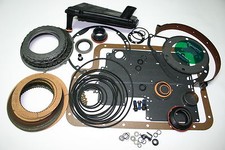
Ford admitted the early trucks ran hot
This is not internet lore. Ford released TSB 00-24-4, "Transmission - 4R100 - Fluid Overheats During Severe Duty." It covers 1999-2000 Super Duty F-Series with the 6.8L or 7.3L built from 1/5/1998 through 2/6/2000, and 2000 Excursions with the same engines built 7/1/1999 through 2/6/2000. Ford's words: those trucks "may benefit from additional cooling during heavy duty use conditions," and it names snow plowing, towing and carrying heavy loads.
The fix was not a band-aid. Ford replaced the radiator (YC3Z-8005-BA, which has the internal transmission fluid cooler), the cooler tubes (YC3Z-7A031-AA and -CA), the hose (YC3Z-7R081-AA) and the clip (YC3Z-7N291-AA) with the updated parts, installed per the 2001 workshop manual. Then it added the transmission in-line filter kit XC3Z-7B155-AA per TSB 00-23-10. The bulletin says to do this only when the transmission hardware confirms inadequate cooling, and to repair any transmission damage first.
What this tells a builder: if you are building a 4R100 for an early-build truck that tows, check the build date on the door tag. If it falls inside that window and still has the original radiator and lines, the cooling system is part of the job. A fresh rebuild behind the original cooler setup is going to see the same heat that killed the last one.
How the cooler circuit works, and how it fails
On the 4R100, oil to the cooler comes out of the torque converter circuit. That matters, because converter and cooler flow share the same oil. Sonnax's Bob Warnke explained in Transmission Digest ("4R100: Repeated Converter Failure") that in the modulated lockup design the TCC regulator valve feeds the converter apply piston first, and the cooler gets what is left. On the related E4OD he gives cooler flow of about 1.2-1.4 gpm in 3rd with the TCC off and 1.8-2.0 gpm with it applied. On the 4R100, flow is higher before lockup and drops during TCC apply.
Between the case and the cooler lines sits the cooler bypass valve (Ford F81Z-7H322-AA per ATSG). Its job is to let oil skip the cooler when the cooler is cold and restrictive. Warnke puts the opening point at around 60 psi of cooler head pressure. The trouble is when it opens too early or leaks. Then hot oil goes straight back to the transmission without ever seeing the cooler.
Sonnax lists the symptoms of a failed bypass valve on 1997-later E4OD and 4R100 units: TCC slip and soft apply, codes 1741, 1744 and 1783, converter overheating and reduced cooler flow. Its 36605-02K kit rebuilds the valve, keeps the original fittings and tubing, and sets cracking pressure back to 70-75 psi. This part is cheap and it is on the outside of the case. On any 4R100 that tows, it is the first upgrade on the list.
Warnke's list of what else kills cooler flow, most likely first: a bypass checkball leaking or stuck open, poor pump volume, and pump orifices someone has modified. His example truck was a 2000 7.3L that had eaten four converters in a row. The real problem was restricted flow, not the converters.
Torque the fittings right
When you install the bypass valve, ATSG gives the case fitting torques: front ("to cooler") fitting 30 N-m (22 ft-lb), rear ("from cooler") fitting 36 N-m (27 ft-lb), with the sealing washers in place. A cooler line fitting that weeps under towing pressure empties the unit on the highway.
The temperature limits the PCM enforces
The 4R100 has a transmission fluid temperature (TFT) sensor in the solenoid pack, and the PCM watches it. ATSG documents two limits:
- P1783: transmission fluid temperature has exceeded 270 F. If you see this code, the unit has been cooked at least once. Pull the pan and look before you hook the trailer up again.
- PTO operation: ATSG notes that PTO use can push fluid temperature past the recommended maximum of 250 F, and the PCM's failure-mode logic disables the PTO above that temperature to protect the unit.
Those are the hard limits. For towing, don't aim anywhere near them. Put a gauge or a scan tool on the TFT PID and watch it on the first long grade with the trailer. If it keeps climbing and doesn't level off, the cooling system is undersized for the load, and a harder climb or hotter day will get you to 270. Watch engine coolant temperature at the same time. On a truck whose transmission cooler sits in the radiator tank, a hot engine means hot ATF too.
No scan tool on the truck? You can read the sensor itself. ATRA's E4OD/4R100 quick reference gives the TFT resistance curve: about 5K-2.7K ohms at 159-194 F, 2.7K-1.5K ohms at 195-230 F, and 1.5K-0.8K ohms at 231-266 F. If the reading doesn't match the fluid temperature, the PCM is running shifts, lockup and the P1783 check on bad data.
Driving it loaded: overdrive cancel
ATSG describes the 4R100's Transmission Control Switch (TCS), also called the overdrive cancel switch. It is the momentary button on the end of the column shift lever. Press it and the PCM limits shifts to 1st through 3rd and lights the "OVERDRIVE OFF" lamp (TCIL). Press it again for 1-4.
Ford's own 2003 RV and Trailer Towing Guide gives the rule for using it: if towing, especially in hilly country, makes the transmission shift back and forth between overdrive and the next lower gear, lock out overdrive to stop it. When it isn't hunting, use overdrive for economy. And lock out overdrive to get engine braking on downgrades. Hunting is the thing to avoid. Every 3-4 and 4-3 shift unlocks the converter, and an unlocked converter under load is where most of the heat comes from.
One related failure to know about. ATSG's code chart lists P1754 for the coast clutch solenoid circuit. If it fails on, you get 3rd-gear engine braking in the overdrive range and the coast clutch may be damaged. If it fails off, you lose 3rd-gear engine braking with overdrive cancelled. That is exactly the braking you rely on coming down a grade with a trailer, so don't ignore it.
Know what the truck is rated for
No upgrade makes a truck rated for more than Ford built it for. Ford's 2003 guide lists fifth-wheel ratings for automatic F-250/350 Super Duty pickups. A 7.3L regular cab SRW 4x2 with 3.73 gears is rated at up to 13,700 lb on a 20,000 lb GCWR. The axle ratio matters a lot on the V-10: 3.73 gears carry a 17,000 lb GCWR (11,200 lb trailer), 4.30 gears carry 20,000 lb (14,200 lb trailer) in the same regular cab SRW 4x2. For conventional towing, the guide caps SRW pickups at 12,500 lb, and says fifth-wheel king pin weight should be 15-25% of the loaded trailer.
For a builder this matters in two ways. A V-10 on 3.73s pulling a heavy trailer is working the converter and the cooler harder than the same truck on 4.30s. And a customer who is overloaded will cook the next transmission no matter what you put in it. Ask what they tow and what gears they have before you promise anything.
Upgrades worth the money, in order
| Upgrade | Why | Pull the unit? |
|---|---|---|
| Cooler bypass valve kit (Sonnax 36605-02K) | Restores 70-75 psi cracking so oil actually goes through the cooler | No |
| TSB 00-24-4 radiator, lines and in-line filter (early builds) | Ford's own fix for severe-duty overheating | No |
| Auxiliary stacked-plate cooler | Adds cooling margin for heavy or frequent towing | No |
| Temperature monitoring (TFT PID or gauge) | You can't manage heat you can't see | No |
| Fresh Mercon V, shorter change interval | Hot fluid oxidizes and loses friction properties | No |
| Pump and converter flow checks at overhaul | Low pump volume and restricted converters starve the cooler | Yes |
The auxiliary cooler
A stacked-plate cooler flows better and sheds more heat for its size than a cheap tube-and-fin unit. Plumb it in series after the factory cooler, on the return line to the transmission, so the oil gets both. Mount it where it gets real airflow and isn't hiding behind the intercooler on a 7.3L. Use hose and clamps rated for ATF and the pressure, and route it away from the exhaust. The factory in-line filter from TSB 00-23-10 goes in the return line too, and that's also where a cooler flush catches anything left from an old failure.
The fluid
The 4R100 was filled with Mercon from the factory. Ford TSB 06-14-4 replaced Mercon with Mercon V (Motorcraft XT-5-QM) as the service fluid for 1981-2004 F-Super Duty and E-Series and 2000-2005 Excursion. The same bulletin warns against ATF supplements, additives and treatments. Check the level hot, 150-170 F, at idle in Park, per ATSG. Remember that a pan drop only gets part of the fluid, because the converter and cooler hold the rest. On a truck that tows, change it well before the normal schedule, and do it right after a hard summer of towing, not before.
At overhaul
If the unit is already out, check the things that feed the cooler: pump volume, converter flow, and the cooler lines themselves. Flush or replace the cooler. Debris from a heat failure sitting in the cooler will go straight into the new converter, which is why Ford added the in-line filter in the first place. If the fluid was burnt, expect the coast clutch and overdrive clutch to be damaged, and replace the frictions and steels rather than reusing them.
While it's apart, replace the front lube/drainback valve. Sonnax explains that the OE valve's plastic ball seat and seat stop melt at high fluid temperature, and once they do they can restrict the front lube feed and take out the overdrive planetary. Its 36425-01K kit swaps in aluminum parts. On a unit that tows, that's cheap insurance. The older E4OD has its own cooling quirks, covered in our E4OD towing upgrades guide.
Shop the part for this fix: Sonnax cooler bypass valve kit 36605-02K
The first upgrade on any 4R100 that tows. It rebuilds the leaking bypass valve at the case so oil goes through the cooler, restoring 70-75 psi cracking pressure with the stock fittings and lines.
See the Sonnax cooler bypass valve kit at CoreTransmissionPartsNeed parts for this job?
Our 4R100 parts page has auxiliary coolers, Mercon V, solenoid packs, pumps and master rebuild kits, with checkout on site. Before you order, confirm the model year, engine, and 2WD or 4WD.
FAQ
Does a 4R100 need an auxiliary transmission cooler for towing?
If the truck tows heavy or tows often, yes. Ford itself released TSB 00-24-4 because early 1999-2000 Super Duty and 2000 Excursion trucks could overheat the 4R100 during towing, plowing and heavy hauling, and the fix was a revised radiator with its internal cooler, new lines and an in-line filter. An auxiliary stacked-plate cooler plumbed after the factory cooler adds margin on top of that.
How hot is too hot for a 4R100?
Per ATSG, the PCM sets P1783 when transmission fluid temperature goes past 270 F, and it shuts off PTO operation above 250 F to protect the unit. Treat those as hard limits, not targets. Watch the TFT PID on a scan tool or gauge while towing and back off before you get anywhere near them.
Should I tow with overdrive off on a 4R100?
Ford's 2003 towing guide says to lock out overdrive if the transmission hunts between overdrive and the next lower gear, and to use it for engine braking on downgrades. On the 4R100 that is the overdrive cancel button (TCS) on the end of the shift lever. If the truck holds 4th with the converter locked and does not hunt, overdrive is fine.
What fluid should a towing 4R100 use?
Ford TSB 06-14-4 made Mercon V (Motorcraft XT-5-QM) the service fluid for the Super Duty, E-Series and Excursion, replacing the original Mercon. The same bulletin says not to add ATF supplements or additives. On a truck that tows, change it more often than the normal schedule.
Related guides
- 4R100 Torque Converter Lockup Shudder Fix
- 4R100 Slipping: Causes, Codes and the Fix
- 4R100 Fluid Change Cost
- Ford 4R100 Problems and Service
- How to Flush a Transmission Cooler After a Failure
- E4OD Towing Upgrades and Cooling
Sources
- Ford Motor Company, TSB 00-24-4, "Transmission - 4R100 - Fluid Overheats During Severe Duty - Availability of Updated Fluid Cooler/Filter Kit" (2000). Backs the affected vehicles and build dates, the severe-duty conditions, the radiator, tube, hose and clip part numbers, the in-line filter kit XC3Z-7B155-AA and the TSB 00-23-10 reference. TSB 00-24-4 (PDF)
- Ford Motor Company, 2003 RV and Trailer Towing Guide. Backs the overdrive lockout guidance for hunting and engine braking, the Super Duty fifth-wheel ratings and GCWRs by engine and axle ratio, the 12,500 lb SRW conventional limit and the 15-25% king pin weight. Ford 2003 towing guide (PDF) (Internet Archive copy; the original host now blocks access)
- ATSG (Automatic Transmission Service Group), Ford 4R100 technical service manual (2003). Backs the TCS overdrive cancel switch and TCIL, P1783 at 270 F, the 250 F PTO limit, P1754 coast clutch solenoid failure modes, the cooler bypass valve part number and fitting torques, and the 150-170 F level check. ATSG manual (PDF)
- Ford Motor Company, TSB 06-14-4, "Mercon ATF Is Being Replaced by Mercon V ATF as a Service Fluid" (2006). Backs Mercon V (XT-5-QM) as the service fluid for F-Super Duty, E-Series and Excursion, and the caution against additives. TSB 06-14-4 (PDF)
- Sonnax, "Cooler Bypass Valve Kit 36605-02K." Backs the failed bypass valve symptoms on 1997-later E4OD and 4R100 (TCC slip and soft apply, codes 1741/1744/1783, overheating, reduced cooler flow) and the 70-75 psi cracking pressure. sonnax.com
- Transmission Digest, Bob Warnke (Sonnax), "4R100: Repeated Converter Failure." Backs the converter-apply priority over cooler flow, the E4OD cooler flow figures, the roughly 60 psi bypass opening point, the ranked causes of low cooler flow and the 2000 7.3L four-converter case. transmissiondigest.com
- ATRA (Automatic Transmission Rebuilders Association), "Quick Reference E4OD/4R100" (2009). Backs the transmission fluid temperature sensor resistance table. ATRA quick reference (PDF)
- Sonnax, "Front Lube/Drainback Valve Kit 36425-01K." Backs the plastic OE ball seat and seat stop melting at high fluid temperature, the restricted front lube feed causing overdrive planetary failure, and the aluminum replacement parts. sonnax.com