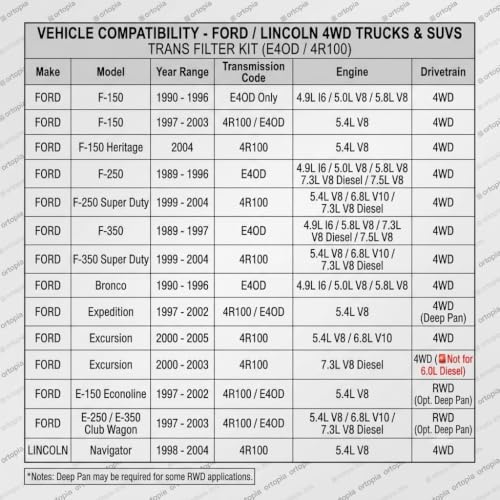
The E4OD went into the trucks Ford sold for towing. From 1989 through 1997 it sat behind the 7.3L diesels, the 7.5L 460 and the 5.8L in F-250 and F-350 pickups, E-Series vans, motorhome chassis and Broncos, and a lot of those trucks spent their lives hooked to a camper or a gooseneck. When one comes in burnt, the cause is almost always heat, not the trailer.
So this is a cooling guide first and a parts guide second. The ratings and driving rules are from Ford's 1996 RV and Trailer Towing Guide and the 1996 F-Series owner guide. The flow numbers and parts data are from Transmission Digest, Sonnax and ATRA. The full list is under Sources.
What Ford rated these trucks to pull
Start here, because no transmission upgrade makes a truck good for more than Ford built it for. The 1996 towing guide lists maximum loaded trailer weight by engine, axle ratio and gross combined weight rating (GCWR) for automatic F-Series trucks. For the engines that usually had the E4OD:
| Engine (automatic) | Axle ratio | GCWR (lb) | Max trailer, heavy-duty pickups (lb) |
|---|---|---|---|
| 7.3L diesel | 3.55 | 16,000 | about 9,400-10,000 |
| 7.3L diesel | 4.10 | 20,000 | 10,000 |
| 7.5L gas V-8 | 3.55 | 15,000 | about 8,900-9,900 |
| 7.5L gas V-8 | 4.10 | 18,500 | 10,000 |
| 5.8L gas V-8 | 4.10 | 13,000 | about 7,000-8,200 |
The exact number depends on cab, 4x2 or 4x4, and single or dual rear wheels, so look up the truck's own row. The same guide caps F-Series fifth-wheel towing at 12,500 lb and puts fifth-wheel pin weight at about 25% of trailer weight. For conventional trailers over 2,000 lb, tongue weight should be 10-15% of the trailer. The optional Class IV hitch receiver on the F-250 HD and F-350 was rated at 7,500 lb weight-carrying and 10,000 lb with a load-equalizing hitch.
Notice what the axle ratio does. A 7.5L on 3.55 gears is rated for 3,500 lb less GCWR than the same engine on 4.10s. Taller gears mean more time with the converter unlocked and more throttle to hold speed, and that is heat in the E4OD. Ask a towing customer what they pull and what gears they have. An overloaded truck will cook the next transmission no matter what goes into it.
The equipment Ford required
Ford's towing guide lists required equipment for F-Series trucks, including fifth-wheel use:
- Trailers 2,000-3,500 lb: Super Engine Cooling or the Trailer Towing Package.
- Trailers over 3,500 lb: Super Engine Cooling with the Handling Package, or the Trailer Towing Package.
The F-Series Trailer Towing Package was option code 535 (532 for the F-350 camper/trailer package), and it included Super Engine Cooling, a heavy-duty battery, a heavy-duty flasher and the handling package. Ford also notes that the new-vehicle warranty could be voided by towing without the required equipment.
For the transmission, the important item is Super Engine Cooling. On these trucks the transmission cooler is in the radiator tank, so the radiator is the transmission's first line of cooling. In the same chart, Ford recommended an aftermarket auxiliary transmission cooler only for cars, not trucks. So a truck built without the towing package, or with a cheap replacement radiator, is starting behind. Check the radiator before you blame the transmission.
How the E4OD cooler circuit behaves
The E4OD does not cool the same way as the 4R100, and the difference changes how you drive it. Sonnax's Bob Warnke measured it for Transmission Digest. Average E4OD cooler flow in 3rd with the torque converter clutch (TCC) released is 1.2-1.4 gpm, and it rises to 1.8-2.0 gpm when the TCC is commanded on. On the 4R100 it goes the other way: flow drops when the clutch applies. Warnke also points out that the E4OD has no external pressure bypass circuit. Oil to the cooler comes out of the converter circuit, and it goes through the cooler.
That gives you two reasons to keep an E4OD locked up when it's loaded. A locked converter isn't slipping, so it isn't making heat. And the unit sends roughly 40-50% more oil to the cooler with the clutch applied. An unlocked converter pulling a trailer up a grade is where most of the heat comes from, and it's also when the cooler gets the least oil. With a flow meter or gauge in the cooler line, Warnke notes, you can see the TCC command as a rise in flow or pressure.
The 1997 exception
Some late units did get a bypass. Sonnax lists its 36605-02K cooler bypass valve kit for 1997-later E4OD as well as the 4R100. On those, the bypass is in the cooler fitting at the case. When it sticks, relaxes its spring or has a worn ball seat, it opens early and hot oil goes back to the transmission without seeing the cooler. The symptoms Sonnax lists are TCC slip and soft apply, codes 1783, 1741 and 1744, overheating, low cooler flow, and an overheated converter and overdrive area. The kit sets cracking pressure back to 70-75 psi. If you have a 1997 unit, look at the cooler fittings on the case and find out which kind you have.
Driving it loaded
The E4OD has a Transmission Control Switch on the end of the shift lever. Press it and "OFF" lights on the knob, and the unit runs in 1st through 3rd. Press it again for overdrive. Ford's instructions for towing, from the 1996 F-Series owner guide and towing guide:
- With an E4OD, tow in Overdrive when the truck will hold it.
- If towing, especially in hills or with a heavy trailer, makes it shift back and forth between overdrive and 3rd, lock out overdrive. When it isn't hunting, go back to overdrive for fuel economy.
- Going down a steep grade with a trailer, run in Drive (overdrive off) instead of Overdrive. If you need more braking, go to 2 or 1.
- Never drive faster than 45 mph when towing in hilly country on hot days.
- Speed control may shut off on long, steep grades. That's normal.
Hunting is the thing to stop. Every 4-3 and 3-4 shift releases the converter clutch, so a unit hunting on a grade is slipping the converter and cutting cooler flow over and over. Lock it in 3rd and let it stay locked. The owner guide also warns against power braking, holding the brake and raising engine speed in gear. It stalls the converter, and Ford says continued stall can cause transmission overheating, malfunction or fluid expulsion.
Know the fluid temperature
You can't manage heat you can't see. The E4OD has a transmission fluid temperature (TFT) sensor inside the unit, and the PCM uses it for shift and lockup decisions. Ford gives normal operating temperature as 150-170°F for checking the level. A scan tool that reads TFT, or an aftermarket gauge in the pan or cooler line, will show you what the unit is doing on the first long grade with the trailer.
If you don't have a scan tool on the truck, you can read the sensor directly. ATRA's E4OD/4R100 quick reference gives the TFT resistance by temperature:
| °F | °C | TFT resistance |
|---|---|---|
| 32-58 | 0-20 | 100K-37K ohms |
| 59-104 | 21-40 | 37K-16K ohms |
| 105-158 | 41-70 | 16K-5K ohms |
| 159-194 | 71-90 | 5K-2.7K ohms |
| 195-230 | 91-110 | 2.7K-1.5K ohms |
| 231-266 | 111-130 | 1.5K-0.8K ohms |
If the reading doesn't match the fluid temperature, the PCM is running shifts and lockup on bad data. If a gauge shows the fluid climbing past the low 200s on a grade and not leveling off, the cooling is undersized for the load, and a hotter day or a longer hill will take it further. Watch engine temperature too. With the cooler in the radiator tank, a hot engine means hot ATF.
One more Ford note. After towing, the owner guide says to shut the truck off for about 30 minutes to let the fluid cool before you check the level. Checking it right after a pull gives a false high reading.
Service interval for a truck that tows
The E4OD is the only transmission in the 1996 F-Series line with a scheduled fluid change on the normal schedule: every 30,000 miles. The owner guide shortens that to 21,000 miles, fluid, filter and seal, under severe duty. Severe duty includes towing a trailer more than 1,000 miles per trip, extended high-speed driving in weather at or above 90°F, 5,000 miles or more a month, and extended idling. Most towing trucks qualify.
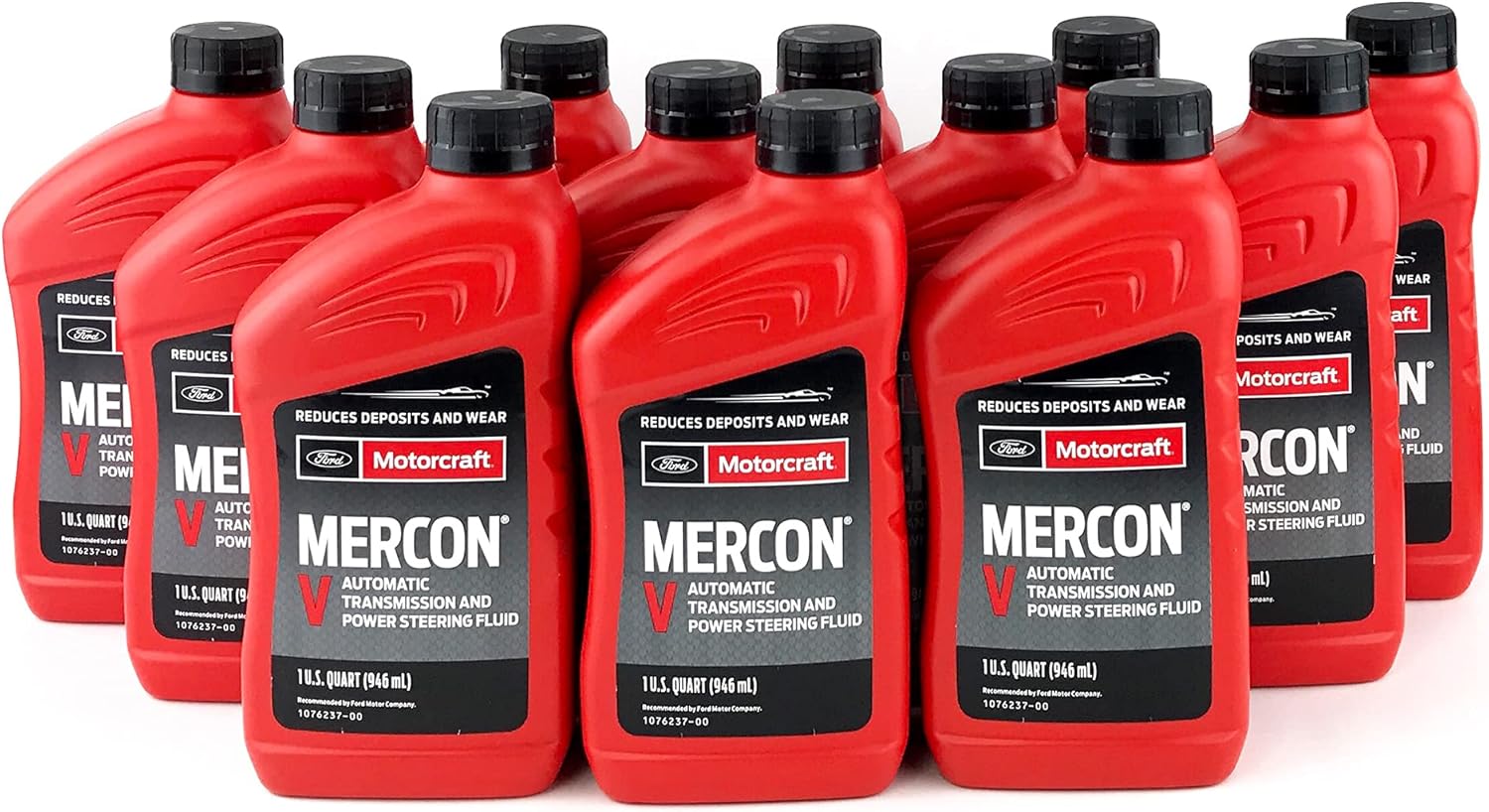
The factory fill was MERCON. Ford's TSB 06-14-4 replaced MERCON with MERCON V (Motorcraft XT-5-QM) as the service fluid for these older units, including the 1981-2004 E-Series and F-Super Duty and the 1981-2003 F-150. The bulletin also says not to use ATF supplements, additives or treatments. Capacity is about 15.7 qt for a 4x2 and 16.2 qt for a 4x4 per the 1996 owner guide, but a pan drop only gets part of that, because the converter and cooler hold the rest. Our E4OD fluid type and capacity guide and filter and pan service guide cover the service itself.
Upgrades worth the money, in order
| Upgrade | Why | Pull the unit? |
|---|---|---|
| Good heavy-duty radiator | The factory cooler is in the radiator tank. Ford required Super Engine Cooling for towing. | No |
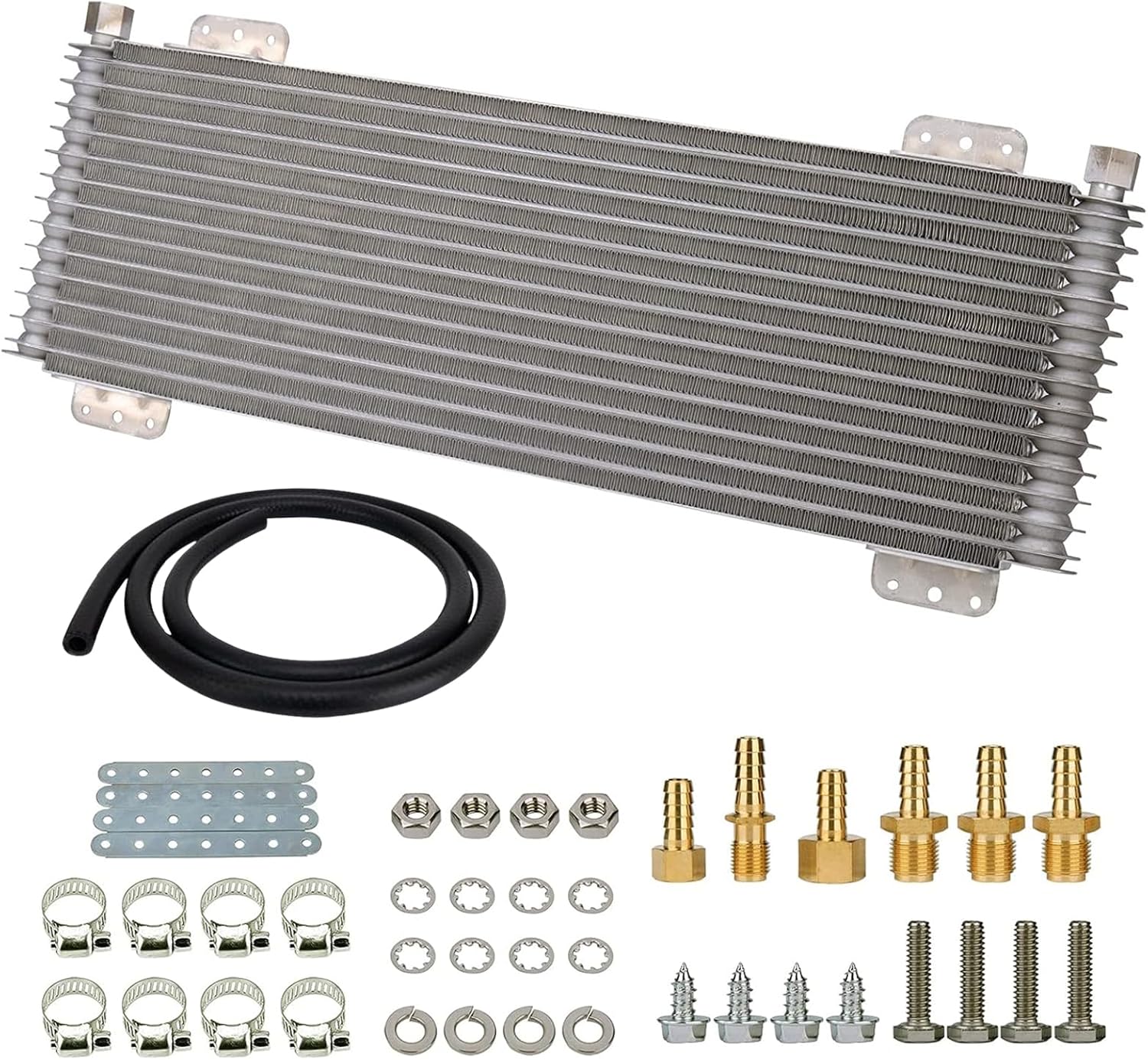
| Auxiliary stacked-plate cooler | Adds margin beyond the radiator tank for heavy or long-distance towing | No |
| Temperature monitoring | Shows when the unit is running hot before the fluid is burnt | No |
| MERCON V on the 21,000-mile severe schedule | Hot fluid oxidizes and loses its friction properties | No |
| Bypass valve kit (1997 units that have one) | Restores 70-75 psi cracking so oil goes through the cooler | No |
| Metal front lube/drainback valve | The plastic OE valve melts and starves the overdrive planetary | Yes |
| Correct-stall converter | The wrong stall makes more heat and drives poorly | Yes |
The auxiliary cooler
A stacked-plate cooler sheds more heat for its size and holds up better than a cheap tube-and-fin unit. Plumb it in series after the radiator-tank cooler, on the return line to the transmission, so the oil passes through both. Mount it in real airflow, away from the exhaust, with hose rated for ATF. If the unit is coming back from a heat failure, flush the radiator cooler and lines first. Debris left in the cooler goes straight into the new converter.
The front lube valve
This is the one to know about on any E4OD that has run hot. Sonnax explains that the OE front lube/drainback valve uses a plastic ball seat and seat stop, and they melt at high fluid temperature. Once they melt, they can restrict the front lube feed, and the result is overdrive planetary failure. Sonnax's 36425-01K kit replaces the plastic parts with aluminum. On a unit that tows it belongs in every rebuild.
The converter
Per Sonnax's Ed Lee, E4OD-family converters come in three stall ranges: a 140 K-factor high stall used mostly behind the small-block gas engines, a 105 K-factor low stall on the E4OD, and a 95 K-factor extra-low stall. Putting an extra-low stall converter into a low-stall application causes off-idle hesitation in a gas truck and turbo lag in a diesel. They all bolt in, so the wrong one fits. Early converter covers with round mounting pads cracked and leaked around the studs. Don't reuse one of those in a towing truck. Our E4OD converter shudder guide covers lockup problems in detail.
Shop the part for this fix: Sonnax front lube/drainback valve kit 36425-01K
Replaces the plastic OE front lube valve parts that melt when an E4OD runs hot and starve the overdrive planetary. Fits E4OD and 4R100, and it's cheap insurance in any rebuild for a truck that tows.
See the Sonnax front lube valve kit at CoreTransmissionPartsNeed parts for this job?
Our E4OD parts page has filter kits, rebuild kits, pumps and valve bodies sorted by year range, and our shop carries stacked-plate coolers and MERCON V, with checkout on site.
FAQ
Is the E4OD good for towing?
Yes, within the truck's rating. Ford's 1996 towing guide rates a 7.3L diesel F-Series with 4.10 gears at a 20,000 lb GCWR and up to 10,000 lb conventional towing, with fifth-wheel towing up to 12,500 lb. Most E4OD failures in towing trucks come from heat, not from the parts being too weak.
Should I tow in overdrive with an E4OD?
Ford says to tow in Overdrive when the truck holds it, and to lock out overdrive with the switch on the shift lever if it hunts between 4th and 3rd. Use Drive (overdrive off), or 2 or 1, for engine braking on steep downgrades. Hunting unlocks the converter on every shift, which makes heat.
How often should I change E4OD fluid if I tow?
Every 21,000 miles, fluid, filter and seal, per the 1996 Ford owner guide's severe-duty schedule. That applies when towing more than 1,000 miles per trip, driving at high speed in 90 degree weather, or running 5,000 miles a month. The normal schedule is 30,000 miles.
Does the E4OD have a cooler bypass valve?
Most don't. Transmission Digest's Bob Warnke notes that the E4OD has no external pressure bypass circuit, so oil to the cooler goes through the cooler. Sonnax does list its 36605-02K bypass valve kit for 1997-later E4ODs, so check the cooler fittings on a 1997 unit.
Related guides
- 4R100 Towing Upgrades and Cooling
- E4OD Torque Converter Shudder
- E4OD Fluid Type and Capacity
- E4OD Won't Shift Into Overdrive
- E4OD Common Problems and Fixes
- E4OD Overheating: Causes and Prevention
Sources
- Ford Motor Company, 1996 Recreation Vehicle and Trailer Towing Guide (RVS 96-300). Backs the F-Series automatic maximum trailer weights and GCWRs by engine and axle ratio, the 12,500 lb fifth-wheel limit, tongue and pin weight percentages, the Class IV hitch receiver ratings, the required Super Engine Cooling or Trailer Towing Package equipment and package contents, the car-only auxiliary cooler recommendation, the overdrive lockout rule for hunting, and 3rd-gear engine braking on downgrades. https://xr793.com/wp-content/uploads/2022/12/1996-Ford-Recreation-Vehicle-Trailer-Towing-Guide.pdf
- Ford Motor Company, 1996 F-150/250/350 Owner Guide. Backs the Transmission Control Switch operation, towing in Overdrive with an E4OD, Drive/2/1 on steep downgrades, the 45 mph hot-weather hill limit, the power-braking stall warning, the 150-170 F level check and 30-minute cool-down after towing, the 30,000-mile E4OD fluid change, the 21,000-mile severe-duty conditions, and the 15.7/16.2 qt capacities. https://web.archive.org/web/20251118225840/http://www.fordservicecontent.com/Ford_Content/catalog/owner_guides/96f23og1e.pdf
- Transmission Digest, Bob Warnke (Sonnax), "4R100: Repeated Converter Failure" (2006). Backs E4OD cooler flow of 1.2-1.4 gpm in 3rd with the TCC released and 1.8-2.0 gpm at TCC command, the opposite behavior on the 4R100, the E4OD having no external pressure bypass circuit, and reading TCC command as a rise in flow or pressure. https://www.transmissiondigest.com/4r100-repeated-converter-failure/
- Sonnax, Cooler Bypass Valve Kit 36605-02K. Backs the 1997-later E4OD fitment, the sticking, spring relaxation and ball seat failures, the listed symptoms and codes 1783, 1741 and 1744, and the 70-75 psi cracking pressure. https://www.sonnax.com/parts/2078-cooler-bypass-valve-kit
- Sonnax, Front Lube/Drainback Valve Kit 36425-01K. Backs the plastic OE ball seat and seat stop melting at high fluid temperature, the restricted front lube feed causing overdrive planetary failure, and the aluminum replacement parts. https://www.sonnax.com/parts/2067-front-lube-drainback-valve-kit
- ATRA (Automatic Transmission Rebuilders Association), "Quick Reference E4OD/4R100" (2009). Backs the transmission fluid temperature sensor resistance table from 32 F to 266 F. https://atracom.blob.core.windows.net/bulletins/quick/ford/e4od/e4od_quick_ref.pdf
- Sonnax, Ed Lee, "Identifying Converter Components: 6 Key Features to Understand in Ford E4OD, 4R100 & 5R110W." Backs the 140, 105 and 95 K-factor stall ranges, the hesitation and turbo lag from an extra-low stall in a low-stall application, the shared converter dimensions, and the cracked round-pad covers. https://www.sonnax.com/tech_resources/626-identifying-converter-components-6-key-features-to-understand-in-ford-e4od-4r100-5r110w
- Ford Motor Company, TSB 06-14-4, "Mercon ATF Is Being Replaced by Mercon V ATF as a Service Fluid" (2006). Backs MERCON V (XT-5-QM) as the service fluid for older Ford automatics including 1981-2004 E-Series and F-Super Duty and 1981-2003 F-150, and the caution against ATF additives. https://www.v8sho.com/SHO/06-14-4.pdf