An E4OD that runs hot doesn't fail right away. It fails later, somewhere else, from something that started months earlier. The customer brings in a truck with burnt fluid and no overdrive, and the real cause is a cooler tube clogged inside the radiator tank, a converter clutch that stopped locking, or a pressure regulator valve that wore until it choked off converter charge oil. Put in a rebuilt unit without finding that cause and the new one cooks the same way.
This guide covers where E4OD heat comes from, how to prove it with a scan tool and a quart bottle, and what fixes it. Code definitions are from ATSG, flow data from Transmission Digest and Sonnax, and service rules from Ford's 1996 F-Series owner guide. Sources are listed at the bottom.
Where the heat comes from
An automatic makes heat in two places: slip and pumping. On an E4OD, almost all of the extra heat comes from slip, and most of that is in the torque converter. An unlocked converter under load is a fluid coupling turning engine power into hot oil. A converter clutch that applies but slips does the same thing faster, and it glazes the lining as it goes. A slipping band or clutch pack adds more, but on these trucks the converter is where to look first.
The other side is getting rid of the heat. The factory cooler is a tube inside the radiator tank, so the transmission can only be as cool as the radiator allows. Anything that cuts flow through that tube, including debris, a kinked line, a stuck bypass or a worn valve in the pump, means the oil stays in the unit longer and gets hotter.
Most overheated E4ODs have one of these causes:
- Converter clutch not applying or slipping. This includes a failed TCC solenoid circuit, worn lining, low apply pressure, or a unit held out of lockup by hunting between 3rd and 4th.
- Low cooler flow. A restricted radiator tank cooler, a crushed or kinked line, a cooler bypass that opens early on late units, or a worn pressure regulator valve that restricts converter charge oil.
- Low fluid level or wrong fluid. A low unit aerates, loses pressure and slips.
- Load beyond what the truck was built for. Heavy trailers, tall gears, PTO work, or power-braking.
- Weak engine cooling. With the cooler in the radiator tank, a hot engine means hot ATF.
What the codes tell you
The PCM watches fluid temperature through the transmission fluid temperature (TFT) sensor in the solenoid body harness, and it watches converter slip by comparing engine speed to turbine speed. ATSG's code chart for the 4R100, the OBD-II successor built on the same hardware, defines the codes that point to heat:
| Code | ATSG definition | What it means for heat |
|---|---|---|
| P1783 | Transmission fluid temperature has exceeded 270°F | The unit actually got that hot. Find out why before you clear it. |
| P1744 | Excessive TCC slip; erratic or no converter clutch operation | The converter clutch is slipping, and slip makes heat |
| P0741 | PCM detected excessive TCC slip during normal operation | Same concern: lockup not holding |
| P0712 | TFT circuit grounded, reads above 315°F | May be a false overheat. Check the circuit before blaming the unit. |
| P0713 | TFT circuit open, reads minus 40°F | The PCM thinks the unit is cold and changes TCC and shift scheduling |
| P1711 | Transmission not at operating temperature during self-test | Warm it up and rerun the test |
Early EEC-IV trucks (1989-95) report three-digit codes instead. Sonnax lists code 628 (converter clutch slip) together with 1744 as a symptom of a worn line-to-lube pressure regulator valve, and lists 1783 with 1741 and 1744 as a symptom of a failing cooler bypass on late units. Those valves come up again below.
Check the TFT signal before you trust any temperature code. A grounded circuit reads over 300°F and makes the unit look like it's cooking. Read TFT on the scan tool with the engine cold and compare it to the coolant temperature sensor. After an overnight sit they should be close. If they aren't, measure the sensor resistance at the transmission connector before condemning anything else.
Proving the converter clutch is doing its job
With a scan tool, drive the truck warm in overdrive at a steady 45-55 mph with light throttle and watch the TCC duty cycle or command against engine rpm and turbine or output speed. When lockup is commanded, the slip between engine and turbine speed should fall to near zero and stay there. If rpm drops only partway, flares on light throttle changes, or the PCM keeps dropping lockup, you have your heat source.
Transmission Digest's Bob Warnke gives an E4OD detail that's useful here. On this unit, average cooler flow in 3rd with the TCC released is about 1.2-1.4 gpm, and it rises to 1.8-2.0 gpm when the clutch is commanded on. The 4R100 goes the other way. With a flow meter or pressure gauge in the cooler line, you can see the TCC command as a rise in flow. It also means that an E4OD that won't lock up is making more heat and sending less oil to the cooler at the same time.
That's also why hunting is so hard on this unit. Every 4-3 and 3-4 shift on a grade releases the converter clutch. A loaded truck hunting in and out of overdrive spends most of its time unlocked. Ford's owner guide says to lock out overdrive with the Transmission Control Switch on the shift lever when towing makes it cycle between overdrive and 3rd. Our E4OD converter shudder guide covers lockup faults in more detail.
Proving cooler flow
Don't guess at the cooler. Measure it. Sonnax's standard, from Jeff Parlee's after-overhaul article, is a minimum of one quart in 20 seconds for a transmission with 5/16-inch cooler lines, and most healthy units will put out a quart in about 10 seconds. The procedure:
- Get the truck to full operating temperature first. A cold check tells you nothing.
- Disconnect the cooler return line at the transmission and route it into a marked container.
- With the unit at the correct level, run the engine at idle in Park and time one quart.
- Shut it off and top the unit back up right away.
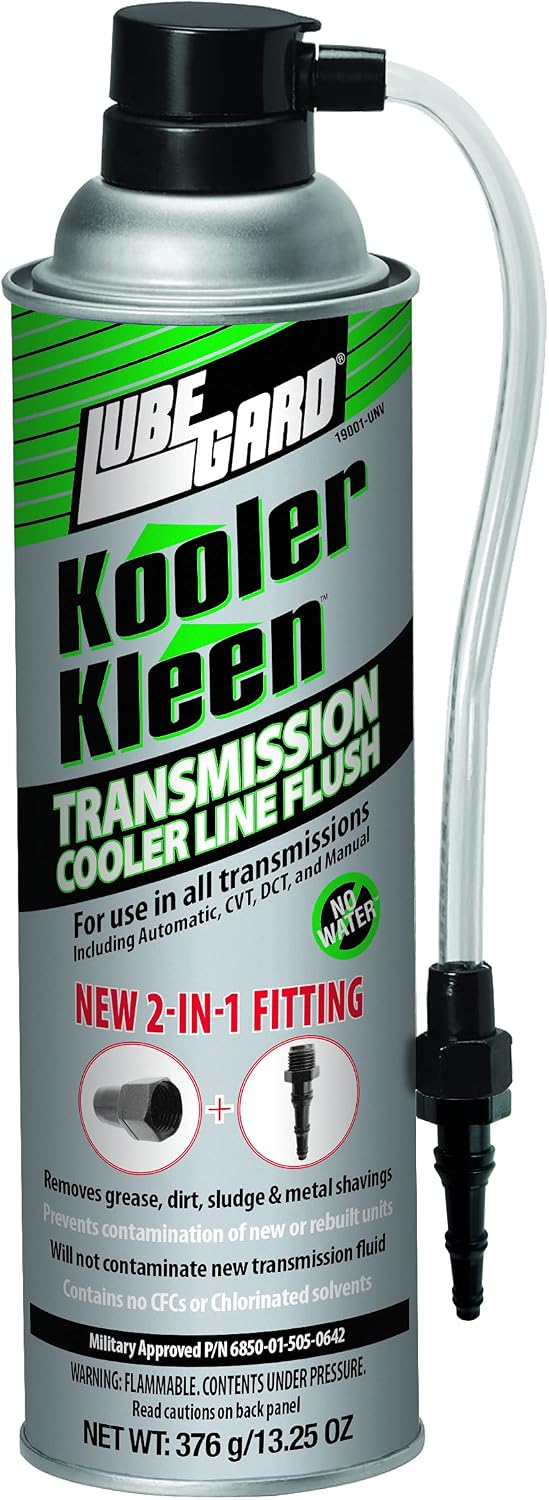
Parlee also warns not to rely on the cooler flusher to judge flow. A flusher pushes harder than the transmission pump does, so it can clear a restriction that then settles back in under normal pressure. He recommends flushing forward for half an hour, back-flushing for half an hour, then flushing forward again, and adding an inline filter on the return line to catch anything left over. Certified Transmission's Mike Steen adds that a flusher with a pressure gauge will show a high reading if the cooler is restricted. He also points out that a thermal bypass valve in the cooler circuit won't fully close unless it's heated during the flush, so the oil bypasses the part you're trying to clean.
After a converter or overdrive failure, assume the radiator tank cooler is full of debris. If it won't flush clean and pass the flow test, replace the radiator or add a separate cooler and bypass the tank.
Late units with a cooler bypass
Warnke notes that the E4OD generally has no external pressure bypass. The exception is late production: Sonnax lists its 36605-02K cooler bypass valve kit for 1997-later E4ODs. When that valve sticks, its spring relaxes or its ball seat wears, it opens early and hot oil returns to the unit without going through the cooler. Sonnax lists TCC slip, soft TCC apply, codes 1783, 1741 and 1744, overheating, low cooler flow, and an overheated converter and overdrive area as symptoms. The kit restores a 70-75 psi cracking pressure. If a 1997 truck fails the flow test with a clean cooler, check the fitting.
The pump valve that chokes off cooler flow
This one gets missed because it's inside the pump. The E4OD's main pressure regulator valve feeds converter charge oil, and converter charge oil is what goes to the cooler. Sonnax explains that when the OE valve wears, it can restrict converter charge and cooler flow, and that too little balance oil can hold the valve in the high line pressure position. The listed symptoms are codes 62, 628 and 1744, engine stall or stumble on Reverse engagement, high line pressure, delayed engagement and an overheated converter. Sonnax's line-to-lube valve 36424-04K for F1, F5, F8 and E9 pump castings uses an internal line-to-lube passage with an anti-drainback check so the cooler circuit keeps flowing.
If the truck has high line pressure, a stall or stumble when you drop it in Reverse, and low cooler flow with a clean cooler, the pump's regulator bore is the next place to look. It doesn't show up on a pan drop.
Shop the part for this fix: Sonnax line-to-lube pressure regulator valve 36424-04K
Drop-in replacement for the worn E4OD/4R100 pressure regulator valve that restricts converter charge and cooler flow and overheats the converter. Fits F1, F5, F8 and E9 pump castings.
See the Sonnax 36424-04K valve at CoreTransmissionPartsWhat heat damages first
When an E4OD has been hot, these are the parts to inspect on teardown, and the reason a rebuild after an overheat has to go further than new frictions:
- Front lube/drainback valve. Sonnax explains that the OE valve uses a plastic ball seat and seat stop that melt at high fluid temperature. Once melted, they can restrict the front lube feed, and the result is overdrive planetary failure. The 36425-01K kit replaces them with aluminum parts. Any E4OD that has run hot should get one.
- Converter. A converter that has run hot has a glazed or burnt clutch lining and cooked oil in it. Replace it. Ed Lee notes for Transmission Digest that E4OD turbine hub bearings have lube passages to move oil around the bushing, and that the 4R100 inherited the family's converter flow problems. A converter from a good rebuilder matters on this unit.
- Coast clutch. ATSG notes that during PTO operation the coast clutch is applied and EPC is raised to about 55 psi. If the PTO input wire to the PCM isn't connected, that pressure rise doesn't happen and the coast clutch burns in a short time.
- Seals and the solenoid body. Hot oil hardens seals and varnishes valves. Clean the valve body and check the solenoid resistances rather than reusing them blind.
Prevention that actually works
Keep the level right and check it hot
Ford's 1996 F-150/250/350 Owner Guide says to check the level at normal operating temperature, 150-170°F, in Park with the engine running. After towing, shut the truck off for about 30 minutes and let the fluid cool first. A reading taken right after a hard pull is false high. The same guide warns against power braking, holding the brake and raising engine speed in gear. It stalls the converter, and Ford says continued stall can overheat the transmission or push fluid out.
Change the fluid on the severe schedule if the truck works
The owner guide lists a 30,000-mile fluid change for the E4OD on the normal schedule, and 21,000 miles, fluid, filter and seal, for severe duty. Severe duty includes towing more than 1,000 miles per trip, sustained high speed in 90°F weather, and high mileage per month. Use MERCON V as the service fluid. Our E4OD fluid type and capacity guide and filter and pan service guide cover the details.
Add cooling margin
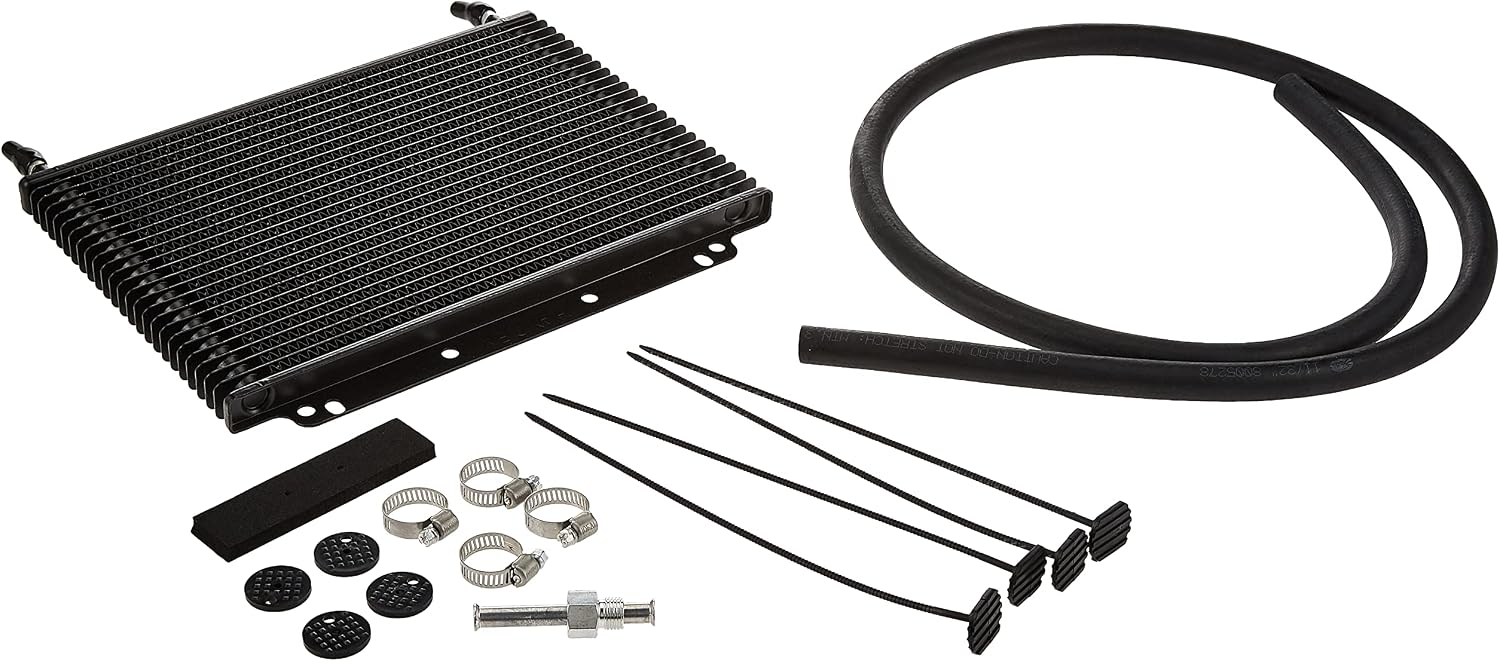
For a truck that tows or works, add an auxiliary cooler in series after the radiator tank, on the return line to the transmission, so the oil passes through both. Mount it in real airflow, away from the exhaust, and use hose rated for ATF. Keep the radiator in good shape too. A cheap replacement radiator can cut the transmission's cooling as much as the engine's.
Know the temperature
A gauge or scan tool that shows TFT tells you whether the cooling is keeping up. ATSG notes that Ford set a 250°F maximum during PTO operation, and the PCM disables the PTO above that temperature. P1783 sets at 270°F. If the fluid climbs past the low 200s on a grade and keeps rising, back off, lock out overdrive, and find the cause before the next trip.
Drive it like Ford said
Lock out overdrive when the truck hunts, use Drive, 2 or 1 for engine braking on long downgrades, and don't hold it at a stall. Our E4OD towing upgrades guide covers Ford's weight ratings and required equipment.
Need parts for this job?
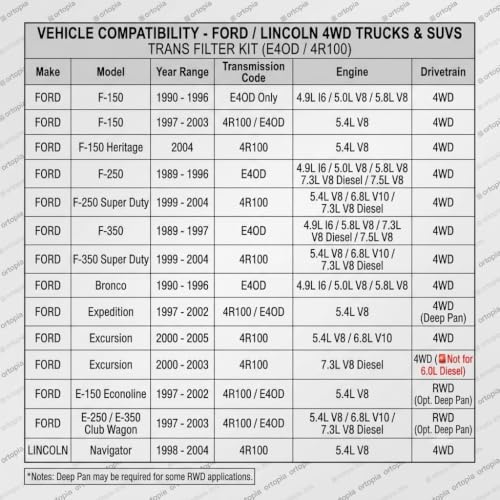
Our E4OD parts page has filter kits, rebuild kits, pumps and valve bodies sorted by year range, and our shop carries add-on coolers and cooler flush, with checkout on site.
FAQ
What causes an E4OD to overheat?
Usually slip in the torque converter, from a converter clutch that won't apply or is slipping, combined with low cooler flow from a restricted radiator tank cooler, a worn pump pressure regulator valve, or a stuck bypass on 1997 units. Low fluid, heavy loads and hunting between 3rd and overdrive make it worse.
What is code P1783 on an E4OD or 4R100?
Per ATSG, P1783 sets when transmission fluid temperature has exceeded 270 degrees F. Verify the TFT sensor reading against coolant temperature first, because a grounded TFT circuit reads over 300 degrees and can fake an overheat.
How much cooler flow should an E4OD have?
Sonnax's standard is at least one quart in 20 seconds at operating temperature for a transmission with 5/16-inch cooler lines, and most healthy units do a quart in about 10 seconds. On the E4OD, flow also rises when the converter clutch is commanded on, from about 1.2-1.4 gpm to 1.8-2.0 gpm per Transmission Digest.
How hot is too hot for an E4OD?
Ford lists 150-170 degrees F as normal operating temperature for checking the level. ATSG notes Ford set a 250 degree maximum during PTO operation, and P1783 sets at 270. If the fluid keeps climbing past the low 200s under load, the cooling is not keeping up.
Can a hot E4OD be saved with a fluid change?
A fluid and filter change on the 21,000-mile severe schedule helps prevent heat damage, but it won't fix the cause. If the converter clutch is slipping or cooler flow is low, find and fix that first, or the new fluid will burn too.
Related guides
- E4OD Towing Upgrades and Cooling
- E4OD Torque Converter Shudder
- E4OD Limp Mode Causes
- E4OD Won't Shift Into Overdrive
- E4OD Common Problems and Fixes
Sources
- ATSG (Automatic Transmission Service Group), Ford 4R100 Technical Service Information (2003). Backs the P1783 270 F definition, P0741 and P1744 TCC slip definitions, P0712/P0713 TFT circuit readings of 315 F and minus 40 F, P1711, the 150-170 F level check at idle in Park, the 250 F PTO limit and PTO disable, and the 55 psi EPC rise and coast clutch damage during PTO operation. https://atoc.ru/uploads/manual/5fb798e27b192.pdf
- Sonnax, Line-To-Lube Pressure Regulator Valve 36424-04K. Backs the worn OE regulator valve restricting converter charge and cooler flow, insufficient balance oil holding high line pressure, codes 62, 628 and 1744, the Reverse stall and overheated converter symptoms, and the F1/F5/F8/E9 pump fitment. https://www.sonnax.com/parts/2057-line-to-lube-pressure-regulator-valve
- Sonnax, Jeff Parlee, "Avoiding After-Overhaul Problems" (2008). Backs the one quart in 20 seconds minimum cooler flow for 5/16-inch lines, the 10-second typical rate, testing hot, the forward/back/forward flush sequence, flusher pressure being misleading, and the inline return-line filter. https://www.sonnax.com/tech_resources/99-avoiding-after-overhaul-problems
- Transmission Digest, Bob Warnke (Sonnax), "4R100: Repeated Converter Failure" (2006). Backs E4OD cooler flow of 1.2-1.4 gpm with the TCC released and 1.8-2.0 gpm at TCC command, the opposite 4R100 behavior, and the E4OD lacking an external pressure bypass. https://www.transmissiondigest.com/4r100-repeated-converter-failure/
- Sonnax, Cooler Bypass Valve Kit 36605-02K. Backs the 1997-later E4OD fitment, the sticking, spring and ball seat failures, the listed symptoms and codes 1783, 1741 and 1744, and the 70-75 psi cracking pressure. https://www.sonnax.com/parts/2078-cooler-bypass-valve-kit
- Sonnax, Front Lube/Drainback Valve Kit 36425-01K. Backs the plastic OE ball seat and seat stop melting at high fluid temperature, the restricted front lube feed and overdrive planetary failure, and the aluminum replacement parts. https://www.sonnax.com/parts/2067-front-lube-drainback-valve-kit
- Ford Motor Company, 1996 F-150/250/350 Owner Guide. Backs the 150-170 F level check, the 30-minute cool-down after towing, the power-braking stall warning, overdrive lockout when hunting, the 30,000-mile E4OD fluid change and the 21,000-mile severe-duty conditions. web.archive.org (archived Ford PDF; the fordservicecontent.com original now returns 403)
- Transmission Digest, Mike Steen (Certified Transmission), "Cooler Bypass" (2011). Backs the flusher pressure gauge showing a restricted cooler and thermal bypass valves not closing unless heated during a flush. https://www.transmissiondigest.com/cooler-bypass/
- Transmission Digest, Ed Lee (Sonnax), "4R100 Flow Issues" (2006). Backs the E4OD turbine hub bearing lube passages and the 4R100 inheriting the family's converter flow problems. https://www.transmissiondigest.com/4r100-flow-issues/