Most E4OD parts mistakes happen before anything is ordered. Somebody reads "E4OD" off an invoice, or sees 1994 on the registration, and orders by the truck's model year. The unit in the truck may be a 1996 swapped in from a salvage yard, or an early case with a late pump somebody bolted on, or not an E4OD at all. The E4OD ran from 1989 through 1997 with enough running changes that a 1989, a 1993 and a 1996 each take different parts in several places.
This is how I identify an E4OD on the bench or in the truck before I pick a kit, pump, solenoid block or valve body. It covers the outside tells that separate it from the C6, 4R70W and 4R100, the ID tag, and the casting numbers and hardware that tell you the year range when the tag is missing. Casting and part data are from Sonnax. The pump and drum interchange details are from Transmission Digest. The tag layout is from ATSG, and the lineup is from Ford's own owner guide. The full list is under Sources.
Step 1: Make sure it's an E4OD
Ford put several automatics behind the same engines in the same trucks. The 1996 F-150/250/350 owner guide lists three automatic transmissions for that model year: the three-speed C6, and two electronic four-speeds, the E4OD and the 4R70W. So "automatic F-250" doesn't settle it. Quick tells:
- C6. Three speeds and hydraulic control. There's no solenoid pack connector on the case and no overdrive section on the front of the case.
- 4R70W. A much smaller, lighter unit from the AOD family, used behind the smaller gas engines. Next to an E4OD it's clearly the smaller case.
- E4OD. A big, heavy unit with a case connector for the internal solenoid pack, and an overdrive section on the front of a case that looks a lot like a C6. The same 1996 guide makes the E4OD the only transmission in that truck line with a scheduled 30,000-mile fluid change, and lists it at 15.7 qt (4x2) and 16.2 qt (4x4).
- 4R100. The E4OD's 1998-up replacement looks nearly identical. ATSG's 4R100 manual shows the tells. There's a 12-pin digital transmission range (DTR) sensor at the manual lever, and on some units a cast-in PTO window on the left side of the case. Inside, ATSG says every 4R100 case, PTO or not, has a dam added to separate rear lube from a new central lube circuit. Transmission Digest adds that the 4R100 has an input speed sensor and the E4OD doesn't. Our 4R100 identification guide covers that unit in detail.
If it has no PTO window, no input speed sensor and no DTR sensor, you're looking at an E4OD. Now work out which one.
Step 2: Read the ID tag
The Ford ID tag is riveted to the left side of the case, toward the rear, near the range sensor and manual lever. Clean it with a rag and solvent before you try to read it. Road grime and paint marker make a 3 look like an 8.
ATSG's 4R100 manual lays out the Ford tag format that unit carries, and it's the best published guide to reading one. There are four lines plus a barcode:
| Line | What it is | ATSG example (4R100) |
|---|---|---|
| 1 | Assembly part number, prefix and suffix | XW4P-AC |
| 2 | Transmission model | RJL-B |
| 3 | Serial number | 004361 |
| 4 | Build date: year digit, month letter, day | BD-9C17 (March 17, 1999) |
On the build date line, the month letters run A for January through M for December, and there's no I, so September is J. The year is a single digit, so you need a rough idea of the decade. On an E4OD, a 9 means 1989, since there were no 1999 E4ODs. Write the whole tag down and keep it with the job. The build date matters more than the truck's model year, because units get swapped.
Two cautions. First, a salvage-yard unit often has a year written on it in paint marker, and that can be wrong. Second, tags fall off or get painted over during a rebuild. If the tag is gone or doesn't make sense, the castings and hardware below are more reliable anyway.
Step 3: The year ranges that actually change parts
For parts purposes, E4ODs split into four groups: 1989, 1990-94, 1995, and 1996-97 (with some late-style parts running into 1998). Here's what changes between them, per Sonnax's E4OD part listings:
| Component | 1989 | 1990-94 | 1995 | 1996-97/98 |
|---|---|---|---|---|
| Main valve body casting | E9 | F0 or F1 | F0 or F1 | F6 |
| Accumulator body casting | E9 | E9 | E9 | F6 |
| Pump casting / outer gear | E9, 11 lobes | E9 or F1, 11 lobes | F5, 10 lobes | F5 (F8 from 1998), 10 lobes |
| Solenoid block | Early (Sonnax 36424A-RRP, '89-'94) | Late (Sonnax 36424B-RRP, '95-'98 and 4R100 non-PWM) | ||
| Rear case bushing | 36008B ('89-'94) | 36008D or oversized 36008C ('95-later) | ||
Two things stand out. The valve body and the solenoid block don't change in the same year. A 1995 unit has an early-style F0/F1 valve body with a late-style solenoid block. And the pump changed in 1995 too. Transmission Digest notes that Ford increased E4OD pump output volume that year. So 1995 is its own case, not just the last year of the early units or the first year of the late ones.
Step 4: Valve body casting numbers
If the pan is off, this is the fastest way to find the year range. Sonnax's E4OD valve body identification chart reads the casting numbers on two parts, the main valve body and the accumulator body:
- 1989: main body E9, accumulator body E9. Sonnax reman valve body F041.
- 1990-95: main body F0 or F1, accumulator body E9. Sonnax reman F040.
- 1996-98: main body F6, accumulator body F6. Sonnax reman F042.
The codes line up with the years: E9 is a 1989 part and F6 is a 1996 part, which makes them a quick check against the tag. Sonnax's chart also shows that the lower valve body and the spacer plate differ between all three ranges, so a spacer plate from a different year range is not a shortcut. If you're replacing the valve body, match the casting you pull out. Our E4OD valve body guide covers testing the one you have.
Step 5: The pump, and why the lobe count matters
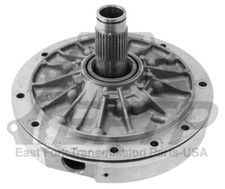
Pull the pump and look at the outer gear. Per Sonnax, E4OD pump castings before 1995 were marked E9 or F1 and had 11 lobes on the outer gear. Those castings had low pump output. Ford superseded them with the F5 casting in 1995 and the F8 casting in 1998, both with a 10-lobe outer gear. Sonnax's advice is to replace an E9 or F1 casting with an F5 or F8 casting instead of rebuilding it. Their drop-in gear set (36438A-03) fits F5 and F8 castings only.
The 1998 change adds a trap. Transmission Digest's Mike Riley explains that Ford went to one common pump body and cover casting, marked F81P, for three pump types: E4OD, 4R100 with on/off lockup, and 4R100 with PWM lockup. The F81P E4OD pump (Ford F81Z-7A103BA) retrofits as an assembly all the way back to 1989. That's a good upgrade, but only if you get the E4OD version. Since the casting number is the same, check two other things:
- Stator support. On an E4OD support, the coast clutch drum sealing rings sit toward the pump cover, which puts the drum bushing journal away from the cover. Every 4R100 support is the reverse, with the journal forward to carry the load of the PTO gear.
- TCC valve end plug. On an E4OD or non-PWM 4R100 pump, the end plug is more than an inch in from the pump cover outside diameter. On a PWM 4R100 pump it's recessed only about 1/4 in., because it's a long sleeve with a valve in it.
The article's rule is to use the solenoid block that matches the pump design. A PWM pump on an E4OD solenoid block is a lockup comeback waiting to happen.
Step 6: The solenoid block
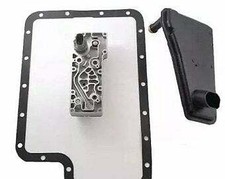
The E4OD solenoid pack sits inside the pan and plugs into the case connector. Sonnax splits it at 1995. The 36424A-RRP fits 1989-94 units. The 36424B-RRP fits late 1995-98 E4ODs and 1998-later non-PWM 4R100s. Match the block to the build year, or to the pump if someone has already installed a later one. Sonnax also notes a common OE failure in these blocks: fatigue in the ribbon cable inside the circuit assembly. Their remanufactured blocks use a printed circuit board to eliminate it. That's worth knowing if an intermittent solenoid code shows up on a unit that's otherwise healthy. Resistance checks are in our E4OD shift solenoid guide.
Step 7: Coast clutch drum and converter
The coast clutch drum is simple on an E4OD. Per Transmission Digest, the E4OD drum never changed. It's cast iron, with the support bushing toward the back of the bore and a non-selective thrust washer between the drum and the pump. If you find a stamped steel drum, it's a 4R100 part, and it takes different coast clutch steels with wider teeth.
The converter has its own tells, laid out by Sonnax's Ed Lee:
- Mounting pads. Early E4OD converter covers had round pads at the base of the studs, and those cracked and leaked around the stud. Later covers have a round pad with flats machined on the inboard and outboard sides. Most round-pad converters are already out of service. If you find one, don't reuse it.
- Cover interior. Late E4OD and 4R100 covers look the same outside. Inside, the E4OD cover is smooth and the 4R100 cover is grooved to hold a clutch. A 4R100 cover can be used to build an E4OD converter.
- Turbine bore. The E4OD turbine piloting bore is 2.765 in., the same as C4, C5, C6 and AOD. The 4R100 is 2.955 in.
- Stall. The impellers come in three vane angles: a 140 K-factor high stall (mostly small-block gas), a 105 K-factor low stall on the E4OD, and a 95 K-factor extra-low stall. Per Sonnax, putting an extra-low-stall converter in a low-stall application causes off-idle hesitation in a gas truck or turbo lag in a diesel.
All of these converters share the pilot diameter, flexplate bolt circle, overall height and 31-spline input, so they bolt in whether they're right or not. Make sure the one going in matches the engine the truck actually has.
The checklist before you order
- Confirm it's an E4OD: no DTR sensor, no PTO window, no input speed sensor.
- Write down the full ID tag and decode the build date.
- If the pan's off, read the main valve body and accumulator body castings (E9/E9, F0-F1/E9 or F6/F6).
- If the pump's out, count the outer gear lobes (11 = E9/F1, replace; 10 = F5/F8). On an F81P pump, check the stator support and the TCC end plug depth.
- Match the solenoid block to the year range (1989-94 or 1995-98) and to the pump.
- Look at the converter's mounting pads and confirm the stall matches the engine.
- Order the kit by the build year you found, not by the truck's title.
If what you find doesn't agree, like a 1992 tag with an F6 valve body, somebody has been inside the unit before. Identify every part separately and order to match what's actually there. The 4R100 vs E4OD comparison covers the 1998-up parts that turn up in rebuilt E4ODs.
Shop the part for this fix: late E4OD solenoid block, 1995-97
If your tag or castings put the unit in the 1995-97 range, this is the late-style solenoid block pack it takes. Early 1989-94 units need the early block.
See the 1995-97 solenoid block at CoreTransmissionPartsNeed parts for this job?
Our E4OD parts page lists kits, pumps, solenoid blocks and valve bodies by year range, with checkout on site. Once you've matched the tag and castings, order by that year range.
FAQ
How do I tell what year my E4OD is?
Start with the build date on the Ford ID tag on the left side of the case. If the tag is missing, read the casting numbers on the main valve body and accumulator body. Per Sonnax, E9/E9 is 1989, F0 or F1 with an E9 accumulator body is 1990-95, and F6/F6 is 1996-98.
How can I tell an E4OD from a 4R100?
The 4R100 has a 12-pin digital transmission range sensor, an input speed sensor the E4OD lacks, and on some units a PTO window on the left side of the case. Inside, the 4R100 stator support seal rings are reversed and its converter cover is grooved for a clutch, while the E4OD cover is smooth.
Which E4OD pump is better, 11-lobe or 10-lobe?
The 10-lobe pump. Sonnax says the pre-1995 E9 and F1 castings with an 11-lobe outer gear had low pump output, and recommends replacing them with a 10-lobe F5 or F8 casting. Transmission Digest notes the 1998 F81P E4OD pump, F81Z-7A103BA, retrofits back to 1989.
Are 1989-94 and 1995-98 E4OD solenoid blocks interchangeable?
No. Sonnax lists 36424A-RRP for 1989-94 units and 36424B-RRP for 1995-98 E4ODs and non-PWM 4R100s. Match the block to the build year, and to the pump if a later pump has been installed.
Is a 1995 E4OD early or late?
It's a mix. A 1995 unit uses the early-style F0 or F1 valve body with the late-style solenoid block, and it got the higher-output F5 pump. Order its parts by component, not by assuming it's all early or all late.
Related guides
- E4OD Gear Ratios and Specs
- 4R100 Identification Guide
- 4R100 vs E4OD: Differences and Interchange
- E4OD Valve Body Symptoms and Testing
- E4OD Shift Solenoid Symptoms
- E4OD Rebuild Cost and What Drives It
Sources
- Sonnax, "Ford E4OD Valve Body Identification." Backs the main valve body and accumulator body casting numbers by year (E9/E9 1989, F0-F1/E9 1990-95, F6/F6 1996-98), the F041/F040/F042 reman part numbers, and the lower valve body and spacer plate differences. https://www.sonnax.com/tech_resources/251-ford-e4od-valve-body-identification
- Sonnax, Pump Gear Set 36438A-03. Backs the pre-1995 E9/F1 pump castings with 11-lobe outer gears and low output, the F5 (1995) and F8 (1998) 10-lobe castings, the advice to replace E9/F1 castings, and the gear set fitting F5/F8 only. https://www.sonnax.com/parts/4514-pump-gear-set
- Sonnax, Remanufactured Solenoid Block 36424A-RRP. Backs the 1989-94 E4OD solenoid block fitment and the OE ribbon cable fatigue failure. https://www.sonnax.com/parts/2064-remanufactured-solenoid-block
- Sonnax, Remanufactured Solenoid Block 36424B-RRP. Backs the late 1995-98 E4OD and 1998-later non-PWM 4R100 fitment. https://www.sonnax.com/parts/2065-remanufactured-solenoid-block
- Sonnax, Ford E4OD unit parts directory. Backs the rear case bushing split (36008B for 1989-94, 36008D and oversized 36008C for 1995-later). https://www.sonnax.com/units/352-e4od
- Sonnax, Ed Lee, "Identifying Converter Components: 6 Key Features to Understand in Ford E4OD, 4R100 & 5R110W." Backs the round vs flatted mounting pads, smooth E4OD vs grooved 4R100 cover, 2.765 in. vs 2.955 in. turbine bore, the 140/105/95 K-factor impellers and the shared converter dimensions. https://www.sonnax.com/tech_resources/626-identifying-converter-components-6-key-features-to-understand-in-ford-e4od-4r100-5r110w
- Transmission Digest, Mike Riley, "E4OD/4R100 Component Upgrade: Mix and Match Is Not an Option" (2014). Backs the 1995 pump volume increase, the 1998 F81P common pump casting, F81Z-7A103BA retrofitting to 1989, the stator support and TCC end plug identification, matching the solenoid block to the pump, and the unchanged cast iron E4OD coast clutch drum. https://www.transmissiondigest.com/e4od-4r100-component-upgrade-mix-and-match-is-not-an-option/
- ATSG, Ford 4R100 Technical Service Information manual (2003). Backs the four-line Ford ID tag layout and build date decode, the 12-pin DTR sensor, the PTO window, and the dam added to all 4R100 cases for central lube. https://atoc.ru/uploads/manual/5fb798e27b192.pdf
- Ford Motor Company, "1996 F-150/250/350 Owner Guide." Backs the C6, E4OD and 4R70W automatic lineup, the E4OD-only 30,000-mile fluid change note, and the 15.7/16.2 qt E4OD capacity. 1996 F-150/250/350 Owner Guide (archived PDF)