The E4OD is the electronic four-speed Ford put behind its big truck engines starting in 1989: the 5.8L, the 7.5L gas V-8, and the 7.3L IDI and Power Stroke diesels in F-Series pickups, Broncos and Econoline vans. It replaced the C6, kept the C6's 31-spline converter hub, and added an overdrive section, a lockup converter and full PCM control. When one of these is on the bench, or a customer wants to know why the truck turns 2,000 rpm at 65, these are the numbers you need.
Everything below comes from ATRA's E4OD/4R100 quick reference and its published gear ratio chart, Sonnax's identification guides for the converter and valve body, Ford's 1996 RV and trailer towing guide, and the unit notes from US Shift, who build standalone controllers for this transmission. Sources are at the bottom.
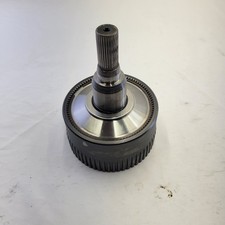
E4OD gear ratios
The E4OD's ratios are the same ones Ford carried into the 4R100, which ATRA's gear ratio chart in GEARS magazine lists as 2.71, 1.54, 1.00, 0.71 and 2.18 reverse. US Shift lists the same four forward ratios for the E4OD itself. They do not change with the engine: a 5.8L gas truck and a 7.3L diesel get the same gearbox ratios, and Ford tuned the truck with axle gears instead.
| Gear | Ratio | Step from previous gear |
|---|---|---|
| 1st | 2.71:1 | — |
| 2nd | 1.54:1 | 1.76x |
| 3rd | 1.00:1 (direct) | 1.54x |
| 4th (overdrive) | 0.71:1 | 1.41x |
| Reverse | 2.18:1 | — |
Compare that to the C6 it replaced. The same ATRA chart lists the C6 at 2.46, 1.46, 1.00 and 2.18 reverse. So the E4OD got a deeper 1st gear, a slightly shorter 2nd, the same reverse, and a 0.71 overdrive the C6 never had. The total spread (1st divided by 4th) is about 3.8. That is narrow by modern standards, and the biggest step in the box is the 1-2 shift at 1.76x, which is the shift that takes the most abuse when a loaded truck pulls away from a light.
Reverse at 2.18 is lower than 2nd but nowhere near 1st. Backing a heavy trailer up a driveway loads the reverse clutches harder than most owners expect.
What is applied in each gear
The gear train is three simple planetary sets: the overdrive set up front and the forward and reverse sets behind it. ATRA's clutch and band application chart shows what has to hold for each ratio. "Holding" here means a one-way clutch is doing the work.
| Gear (selector) | Applied | One-way clutches holding |
|---|---|---|
| Reverse (R) | Coast, direct, low/reverse clutches | Overdrive |
| 1st (D) | Forward clutch (coast clutch with TCS on) | Overdrive, low/reverse |
| 2nd (D) | Forward, intermediate clutches (coast with TCS on) | Overdrive, intermediate |
| 3rd (D) | Forward, direct clutches (intermediate applied but ineffective) | Overdrive |
| 4th (D) | Overdrive, forward, direct clutches (intermediate applied but ineffective) | None |
| Manual 3rd (TCS on) | Coast, forward, direct clutches | Overdrive |
| Manual 2nd (2 or 1) | Intermediate band, coast, intermediate, forward clutches | Overdrive, intermediate |
| Manual 1st (1) | Coast, forward, low/reverse clutches | Overdrive, low/reverse |
Use it as a diagnosis chart. Drive 1st needs only the forward clutch and the low/reverse one-way clutch, so a slip in 1st that goes away in Manual 1 points at that one-way clutch, because Manual 1 applies the low/reverse clutch instead. 2nd in Drive depends on the intermediate one-way clutch holding; Manual 2 adds the intermediate band, so a slip in D2 that goes away in manual 2nd points at the sprag. 4th is the only gear with no one-way clutch holding and the overdrive clutch applied, so a slip or flare only on the 3-4 shift puts you in the overdrive section. The coast clutch is what gives you engine braking whenever the TCS (overdrive cancel) is on or you are in a manual range.
Solenoid pattern and failsafe
The E4OD has two shift solenoids (SS1, also called A, and SS2, also called B), a torque converter clutch solenoid, a coast clutch solenoid and the EPC solenoid that sets line pressure. ATRA's solenoid sequence chart:
| Commanded gear (D) | SS1 (A) | SS2 (B) | Coast clutch solenoid |
|---|---|---|---|
| Park / Reverse / Neutral | On | Off | Off |
| 1st | On | Off | Off |
| 2nd | On | On | Off |
| 3rd | Off | On | Off |
| 4th | Off | Off | Off |
With the TCS button pressed, the unit runs 1st through 3rd on the same SS1/SS2 pattern and the coast clutch solenoid is always on. In Manual 1 the coast clutch solenoid is on and SS1 on, SS2 off gives 1st. The TCC solenoid is PCM controlled in the forward gears.
The failsafe is worth memorizing. With both shift solenoids off, the pattern is 4th gear, so an E4OD that loses solenoid power starts out in 4th in Drive. ATRA's "actual gear obtained" tables for a failed solenoid also show the manual 2 and 1 positions landing in 2nd when SS1 is dead. A truck that takes off like it is in a high gear and never shifts is usually an electrical problem, not a hard-parts one. Check the solenoid feed and fuse before you pull the pan.
Line pressure specs
The line pressure tap is on the side of the case. ATRA's pressure chart:
| Range | Idle | Stall |
|---|---|---|
| Park, Neutral | 50-65 psi | n/a |
| Reverse | 70-100 psi | 245-290 psi |
| Overdrive, 2 | 50-65 psi | 165-185 psi |
| Manual 1 | 70-100 psi | 175-210 psi |
Reverse and Manual 1 run higher because both use the low/reverse clutch to hold the reaction load of a low gear. If Reverse at stall will not climb well above the Drive number, the boost circuit is the first suspect.
Fluid temperature sensor values
The TFT sensor tells the PCM when to change shift timing and lockup for a cold or hot unit. A sensor stuck at a cold reading can hold off lockup and overdrive. ATRA's chart:
| Fluid temperature | Resistance |
|---|---|
| 32-58 F (0-20 C) | 100K-37K ohms |
| 59-104 F (21-40 C) | 37K-16K ohms |
| 105-158 F (41-70 C) | 16K-5K ohms |
| 159-194 F (71-90 C) | 5K-2.7K ohms |
| 195-230 F (91-110 C) | 2.7K-1.5K ohms |
| 231-266 F (111-130 C) | 1.5K-0.8K ohms |
Physical specs, fluid and converter
- Weight: about 270 lb dry with the converter, aluminum case (US Shift).
- Fluid: about 18 quarts total with the converter, and US Shift lists MERCON V. A pan drop gives back only part of that, because the converter and cooler stay full. Set the final level hot on the dipstick, never by the number.
- Converter: Sonnax says every E4OD, 4R100 and 5R110W converter shares the pilot diameter, the flexplate bolt circle, the overall height, 31 input splines (the same as a C6) and the stator splines. The E4OD turbine bore is 2.765 inch, against 2.955 inch on the 4R100, so a 4R100 converter is not a drop-in on an E4OD input shaft.
- Stall: Sonnax lists an E4OD-only high-stall impeller at a 140 K-factor and an E4OD low-stall at 105. Early E4OD covers used round mounting pads that were prone to cracking; later covers have flat-machined pads.
Year changes that affect specs
Ratios did not change over the run, but plenty else did. Sonnax dates the valve body by casting number: 1989 units have an E9 main valve body and E9 accumulator body, 1990-95 units have an F0 or F1 main body with the E9 accumulator body, and 1996-98 units have F6 on both. The lower valve body and spacer plate changed at the same breaks, so parts are not interchangeable across them.
US Shift adds two electrical changes that catch people. E4ODs built before 1995 used a range sensor (MLPS) that was not weatherproof enough, so water got into the connector and corroded the pins. And not every E4OD has a speedometer drive gear: in 1992 Ford started using the rear differential speed sensor instead, so check what the truck has before you order a tailshaft housing or sensor. The 4R100 that followed added a dedicated output shaft speed sensor and a PWM converter clutch solenoid.
Shop the part for this fix: E4OD/4R100 hard parts at CoreTransmissionParts
Planetary carriers, one-way clutches, drums and rebuild kits for the E4OD and the 4R100 that followed it. Match your year and valve body casting before you order.
Browse E4OD/4R100 parts at CoreTransmissionPartsWhat the ratios mean at the axle
The transmission ratio times the axle ratio is what the tires see. Ford's 1996 RV and trailer towing guide lists automatic F-Series trucks on 3.55 and 4.10 axles for the 7.3L diesel and the 7.5L gas V-8, and those two axles cover most of the E4OD trucks you will see. The overall ratios work out like this:
| Axle | 1st (2.71) | 2nd (1.54) | 3rd (1.00) | 4th (0.71) | Reverse (2.18) |
|---|---|---|---|---|---|
| 3.55 | 9.62 | 5.47 | 3.55 | 2.52 | 7.74 |
| 4.10 | 11.11 | 6.31 | 4.10 | 2.91 | 8.94 |
The axle choice changed Ford's ratings a lot. In that guide, the 7.3L diesel with the automatic is rated at 16,000 lb GCWR on a 3.55 and 20,000 lb on a 4.10. The 7.5L gas V-8 goes from 15,000 lb on a 3.55 to 18,500 lb on a 4.10. Taller gears mean more time with the converter unlocked and more heat in the transmission, so a truck on 3.55s pulling near its limit is the one that cooks E4ODs.
For cruise rpm with the converter locked in 4th, use rpm = mph x axle x 0.71 x 336 / tire diameter in inches. On a 31.7 inch tire at 65 mph, a 3.55 axle turns about 1,740 rpm and a 4.10 about 2,010 rpm. With overdrive cancelled (3rd, 1.00), those numbers jump to about 2,450 and 2,830 rpm. If the truck is running on bigger tires than stock, redo the math and recalibrate the speedometer, because the PCM schedules shifts off vehicle speed.
Need parts for this job?
Our E4OD parts page has planetaries, sprags, drums, pumps, valve bodies and master rebuild kits sorted by year range, all on our own checkout. Know your year and valve body casting before you order.
FAQ
What are the E4OD gear ratios?
1st is 2.71:1, 2nd is 1.54:1, 3rd is 1.00:1 (direct), 4th (overdrive) is 0.71:1 and reverse is 2.18:1. These are the same ratios Ford carried into the 4R100, as listed in ATRA's gear ratio chart, and they do not change with the engine.
Does the E4OD have the same gear ratios as the C6?
No. ATRA lists the C6 at 2.46, 1.46, 1.00 and 2.18 reverse. The E4OD has a deeper 2.71 first gear, a 1.54 second, the same 2.18 reverse, and adds a 0.71 overdrive the C6 never had.
Are the E4OD and 4R100 gear ratios the same?
Yes, both are 2.71, 1.54, 1.00, 0.71 with a 2.18 reverse. Many parts are not interchangeable, though. Sonnax lists the E4OD turbine bore at 2.765 inch against 2.955 inch on the 4R100, so the converters do not swap.
How much fluid does an E4OD hold?
US Shift lists about 18 quarts total with the converter, using MERCON V. A pan and filter service only drains part of that because the converter and cooler stay full, so set the final level hot on the dipstick.
What rpm does an E4OD truck turn at 65 mph?
With the converter locked in 4th (0.71) and a 31.7 inch tire, a 3.55 axle turns about 1,740 rpm and a 4.10 about 2,010 rpm. Use rpm = mph x axle x 0.71 x 336 / tire diameter for your own setup.
Related guides
- 4R100 vs E4OD: Differences
- E4OD Identification Guide
- E4OD Fluid Type and Capacity
- E4OD Towing Upgrades and Cooling
- E4OD Shift Solenoid Symptoms
- 4R100 Gear Ratios and Specs
Sources
- ATRA, E4OD/4R100 Quick Reference (2009). Backs the clutch and band application chart by gear, the solenoid sequence chart and the dead-solenoid "actual gear obtained" tables, the line pressure specs (P/N 50-65 psi idle; R 70-100 idle, 245-290 stall; OD/2 50-65 idle, 165-185 stall; 1 70-100 idle, 175-210 stall), and the fluid temperature sensor resistance table. https://atracom.blob.core.windows.net/bulletins/quick/ford/e4od/e4od_quick_ref.pdf
- ATRA, GEARS magazine, "Gear Ratios" reference chart, January/February 2006, pages 58-60. Backs the 2.71, 1.54, 1.00, 0.71 and 2.18 reverse ratios listed for the 4R100, and the C6 at 2.46, 1.46, 1.00 and 2.18 reverse. https://atracom.blob.core.windows.net/bulletins/quick/2006-01_58.pdf
- Sonnax, Ed Lee, "Identifying Converter Components: 6 Key Features to Understand in Ford E4OD, 4R100 & 5R110W." Backs the shared pilot, bolt circle, height, 31 input splines and stator splines, the 2.765 inch E4OD versus 2.955 inch 4R100 turbine bore, the 140 and 105 K-factor E4OD impellers, and the round versus flat mounting pads. https://www.sonnax.com/tech_resources/626-identifying-converter-components-6-key-features-to-understand-in-ford-e4od-4r100-5r110w
- Sonnax, "Ford E4OD Valve Body Identification." Backs the main valve body and accumulator body casting numbers by year (E9/E9 1989, F0-F1/E9 1990-95, F6/F6 1996-98) and the lower valve body and spacer plate changes. https://www.sonnax.com/tech_resources/251-ford-e4od-valve-body-identification
- Ford Motor Company, 1996 Recreation Vehicle and Trailer Towing Guide. Backs the automatic F-Series GCWR ratings by engine and axle (7.3L diesel 16,000 lb on 3.55 and 20,000 lb on 4.10; 7.5L gas 15,000 lb on 3.55 and 18,500 lb on 4.10). https://xr793.com/wp-content/uploads/2022/12/1996-Ford-Recreation-Vehicle-Trailer-Towing-Guide.pdf
- US Shift, "Ford E4OD / 4R100 Control and Swap Info." Backs the E4OD forward ratios, the 1989-97 production run with 1997 as the transition year, the 270 lb dry weight with converter, the 18 quart MERCON V total capacity, the pre-1995 range sensor corrosion, the 1992 switch to the differential speed sensor, and the 4R100's added output shaft speed sensor and PWM TCC solenoid. https://www.usshift.com/e4od.shtml