You drop the shifter into Drive or Reverse, the engine rpm sags a little, and nothing happens. One second, two seconds, sometimes more, and then the truck lurches into gear. On an E4OD that pause is the transmission telling you a clutch is not getting pressure fast enough, and the good news is that it also tells you where to look. The E4OD uses different clutches for Drive and Reverse, so the range the delay shows up in narrows the list in about thirty seconds.
Everything below is built on ATRA's E4OD/4R100 quick reference (the clutch application chart, the line pressure chart and the pressure-test diagnosis tree), Transmission Digest's write-up on the 1989-95 delayed reverse, and Sonnax's parts engineering notes on the worn bores and leaking circuits that cause it. Sources are at the bottom.

What has to apply before the truck moves
ATRA's clutch and band application chart for the E4OD shows exactly what the hydraulics have to fill in each range:
| Range | Applied | Holding |
|---|---|---|
| Drive, 1st | Forward clutch (coast clutch also applied when overdrive is cancelled) | Overdrive one-way clutch, low/reverse one-way clutch |
| Reverse | Coast clutch, direct clutch, low/reverse clutch | Overdrive one-way clutch |
| Manual 1 | Coast clutch, forward clutch, low/reverse clutch | Overdrive one-way clutch |
Drive engagement is one clutch: the forward clutch. The one-way clutches do the rest. Reverse needs three clutches to fill, and they have to fill in the right order. That difference is why a truck can engage Drive instantly and sit there for two seconds in Reverse, or the other way around.
Sort it by range first
Warm the truck up and do the engagement test in a consistent way: foot on the brake, engine at a normal hot idle, shift from Neutral to Drive, back to Neutral, then Neutral to Reverse. Count the delay each time. Then try Manual 1, because it uses the forward clutch and the low/reverse clutch together. Our rule of thumb on the bench: a healthy E4OD engages about as fast as you can move the lever. Anything you can count out loud is a problem.
- Delayed in Drive and Reverse: something common to every circuit. Fluid level, filter, pump, main regulator and boost valve.
- Delayed in Drive only: the forward clutch circuit. The center support, the forward clutch piston and seals, or the valve body.
- Delayed in Reverse only: the reverse circuit. The low/reverse modulator valve, manual valve bore, direct or low/reverse clutch, coast clutch, or the separator plate.
- Delayed when cold, fine when hot (or the other way): usually hardened seals when it is cold-only, and wear that leaks more as the fluid thins when it is hot-only.
Step 1: fluid level and condition
This sounds basic, but low fluid is the first item on ATRA's list for low line pressure in every range, and an E4OD that is a quart or two low will pull air at the filter when you shift and the fluid sloshes. Check it hot, engine running, in Park, on level ground. This is a high-capacity unit, so a couple of quarts low does not look like much on the stick, but it is plenty to starve the pump.
Ford originally specified MERCON for the E4OD. Straight MERCON is no longer sold, and Motorcraft's MERCON V product sheet says to use MERCON V in transmissions previously serviced with MERCON. Do not top it off with MERCON LV or Type F. While you are under there, smell the fluid and look at the pan. Heavy friction material in the pan with a delay usually means the clutch that is slow to apply is already burning.
Step 2: put a gauge on it
The E4OD has a line pressure tap on the side of the case, near the ID tag. ATRA's pressure chart gives these specs:
| Range | Idle | Stall |
|---|---|---|
| Park, Neutral | 50-65 psi | n/a |
| Reverse | 70-100 psi | 245-290 psi |
| Overdrive, 2 | 50-65 psi | 165-185 psi |
| Manual 1 | 70-100 psi | 175-210 psi |
Line pressure alone does not show everything, because a leak downstream of the tap (a bad clutch seal or sealing ring) can read normal at the tap and still delay the apply. But a reading that is low tells you plenty, and ATRA's diagnosis tree lays out what each pattern means:
- Low at idle in all positions: low fluid, a restricted inlet filter, a loose main control, solenoid body or accumulator body, excessive leakage in the pump, case or control bodies, a sticking main regulator valve, a damaged inlet tube seal on the filter, or damaged gaskets or separator plate.
- Low only in D: forward clutch or valve body.
- Low only in R: separator reinforcing plate, coast clutch, low/reverse clutch or direct clutch, valve bodies.
- Low only in 1: forward clutch, low/reverse clutch or coast clutch, valve body.
- High at idle in all positions: main regulator valve, solenoid body and wiring harness. Run the electrical quick test before you touch hardware.
Also watch how pressure rises in Reverse and at stall. Reverse should jump well above Drive. If it does not, the boost circuit is suspect (more on that below).
Delayed in every range: filter, pump and boost valve
The filter comes first because it is cheap. A clogged filter or a torn or rolled inlet tube seal at the pump bore lets the pump suck air instead of fluid, and the delay tends to get worse as the truck warms up and after hard stops. Replace the filter and the seal together, and make sure the seal is fully seated in the case bore.
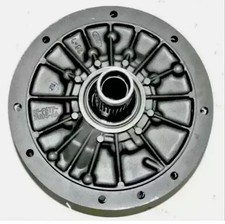
If the filter is fresh and pressure is still low in every range, look at the pump and the pressure regulator. On high-mileage units, worn pump gear pockets and a scored pump body are common, and the pump loses volume at idle first, which is exactly when you are trying to engage a gear. The boost valve is the other common one. Sonnax's engineering note on boost valve kit 36424-01K says E4OD and 4R100 units frequently have poor line rise and soft shifts caused by severe wear of the pressure regulator boost sleeve, which lets EPC and Reverse boost oil leak. That leak robs the pressure increase the transmission counts on to fill the Reverse clutches quickly, so a worn sleeve often shows up as a slow Reverse first and a soft everything else later.
Delayed in Drive: the forward clutch and the center support
When Drive is slow and Reverse is fine, the forward clutch is not filling. On an E4OD there are two main places that oil gets lost.
Center support leakage
Forward clutch oil passes through the center support. Sonnax traced a lot of forward clutch failures to leakage between the center support and its hub, caused by an insufficient number and staggered spacing of the mounting screws plus surface finish flaws and flatness defects. Their fix is a gasket with a printed silicone bead that fills those gaps (part 36743G). If you have the unit apart for a forward clutch, deal with the center support at the same time or you will be back.
Forward clutch piston and seals
Sonnax lists a replacement forward clutch piston (36434A) for burnt forward clutch conditions, and a delayed Drive engagement is how a lot of those burnt clutches start. A cracked or distorted piston or a hardened lip seal lets apply oil escape, the clutch fills slowly, and it slips each time it engages until the frictions are gone. Air check the forward clutch on the bench. It should apply with a firm, clean thump and hold air without a hiss.
Also check the sealing rings on the parts that feed the forward drum, and the bushings under them. A worn bushing lets the shaft move, the rings lose their seal on the bore, and the leak gets worse as the fluid heats up.
Shop the part for this fix: Sonnax center support gasket 36743G
The printed-bead gasket that seals the E4OD/4R100 center support to its hub, the leak Sonnax ties to forward clutch failure and poor lube. Cheap insurance on any forward clutch job.
See the center support gasket at CoreTransmissionPartsDelayed in Reverse: timing and the manual valve
The 1989-95 delayed bang into Reverse
Transmission Digest covered this one in its June 2003 issue: 1989-95 E4OD trucks, before or after an overhaul, can show a delayed bang shift into Reverse. The cause is a weak low/reverse modulating valve spring, which throws off the timing between the direct clutch and the low/reverse clutch. If the direct clutch applies first, the geartrain starts to turn, and when the low/reverse clutch finally comes on it stops it with a bang. The fix they published is a low/reverse modulating valve spring with double the tension (Superior sells it as a "no bang" engagement spring, K043), which puts the low/reverse clutch back in sequence with the direct clutch.
Two cautions from that article. The spring change is for 1989-95 units only, because Ford changed the low/reverse modulator hydraulics for 1996 E4ODs and the 4R100. And there are three different low/reverse modulator valve line-ups, so identify what is in the valve body before you order parts.
Manual valve bore wear
Sonnax says Reverse problems on the E4OD and 4R100 are often a direct result of wear and scoring of the valve body bore by the OE manual valve. Their oversized manual valve kit (36947-13K) is aimed at delayed Reverse, Reverse slip and low/reverse clutch failure, and it requires reaming the bore with their tool kit. Sonnax designed its valve with an extra support spool for the Park and Reverse positions, where the valve is pulled furthest out of the bore, so check the bore wear at that end with the valve body on the bench.
Clutch leaks and the separator plate
If the valve body checks good, go back to ATRA's list for low pressure in Reverse: the coast clutch, the direct clutch, the low/reverse clutch, and the separator reinforcing plate. Air check each clutch through the case with the valve body off. A loose or missing reinforcing plate lets the separator plate flex and cross-leak, so check that every bolt is present and torqued.
Do not skip the electronics
The E4OD sets line pressure with the EPC solenoid. If pressure is wrong in every range, ATRA points you at the main regulator valve, the solenoid body and the wiring harness, and tells you to run the quick test. A PCM that sees a bad throttle position or MAF signal can command the wrong EPC pressure, and an EPC circuit fault on these trucks usually shows up as a harsh engagement rather than a delay, so make sure you are not chasing a harsh-shift problem when you think it is a delay. Pull codes, including continuous memory on 1989-95 EEC-IV trucks, before you pull the pan.
The fix, in order
- Sort by range: Drive, Reverse, Manual 1, cold and hot.
- Check fluid level and condition hot, and use MERCON V.
- Pull codes and run the quick test.
- Pressure test at the line pressure tap and compare to ATRA's chart.
- All ranges low: filter and inlet seal, then boost valve and pump.
- Drive only: center support gasket and shim, forward clutch piston, seals and sealing rings.
- Reverse only: low/reverse modulator spring on 1989-95 units, manual valve bore, then the Reverse clutches and separator plate.
Need parts for this job?
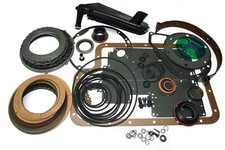
Our E4OD parts page has filter kits, pumps, valve bodies and master rebuild kits sorted by year range, all on our own checkout.
FAQ
Why does my E4OD take a few seconds to go into gear?
The clutch for that range is not getting pressure fast enough. Drive uses only the forward clutch, while Reverse needs the coast, direct and low/reverse clutches, so note which range is slow. Check the fluid level hot first, then put a gauge on the line pressure tap and compare to ATRA's spec of 50-65 psi at idle in Drive and 70-100 psi in Reverse.
What causes delayed reverse in an E4OD?
On 1989-95 units, Transmission Digest traced a delayed bang into Reverse to a weak low/reverse modulating valve spring that lets the direct clutch apply before the low/reverse clutch. Other common causes are manual valve bore wear, a worn boost valve sleeve leaking Reverse boost oil, and leaks in the coast, direct or low/reverse clutch circuits.
What causes delayed engagement into Drive on an E4OD?
Drive engagement depends on the forward clutch. The usual leaks are between the center support and its hub, which Sonnax ties to too few, unevenly spaced mounting screws and flatness defects, and a cracked forward clutch piston or hardened seals. A delay in Drive that gets worse over time usually ends in a burnt forward clutch.
Can low fluid cause delayed engagement in an E4OD?
Yes. Low fluid is the first item on ATRA's list for low line pressure in every range. Check it hot, running, in Park on level ground, and top off with MERCON V, which Motorcraft says to use in transmissions previously serviced with MERCON.
Related guides
- E4OD No Reverse: Causes and Fix
- E4OD Slipping: Causes and Fix
- E4OD Harsh Shift Causes and Fix
- E4OD Pressure Control (EPC) Solenoid Symptoms
- E4OD Fluid Type and Capacity
Sources
- ATRA, E4OD/4R100 Quick Reference (2009). Backs the clutch and band application chart (forward clutch in Drive 1st; coast, direct and low/reverse clutches in Reverse; coast, forward and low/reverse in Manual 1), the line pressure spec table (P/N 50-65 psi idle; R 70-100 idle, 245-290 stall; OD/2 50-65 idle, 165-185 stall; 1 70-100 idle, 175-210 stall), the line pressure tap location, and the low/high pressure diagnosis tree by range. https://atracom.blob.core.windows.net/bulletins/quick/ford/e4od/e4od_quick_ref.pdf
- Transmission Digest, Tech/Talk, June 2003 issue. Backs the 1989-95 E4OD delayed bang shift into Reverse, the weak low/reverse modulating valve spring and direct vs low/reverse clutch timing, the double-tension spring fix (Superior K043), the 1989-95-only note, the three valve line-ups and the 1996/4R100 hydraulic change. https://www.transmissiondigest.com/june-2003-issue/
- Sonnax, Center Support Gasket 36743G. Backs the leakage between center support and hub causing forward clutch failure and poor lube flow, the mounting screw and flatness causes, and the printed silicone bead fix for E4OD/4R100. https://www.sonnax.com/parts/2081-center-support-gasket
- Sonnax, Oversized Manual Valve Kit 36947-13K. Backs Reverse problems from manual valve bore wear and scoring, and the delayed Reverse, Reverse slip and low/reverse clutch failure the kit addresses in a reamed bore. https://www.sonnax.com/parts/2103-oversized-manual-valve-kit
- Sonnax, Boost Valve Kit 36424-01K. Backs poor line rise and soft shifts on E4OD/4R100 caused by pressure regulator boost sleeve wear leaking EPC and Reverse boost oil. https://www.sonnax.com/parts/2055-boost-valve-kit
- Ford Motorcraft, MERCON V Automatic Transmission Fluid product details. Backs using MERCON V in transmissions previously serviced with MERCON, and not using it where MERCON LV or Type F is specified. https://fcsdchemicalsandlubricants.com/products/transmission-fluid/productdetails?id=2