The 5R110W TorqShift arrived for the 2003 model year in F-Series trucks and the Excursion behind the 6.0L diesel, and it is best understood as a heavily reworked 4R100. It is a five-speed that actually carries six forward ratios, because the shift schedule changes with fluid temperature. Mechanically it is a strong unit. What sends it to the bench is a short, repeatable list: a snap ring that walks out of the case, a direct clutch that gets abused by line pressure, two bores in the pump that wear, a manual valve that goes soft, and a cooling and filtration circuit that Ford redesigned mid-life in a way that catches rebuilders who do not check which version is in front of them.
This is that list in the order the failures actually happen, with the part numbers, bore specs and diagnostic values that settle each one. The single most expensive mistake on this unit is not a wear item at all — it is putting the wrong pump or the wrong solenoid body into the wrong model year. So that is where we start.
ATSG 5R110W TorqShift Rebuild Manual
The full teardown, clutch clearance and hydraulic reference for the unit. If you build these regularly, this is the book that lives on the bench.
See the manual →
Before you order anything: identify which build you have
There are three separate version splits inside this family, and they do not line up with each other. Sort all three before a single part goes on the order sheet.
Split 1: pressure switches (through late 2004)
Early solenoid bodies carry five normally closed pressure switches, one per shift pressure control solenoid, each designed to open when that solenoid's control pressure exceeds 40 psi. Here is the part most techs do not know: the PCM on these vehicles was never programmed to monitor those switches at all, and Ford deleted them in late 2004. Later solenoid bodies may carry a single switch with no wire attached, functioning purely as a plug, with the remaining four holes cast over. Sonnax documents this and points to Ford Special Service Message 17614 for the detail.
What that means on the bench: a reman solenoid body built to the late design, with a plug where the switch was, drops into an early one-switch or five-switch truck without a problem. Leave the switch wiring in position and simply do not connect it. You are not defeating a monitor, because there never was one.
It also means the classic early TorqShift complaint has a clean fix. The rubber boot on the back of those pressure switches ruptures and dumps solenoid control pressure, which reads on the road as a shift concern with no obvious electrical fault. Sonnax sells an o-ringed end plug kit, 36940-17K, that fits any of the five locations.
Split 2: the cooler filtration system (2008)
From launch, the 5R110W used a bypass filtration design rather than a conventional inline cooler filter. Most of the cooler oil routes around the filter, and a small share — roughly 10 percent — is forced through a small orifice into a screw-on element that looks like a roll of toilet paper, then returned to the rear lube circuit. Over a few thousand miles, all the fluid gets cleaned to that level.
Beginning in 2008 Ford started deleting that external bypass system in favor of a redesigned sump filter. Transmission Digest technical editor Mike Riley documented what the change did to cold-weather durability: the later non-bypass units became susceptible to failure of the low-diode one-way clutch, which is a bigger deal on this unit than it sounds, because that OWC is made to the rear planetary.
Split 3: the pump (two service numbers, three casting generations)
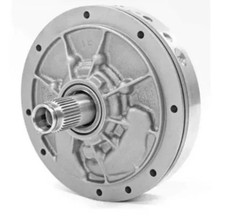
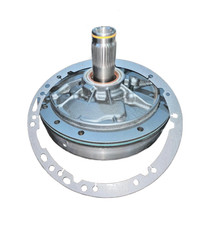
Ford released two pumps to cover the filtration change, and they are not interchangeable:
- 9C3Z-7A103A — for models using the external filter-bypass system. This one retrofits all the way back to 2003.
- 9C3Z-7A103B — for applications without the external bypass. Identify it by the production number 9C3P-7A103AC etched into the machined front face of the pump.
The pump bodies are the same. The difference is in the cover: the non-bypass cover has a notch cut into one worm track so oil can cross at all times, which is what maintains lube flow at extreme low temperature. That small notch is the whole fix. Installing the non-bypass pump into a truck that still has the factory external bypass filter is the error to avoid.
Separately, Sonnax notes that three pump generations were produced with different casting hardness. That matters if you are reaming the pressure regulator bore, because the reamer has to be matched to the casting or you ruin both the finish and the tool. Sonnax carbide tool kit F-36940-TL3C is the one rated for all generations.
How this unit controls itself: no shift valves
You cannot diagnose a TorqShift with 4R100 habits. The control valve body was completely redesigned. There is a solenoid and a pressure switch dedicated to each clutch pack except the forward clutch, which is controlled by the manual valve, and there are no shuttle or shift valves in the solenoid body beyond the manual valve and an overpressurization relief ball. Every shift is commanded directly by a variable force solenoid. That is why solenoid testing or replacement is not optional on a rebuild: there is no valve downstream to mask a lazy solenoid.
Seven variable force solenoids do the work, and three of them run backwards from the other four. Getting this table wrong will send you chasing a wiring fault that does not exist:
| Solenoid | Controls | Pressure vs. current |
|---|---|---|
| SSPC-A | Coast clutch | Inversely proportional |
| SSPC-B | Overdrive clutch | Directly proportional |
| SSPC-C | Intermediate clutch | Directly proportional |
| SSPC-D | Direct clutch | Inversely proportional |
| SSPC-E | Low/reverse clutch | Directly proportional |
| TCC | Torque converter clutch | Directly proportional |
| EPC / PC-A | Line pressure | Inversely proportional |
Current varies between 0 and 1 amp. On the directly proportional solenoids, 1 amp equals maximum pressure in that circuit. On the inversely proportional ones — coast, direct and line pressure — 0 amp equals maximum pressure. So a line pressure solenoid that has gone open circuit does not give you low pressure. It gives you maximum pressure, harsh engagements and burnt clutches. Same story with an accelerator pedal position sensor failure: the PCM deliberately defaults to higher than normal line pressure to protect the unit, and the customer complains about harsh upshifts and harsh engagements.
Ratios are 3.09 in 1st, 2.20 in 2nd, 1.54 in 3rd, 1.00 in 5th and 0.71 in 6th. Below -15°C (5°F) the transmission enters cold mode, applies the overdrive clutch in 3rd to produce a 1.09 fourth gear, and shifts 4th straight to 6th. In hot mode it runs 1-2-3-5-6. A customer reporting that "it shifts different when it is cold out" is describing normal operation, not a fault.
Wear point 1: the low/reverse retaining ring
This is the failure that turns a clutch job into a case. The low/reverse retaining ring pops out of its groove in the case, producing slipping in reverse and severe damage to the case lugs on the way out. The complaint pattern is reverse slip, no reverse, or no manual first.
The OE ring simply does not carry enough outward tension. Sonnax 36885 is a wider ring with increased tension and stiffness that stays seated in the groove. On a unit that is already apart, this is a cheap part that prevents a scrapped case, and it belongs in every build regardless of what the old ring looked like. Inspect the case lugs carefully while you are in there — a ring that has been walking leaves witness marks before it lets go completely.
Wear point 2: the direct clutch
The direct clutch pack takes the abuse on this unit, and the failure is usually a pressure problem wearing a mechanical mask. The bottom clutch plate bends, clamping force drops, and the pack cooks. On the road it presents as a 3-5 shift complaint: flare, or flare followed by a bang.
Two Sonnax parts address the mechanical side — heavy duty direct clutch backing plate 36965-03 at .240 in. (6.10 mm) thick, and high capacity direct clutch apply piston kit 36965-01K. But installing them without fixing the hydraulics behind them is how you build a comeback, which brings us to the most useful piece of field data in this article.
An ATRA Gears case study on a 2006 F-350 with the 6.0L is worth reading in full. The customer arrived complaining of a 2-3 slip; a prior rebuild, two different transmissions and two different PCMs had already been thrown at it. Scan data recorded during the road test showed the actual fault was a 3-5 shift, not 2-3. Line pressure was captured with a transducer on the main line pressure port, and the number every builder should know came out of it: the PCM raises line pressure to 175 psi during every shift, and during the 3-5 flare it went higher still because engine RPM and fluid volume were up. The unit contained an aftermarket kit producing higher than stock line pressure, aftermarket direct clutches, a molded piston and non-factory fluid. The fix was the direct drum molded piston, factory-spec direct clutches and the correct fluid. The flare disappeared.
Two lessons for the bench. First, get a pressure transducer on the line pressure port and record PIDs on a road test before you pull the unit, because the gear the customer names is frequently not the gear that is failing. Second, stacking a shift kit on top of a modified engine can put more pressure into the direct clutch than the pack was ever designed to hold.
Wear point 3: the pressure regulator bore in the pump
Pump body pressure regulator bore wear is the quiet one, because it degrades several circuits at once. As the bore deteriorates, the valve can no longer provide higher line pressure as fluid is pulled into the suction port, and critical line pressure exhausts past the excess valve-to-bore clearance. The PR valve also meters flow entering the converter and lube circuits, so wear there cuts cooler flow at the same time it drops line pressure.
The symptom set is low line pressure plus torque converter clutch concerns, commonly with codes P1744 and P1783. Sonnax oversized pressure regulator valve kit 36940-03K restores valve-to-bore clearance and salvages the pump body. Note the tooling requirement: an oversized base plate VB-06 has to be mounted to the VB-FIX fixture to accommodate the 5R110W pump body, and carbide tool kit F-36940-TL3C is the one that works across all three pump generations.
While the pump is apart, check the bushing. Sonnax pump bushing 36002-01 is a finish-in-place steel-backed bronze bushing, 0.695 in. wide, for a 1.996 in. shaft diameter in a 2.124 in. housing bore. Excess converter hub to bushing clearance shows up as a leaking front seal, pump noise and low pump volume.
Wear point 4: the converter pressure limit valve
On 2005 and later units, bore wear at the converter pressure limit valve prevents accurate TCC pressure control. The symptom list is broad and easy to misread as a converter problem: erratic apply pressure, soft or harsh TCC apply, TCC slip, TCC lining failure, overheating and codes including P0741. In extreme cases pressure climbs far enough to balloon the converter.
Sonnax drop-in kit 36940-06K repairs it, but read the fitment note carefully because it is a real trap: it replaces OE valves with a .298 in. or.312 in. diameter balance spool only, and is not compatible with.402 in. diameter valves. Measure before you order. If the TCC complaint is cycling and slip with code P1783 or P0741, also look at the TCC control plunger valve, addressed by kit 36940-01K.
Sonnax specifies vacuum testing at the indicated ports as the go/no-go: if the bore fails to hold the recommended minimum in-Hg, or wear is visible, it needs the repair. Vacuum testing a valve body is not optional on this unit, given how much of the shift quality lives in the pump and how little of it lives in valves.
Ford 5R110W TorqShift 7-Piece Shift Solenoid Set
A full set of the seven variable force solenoids for the TorqShift solenoid body. With no shift valves downstream to cover for a marginal solenoid, this is a replace-as-a-set item on any rebuild.
See the solenoid set →Wear point 5: the manual valve
Delayed engagement into drive and reverse on a TorqShift is very often a worn manual valve, not a pump or a clutch. Because the forward clutch is fed directly through the manual valve rather than through a solenoid, wear there shows up as a delay you can feel at every engagement, and it can drag line pressure down as well.
Sonnax offers a straight replacement, 36940-22, which fits all 5R110W units and covers OE valves with or without holes in the long spool. If the casting bore itself is worn, the oversized manual valve 36940-11 with tool kit F-36940-TL11 recovers a valve body that would otherwise be scrap.
Wear point 6: the cooling and filtration circuit
This is the wear point that lives outside the transmission and destroys the work you did inside it. Any debris left in the cooler system will migrate back into the unit and straight into the solenoids, which on this transmission are doing all the shifting with no valves to protect them. Ford's own position is that the oil-to-air cooler in front of the radiator should be replaced as part of any overhaul or exchange, and specifically that you should not try to back-flush and clean it.
The cold-weather side of the same circuit deserves attention on any unit going into a cold climate. Fluid can gel in a radiator tank or cooler line and cut off lubrication entirely, and where a cooler-line thermal bypass is fitted, it needs to come apart, get cleaned and be verified free. A job done in October at 50 degrees comes back on a hook in January at 20 below.
Need parts for this job?
Rebuild kits, solenoid sets, filters, pans, hard parts and the bench tooling for the Ford 5R110W TorqShift, all in one place.
Shop 5R110 parts →Fluid and service intervals
The 5R110W launched requiring Mercon SP, which is not interchangeable with Mercon or Mercon V. Ford's warning at the time was blunt: using any fluid other than Mercon SP can result in abnormal operation and/or transmission failure. Mercon SP has since gone out of production and Ford issued service supersessions for it, so do not guess and do not substitute a generic multi-vehicle ATF on the strength of a forum post. Confirm the current Motorcraft supersession for your VIN at the parts counter before you fill. It is worth remembering that the ATRA case study above found non-factory fluid in a truck that had already been through two transmissions.
Ford's service interval for this unit is fluid and bottom pan filter every 30,000 miles (48,000 km) regardless of normal or severe operating conditions, and on bypass-equipped trucks the remote cooler-line filter gets replaced at every service as well. That is an aggressive interval by modern standards, and it is one of the reasons a maintained TorqShift lasts.
After the rebuild: the relearn nobody does
Any time the battery is disconnected, a PCM is installed, or the calibration is reflashed, the adaptive strategy for the engagement schedule has to be updated or the customer comes back complaining about firm or harsh engagement. The procedure is short:
- Connect a scan tool and monitor transmission fluid temperature.
- Warm the fluid to 54°C (130°F) as indicated by the TFT PID.
- Perform five engagements Park to Reverse, five seconds apart.
- Five engagements Drive to Reverse, five seconds apart.
- Five engagements Reverse to Drive, five seconds apart.
- Five engagements Neutral to Drive, five seconds apart.
All four sets have to be performed for the engagement pressures to adapt correctly. Ten minutes on the lift is cheaper than a comeback.
Which upgrades are actually worth the money
Ranked by return per dollar on a truck that works for a living rather than one that goes to shows:
- Low/reverse retaining ring 36885. The cheapest insurance against a destroyed case in the entire build. There is no argument against it.
- Full solenoid replacement. No shift valves means no margin for a marginal solenoid. Reman EPC solenoid 36940E-RRP covers the line pressure circuit if you are replacing individually.
- Pressure regulator bore repair 36940-03K, if it tests bad. Fixing line pressure and cooler flow at the source protects everything downstream, including the clutches you just installed.
- Direct clutch package: backing plate 36965-03 plus apply piston kit 36965-01K. Worth it on any truck that tows, and effectively mandatory on anything with engine power added — but only after the line pressure question is answered.
- Heavy duty input shaft 36670-HD. For high-torque applications. This part is shared across E4OD, 4R100 and 5R110W.
- An inline cooler filter on the return line. On non-bypass units especially, this is the last line of defense between cooler debris and seven solenoids.
What is conspicuously absent from that list is a generic shift kit. On a transmission where the PCM already commands 175 psi on every shift and the direct clutch is the known casualty, raising pressure further without understanding why is how the 3-5 flare gets built in at the bench.
The short version
Identify the pressure switch version, the filtration version and the pump generation before ordering. Put the wider low/reverse snap ring in every build. Vacuum test the pressure regulator and converter pressure limit bores rather than assuming the pump is fine. Replace the solenoids as a set, because nothing downstream will cover for them. Diagnose a 3-5 complaint with a pressure transducer and recorded PIDs before pulling the unit, because it gets reported as a 2-3 problem. Replace the cooler instead of flushing it. Confirm the current fluid supersession rather than substituting. Then do the engagement relearn before the truck leaves.
Sources
- Transmission Digest — "Ford 5R110W (TorqShift)," Dale England, October 2004. Backs the 2003 introduction in F-Series and Excursion with the 6.0L diesel and the unit's origin as a redesigned 4R100; the gear ratios of 3.09, 2.20, 1.54, 1.00 and 0.71 with the 1.09 fourth gear in cold mode; cold mode below -15°C (5°F) with the 4th-to-6th shift and the hot mode 1-2-3-5-6 pattern; the seven variable force solenoids, five normally closed pressure switches opening above 40 psi, and the absence of shift or shuttle valves in the solenoid body; the directly and inversely proportional solenoid behavior across 0 to 1 amp; the accelerator pedal position sensor failure raising line pressure and causing harsh upshifts; the Mercon SP requirement and its non-interchangeability with Mercon and Mercon V; the 30,000 mile (48,000 km) fluid and bottom pan filter interval regardless of operating conditions; the bypass remote filter passing roughly 10 percent of flow; the instruction to replace rather than back-flush the oil-to-air cooler at overhaul; and the full engagement adaptive relearn procedure at 54°C (130°F). transmissiondigest.com
- Transmission Digest — "5R110W Lubrication Concern (Warm weather – no problem, but winter's coming)," Mike Riley, Technical Editor, December 2014. Backs the bypass cooler filtration design used from 2003 and its replacement by a redesigned sump filter beginning in 2008; the resulting low-diode one-way clutch failure and that the OWC is made to the rear planetary; pump service numbers 9C3Z-7A103A for filter-bypass models retrofitting back to 2003 and 9C3Z-7A103B for non-bypass applications; the 9C3P-7A103AC production number etched into the pump front face; the pump cover worm-track notch that maintains lube crossflow at all temperatures; the warning against fitting the non-bypass pump to a bypass-equipped vehicle; and the cold-weather fluid gelling and thermal bypass inspection guidance. transmissiondigest.com
- Sonnax — "5R110W Solenoid Identification & Functions," Valve Body Xpress, January 2013. Backs the full solenoid table used above: SSPC-A coast clutch (inversely proportional), SSPC-B overdrive (directly proportional), SSPC-C intermediate (directly proportional), SSPC-D direct clutch (inversely proportional), SSPC-E low/reverse (directly proportional), TCC (directly proportional) and EPC/PC-A line pressure (inversely proportional), along with the clutch application chart by gear. sonnax.com
- Sonnax — "5R110W Pressure Switches Notice," Valve Body Xpress, January 2013. Backs the one-versus-five pressure switch variation by model year; that the vehicle computer was never programmed to monitor the pressure switches; Ford's removal of them in late 2004; the later solenoid body carrying a single unwired switch used only as a plug with the remaining four holes cast over; the interchangeability of a late-design solenoid body into early applications with the switch wiring left in place and disconnected; and the reference to Ford Special Service Message 17614. sonnax.com
- Sonnax — Ford 5R110W transmission parts catalog and unit page. Backs every part number and specification cited: oversized pressure regulator valve kit 36940-03K with the VB-06 base plate requirement, the three pump generations of differing casting hardness and the F-36940-TL3C carbide tool kit rated for all of them, and the P1744/P1783 low line pressure and TCC symptom set; converter pressure limit valve kit 36940-06K for 2005-later units with the.298 in. and.312 in. balance spool fitment, the.402 in. incompatibility, and its TCC symptom list including converter ballooning; TCC control plunger valve kit 36940-01K with codes P1783 and P0741; low/reverse retaining ring 36885 of increased width and tension curing case damage, reverse slip, no reverse and no manual first; heavy duty direct clutch backing plate 36965-03 at.240 in. (6.10 mm); high capacity direct clutch apply piston kit 36965-01K; heavy duty input shaft 36670-HD shared with E4OD and 4R100; manual valve 36940-22 and oversized manual valve 36940-11 for delayed drive and reverse; pressure switch o-ringed end plug kit 36940-17K; reman EPC solenoid 36940E-RRP; pump bushing 36002-01 at 0.695 in. width, 1.996 in. shaft diameter and 2.124 in. housing bore; and the vacuum-test pass/fail criterion. sonnax.com
- Gears Magazine (ATRA) — "Case Study of a 2006 Ford F-350 5R110W Transmission, 2-3 Flair," Jesse Zacarias. Backs the field data on the 6.0L F-350 with a reported 2-3 slip that recorded PIDs proved to be a 3-5 shift fault; the PCM raising line pressure to 175 psi during each shift and higher during the 3-5 flare; the SSPC-C and SSPC-D circuit testing method and their directly and inversely proportional behavior; and the root cause of an aftermarket kit raising line pressure above stock combined with aftermarket direct clutches, a molded piston and non-factory fluid, corrected by returning to the factory-spec direct clutches, direct drum molded piston and correct fluid. gearsmagazine.com