The 5R110W does not have a valve body in the sense you are used to. Ford calls it a solenoid body, and that is not marketing. There are no shift valves in it. Apart from the manual valve and an overpressurization relief ball, every clutch apply and release rate in this transmission is metered directly by a solenoid. That one design decision changes how you diagnose it: on a 4R100 a bad shift could be a stuck valve or a lazy solenoid, but on a TorqShift, if a clutch is applying wrong, the solenoid is either the problem or is being lied to.
Which is exactly why so many complete solenoid sets get thrown at these trucks. This is how to narrow it to the one that is actually bad, and how to tell a dead solenoid from a dead circuit.
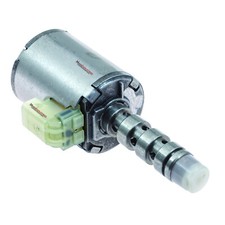
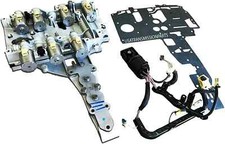
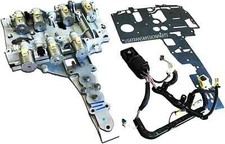
Seven solenoids, and which clutch each one owns
The solenoid body carries seven variable-force solenoids, the transmission fluid temperature sensor, the manual valve, the relief ball, and depending on year, up to five pressure switches. Each clutch pack gets its own dedicated solenoid, except the forward clutch, which is applied straight through the manual valve. Memorize this table, because every code you are about to read refers to it by letter:
| Solenoid | Controls | Pressure vs. current |
|---|---|---|
| PC-A (EPC) | Line pressure | Inversely proportional |
| SSPC-A | Coast clutch | Inversely proportional |
| SSPC-B | Overdrive clutch | Directly proportional |
| SSPC-C | Intermediate clutch | Directly proportional |
| SSPC-D | Direct clutch | Inversely proportional |
| SSPC-E | Low/reverse clutch | Directly proportional |
| TCC | Torque converter clutch | Directly proportional |
Directly proportional means the PCM drives it from 0 to 1 amp and 1 amp equals maximum pressure in that circuit. Inversely proportional means 0 amp equals maximum pressure. That distinction matters on the bench and it matters when you are staring at a scan tool: a directly proportional solenoid that has lost its command sends no oil, while an inversely proportional solenoid that has lost its command sends full oil. A dead SSPC-D circuit does not release the direct clutch. It slams it on.
This transmission also runs six forward ratios out of five speeds depending on fluid temperature, so one bad solenoid can produce a strange-sounding complaint. Below roughly 5°F as read by the TFT sensor, the cold shift schedule engages the overdrive clutch in 3rd to produce a 1.09 ratio in 4th, then jumps 4th straight to 6th. Hot mode runs 1st, 2nd, 3rd, 5th and 6th. So "it skips a gear when it is cold" may be correct behavior, and "it will not skip 4th anymore" can be a TFT fault rather than a solenoid fault. Read TFT before anything else.
The codes, and what they are actually telling you
Two families of code show up on solenoid complaints, and they mean very different things.
P07xx electrical and performance codes point at the solenoid circuit itself. Wayne Colonna documented a 2005 F-350 6.0L in Transmission Digest that stored P0753 (Pressure Control Solenoid A, electrical fault) and later P0752 (stuck on) and P0973 (circuit low). Every one of those reads like a bad PC-A solenoid. The actual cause was that the water-in-fuel sensor in the fuel/water separator was leaking, diesel had wicked up the C138E harness, and the PCM on the driver-side inner fender had about a pint of fuel inside it. The PCM had to be replaced along with the sensor. That is worth carrying around in your head: on the 6.0L, a full spread of pressure control codes deserves a look at the C138E connector before it deserves a parts order.
P2700 through P2704 are the apply-time codes, and they follow the same A-through-E element lettering as the SSPC solenoids. They set when a friction element takes too long to apply to zero clearance. P2702 is "Transmission Friction Element C Apply Time Range/Performance," which is the intermediate clutch circuit, meaning that when 2nd is commanded, the controller never sees the correct 2nd gear ratio. P2701 is element B, the overdrive clutch.
| Code | Element | Clutch | Solenoid on the hook |
|---|---|---|---|
| P2700 | A | Coast | SSPC-A |
| P2701 | B | Overdrive | SSPC-B |
| P2702 | C | Intermediate | SSPC-C |
| P2703 | D | Direct | SSPC-D |
| P2704 | E | Low/reverse | SSPC-E |
An apply-time code is a hydraulic statement, not an electrical one. The solenoid can be perfectly good electrically and still fail this test, which is the whole reason resistance alone will not clear you.
The stem crimp: the failure nobody looks for
Pete Luban of ATSG published a case in Transmission Digest on a late-model F-250 diesel storing P2702, with a delay into Drive (Reverse had no delay), a flared 1-2 shift, limp mode and a flashing Tow/Haul lamp. The pan looked clean for the mileage. Being a later unit, it had no intermediate pressure switch to interrogate. When the tech pulled the SSPC-C solenoid, the solenoid body and its stem came out of the bore as two pieces.
The stem on these solenoids is held to the body by nothing but evenly spaced crimps. When that joint lets go, the second-clutch circuit leaks internally, the clutch never reaches zero clearance in time, and you get P2702 plus a delay and a flare. Luban noted that on a shelf of used 5R110W solenoids he could pull a stem out of one by hand with enough effort.
Make it standard procedure: as each solenoid comes out, grip the body in one hand and the stem in the other and try to work them apart. A stem that has any movement at the crimp is scrap regardless of what the ohmmeter says.
Bench testing: read the snout, then read the ohms
The solenoids all look alike, and they are keyed differently in the body specifically so you cannot install them in the wrong bore. But once they are in a tray, you need the ID marks. Jarad Warren laid this out in ATRA's Gears magazine, and it is the fastest way to sort a pile of 5R110 solenoids:
- Hold the solenoid with the snout toward you and the connector at the top. The lines on each side of the snout are the ID.
- Marks centered on the snout, stepped back: PC-A, the line pressure solenoid. Inversely proportional.
- Marks low, below center, stepped back: SSPC-A and SSPC-D. Inversely proportional.
- Marks high, above center, flat back: TCC, SSPC-B, SSPC-C and SSPC-E. Directly proportional.
Then the electrical check. Per Gears, all seven solenoids should read around 4.5 ohms. That is one number to remember for the whole set, which makes the sweep quick. Anything wildly off, open, or shorted comes out. Anything at 4.5 ohms is still a suspect, because the failure modes on this unit are mechanical.
The mechanical check is a shake test. Warren's procedure is worth doing before you buy anything:
- Pull the plastic cap off the end of the solenoid with pliers.
- Do not touch the adjustment at the tip of the snout. The solenoid is calibrated there. Removing the adjuster or the valve without a solenoid or valve body test machine to recalibrate it makes the solenoid junk.
- Bend the four tabs out with a screwdriver, just far enough to pull the snout off. The valve lives in the snout.
- Shake the snout. You should hear and feel the valve move freely. If it does not move, you have confirmed the fault without guessing.
- Most stuck valves free up with solvent and air, blowing the valve back and forth until it shuttles cleanly. Then pull the plunger and coil out of the can, wash everything, reassemble with the plunger tapered end into the can, and bend the four tabs back.
Do one solenoid at a time so plungers and snouts do not get mixed between units. A full set takes about half an hour once you have done a few, and on this transmission that half hour is a real line item off the parts list.
Ford 5R110W TorqShift 7-Piece Shift Solenoid Set
When the shake test or the crimp check condemns them, this is the complete seven-solenoid set for the 5R110W solenoid body — PC-A, TCC and SSPC-A through E.
View the solenoid set →Pressure switches: know what year you are looking at
Early 5R110W solenoid bodies carried five normally closed pressure switches, one per shift solenoid circuit, designed to open when shift solenoid control pressure exceeds 40 psi. PS-A was coast, PS-B overdrive, PS-C intermediate, PS-D direct, PS-E low/reverse, and all five interchange.
Here is the part that saves you a diagnostic rabbit hole: the computer on these vehicles was never programmed to monitor the pressure switches, and Ford removed them in late 2004. Later bodies may carry a single pressure switch with no wire to it, used purely as a plug, with the other four holes cast over. Sonnax points to Ford Special Service Message 17614 for the detail. Their remanufactured solenoid body, F05R110, ships with no switches at all and a plug where the last one was, and it drops into early one-switch and five-switch applications — leave the switch wiring in place and unconnected.
So do not chase a pressure switch code on a 5R110W, and do not assume a missing switch is a missing part. The one thing the switches did give you was a leak path: the rubber boot on the back of an original switch is a known rupture point, and that is a pressure loss in a shift solenoid control circuit that will read as a solenoid complaint. Plug kits exist for exactly that reason.
When it is not the solenoid at all
Two traps worth knowing before you condemn a solenoid on a rebuilt unit.
Missing clutch B bleed filter. Colonna documented a 5R110W with no access to 2nd or 6th gear setting P0732 (gear ratio error in 2nd), P0756 (B or overdrive clutch solenoid stuck off) and P2701 (B clutch apply time out of range). That is three codes all pointing at SSPC-B. The actual cause was that the clutch B bleed filter was missing from a remanufactured pump. The filter is non-serviceable, so the pump cover has to be replaced — see ATSG bulletin 19-37 for pump cover to pump body interchangeability. Do not plug the filter hole with a solid plug or a substitute filter, because that causes 1-2 and 5-6 shift abnormalities of its own.
The inline filter. These trucks have a remote filter in addition to the sump filter, and it feeds the solenoids. The first design was a canister with a replaceable element, used from the start of production into the 2006 model year. From roughly 12-18-06 onward it became a sealed, non-serviceable assembly under the bellhousing, Ford part number 7C3Z-7B155-B, which has to be replaced outright. Cut an old one open sometime. Whatever that filter has been holding back is what your new solenoids get to eat if you skip it, and these solenoids are not forgiving of debris.
Fluid and the post-repair relearn
The 5R110W was released requiring MERCON SP, which is not interchangeable with MERCON or MERCON V, and Ford's original service interval was fluid and bottom-pan filter every 30,000 miles regardless of duty cycle. Ford later authorized MERCON LV for this family, but the supersession has been muddled by secondhand retellings, so pull the current fluid callout for the exact VIN out of Ford's own service information rather than trusting a forum post or this page. I am not going to print a fill spec I cannot source.
The step people skip is the adaptive relearn. Any time the battery has been disconnected, the PCM replaced, or the calibration reflashed, the engagement schedule adaptive strategy has to be relearned or the customer comes back complaining about harsh engagements. Ford's procedure:
- Monitor TFT on a scan tool and warm the fluid to 130°F (54°C).
- Five Park-to-Reverse engagements, five seconds apart.
- Five Drive-to-Reverse engagements, five seconds apart.
- Five Reverse-to-Drive engagements, five seconds apart.
- Five Neutral-to-Drive engagements, five seconds apart.
All four sets have to be done for engagement pressures to adapt correctly.
One tool note
A divided parts tray and a small ultrasonic bath pay for themselves on the first set you clean instead of replace. Small bench ultrasonic cleaners cost less than two 5R110 solenoids.
Need parts for this job?
Solenoid sets, filter kits, coolers, rebuild manuals and overhaul parts for the Ford 5R110 TorqShift — the parts that fix what the bench test actually found.
Shop 5R110 parts →The short version
Read TFT first, because the 5R110W's shift pattern legitimately changes with fluid temperature. Sort the solenoids by the snout ID marks, sweep them all for roughly 4.5 ohms, then do the two mechanical checks the meter cannot do: pull on the stem to find a failed crimp, and shake the snout to find a stuck valve. Treat P2700 through P2704 as apply-time faults in element A through E, matching SSPC-A through E. Ignore pressure switch theories, because the computer never watched them and Ford deleted them in late 2004. And on a unit that was recently rebuilt with a reman pump, check for the clutch B bleed filter before you blame SSPC-B for a missing 2nd and 6th.
Sources
- Sonnax — "5R110W Solenoid Identification & Functions." Backs the complete solenoid function table used above: SSPC-A controlling the coast clutch (inversely proportional), SSPC-B the overdrive clutch (directly proportional), SSPC-C the intermediate clutch (directly proportional), SSPC-D the direct clutch (inversely proportional), SSPC-E the low/reverse clutch (directly proportional), TCC the torque converter clutch (directly proportional), and EPC/PC-A line pressure (inversely proportional). sonnax.com
- Sonnax — "5R110W Pressure Switches Notice." Backs the statement that original solenoid bodies carried one or five pressure switches depending on model year; that the computer on these vehicles was never programmed to monitor the pressure switches; that Ford removed them in late 2004; that the later body may carry a single unwired switch used only as a plug with the remaining four holes cast over; that the remanufactured solenoid body F05R110 ships without switches and works in early one- and five-switch applications with the switch wiring left unconnected; and the reference to Ford Special Service Message 17614. sonnax.com
- Transmission Digest — "Ford 5R110W ('TorqShift')," Dale England, October 1, 2004. Backs the solenoid body containing seven variable-force solenoids, five normally closed pressure switches, the TFT sensor, the manual valve and an overpressurization relief ball with no other valves present; a dedicated solenoid per clutch pack except the forward clutch, which is controlled by the manual valve; the 0 to 1 amp drive range with 1 amp equalling maximum pressure on directly proportional solenoids and 0 amp equalling maximum pressure on inversely proportional solenoids; the pressure switches opening above 40 psi and the PS-A through PS-E clutch assignments; the solenoids being keyed to prevent misassembly; the cold-mode shift schedule below -15°C (5°F) producing a 1.09 fourth-gear ratio and a 4-6 shift versus the hot-mode 1-2-3-5-6 pattern; the MERCON SP requirement and its non-interchangeability with MERCON and MERCON V; the 30,000 mile fluid and bottom-pan filter interval; and the full battery-disconnect adaptive relearn procedure at 54°C (130°F) with four sets of five engagements five seconds apart. transmissiondigest.com
- Transmission Digest — "What the …!," Pete Luban, ATSG, September 1, 2010. Backs the P2702 case on a late-model Ford diesel F-250 with delay into Drive, no delay in Reverse, a flared 1-2 shift, limp mode and a flashing Tow/Haul lamp; the definition of P2702 as "Transmission Friction Element C Apply Time Range/Performance" and its meaning that the controller does not see the correct second-gear ratio when second is commanded; the SSPC-C solenoid body separating from its stem, which is retained only by equally spaced crimps, causing a leak in the second-clutch circuit; the recommendation to check solenoid body to stem fit as standard procedure; and the remote inline filter history — serviceable canister design from start of production into 2006, replaced by the sealed non-serviceable assembly under the bellhousing, part number 7C3Z-7B155-B, used from around 12-18-06. transmissiondigest.com
- Transmission Digest — "Ford 5R110W without second or sixth gear," Wayne Colonna, October 31, 2024. Backs the no-2nd-and-6th-gear complaint setting P0732 gear ratio error in second, P0756 B or overdrive clutch solenoid stuck off and P2701 B clutch apply time out of range; the cause being a missing clutch B bleed filter in a remanufactured pump; the bleed filter being non-serviceable so the pump cover must be replaced; the reference to ATSG bulletin 19-37 for pump cover to pump body interchangeability; and the warning not to plug the filter hole with a solid plug or substitute filter because it can cause 1-2 and 5-6 shift abnormalities. transmissiondigest.com
- ATRA / Gears Magazine — "Ford 5R110: Money in Your Pocket," Jarad Warren, May 25, 2017. Backs the snout ID mark system for sorting solenoids — marks centered with a stepped back for PC-A, marks below center with a stepped back for SSPC-A and SSPC-D, marks above center with a flat back for TCC, SSPC-B, SSPC-C and SSPC-E; the approximately 4.5 ohm resistance specification for all solenoids; the warning never to disturb the calibration adjustment at the tip of the snout without a valve body or solenoid test machine; the full disassembly sequence of removing the plastic cap, bending the four tabs and removing the snout to shake-test the valve; the solvent-and-air cleaning method for a stuck valve; reassembly with the plunger tapered end facing into the can; the recommendation to do one solenoid at a time to avoid mixing plungers and snouts; and the roughly thirty minutes required to clean a full set. gearsmagazine.com
- Transmission Digest — "Dealing with PCM fault codes on the Ford 5R110W," Wayne Colonna, January 23, 2023. Backs the 2005 Ford F-350 6.0L diesel case storing P0753 Pressure Control Solenoid A electrical fault and P2700 Transmission Friction Element A apply time out of range, later adding P0752 Pressure Control Solenoid A stuck on and P0973 Pressure Control Solenoid A circuit low; the cause being diesel fuel from a leaking water-in-fuel sensor wicking up the C138E harness into the PCM mounted on the driver-side inner fender; and the correction requiring PCM and water-in-fuel sensor replacement. transmissiondigest.com