"TCC lockup" gets thrown around a lot in diagnostic conversations without much explanation of what's actually happening inside the converter, or why a 4R75W that shudders at 45 mph and one that won't lock up at all point at completely different parts. Both complaints trace back to the same mechanism -- the torque converter clutch -- but the fix for one is a fifteen-dollar solenoid and the fix for the other is a valve buried in the valve body casting. Knowing which is which before the car comes apart saves a lot of wasted labor.
What TCC Lockup Actually Does
A torque converter normally drives the transmission through fluid -- the engine-driven pump pushes ATF against the turbine, and there's always some slip between the two, which is exactly how a converter multiplies torque off idle. That slip also makes heat and costs fuel once the vehicle is cruising and torque multiplication isn't needed anymore. The torque converter clutch is a friction disc mounted to the turbine that, when the PCM commands it, gets clamped directly against the converter cover by hydraulic pressure. Once it's clamped, the pump and turbine spin as one solid piece -- no more slip, no more converter heat, and a direct mechanical path from the engine to the gearset. That's the entire point of lockup: it only matters at steady cruise, which is why nearly every shudder complaint tied to TCC shows up in a narrow speed window rather than at idle or under hard acceleration.
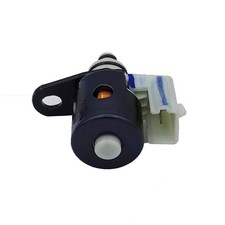
On the 4R70W/4R75W family, the hydraulic circuit that controls this has two players working together: a TCC solenoid that the PCM switches to direct oil toward the apply side of the converter, and a converter limit valve downstream in the valve body that regulates how much pressure actually reaches that apply circuit. The solenoid decides whether lockup is commanded at all. The limit valve decides whether the pressure that gets there is correct. A fault in either one produces a different complaint, and that split is the key to diagnosing this correctly instead of guessing.
Classify the Complaint First
Sonnax's own technical writeup on lockup diagnosis, written for rebuilders working conventional single- or multi-plate TCC systems like the 4R75W's, starts by sorting the complaint into one of three buckets before any testing begins: no lockup at all, unintended or stuck lockup, or a drivability complaint like shudder with lockup otherwise working normally. Each one points at a different part of the circuit, and treating them as the same problem is how good solenoids get replaced for a worn valve, or vice versa.
For a no-lockup complaint, Sonnax's approach treats the converter as effectively a one-way valve: release oil flows out continuously, and when apply oil is commanded, that flow reverses and the piston contacts the cover. A flow meter on the circuit should show a momentary drop in flow the instant lockup is commanded -- if it doesn't, the control valve isn't stroking, which points at the solenoid or its circuit rather than the converter itself. For unintended or dragging lockup, the same source gives a concrete number: TCC release oil flow dropping below roughly 0.45 gallons per minute lets the piston start to drag against the cover even when lockup isn't supposed to be applied, and the condition gets worse as flow drops further -- looping the cooler lines is one way to confirm whether the restriction is in the cooler circuit or upstream of it. The article also flags something specific to this platform: on some Ford converters, an alternate flow path has to be provided for TCC release oil where the turbine hub bearing would otherwise restrict it, which is a detail worth knowing before condemning a converter that's actually fine.
The Shudder Complaint, Specifically
Shudder is its own category because it's easy to misdiagnose as an engine problem, and ATRA's Gears Magazine makes that the first step in its own shudder-diagnosis approach: before touching the transmission, pin down the exact speed, gear, engine rpm and throttle position where the vibration happens, and check for any related technical service bulletin on the vehicle. Their reporting identifies a shudder in the roughly 35-45 mph range, typically in 3rd or 4th gear at light steady throttle, as a strong candidate for torque converter clutch engagement specifically -- which lines up with when lockup is actually active on this family of transmissions, since it's a cruise-speed feature by design.
That narrow speed-and-gear window matters because plenty of other things shudder or shake at similar road speeds -- a misfiring cylinder, worn CV joints, an out-of-balance tire, a driveline vibration. Ruling those out before assuming the transmission is at fault is standard practice, and it's exactly what the next test is built to do.
The Test That Actually Proves It's TCC
There's a confirmation procedure that answers this cleanly instead of guessing, and GM has published it in full as part of a factory shudder bulletin: drive the vehicle in three distinct states with a scan tool capable of commanding the converter clutch. First, normal operation, viewing only -- confirm the vibration is actually present. Second, with the scan tool commanding TCC disabled (converter fully open, no lockup possible). Third, with the scan tool commanding TCC enabled and locked. If the vibration shows up in normal driving, disappears with the clutch disabled, and disappears or changes character with it forced locked, the root cause is TCC shudder. If the vibration is still present with the converter clutch forced open -- meaning there's no way the lockup clutch itself is touching anything -- it isn't TCC shudder, and the real cause is somewhere else: the engine, the tires, or the driveline.
That bulletin was written for a GM 8-speed, not a Ford 4R70W/4R75W, and the specific speed, rpm and torque windows in it don't transfer over. But the logic -- confirm, disable, re-enable, and compare -- doesn't depend on which transmission is underneath. It works on any TCC-equipped automatic, because it isolates the one variable that matters: whether the lockup clutch is mechanically connected to anything when the vibration happens.
What's Actually Failing on a 4R75W
Once a shudder or slip complaint is confirmed as TCC-related on this platform, Sonnax's documentation for the 4R70W/4R75W/AODE converter limit valve gives a specific, repeatable failure mechanism rather than a vague "worn valve body" answer. The valve has two spools that wear differently and produce different symptoms. Wear and excess clearance at the inboard spool lets converter pressure bleed away, which shows up as low converter pressure, shudder, and TCC slip -- the valve simply can't hold the regulated pressure the apply circuit needs. Separately, debris damage or bore wear at the outboard spool can make the whole valve stick, and which direction it sticks matters: stuck low, it can't supply proper pressure to the converter circuits at all, producing the same shudder-and-slip symptoms as inboard wear; stuck high, it can't limit pressure into the converter, which overheats or physically damages the converter instead. Sonnax's fix for this specific wear pattern is a drop-in replacement valve with extended lands and a lengthened, hardcoat-anodized outboard spool, sized to restore proper clearance without machining the bore.
One more internal cause belongs on the list before the converter limit valve takes the blame. Sonnax's tech and install tips for its F095/F098 4R70W/4R75W remanufactured valve bodies point out that TCC shudder and premature converter clutch failure can come from wear in the stator support where the turbine shaft solid sealing rings ride. That wear leaks apply and release oil between circuits no matter how good the valve body is, so check the ring lands and stator bore whenever the unit is apart.
Before any of that gets blamed, rule out the cheap stuff. The 4R75W is specified for MERCON V -- Ford's current Automatic Transmission Fluid Chart lists the 4R70W, 4R70E, 4R75W and 4R75E together under MERCON V, sold as Motorcraft part XT-5-QMC in quarts, and the same chart warns against any supplemental additive or treatment. Fluid that's the wrong type, badly oxidized, or carrying glazed friction material from age can produce a shudder that feels identical to a worn limit valve, and it costs a fraction of the price to rule out first with a proper fluid and filter service.
Diagnostic Order
- Pin down the exact conditions. Speed, gear, rpm and throttle position when the complaint happens, and check for any applicable TSB before doing anything else.
- Classify the complaint. No lockup at all, unintended/dragging lockup, or shudder with lockup otherwise functioning -- each points at a different part of the circuit.
- Rule out fluid. Confirm it's MERCON V, not a substitute, and that it isn't degraded or carrying glazed friction material before condemning hardware.
- Run the three-mode test. Normal operation, TCC commanded disabled, TCC commanded locked. If the vibration persists with the clutch forced open, it isn't TCC -- look at the engine, tires, or driveline instead.
- If it is TCC and lockup won't engage at all, check solenoid resistance and the control circuit before assuming an internal fault -- Sonnax's 4R70W/4R75W ZIP kit booklet and its F095/F098 valve body sheet both list the TCC solenoid at 10-16 ohms, and note that TCC apply is a PCM command, so confirm the scan tool is actually commanding lockup before you ohm anything. A flow meter on the circuit should show a momentary drop in flow the instant lockup is commanded.
- If it is TCC and the symptom is shudder, slip, or an overheated converter, suspect the converter limit valve's inboard or outboard spool wear rather than the solenoid.
Lockup gets blamed for a lot of vibrations it didn't cause, and the three-mode test exists precisely to stop that guessing. Work the complaint in that order -- conditions, classification, fluid, confirmation test, then the specific part -- and the diagnosis holds up whether the fix ends up being a solenoid, a valve, or nothing in the transmission at all.
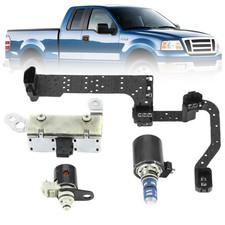
Confirmed TCC solenoid fault on a 2005-2008 4R75W?
This 3-piece lockup solenoid kit replaces the TCC-side solenoids as a matched set rather than guessing at which one is out of spec. If your valve body needs a full rebuild instead, the complete 4R75W parts collection covers converter limit valve kits, pressure control solenoids and valve bodies by year.
Shop the 4R75W TCC solenoid kit →FAQ
What does TCC lockup actually mean on a 4R75W?
The torque converter clutch is a friction disc inside the converter that, once the PCM commands it, clamps the turbine directly to the engine-driven cover so the two spin as one solid unit instead of through fluid. Locked up, there's no converter slip left to generate heat or rob power, which is why lockup shows up mainly at steady cruise -- it's a fuel-economy and heat-management feature, not something the transmission needs for normal shifting.
How do I tell if a shudder at speed is actually TCC lockup and not something else?
Record exactly when it happens first -- the speed, the gear, the engine rpm and the throttle position -- because Gears Magazine's own shudder diagnosis approach starts there before touching anything on the car. Then run the vehicle through three states with a scan tool: normal operation, TCC commanded disabled (fully open), and TCC commanded locked. If the vibration shows up in normal driving but disappears with the converter clutch disabled, and disappears or changes character with it fully locked, the TCC is the cause. If the vibration is still there with the clutch disabled, look at the engine, tires or driveline instead -- GM documents this exact three-mode logic in a published shudder bulletin, and the same reasoning applies to any TCC-equipped automatic, 4R75W included.
Can bad fluid alone cause TCC shudder, or is it always a worn valve?
Fluid condition matters because the friction material on the lockup clutch needs the correct ATF chemistry to apply smoothly -- the 4R75W is specified for MERCON V (Motorcraft XT-5-QMC) per Ford's current fluid chart, and the wrong fluid or badly degraded fluid can produce a shudder that looks identical to a worn converter limit valve. Start with a fluid and filter service before condemning hardware. But if the shudder persists after a correct fluid change, Sonnax's documentation for this transmission family points at a specific, repeatable hardware cause: wear at the converter limit valve's inboard spool bleeding off converter pressure.
Is the TCC solenoid the same part as the converter limit valve?
No, and mixing them up leads to the wrong parts order. The TCC solenoid is the PCM-controlled electrical component that tells the valve body to direct apply oil to the converter clutch; the converter limit valve is a separate, non-electrical valve inside the valve body that regulates how much pressure actually reaches the converter circuit once the solenoid calls for it. A solenoid that's stuck, shorted, or out of resistance spec causes no-lockup or unintended-lockup complaints. A worn converter limit valve bore, per Sonnax's documentation for the 4R70W/4R75W family, causes shudder, slip, or an overheated and damaged converter even when the solenoid itself is working correctly.
Sources
- Sonnax — Converter Limit Valve Kit, Ford 4R70E/4R70W/4R75E/4R75W/AODE technical product page. Backs the inboard/outboard spool wear mechanism, the stuck-low vs. stuck-high symptom split (shudder/slip vs. overheated/damaged converter), and the diagnostic vacuum-test criteria. sonnax.com
- Sonnax — "Troubleshooting Lockup Issues" technical article (Ed Lee). Backs the no-lockup/unintended-lockup/shudder classification method, the flow-meter test for no lockup, the ~0.45 GPM release-oil-flow drag threshold, the cooler-line loop test, and the Ford-specific alternate TCC release oil path note. sonnax.com
- Gears Magazine (ATRA) — "Shudder Diagnosis," April 2023. Backs the diagnostic starting point (speed, gear, rpm, throttle, TSB check) and the 35-45 mph / 3rd-4th gear shudder window commonly tied to TCC engagement. gearsmagazine.com
- General Motors Service Bulletin 16-NA-175 (NHTSA-hosted), "Shake and/or Shudder During Light Throttle Acceleration." Backs the three-mode confirmation test (normal operation, TCC commanded disabled, TCC commanded locked) used to prove or rule out TCC shudder. Published for GM 8L90/8L45 transmissions; cited here for its confirmation methodology, not as a 4R75W-specific procedure. static.nhtsa.gov (PDF)
- Ford Motor Company / FCSD Chemicals and Lubricants — Automatic Transmission Fluid Chart by Transmission. Backs the MERCON V fluid specification and Motorcraft XT-5-QMC part number for the 4R70W/4R70E/4R75W/4R75E. fcsdchemicalsandlubricants.com (PDF)
- Sonnax — 4R70E/4R70W/4R75E/4R75W Remanufactured Valve Body F095/F098 Tech & Install Tips, and the AODE-4R75E-ZIP Kit Installation & Testing Booklet. Back the 10-16 ohm TCC solenoid resistance spec, TCC apply as a PCM-commanded state in the solenoid application chart, and stator/turbine shaft sealing ring wear as a cause of TCC shudder and premature converter clutch failure. F095/F098 sheet (PDF) · ZIP kit booklet (PDF)