P0742 reads "torque converter clutch circuit stuck on," and on a 4R70W it usually walks into the shop as a stalling complaint rather than a check engine light complaint. The customer coasts up to a red light, the engine shudders and dies, and it restarts and drives away fine. That is a converter clutch that never let go, dragging the engine down to a stop through a locked driveline.
The reason this code gets misdiagnosed on Ford units is that most of what people have read about lockup describes a GM-style two-path converter, where the clutch applies when you send pressure to it. The AODE and 4R70W do not work that way, and once you understand which direction the oil moves, the whole diagnosis flips around and gets a lot simpler.
The Circuit: On This Unit, Oil Holds the Clutch Off
Per Sonnax technical specialist Gregg Nader, the Ford CD4E, AXOD/E, AX4N, AODE/4R70W and G4/F4EAT transmissions use three oil circuits at the converter: converter impeller in (CI), converter turbine out (CT), and a third circuit called converter bypass (CBY). Flow direction in CI and CT never changes. From the moment the engine is first started, oil is fed into the converter through both CI and CBY, and that bypass oil flows between the front cover and the lockup piston, holding the piston away from the cover in the released position.
To apply the clutch, the PCM commands the TCC solenoid, the bypass valve strokes, and CBY pressure is reduced — the valve restricts oil into the bypass circuit and the pressure remaining between cover and piston exhausts. Because CBY pressure is varied instead of switched, lockup has three stages: full release, controlled modulated apply, and full apply.
Now invert that for P0742. A stuck-on converter clutch on a 4R70W is not a clutch that is getting extra apply oil. It is a clutch that is not getting its bypass oil back. Anything that keeps the bypass circuit from re-pressurizing — a valve stuck in the stroked position, a solenoid or driver holding on, a control valve worn until it cannot return — leaves the piston clamped to the cover. That one sentence should reorder your entire diagnostic list.
What the PCM Is Actually Watching
Converter clutch slip is engine speed minus turbine speed. For P0741 the PCM commands lockup and sees too much slip. For P0742 it commands lockup off and still sees almost none — the clutch is holding when it should be free. On a 2004-and-later 4R70W you have a turbine shaft speed sensor and can graph that difference directly. On earlier units there is no turbine speed PID to watch, so you will lean harder on the physical tests below.
The place the difference is easiest to see is deceleration. Roll off the throttle from about 45 mph and watch slip open up as the clutch releases. If slip stays pinned near zero all the way down to idle, and the engine starts pulling down as the vehicle stops, you have confirmed the complaint before you have touched a wrench.
Cause 1: The Bypass Clutch Control Plunger Valve Will Not Return
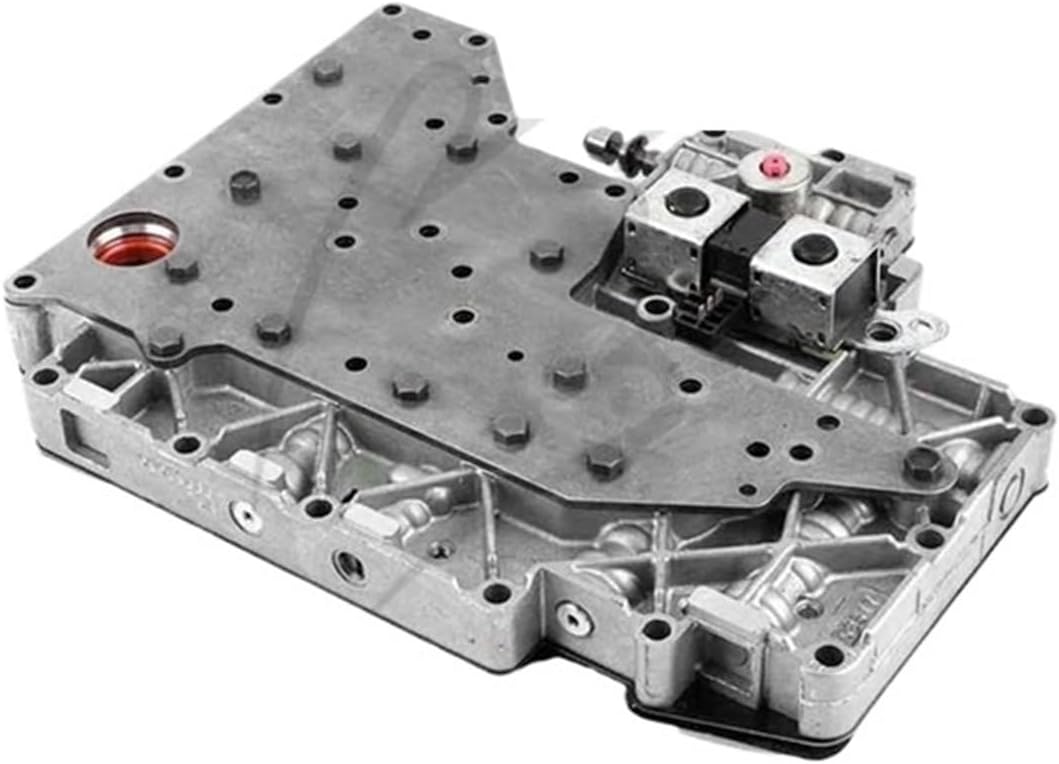
This is the first place to look on any high-mileage AODE-family unit. Sonnax states that it is common for Ford AODE, 4R70E, 4R70W, 4R75E and 4R75W units to experience TCC shudder, delayed lockup, no lockup or converter codes, and that this can often be attributed to wear at the bypass clutch control plunger valve and sleeve in the valve body.
Wear at that plunger and sleeve does not only cause a lazy apply. An aluminum bore that has gone oval around a steel valve is also a bore a valve can hang up in, and this one hangs up in the position that keeps the bypass circuit restricted. Add varnish from cooked fluid or debris from an earlier failure and a valve that used to shuttle freely parks itself in apply and stays there until the engine is shut off.
Sonnax offers two drop-in repairs for that bore, and the sleeve orifice is the difference between them:
- 76948-64K uses four .063 in. orifices to mimic the OE hydraulic design, letting the bypass clutch control valve match OE timing when it strokes to the TCC apply position. This is the one for a stock truck or Panther-platform car where you want factory feel back.
- 76948-04K uses a single .030 in. orifice. Sonnax is straight about the tradeoff: compared to the OE valve design, that smaller orifice can create a more pronounced lockup engagement. Use it where a firmer, quicker lockup is wanted.
Both are Zip Valve repairs that require no reaming, which matters when you are already into the valve body chasing a stuck-on complaint and do not want to add a machining operation to the job.
Sonnax 76948-04K Bypass Clutch Control Plunger Valve Kit
The repair for the exact bore behind this code — hardcoat anodized plunger, wear-resistant sleeve, drop-in with no reaming. Choose the 64K version instead if you want stock lockup feel on a 1996-up unit.
Get the 76948-04K bypass valve kit →Need the rest of the valve body, a solenoid or a rebuild kit? Browse the full 4R70W parts collection.
Cause 2: The Converter Limit Valve Stuck in the High-Pressure Position
This one gets missed because a lot of people do not know the valve is there. Sonnax describes various TCC concerns and failures as common on Ford 4R70E, 4R70W, 4R75E, 4R75W and AODE units, with many traceable to excess clearance or binding at the converter limit valve. Wear at the inboard spool lets converter pressure exhaust; debris-related wear and bore damage at the outboard spool binds the valve so it sticks in either the high or the low converter limit pressure position.
Stuck low, you get the shudder-and-slip family of complaints. Stuck high is the one that belongs in a P0742 writeup: Sonnax notes it prevents proper limiting of pressure into the converter circuit and results in damaged or ballooned converters. Excess pressure crowding the clutch is exactly the condition that keeps a piston loaded against the cover when the circuit is supposed to let it float free, and it is why some of these come apart with a converter that is visibly swollen.
If you find a ballooned converter or a heat-blued contact pattern on the cover on a unit that also drags at idle, pull the converter limit valve before you blame the converter for its own destruction. Sonnax drop-in kit 76948-56K addresses the wear and binding at that bore.
Cause 3: Solenoid Regulator Wear — Premature Lockup and Slow Release
Sonnax vice president of technical development Bob Warnke gives the cleanest description of this failure mode in his hydraulics work on converter clutch control: too much pressure into the solenoid circuit causes too much pressure out, and the result is premature lockup and slow release. Low pressure, by contrast, gives you shudder and slip. Premature lockup with a slow release is a P0742 complaint written in hydraulic terms.
The 4R70W has a known wear point that produces exactly that input condition. Sonnax describes the solenoid regulator valve in the Ford 4R70E, 4R70W, 4R75E, 4R75W and AODE as the valve that ensures the solenoids are not flooded with more pressure than they can exhaust, and notes that when that regulator valve sticks, pressure gets too high and the unit may exhibit wrong-gear starts. The more common wear direction drops working pressure and gives you no 2nd, no 3rd, or a neutral on a 3-4 or 4-3 shift — so if the vehicle in front of you has a stuck-on converter clutch and a shift complaint, look at this valve before you assume two unrelated problems.
Warnke's standing instruction on this circuit is worth adopting as shop policy: vacuum test the main regulator, the solenoid regulator and the converter regulator on every valve body that comes across the bench. On a stuck-on job, all three feed the condition you are chasing.
Cause 4: Electrical — A Circuit That Really Is Stuck On
It happens, and it is cheap to rule out. A shorted TCC solenoid, a chafed harness rubbing through to ground, a case connector wet with fluid, or a PCM driver that has failed on will hold the solenoid energized regardless of what the strategy is commanding. Check solenoid resistance against the specification in the service information for that build year rather than a number off a forum — the solenoid changed across this family's production run and the early and late parts do not share a resistance spec. Then wiggle-test the case connector and the harness where it runs past the exhaust.
Cause 5: The Clutch Cannot Physically Release
Last on the list because it is last in frequency, but it is real. Warnke notes that insufficient release allows the clutch to drag, which relates to rough idle and eventually friction overheat, and that clutch release clearance is a dimension accounted for during assembly of the converter. A converter built with too little release clearance, or one whose lining has swollen, will drag even behind a perfect valve body.
He also gives the two ways to catch it. On the scan tool, a dragging clutch shows up as surging turbine RPM. Physically, the best position to check release oil or the cause of a dragging clutch is in reverse, at a hot idle — that is the condition that loads the circuit and makes a marginal release obvious.
Diagnosing It in the Driveway
Work this order and you will separate a valve kit from a converter in about half an hour. Get the unit to full operating temperature first.
- Confirm the stall is load-related. Idle it in Neutral, then shift to Drive with the brake on. An engine that idles clean in Neutral and pulls down, shudders or dies in gear is being dragged by a clamped converter clutch. Check fluid level and condition hot on level ground before anything else.
- Unplug the TCC solenoid and drive it. This is the highest-value test on the list. On this bypass design, no solenoid command means no bypass valve stroke, which means the clutch should release. If the stall disappears, the fault is electrical or is in the solenoid itself. If it still stalls, you have a stuck valve or a dragging clutch and you can stop chasing wiring.
- Graph slip on deceleration. On 2004-up units, watch engine RPM against turbine shaft speed as you coast down from 45 mph. Slip should open well before the vehicle stops. Flat, near-zero slip into the stop confirms the clutch is holding.
- Check release in reverse at hot idle. Warnke's test for a dragging clutch. Pair it with a cooler flow check — poor release and low flow travel together.
- Gauge line pressure. Elevated line makes everything downstream worse. Most valves limit apply pressure to the TC piston around 130 psi; if apply pressure has been modified and line pressure is elevated by wear or by a shift kit, Warnke notes the piston can see 150 to 200-plus psi across its area.
- Pull the valve body and vacuum test. Main regulator, solenoid regulator, converter regulator, then the bypass clutch control plunger and sleeve and the converter limit valve. A bore that will not hold vacuum is a bore that is not sealing oil.
- Inspect the converter last. Look for ballooning, a blued contact face on the cover, and lining material in the pan and the cooler return.
What a Stuck-On Clutch Does While You Are Diagnosing It
Do not let one of these keep driving for a month while parts come in. Warnke lays out the damage sequence when a clutch is held into high apply pressure: the converter will not release properly for upshifts and downshifts so they are harsh, the clutch lining starts to flake from stress, damper springs break, and the piston deforms from over-pressure. His summary of where the debris ends up is the reason this repair grows if you wait — the lining goes to the radiator, and the converter goes to the rebuilder.
That is also why the cooler flush is not optional here. Lining material that made it into the cooler will come straight back into whatever you install.
Fluid and Refill
Ford's fluid application chart covers the 4R70W, 4R70E and 4R75W/E, and the fluid for this family is MERCON V. The chart is explicit that the listed fluids are unique and must be used in the applications recommending them, so MERCON LV off the shelf is not a substitute. Figure roughly 13.5 to 14 quarts dry including the converter and about 5 to 6 quarts for a pan and filter service, confirmed against the workshop manual for the application.
The same chart cautions against supplemental transmission fluid additives, treatments and cleaning agents, warning they may affect transmission operation and result in damage to internal components. There is no bottle that unsticks a bound converter limit valve, and a solvent-type additive turned loose in a unit with a marginal bore tends to move debris somewhere less convenient.
The Short Version: A P0742 Checklist
- Verify fluid level and condition hot, and confirm the stall only happens in gear.
- Unplug the TCC solenoid and road test. Stall gone means electrical or solenoid. Stall stays means hydraulic or mechanical.
- Graph slip on deceleration if the unit has a turbine speed sensor.
- Check clutch release in reverse at hot idle, and flow check the cooler.
- Gauge line pressure before opening anything.
- Vacuum test the main, solenoid and converter regulator valves.
- Repair the bypass clutch control plunger valve and sleeve — 76948-64K for OE feel, 76948-04K for a firmer apply.
- Inspect the converter limit valve bore for binding, and correct it before installing a converter.
- Flush and flow check the cooler, refill with MERCON V, no additives.
Worked in that order, the majority of these turn out to be a valve body job rather than a converter job. The one test worth building a habit around is unplugging the solenoid: on a Ford bypass converter, that single move splits the diagnosis in half before you have lifted the vehicle.
FAQ
What are the symptoms of P0742 on a 4R70W?
The signature complaint is an engine that stalls when you come to a stop with the transmission in gear, because the converter clutch never releases and the engine is being dragged down through a locked driveline. Below that you get bucking and chugging at low speed, harsh upshifts and downshifts because the converter cannot release between shifts, and a rough idle in gear. Sonnax describes insufficient clutch release as producing exactly that dragging condition, along with friction overheat if it is left alone.
Why does a Ford converter clutch stay applied when the solenoid is off?
Because the AODE and 4R70W use a three-circuit bypass converter, and bypass oil is what holds the clutch released. Per Sonnax, oil is fed between the front cover and the lockup piston from the moment the engine starts, and the clutch applies when the PCM commands the solenoid and bypass pressure is reduced. If a valve sticks in the stroked position, bypass oil never comes back, so the clutch stays clamped no matter what the solenoid is doing. Unplugging the solenoid proves this in about a minute.
Can I unplug the TCC solenoid to stop a 4R70W from stalling?
As a diagnostic test, yes, and it is the fastest way to split electrical causes from hydraulic ones. With the solenoid disconnected the PCM cannot command lockup, so the clutch should release and the stall should go away. If it still stalls at a stop with the connector off, the fault is a stuck valve or a dragging clutch inside the converter, not wiring. It is a test, not a repair, and it will store solenoid circuit codes while you drive it.
Does P0742 mean my torque converter is bad?
Not by itself. A clutch that cannot release because of a stuck bypass or converter limit valve produces the same complaint as a converter with too little release clearance, and the valve is far more common on this unit. What does ruin the converter is leaving it applied: Sonnax notes that most valves limit apply pressure to the piston around 130 psi, and that over-pressure flakes the clutch lining, breaks damper springs and deforms the piston. Fix the circuit first, then decide about the converter.
Do I have to flush the cooler after a stuck-on converter clutch?
Yes, if there is any evidence the lining broke down. Sonnax puts it bluntly: when a clutch is run under over-pressure the lining goes to the radiator. That debris will come straight back into a new converter and a freshly rebuilt valve body. Flush the cooler and lines, run a flow check afterward to confirm the circuit is open, and refill with MERCON V per Ford's fluid application chart.
Working a 4R70W this week?
Bypass and converter limit valve kits, TCC and shift solenoids, valve body parts, filters and full rebuild kits — shipped fast from the USA.
Shop 4R70W parts →Sources
- Sonnax — "Ford Bypass Converter Clutch Circuits," Gregg Nader. Backs the three-circuit bypass converter design used on the AODE/4R70W (converter impeller in, converter turbine out, converter bypass), that CI and CT flow direction never reverses, that bypass oil is fed between the front cover and the piston from engine start and holds the clutch released, that the clutch applies when the PCM commands the solenoid and CBY pressure is reduced, and the three stages of lockup. Also backs valve body bore wear at the bypass sleeve and plunger, bypass valve and converter regulator valve as causes of poor bypass control. sonnax.com
- Sonnax — "AODE, 4R70W Series Bypass Clutch Control Valve Repair Options: When to Use Sonnax 76948-04K vs. 76948-64K," Tory Royce. Backs that TCC shudder, delayed lockup, no lockup and converter codes are common on AODE, 4R70E, 4R70W, 4R75E and 4R75W units and are often attributable to wear at the bypass clutch control plunger valve and sleeve; the single .030 in. orifice in 76948-04K and its more pronounced lockup engagement; the four .063 in. orifices in 76948-64K matching OE timing to the TCC apply position; and that both are drop-in Zip Valve repairs requiring no reaming. sonnax.com
- Sonnax — Converter Limit Valve Kit 76948-56K product and technical page. Backs that TCC concerns and failures on Ford 4R70E, 4R70W, 4R75E, 4R75W and AODE units are commonly traceable to excess clearance or binding at the converter limit valve; that inboard spool clearance lets converter pressure exhaust while debris-related wear at the outboard spool binds the valve in either a high or low converter limit pressure position; and that a valve stuck in the high pressure position prevents proper limiting of pressure into the converter circuit, resulting in damaged or ballooned converters. sonnax.com
- Sonnax — Solenoid Regulator Valve Kit 76948-14K product and technical page. Backs the function of the solenoid regulator valve in Ford 4R70E, 4R70W, 4R75E, 4R75W and AODE transmissions in preventing the solenoids from being flooded with more pressure than they can exhaust, the sticking failure that drives pressure too high and can produce wrong-gear starts, and the more common bore wear that lowers working pressure and causes no 2nd, no 3rd or a neutral on the 3-4 and 4-3 shifts. sonnax.com
- Transmission Digest — "Hydraulics Fundamentals: Converter Clutch Control Part 2," Bob Warnke (Sonnax TASC Force), June 1, 2019. Backs that insufficient release allows the clutch to drag, producing rough idle and eventual friction overheat; that release clearance is a dimension set during converter assembly; that a dragging clutch shows on a scan tool as surging turbine RPM and is best checked in reverse at a hot idle; that most valves limit apply pressure to the TC piston around 130 psi and that elevated line pressure can push the piston to 150-200-plus psi; the damage sequence of harsh shifts, flaking lining, broken damper springs and a deformed piston with lining ending up in the radiator; that excess solenoid pressure causes premature lockup and slow release while low pressure causes shudder and slip; and the instruction to vacuum test the main, solenoid and converter regulator valves. transmissiondigest.com
- Ford Customer Service Division — "Automatic Transmission Fluid Chart" (PDF). Backs Ford's current fluid application listing covering the 4R70W, 4R70E and 4R75W/E and the MERCON V requirement for that family, the statement that the listed fluids are unique and must be used in the applications recommending them, and the manufacturer caution that supplemental transmission fluid additives, treatments and cleaning agents may affect transmission operation and result in damage to internal components. fcsdchemicalsandlubricants.com