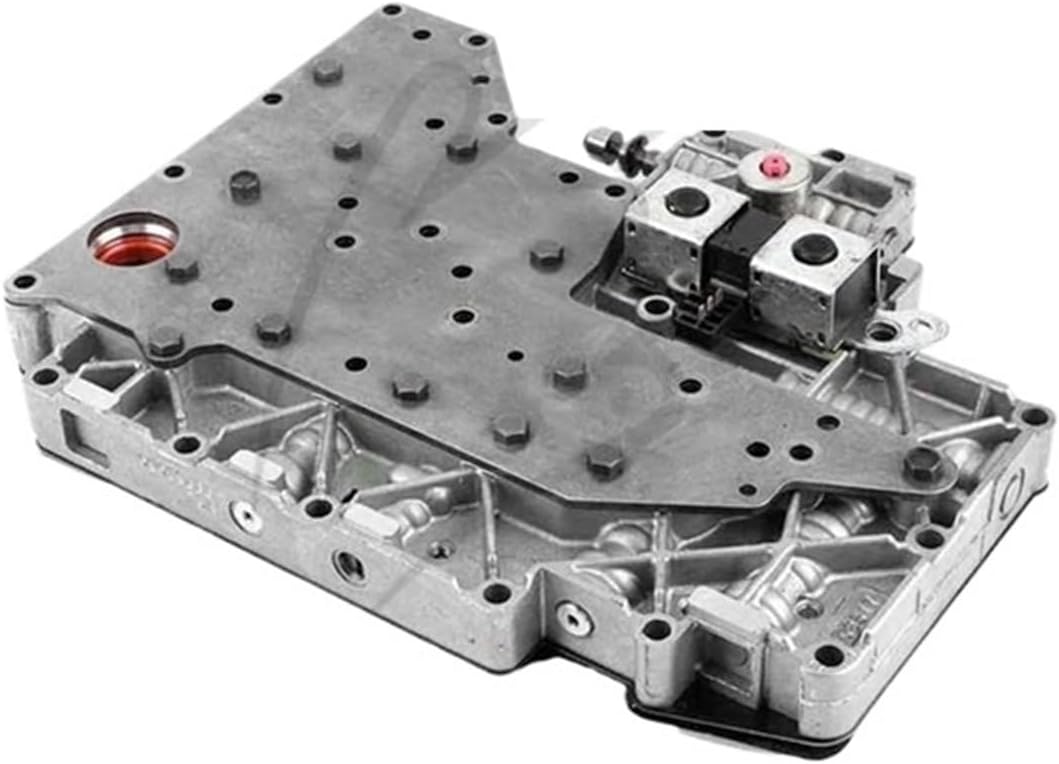
Most 4R70W units that come back after a rebuild do not come back because somebody installed a clutch pack wrong. They come back because the valve body went back in with the same worn bores it had when it came out. Aluminum castings wear where valves stroke, and on this family — AODE, 4R70W, 4R70E, 4R75W, 4R75E — the wear locations are so consistent that you can work backward from the customer's complaint to the bore before you ever pull the pan.
This is a bench article: which bore produces which symptom, how to confirm it with a vacuum gauge instead of a hunch, and how to decide between a drop-in repair and reaming for an oversized valve. The broader failure catalog for this unit is covered separately in our Ford 4R70W and 4R75W problems write-up.
Why These Bores Wear in the First Place
Valve bore wear is not random. It concentrates in three categories of valve, and knowing which category a valve falls into tells you how likely it is to be worn before you test it.
Active valves stroke constantly. The main pressure regulator and its boost assembly reposition every time EPC pressure changes, which Transmission Digest points out can happen thousands of times in a single drive cycle. That makes them among the most active valves in the transmission and, predictably, among the first to wear.
Modulated valves are driven by low-resistance solenoids that pulse at 32 Hz. That is fast enough to modulate the valve but slow enough that the valve actually strokes in the bore before reversing direction, so it etches a groove in a narrow band. Sonnax calls out AODE converter valves by name as a textbook example of this failure mode. Later designs moved to 300 Hz solenoids specifically because the valve cannot travel far between pulses, which is why newer units show far less etching in the same locations.
Regulating valves hold a pressure to a set parameter and therefore live in a narrow section of bore — exactly where sealing matters most. The main PR valve and the solenoid regulator valve both fall here.
The 4R70W pressure regulator valve is all three at once. That is why it is the first place to look.
The Symptom-to-Valve Map
Sonnax publishes a critical wear area guide for this valve body that maps each bore to the complaints it produces. This is the condensed version, and it is the fastest triage tool you can keep at the bench.
| Valve | Complaint | Sonnax part |
|---|---|---|
| Main pressure regulator | Poor shift quality, soft shifts, low line rise, erratic buzz, premature clutch/band failure | 76948-01 or 76948-16K (1991-95); 76948-09 or 76948-17K (1996-later) |
| Boost valve | Low reverse boost, reverse slip, no reverse, delayed reverse, burnt reverse clutch | 76948-02K |
| Bypass clutch control valve | Codes 628, 741, 1741, 1744; no lockup, TCC slip, low cooler flow | 76948-31 (reamed) |
| Bypass clutch control plunger valve & sleeve | Shudder, code 628, no lockup, delayed lockup, TCC apply and release concerns | 76948-04K or 76948-64K |
| Solenoid regulator valve | Erratic shifts, 2-3 neutral, neutral after 4th, 3rd and reverse only, no 2nd, loss of forward under hard acceleration from a stop | 76948-14K or 76948-47K |
| Overdrive servo regulator valve | No 4th, burnt OD band, 4-3 neutral | 76948-29K ('01-later sleeve version) |
| Manual valve | Delayed engagement, low line pressure, burnt bands and clutches | 76948-46 |
| Converter pressure limit valve | Low converter pressure, lube failures | 76948-58K |
| 3-4 shift valve end plug | Burnt bands, no reverse, no 4th | 76948-49K |
Two entries are worth reading twice. "Loss of forward under hard acceleration from a stop" is a solenoid regulator complaint, not a forward clutch complaint — techs replace a lot of good clutch packs over that one. And "burnt bands, no reverse, no 4th" pointing at a shift valve end plug is the kind of thing you will never find visually.
The Main Pressure Regulator: Two Bores, Two Opposite Symptoms
The PR valve regulates line pressure using five inputs: source pressure from the pump, spring force, balance oil, an exhaust passage, and opposing EPC force. Wear in different parts of that bore produces opposite results, which is why "low line pressure" and "high line pressure" can both trace back to the same valve.
Outboard spool wear: low line rise
Scoring on the EPC end of the valve is the common one, and Sonnax notes it is usually severe enough to be obvious to the naked eye. The wear lets EPC oil cross-leak to exhaust, so the valve never gets pushed to its high-pressure position. You get poor line rise, soft shifts, and eventually burnt clutches and bands. Transmission Digest names the AODE/4R70W as one of the most common examples of this specific line-to-exhaust cross-leak in any unit.
The tell is that it gets worse with heat. As fluid warms it thins, leakage through the worn clearance increases, and a problem that was tolerable cold becomes a throttle-sensitive buzz hot. If a customer says it shifts fine for the first ten minutes, believe them — that is a hydraulic leak, not an electrical fault.
Inboard balance spool wear: high line pressure
Less discussed and more destructive. Wear at the inboard balance spool bore lets balance pressure cross-leak, so it takes higher line pressure to counteract the PR spring. The unit then runs excessively high line pressure, which is hard on everything and can crack the case. Harsh shifts on a unit with no codes are worth a look here.
Do not just swap the valve
This is the mistake that generates comebacks. If the valve is scored badly, the bore almost certainly is too, and a new valve in a worn casting will not seal. Sonnax is direct about it: a worn casting will not allow for proper sealing even with a new valve installed. Bore wear is difficult to see, so it has to be measured.
Vacuum Testing: Measuring What You Cannot See
Vacuum testing seals a circuit around a valve spool and pulls air through the clearance between spool and bore. Tight clearance holds vacuum; a worn bore leaks and the reading drops. The result is a number in inches of mercury, which is the whole point — it is repeatable, and it is not a judgment call the way a wiggle test is.
The reference points: a perfect seal with no leakage would read 29.9 in-Hg, though that shifts with elevation. No real circuit reaches it. In the cross-section example Sonnax uses to illustrate the method, a very good circuit approaches 22 to 23 in-Hg and a severely worn bore can read as low as 8 in-Hg. Vacuum loss is directly proportional to the amount of wear.
Two practical notes before you start. Sonnax recommends a 3 cfm pump for valve body work. And test valves in the position they actually operate in — a valve that spends its life in a narrow band of the bore is more accurately tested there, and a small check ball, washer, or retainer can hold it in place while you pull vacuum.
The homemade PR test tool
You do not need a commercial plate to check the PR bore on this unit. Sonnax publishes a shop-built version using a discarded reverse boost sleeve:
- Drill a hole through the end of an old boost sleeve. The hole size does not matter.
- Insert 1/4 inch rubber or plastic tube into the sleeve far enough to block the oil feed holes in the side.
- Slip a piece of rubber vacuum hose over the end of the 1/4 inch tubing to connect your gauge.
- Insert a known-good PR valve into the bore and hold it inboard with a pick, then pull vacuum through the sleeve tool inserted into the bore beyond the EPC circuit.
If you would rather buy tooling, the plate kit for this family is 76948-VTP and the test stand is VACTEST-01K.
There is no universal pass number
This trips up people new to vacuum testing. Sonnax does not publish a single pass/fail figure per bore, and that is not an oversight. Readings depend on your pump, gauge, calibration orifices, how many spools sit in the captive circuit, spool diameter, and contact length. Pass/fail has to be established for your setup.
The way to do it: test the same circuit on every core that crosses your bench and write the number down. After a dozen units you will know what a healthy 4R70W PR bore reads on your stand, and anything well below that is worn.
Mityvac MV8000 Selectline Hand Vacuum Pump Tester Kit
A hand vacuum pump and gauge is the entry point for bore testing if you are not ready to build a bench stand. It reads in-Hg directly, so you can start logging baseline numbers on the PR and bypass clutch control circuits on the next few cores that come through.
View in the Gearbox Insider store →One more thing to do before the pan comes off: put a gauge on the line pressure port and drive it. Transmission Digest makes the point that this is the least invasive check available, and a pressure problem measured in the vehicle tells you where to concentrate on the bench.
The Bypass Clutch Control Circuit: Two Separate Valves
Lockup complaints on this unit trace to two different parts in the same area, and they are not interchangeable. Reading the symptom carefully saves you from buying the wrong repair.
The bypass clutch control plunger valve and sleeve is the shudder part. Wear in the OE plunger and sleeve lets regulated converter charge oil leak to exhaust, giving you shudder, delayed lockup, no lockup, and TCC apply and release complaints. This is a drop-in fix with no reaming.
The bypass clutch control valve itself is the pressure part. A worn valve or bore lowers converter and TCC apply pressure, which shows up as TCC codes, shuttling or loss of lockup, converter overheat, and reduced or lost cooler flow. Low cooler flow is the one to respect — that is how a lockup problem turns into a cooked unit. This one requires reaming to accept oversized valve 76948-31.
76948-04K versus 76948-64K
Both are drop-in Zip Valve repairs for the plunger and sleeve, and the difference is orifice design, which changes lockup feel.
- 76948-04K uses a single.030 inch orifice in the Sonnax sleeve. Compared to OE, that produces a more pronounced, firmer, quicker lockup engagement. You can drill an additional orifice if you want OE feel back, but that plus plate modifications on earlier units adds steps.
- 76948-64K uses four.063 inch orifices to mimic the OE hydraulic design, so the valve matches OE timing when it strokes to the TCC apply position. No drilling required.
The selection rule, per Sonnax technical support engineer Tory Royce of the TASC Force: on earlier units where a firmer, quicker lockup is wanted, stay with 76948-04K. On 1996-later applications, lean toward 76948-64K — engine lugging and harsh TCC apply can occur on those if the OE calibration is not observed. Putting an aggressive lockup calibration into a truck that was not designed for it is a comeback waiting to happen.
Drop-In or Ream? Making the Call
Once you have vacuum numbers, the decision is straightforward.
Drop-in Zip Valve repairs (76948-04K, 76948-64K, 76948-02K, 76948-29K) replace the OE valve with a design that seals in a moderately worn bore and guards against future wear. No reaming, no fixture, no bore sizing — that is the whole job.
Oversized valves require reaming and are the answer when the casting is too far gone for a drop-in to seal. For the PR bore you have two tooling paths with kit 76948-16K: tool kit F-76948-TL, which includes reamer, jig, and guide and requires reaming fixture VB-FIX; or bench tool kit 76948-TL4, which does not need VB-FIX but should be followed with bore sizing tool 76948-BST for exact sizing and a better bore finish. The oversized bypass clutch control valve 76948-31 requires 76948-TL6 or F-76948-FL6.
Two details that will bite you if you skip them. First, the oversized reverse boost valve and sleeve supplied in the PR kits must be used when replacing the PR valve — they are not optional extras in the box. Second, kit 76948-16K replaces 1995-and-earlier four-spool valves only and does not replace three-spool valves. Count the spools on the valve you pulled before you order.
What you get for the extra labor: the 76948-16K valve is hardcoat anodized aluminum, carries annular grooves that prevent side-loading wear, and uses an improved PR-to-EPC reaction area ratio giving higher line rise response and noticeably firmer shifts. Set customer expectations accordingly — it will not feel exactly like it did new.
Reassembly and Fluid
This valve body has eight check ball locations. Sonnax publishes an exploded view with them marked and the valve trains numbered 101 through 111 — 111 is the main PR valve inboard with the boost valve and sleeve outboard, 110 is the bypass clutch control valve inboard with the plunger valve and sleeve outboard, 106 is the solenoid regulator, 107 the manual valve. Print that page and lay it on the bench rather than trusting memory across a lunch break.
Note the year splits while you are in there: the 2-3 capacity modulator valve is not used in 2001-later units, and the overdrive servo regulator on those units uses a valve-and-sleeve assembly rather than the earlier plain valve.
On fluid, do not improvise. Ford's own Automatic Transmission Fluid Chart specifies MERCON V for the 4R70W, 4R70E, 4R75W, and 4R75E, sold as part number XT-5-QMC in quarts and XT-5-DMC in 55-gallon drums. Ford's stated caution is that failure to use the recommended fluid may affect transmission performance and durability. MERCON LV and MERCON ULV are different specifications for different units — they are not backward-compatible substitutes here, and viscosity changes the leakage behavior in exactly the worn bores you just spent the afternoon fixing.
The Short Version
- Gauge line pressure in the vehicle before dropping the pan.
- Match the complaint to a bore using the wear map above.
- Vacuum test that bore. Do not judge it by eye — bore wear does not look like anything.
- Build your own pass/fail baseline by logging every core on your own equipment.
- Moderate wear takes a drop-in Zip Valve. Severe wear takes a reamed oversized valve, correct tooling, and the supplied boost sleeve.
- Refill with MERCON V. Nothing else.
The unit is not fragile. The castings have just logged a lot of valve strokes, and the shops that check those bores instead of assuming them are the ones not doing the job twice.
- Ford Motor Company (FCSD Chemicals & Lubricants). "Automatic Transmission Fluid Chart" — specifies MERCON V for 4R70W / 4R70E / 4R75W / 4R75E, part numbers XT-5-QMC (1 quart) and XT-5-DMC (55 gallon drum), plus the caution on non-recommended fluids. fcsdchemicalsandlubricants.com/quickref/atfUS.pdf
- Sonnax. "Ford 4R70E, 4R70W, 4R75E, 4R75W, AODE Vacuum Test Guide" — critical wear areas, the symptom-to-valve map, codes 628/741/1741/1744, the eight check ball locations, valve train IDs 101-111, part numbers, and the 2001-later year splits. sonnax.com/tech_resources/535
- Sonnax. "Watch Out For 4R70W PR Valve & Casting Wear" — EPC-end scoring, why a new valve will not seal a worn casting, and the step-by-step homemade vacuum test tool built from a reverse boost sleeve. sonnax.com/tech_resources/1152
- Sonnax (Tory Royce, TASC Force). "AODE, 4R70W Series Bypass Clutch Control Valve Repair Options: When to Use 76948-04K vs. 76948-64K" — the.030 inch single-orifice versus four.063 inch orifice designs, lockup feel, and the 1996-later engine lugging caution. sonnax.com/tech_resources/1369
- Sonnax. "Vacuum Testing for Leakage" — the 29.9 in-Hg reference, the 22-23 in-Hg good / 8 in-Hg severely worn illustration, active vs. modulated vs. regulating valve categories, 32 Hz vs. 300 Hz solenoid etching, the 3 cfm pump recommendation, and why pass/fail must be shop-specific. sonnax.com/tech_resources/121
- Transmission Digest. "Hydraulics Fundamentals: Main Pressure Regulator Valve Lineups" — the five elements of PR regulation, why the PR valve is among the most active valves in the unit, balance-end versus exhaust-side wear producing opposite symptoms, the AODE/4R70W as the common cross-leak example, and starting diagnosis with a line pressure gauge. transmissiondigest.com/hydraulics-fundamentals-main-pressure-regulator-valve-lineups
- Sonnax. "Oversized Pressure Regulator & Boost Valve Kit 76948-16K" — inboard balance spool wear causing excessively high line pressure, the two reaming tooling paths (F-76948-TL + VB-FIX, or 76948-TL4 + 76948-BST), the mandatory oversized boost valve and sleeve, hardcoat anodized construction, and the four-spool-only fitment note. sonnax.com/parts/2400