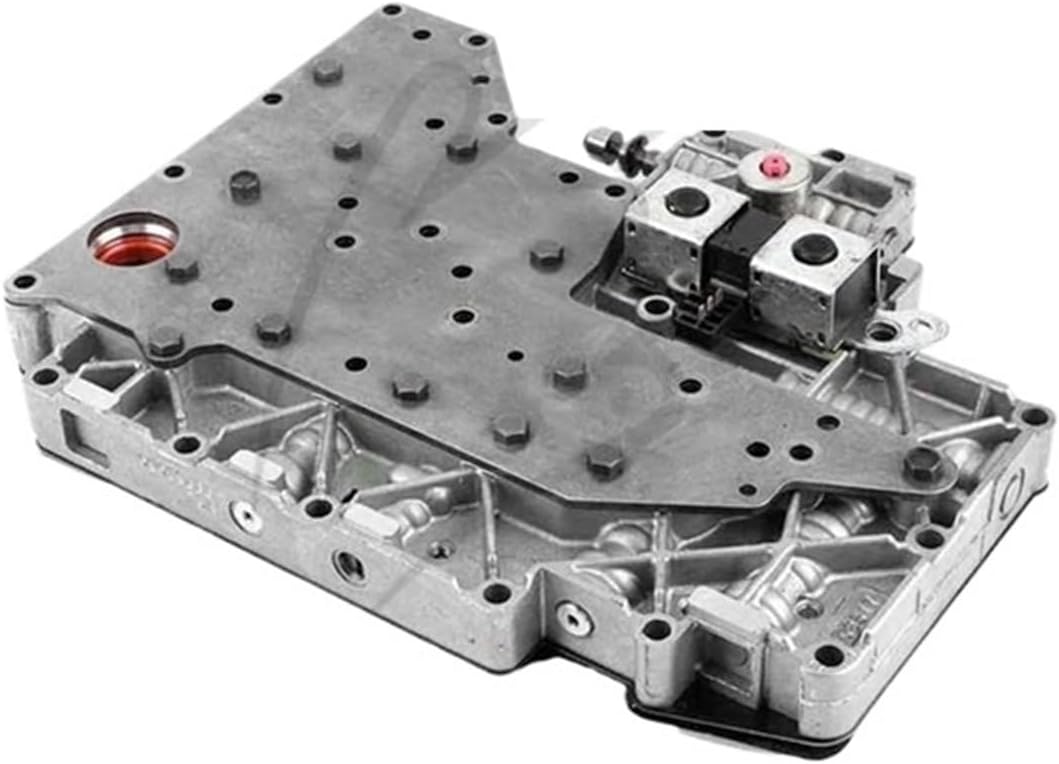
The 4R70W is a two-bit transmission. Not an insult — a literal description. The entire forward shift schedule of an AODE, 4R70W, 4R70E, 4R75W or 4R75E is decided by two on/off shift solenoids, SS1/A and SS2/B. Four combinations, four gears. Everything else in the electrical package is doing a different job: the EPC solenoid meters line pressure, the TCC solenoid handles converter lockup, and the transmission oil temperature sensor tells the PCM whether it is allowed to do any of it yet.
That simplicity is the diagnostic advantage on this unit. On a modern six-speed you are guessing which of seven variable-force solenoids is lying to you. On a 4R70W, the gear it is stuck in tells you which solenoid failed and which way, before you pull a meter out of the drawer. Most of the solenoid sets sold for these transmissions go to people who never used that.
The pattern: four gears out of two solenoids
Here is the solenoid application chart for the AODE/4R70W family, straight out of the Sonnax installation booklet for the AODE-4R75E Zip Kit. ATRA published the same pattern in the GEARS solenoid application charts, where the AODE/4R70W is listed as a two-solenoid "Type 3" unit — the two documents agree line for line, which is a good sign when you are working off charts.
| Range / Gear | SS1 (SSA) | SS2 (SSB) | TCC |
|---|---|---|---|
| Park | ON | OFF | — |
| Reverse | ON | OFF | — |
| OD — 1st | ON | OFF | PCM command |
| OD — 2nd | OFF | OFF | PCM command |
| OD — 3rd | OFF | ON | PCM command |
| OD — 4th | ON | ON | PCM command |
Read that table sideways instead of down and it becomes a fault chart. The first thing it tells you is the default: both solenoids off is 2nd gear. Kill the shared 12-volt feed to the solenoid pack and the valve body lands in second and stays there. That is why the classic dead-electrical 4R70W drives away in a gear that feels far too tall and still backs up fine — Reverse is hydraulic through the manual valve, and it does not care that the solenoids are dark.
Now work the individual failures:
- SS1/A stuck OFF (or open circuit): you lose the two gears that need it, 1st and 4th. The vehicle starts in 2nd, will shift 2-3, and will not go to overdrive. Expect P0750 plus a ratio code.
- SS2/B stuck OFF: you lose 3rd and 4th. It launches in 1st, shifts to 2nd, and quits there. P0755 territory.
- SS1/A stuck ON: commanded 2nd gives you 1st, and commanded 3rd gives you 4th. The customer describes it as grabbing a gear too tall on the top shift and refusing to come back down. This one sets ratio codes (P0731 through P0733) far more often than it sets a solenoid circuit code, because electrically nothing is wrong.
- SS2/B stuck ON: commanded 1st becomes 4th. That is a bog-off-the-line, engine-lugging complaint, and it is the one that gets misdiagnosed as a converter or a slipping forward clutch.
Two of those four failures never set a solenoid electrical code. Keep that straight before you decide the codes told you everything.
Codes on this unit describe circuits, not parts
P0750 is Shift Solenoid A circuit. P0755 is Shift Solenoid B circuit. P0743 is the TCC solenoid circuit. On the Ford-specific side, P1746 is EPC solenoid open circuit and P1747 is EPC solenoid short, while P1751 and P1756 are shift solenoid A and B performance — meaning the PCM commanded a state and the ratio did not follow.
ATRA's Gears magazine makes this point better than I can, working a solenoid circuit code end to end: any fault anywhere in the circuit — power feed, ground, wiring, connections, or the computer itself — will set the code, so replacing the solenoid is a coin flip until you have proved the rest of the loop. That article also carries the one warning worth writing on the toolbox lid: never diagnose a computer-driven circuit with a test light. A test light will glow on a circuit carrying nowhere near enough current to pull a solenoid in. Use a meter, and better still, use an ammeter.
Testing at the case connector
All four solenoids are checked from outside the transmission through the case connector, and Sonnax publishes the terminal pairs and ohm ranges for both connector styles in the Zip Kit booklet. That booklet shows three case connector generations across this family — a '97-and-earlier, a 1998-2008, and an '09-later — so identify the connector in front of you before you start counting pins.
| Solenoid | 10-pin terminals | 8-pin terminals | Resistance |
|---|---|---|---|
| Solenoid 1/A | 1 & 2 | 4 & 7 | 20–30 ohms |
| Solenoid 2/B | 6 & 2 | 4 & 8 | 20–30 ohms |
| TCC solenoid | 3 & 8 | 4 & 3 | 10–16 ohms |
| EPC solenoid | 7 & 10 | 4 & 6 | 2–5 ohms |
Two things about that table earn their keep. First, the EPC is a 2 to 5 ohm part sitting in the same connector as two 20 to 30 ohm parts. If you sweep the connector expecting shift-solenoid numbers and the EPC reads low, it is not shorted, it is an EPC. Plenty of good pressure control solenoids get condemned by someone who never looked up the spec for that specific circuit.
Second, look at the pin functions rather than just the pin numbers. On the 10-pin connector, pin 2 is the 12-volt supply for the shift solenoids and pins 1 and 6 are the SS1/A and SS2/B grounds; pin 3 is TCC ground, pin 8 is TCC power, pin 7 is EPC power, pin 10 is EPC ground, and pins 5 and 9 are the transmission oil temp sensor ground and power. On the 8-pin, pin 4 is the 12-volt supply for the solenoids, pins 7 and 8 are the SS1/A and SS2/B grounds, pin 3 is TCC ground, pin 6 is EPC ground, and pins 2 and 5 are the temp sensor. On both, the power feed is shared. If everything in the connector reads open from that one common terminal, you have one bad terminal, not four bad solenoids.
Resistance is the cheap check, not the good one. A solenoid that measures 24 ohms cold on the bench can still fail to pull in under a hot 12-volt load. If you have a bidirectional scan tool, command SS1/A and SS2/B on and off with the vehicle in Park and listen at the pan while you watch current. With a 20 to 30 ohm winding on a running-vehicle bus you should see something on the order of half an amp — roughly the 0.42 to 0.63 amp window Gears cites for a solenoid circuit in that resistance range. A circuit that reads correct resistance but pulls no current under command has a supply or ground problem, not a solenoid problem.
The failure that fools everybody after a rebuild
Transmission Digest ran a case every rebuilder should read once. A 4R70W came apart for overhaul, the hard wire frame and case connector both got replaced, and on the first road test the vehicle took off in a higher gear with the MIL on and a fistful of solenoid codes that were not in the original scan. The cause was a sub-standard aftermarket case connector with two terminals pushed back into the housing so they never contacted the hard wire frame — and one of those two was the 12-volt solenoid supply circuit. Look back at the chart: no solenoid power means both shift solenoids off, which means a start in 2nd. Ford original equipment connector and frame went in, the codes cleared and did not come back.
The rule that comes out of that is worth more than the part number: codes that appear after your repair and were not in the pre-teardown scan belong to your repair. The pass-through connector and the internal harness are the two things you touched that the customer never did. On '01-'08 units the solenoids tie into a molded lead frame; on '09-later they connect to a soft wire harness, and Sonnax sells the assemblies both ways (F095HD for the lead frame units, F098HD for the soft wire units). They are different animals, and mixing generations is a good way to manufacture the exact fault above.
When the solenoid is fine and the bore is not
This is the part that separates a 4R70W diagnosis from a parts swap. Two hydraulic wear points in this valve body produce complaints that read exactly like electrical solenoid failures.
The solenoid regulator valve
Everything the shift solenoids do depends on regulated solenoid feed oil. When the solenoid regulator valve bore wears, that feed goes unstable, and Sonnax lists the resulting complaints as erratic shifts, 2-3 neutral, neutral after 4th, 3rd and reverse only, no 2nd, and loss of Forward under hard acceleration from a stop. Every one of those looks like a shift solenoid problem from the driver's seat, and not one of them will show up on an ohmmeter. The repair is a valve kit — 76948-14K, or 76948-47K for the oversized version — and it is a reaming job, so it needs the matching tool and fixture rather than a screwdriver and optimism.
Pressure regulator bore wear that eats EPC pressure
The other one is nastier because it hides. Transmission Digest documented a wear pattern in the AODE/4R70W pressure regulator valve bore that causes reduced or complete loss of EPC pressure once the unit is hot: no line rise, medium- to full-throttle slipping in gear, sliding shifts. EPC oil is routed to the pressure regulator valve right alongside the circuit Ford calls boost, and that boost circuit runs back to the inlet side of the pump. Wear enough material between the two and the pump quietly sucks your EPC pressure away. The usual outcome is a tech watching 0 psi on the EPC tap at every throttle opening, replacing the EPC solenoid, and getting nowhere.
The tech in that article gives a test you can do in twenty minutes: drop the pan and filter, then blow compressed air into the TV pressure port. Air and fluid blowing out around the EPC solenoid area is normal — do not panic at that. Air and fluid blowing out of the filter is the bore wear, confirmed. At the time that piece was published there was no aftermarket fix and the valve body had to be replaced. One extra note from the same article that is easy to miss: if the wear is mild the pressure complaint may never surface, but the low line pressure shows up instead as premature forward clutch wear. If you are on your second forward clutch in a unit with no obvious cause, run the air test.
Doing the replacement
The shift solenoids come off with the valve body, and the reassembly specs from the Sonnax booklet are the ones people get wrong by feel. Valve body to case bolts and valve body plate bolts are both 106 in-lb — inch-pounds, on a wrench that actually reads in that range, not a guess with a 3/8 ratchet. Pump-to-case and pump-to-stator bolts are 15 ft-lb. OE endplay on this family is.005 to.020 inch, so if you are in that deep, check it on the bench rather than after the unit is back under the vehicle.
Two habits worth keeping. Replace the filter and gasket any time the pan comes off for solenoid work — you just disturbed every bit of debris in the sump, and a fresh solenoid does not enjoy eating it. And use OE-grade pass-through hardware, for the reason the Transmission Digest case above spells out.
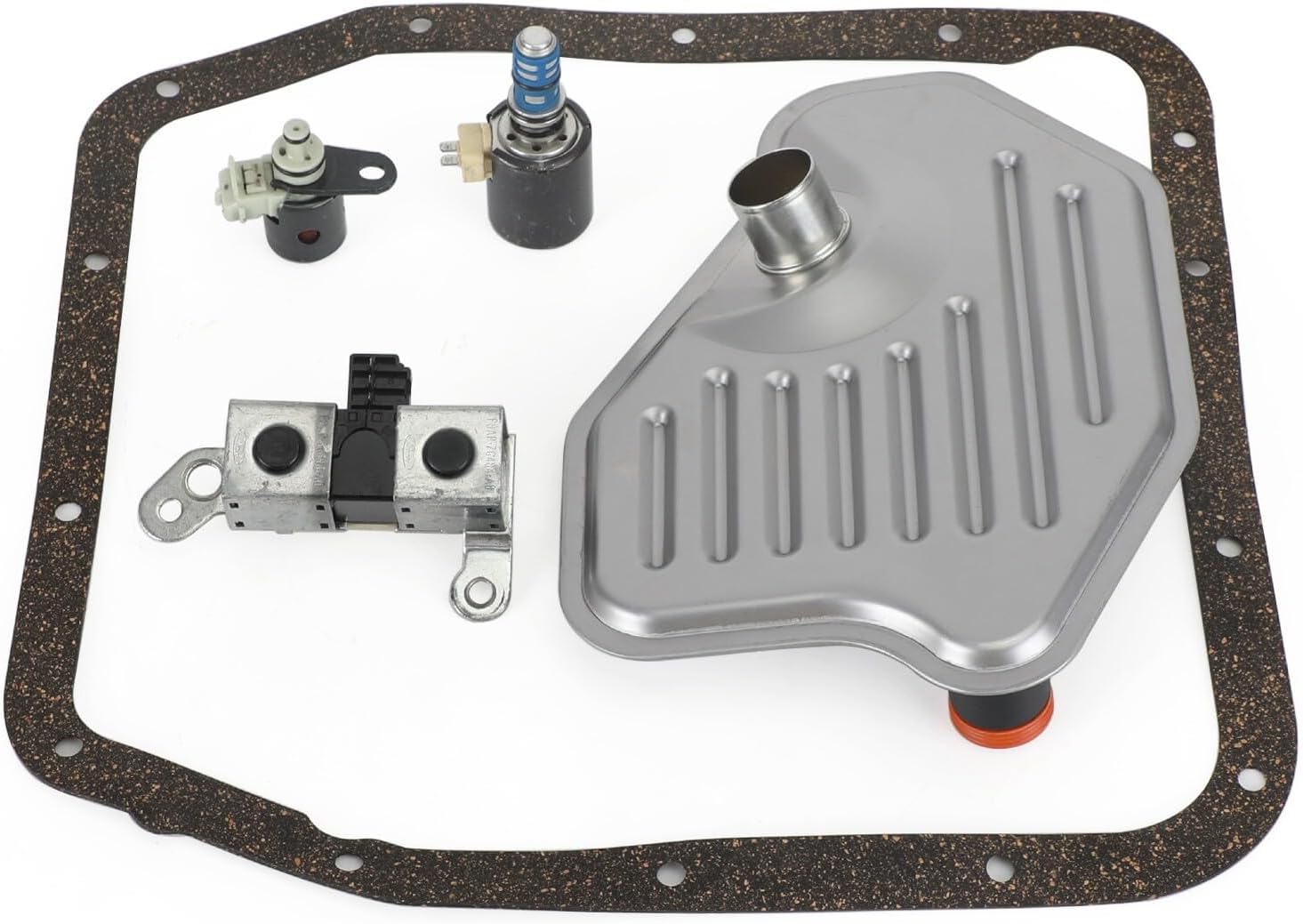
4R70W/4R75W Shift Solenoid Set with Filter and Gasket Kit
Both shift solenoids plus the pan filter and gasket in one box, so the sump does not go back together with the old filter still in it. Fits the 14-bolt pan 4R70W/4R75W units.
See the kit →One tool note
If you do not already own an inductive current clamp that resolves down to fractions of an amp, that is the tool that turns this job from guessing into measuring — it is what lets you watch a commanded solenoid actually pull its half amp instead of assuming it did. Low-current automotive clamp meters cost less than one wrong valve body.
Fluid, and the additive trap
Ford's own Customer Service Division fluid application chart lists the 4R70W, 4R70E, 4R75W and 4R75E as MERCON V, part number XT-5-QMC in quarts. Not MERCON LV, not MERCON SP, and not whatever universal jug is nearest the bench. That same chart tells you to service with the fluid it shows even when an older owner guide, workshop manual or dipstick calls out something else, because Ford has revised recommendations since some of those were printed. Capacity varies enough by chassis and pan that I am not going to print one fill figure here — pull it for the specific application out of the workshop manual.
The chart carries one more line that matters for solenoid work, in Ford's own capital letters: do not use supplemental transmission fluid additives, treatments or cleaning agents, because they may affect transmission operation and result in damage to internal components. A bottle of stop-slip is a popular answer to the sliding shifts described above. It is not an answer to a worn pressure regulator bore, and it is a good way to turn a valve body job into a full overhaul.
The short version
Read the SS1/SS2 chart backwards to name the solenoid before you touch anything. Both solenoids off is 2nd, so a start in 2nd means you are hunting a shared power feed, not two dead solenoids. Sweep the case connector for 20 to 30 ohms on the shift solenoids, 10 to 16 on the TCC and 2 to 5 on the EPC. Command them and watch current, not a test light. If the electrical side checks out and you still have erratic shifts, 2-3 neutral, or no line rise when hot, stop buying solenoids and go look at the solenoid regulator valve and the pressure regulator bore — that is where a lot of "bad solenoid" 4R70Ws actually live.
Need parts for this job?
Shift solenoid sets, EPC and TCC solenoids, filter and gasket kits, Sonnax valve body kits, bands and overhaul parts for the Ford AODE/4R70W/4R75W family.
Shop 4R70W parts →Sources
- Sonnax — "Ford 4R70E, 4R70W, 4R75E, 4R75W, AODE Zip Kit, Part Number AODE-4R75E-ZIP, Installation & Testing Booklet" (2019). Backs the full solenoid application chart used above (SS1/A and SS2/B states for Park, Reverse and OD 1st through 4th, with TCC on PCM command); the 10-pin and 8-pin electronic check tables — Solenoid 1/A and Solenoid 2/B at 20–30 ohms, TCC solenoid at 10–16 ohms, EPC solenoid at 2–5 ohms; both terminal location and function lists, including the shared 12-volt solenoid supply, the transmission oil temp sensor pins and the EPC and TCC power and ground pins; the note that the EPC solenoid is located in the case; the three case connector generations ('97-earlier, 1998-2008, '09-later); and the technical specifications of 106 in-lb on valve body to case and valve body plate bolts, 15 ft-lb on pump-to-case and pump-to-stator bolts, and.005–.020" OE endplay. sonnax.com (PDF)
- ATRA / GEARS Magazine — "Solenoid Application Charts," January/February 2006, pages 77–78. Backs the independent confirmation of the shift pattern: the AODE/4R70W is listed as a two-solenoid unit using the Type 3 chart, which is 1st ON/OFF, 2nd OFF/OFF, 3rd OFF/ON and 4th ON/ON for SS1/SSA and SS2/SSB — matching the Sonnax booklet, and the basis for the statement that both solenoids de-energized lands the valve body in 2nd gear. atracom (PDF)
- ATRA / Gears Magazine — "A Logical Approach to Solenoid Circuit Testing." Backs the principle that a solenoid electrical code describes the whole circuit — power, ground, wiring, connections and the computer — rather than the solenoid alone; the instruction never to use a test light to diagnose computer-controlled circuits, because they illuminate at voltages too low to operate the component; and the roughly 0.42 to 0.63 amp current draw expected from a solenoid circuit in the 20–30 ohm range. gearsmagazine.com
- Transmission Digest — "Ford 4R70W solenoid codes set." Backs the post-overhaul case in which a 4R70W took off in a higher gear with the MIL lit and solenoid codes that were not present in the original scan; the cause being a sub-standard aftermarket case connector with two terminals pushed into the connector so they never contacted the hard wire frame, one of which was the 12-volt solenoid supply circuit; and the correction of installing Ford original equipment hard wire frame and case connector, after which the codes cleared and did not return. transmissiondigest.com
- Transmission Digest — "I Lost My EPC!" Backs the AODE/4R70W pressure-regulator-valve bore wear failure: reduction or complete loss of EPC pressure when the unit is hot, producing no or minimal line rise, medium- to full-throttle slipping in gear and sliding shifts; EPC pressure reading near zero at any throttle opening; EPC pressure being routed to the pressure regulator valve alongside the circuit Ford identifies as boost, which is routed back to the inlet side of the pump; the compressed-air test at the TV pressure port with the pan and filter removed, where blow-by around the EPC solenoid area is normal but air and fluid out of the filter confirms the bore wear; the note that no aftermarket fix was available and the valve body must be replaced; and the observation that minimal bore wear may go unnoticed but show up as premature forward clutch wear. transmissiondigest.com
- Ford Customer Service Division — "Automatic Transmission Fluid Chart" (FCSD Chemicals and Lubricants). Backs the fluid callout that the 4R70W/4R70E and 4R75W/E take MERCON V, part number XT-5-QMC (1 quart) and XT-5-DMC (55 gallon drum); the instruction to service using the fluid shown in the current chart even where older owner guides, workshop manuals or fluid level indicators show a different fluid; and Ford's caution not to use supplemental transmission fluid additives, treatments or cleaning agents, as they may affect transmission operation and result in damage to internal components. fcsdchemicalsandlubricants.com (PDF)
- Sonnax — Ford 4R70W unit parts listing. Backs the solenoid regulator valve complaint list (erratic shifts, 2-3 neutral, neutral after 4th, 3rd and reverse only, no 2nd, loss of Forward under hard acceleration from a stop) and the corresponding Solenoid Regulator Valve Kit 76948-14K and Oversized Solenoid Regulator Valve Kit 76948-47K requiring the matching reaming tool and fixture; and the harness generation split, with F095HD covering '01–'08 units whose solenoids connect to a molded lead frame harness and F098HD covering '09-later units whose solenoids connect to a soft wire harness. sonnax.com