P0715 is the generic OBD-II definition for an input/turbine speed sensor "A" circuit fault. On a Ford 4R70W-family transmission it is one of the more misdiagnosed codes on the bench, because the obvious move — throw a turbine shaft speed sensor at it — fixes it maybe a third of the time. The rest of the time the sensor is fine and something inside the case is stopping it from seeing its target, or the signal never makes it out to the case connector.
Ford also has a manufacturer-specific companion code, P1901, for a turbine shaft speed sensor circuit that is intermittent rather than hard-failed. If you see P1901 alongside P0715, treat it as a connection or air gap problem rather than a dead sensor.
Step Zero: Does This Transmission Even Have a TSS?
Before anything else, confirm the unit is a 2004-or-later build. The turbine shaft speed sensor was not part of the original 4R70W. It arrived at the start of 2004 production, mounted in the center of the case, with two supporting changes: a new sun shell and a center support machined to clear the sensor. Per the ATRA technical manual section on this family, the 4R70E/75E center support has an extra notch cut into it specifically to make room for the turbine speed sensor. Pre-2004 units do not have the sensor, the bore, or the notch.
Used-unit swaps are common on F-150s, E-Series vans, Explorers and Mustangs, so it is entirely possible to end up with a 2001 case bolted behind a 2005 PCM. The PCM looks for a turbine signal, finds nothing, and sets P0715 forever. No sensor you buy will fix that.
How the TSS Actually Reads Speed on This Unit
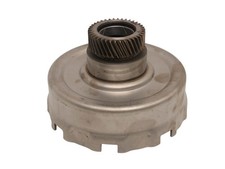
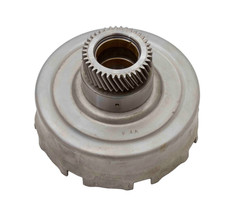
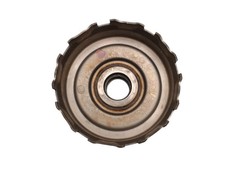
Here is the part that trips up builders coming from other Ford transmissions. The turbine shaft speed sensor on a 2004-up 4R70E/4R75E does not read a dedicated tone ring bolted to a shaft. It reads raised notches stamped into the forward clutch drum, and it reads them through the sun shell.
That only works because the 2004-up sun shell is non-magnetic. ATRA calls this the single most important change in the 4R70E/75E shell and notes it is something you cannot see with the naked eye: for the input speed sensor to work, the shell must be non-magnetic so the sensor can pick up the signal from the stamping on the forward drum. Put a magnetic shell in that case and the sensor is looking at a steel curtain.
The 2004-up shell is dimensionally different too. Height from the bottom of the sun gear to the bearing surface dropped .030 in. for a thicker two-piece bearing — 2.0550 in. early versus 2.0250 in. late, with the related dimension going 1.177 in. to 1.167 in. So the shell, bearing and forward sun gear change as a set or end play will be wrong. Ford sells all three under part number 4L3Z-7D234-AA.
Cause 1: A Magnetic Sun Shell (The Number One Post-Rebuild Cause)
If P0715 appeared the first time you road-tested a freshly built 2004-up unit, look here first. Somebody reused a pre-2004 sun shell, or an aftermarket shell went in that is magnetic. The symptom is exactly what ATRA describes: harsh or no shifting, with possible ratio codes and input speed sensor codes.
The check takes ten seconds and costs nothing. Put a magnet on the shell. If it sticks, that shell does not belong in a TSS-equipped case. Do this on the bench on every 2004-up build, because finding it after the transmission is in the truck means pulling it back out. And replace the set — swapping only the shell leaves you .030 in. off the stack you set up, and end play is wrong before you start measuring.
Cause 2: The Wrong Center Support
Second on the list, and just as easy to do by accident. The 4R70E/75E center support has an extra notch cut out to clear the turbine speed sensor. Install a pre-2004 4R70W support in a 2004-up case and, per ATRA, the turbine speed sensor will not install all the way into the case.
A sensor that will not seat sits too far from its target, and air gap is unforgiving on a magnetic pickup. Sonnax's write-up on the AX4S and AX4N turbine speed sensors makes the point cleanly on a different Ford unit: a sensor that is too long lets the reluctor contact and damage it, while too much air gap produces ratio codes and a turbine speed sensor code. On that transmission the correct gap is roughly .120 in., about two stacked business cards. There is very little room to be wrong.
So if the sensor will not push flush into the case, find out why instead of forcing it. ATRA does note that in a pinch, grinding a notch into the early support will not pose a problem — a field fix, not a first choice, and one that needs the support out and the chips washed out.
Cause 3: The Internal Hard Wire Frame and Case Connector
A perfect sensor reading a perfect target still sets P0715 if the signal never reaches the PCM. On this transmission the internal path runs through a hard wire frame to a case connector, and both are common repair items during an overhaul.
Transmission Digest documented the failure mode directly on a 4R70W. During an overhaul the hard wire frame and case connector were replaced, and on the first road test the transmission took off in a higher gear with the MIL on and solenoid codes that had not been there before. The cause was a substandard aftermarket case connector with two terminals pushed into it so they never contacted the hard wire frame, one of them the 12-volt solenoid supply. Ford original equipment parts cleared it for good: F8AZ-7G276-BA for the hard wire frame, F8AZ-7G276-A for the connector.
That lesson generalizes to any circuit code here. Before condemning the sensor, unplug the case connector and inspect both halves under good light for a terminal sitting lower than its neighbors, spread female terminals, corrosion, or fluid wicking out of the connector body. A terminal pushed back a millimeter looks perfect and conducts nothing. Harness generation matters too: ATRA notes the 1993-1997 connector is white with soft wiring built in, while 1998-on is black with a separate hard plastic harness, and that installing the wrong harness can create multiple codes and erratic shifts.
Diagnosing It on the Scan Tool Before You Pull Anything
Do not diagnose a speed sensor from a single PID. Sonnax's speed sensor article on the Ford 10R family lays out the method that applies to any modern Ford automatic: pull the raw speed PIDs together — engine speed, turbine shaft speed raw, output shaft speed raw — plus commanded gear and measured gear ratio, and read them as a set. Two checks do most of the work:
- Stationary in Park and Neutral. The turbine is coupled to the converter, so with the engine running and the vehicle stopped, turbine speed should report RPM while output speed sits at zero. Zero turbine speed there means no signal: sensor, air gap, target, or wiring. It is the most useful ten-second test on the list.
- Ratio math while driving. Divide turbine speed by output speed and compare against the 4R70W's published ratios: 2.84:1 in first, 1.55:1 in second, 1.00:1 in third, 0.70:1 in overdrive, 2.32:1 in reverse. A turbine PID that tracks but reads low or erratic in every gear points at air gap or a damaged target rather than an open circuit.
Watch how the code behaves, too. A hard P0715 that sets at key-on-engine-running and never recovers reads as an open or shorted circuit. A signal that drops out only at certain speeds or after the unit gets hot reads as marginal air gap, a chafed wire, or a connector terminal — the pattern that usually carries P1901 with it.
Testing the Sensor Itself
If the target and the connector check out, test the sensor. Measure resistance across the two pins: you want a stable reading with the coil neither open nor shorted, and comparing against a known-good sensor of the same part number beats any number copied off a forum. An open or dead short is conclusive; anything in between needs the second test.
That second test is what actually proves the sensor. Set the meter to AC volts, back-probe it, and rotate the input. A magnetic pickup generates its own voltage, so a good sensor at the right air gap produces measurable AC while the target moves past and nothing when it stops. One that passes a resistance check but makes no AC has either failed internally or is not close enough to its target — which puts you back on the center support. Finish by wiggle-testing the harness while watching live data.
4R70W Speed Sensor, 1996-2008
Once you have ruled out the sun shell, the center support and the case connector and the sensor itself is the fault, this is the direct-fit replacement. Confirm your unit's year before ordering, because sensor length changed with the 2004 redesign.
Get the 4R70W speed sensor →Not sure which one you need? Browse the full 4R70W parts collection.
Do Not Confuse This With P0720
P0715 and P0720 are different sensors at opposite ends of the transmission, and on this family P0720 has a specific mechanical cause with nothing to do with the turbine sensor.
For 2004, Ford changed how the output speed sensor reads. The new sensor uses an exciter ring made of 24 extended parking pawl lugs, where the older setup used six holes machined around the ring gear. ATRA spells out what happens when those get mixed: an early ring gear in a late transmission cuts the output signal by 75 percent and the unit will not shift out of first, while a late ring gear in an early transmission produces a signal 400 percent too fast and puts the transmission in fourth by the time you hit 10 mph. There is no interchange. The sensor changed too — oval connector to square in 2001, length unchanged until the 2004 ring gear revision.
So: a no-shift-out-of-first complaint or a wildly wrong speedometer is a ring gear and OSS story. Harsh engagement and failsafe from a slip calculation the PCM cannot make is a TSS story.
Fluid, and What Not to Put in It
Ford's current fluid application chart specifies MERCON V for the 4R70W, 4R70E, 4R75W and 4R75E. It is not interchangeable with the low-viscosity fluids in Ford's later six- and ten-speeds, and the chart is explicit that the listed fluids are unique and must be used in the applications recommending them. It also cautions against supplemental additives, treatments and cleaning agents, which may affect transmission operation and damage internal components. After you fix a P0715, the fix is the fix — a bottle of stop-slip does nothing for a sensor circuit and can cost you the clutches.
One More Thing: Check the Engine Side
Before you accept any speed-sensor diagnosis on a 4R70W, rule out the engine. Rolly Alvarez's case study in GEARS Magazine shows how easily an engine fault reads as a transmission fault: a warped plastic intake manifold letting coolant into the combustion chambers caused an intermittent misfire that showed on the scanner only in the 35-45 mph lockup range and during 4-6 mph acceleration, with no check engine codes stored at all. A misfire under converter lockup produces shudder and speed signal noise that feels like a transmission problem from the driver's seat.
The Short Version: A P0715 Checklist
- Confirm the unit is 2004-or-later and physically has a TSS in the center of the case.
- Read live data. Turbine speed should report RPM in Park and Neutral, engine running, vehicle stopped. Zero there means no signal.
- Inspect the case connector and internal hard wire frame for pushed-back, spread or corroded terminals. Use Ford OE parts.
- Wiggle-test the external harness while watching the turbine PID.
- Test the sensor: resistance for opens and shorts, then AC output with the target turning.
- If the unit is apart: magnet-check the sun shell, and confirm the center support is the notched 2004-up part.
- Replace shell, bearing and forward sun gear as a set (4L3Z-7D234-AA) and reset end play.
- Refill with MERCON V. No additives.
Worked in that order, this is a two-hour diagnosis instead of a second teardown. The habit worth building is the magnet check on the bench: it is free, and it prevents the most expensive version of this failure.
FAQ
Does a pre-2004 4R70W have a turbine shaft speed sensor?
No. The TSS was added to this family at the start of 2004 production, along with a non-magnetic sun shell and a center support machined to clear the sensor. If a 2003-or-earlier 4R70W is setting P0715, the transmission and the vehicle do not match, which is what happens when a used-unit swap puts an early case under a 2004-up PCM.
What is the difference between P0715 and P0720 on a 4R70W?
P0715 is the turbine (input) shaft speed sensor circuit, reading the forward clutch drum through the sun shell in the middle of the case. P0720 is the output shaft speed sensor circuit, reading the ring gear at the back of the unit. On this transmission they have completely different causes: P0720 is usually a ring gear or sensor-length mismatch between pre-2004 and 2004-up parts.
Why did P0715 come back right after I rebuilt the transmission?
That is the classic pattern, and it usually is not the sensor. The three build errors that set it are a magnetic sun shell in a 2004-up case, a pre-2004 center support that will not let the sensor seat fully, and a damaged or aftermarket internal hard wire frame and case connector. Check those three before buying another sensor.
Can you drive a truck with a P0715 code?
You can move it, but you should not keep driving it. Without a turbine speed signal the PCM loses its slip calculation and drops the transmission into failsafe: harsh engagement, a fixed gear, no torque converter clutch. Miles in failsafe put full line pressure through the clutches on every shift, which is how a sensor complaint turns into a clutch complaint.
What fluid does a 4R70W take?
MERCON V. Ford's current fluid application chart lists MERCON V for the 4R70W, 4R70E, 4R75W and 4R75E. That chart also carries an explicit caution against supplemental transmission additives, treatments and cleaning agents.
Working a 4R70W this week?
Speed sensors, internal wiring harnesses and case connectors, solenoid kits, sun shells, valve body parts and rebuild kits — shipped fast from the USA.
Shop 4R70W parts →Sources
- ATRA — "Ford 4R70W/4R70/75E" technical manual section, 2009 (PDF). Backs the non-magnetic sun shell requirement for the input speed sensor to read the forward drum stamping and the resulting harsh or no shift with ratio and input speed sensor codes; the 4R70E/75E center support notch cut for turbine speed sensor clearance; the Ford sun shell, bearing and forward sun gear service kit 4L3Z-7D234-AA and the 2.0550 in. versus 2.0250 in. and 1.177 in. versus 1.167 in. dimensional changes; the 1993-1997 white versus 1998-on black case connector and hard wire frame change; and the 2004 output speed sensor change to a 24 extended parking pawl lug exciter ring with the 75 percent and 400 percent signal errors from mismatching ring gears. atracom.blob.core.windows.net
- Transmission Digest — "Ford 4R70W solenoid codes set," Wayne Colonna, January 23, 2023. Backs the internal hard wire frame and case connector as a real cause of electrical codes on this transmission after an overhaul, the substandard aftermarket connector with terminals pushed back out of contact, and the Ford part numbers F8AZ-7G276-BA for the hard wire frame and F8AZ-7G276-A for the connector. transmissiondigest.com
- Ford Customer Service Division — "Automatic Transmission Fluid Chart" (PDF). Backs MERCON V as the specified fluid for the 4R70W, 4R70E, 4R75W and 4R75E, and the manufacturer caution against supplemental transmission fluid additives, treatments and cleaning agents. fcsdchemicalsandlubricants.com
- Sonnax — "AX4S and AX4N Turbine Speed Sensors," Mike Steen, March 19, 2004. Backs the air gap principle used in the bench-check section: a turbine speed sensor that is too long contacts the reluctor and is damaged, while too much air gap produces ratio codes and turbine speed sensor codes, on a unit where the correct gap is approximately .120 in. sonnax.com
- Sonnax — "Diagnosing Ford 10R60, 10R80 & 10R140 Series Speed Sensor Issues," Jim Mobley, February 8, 2024. Backs the scan tool method used here: pull the raw turbine, output and engine speed PIDs together, confirm that turbine speed reports RPM with the vehicle stationary in Park and Neutral, and divide input speed by output speed to check the measured ratio against the unit's published gear ratios rather than trusting a single PID. sonnax.com
- GEARS Magazine (ATRA) — "The 4R70W: Getting the Shaft," Rolly Alvarez, May 3, 2021. Backs the point that engine-side faults drive transmission complaints on these units: an intermittent misfire from a warped plastic intake manifold showed up on the scanner only in the 35-45 mph lockup range and during 4-6 mph acceleration, with no check engine light stored. gearsmagazine.com