P0730 is the code that gets parts thrown at a TorqShift. It reads "incorrect gear ratio," which sounds like a single fault, and a lot of trucks get a solenoid kit or a used transmission on the strength of it. On a Ford 5R110W the code does not name a part. It means the PCM compared what the turbine and output shafts were doing against the gear it commanded and the numbers did not add up. Something between those two sensors slipped, failed to apply, or failed to release. Your job is to find out which clutch, in which gear, and why.
Below: how the PCM works out the ratio, what the companion codes tell you, how to split the unit in half with the intermediate shaft speed sensor, and the documented causes. Sources are listed at the end.
What P0730 means on the 5R110W
P0730 is the generic SAE "incorrect gear ratio" code. The ATSG 5R110W manual lists it in the TorqShift code chart as "PCM has detected a gear ratio error," with the component given as "Clutch Control Solenoid or Internal Problem." That is the whole definition. It does not say which gear and it does not say which clutch.
Ford's own monitor on this transmission goes further, and that matters for diagnosis. Ford's 2004 OBD system operation summary for the 6.0L diesel states that the 5R110W cannot isolate a shift solenoid fault from the rest of the mechanical and hydraulic system. So instead of blaming a solenoid, the PCM tests each clutch system as a whole: the solenoid, its circuit in the solenoid body, the seals and the clutch pack. A clutch-system code sets when that clutch is in the wrong state for 3 commanded cycles. After the first bad event the PCM can run a test mode that cycles the suspect clutch and retests it, usually within about 30 seconds of driving.
The early calibrations set P2700 through P2704 (coast, overdrive, intermediate, direct and low/reverse clutch). Ford's later summaries say these were replaced by codes that tell you the failed state: P0751/P0752 for the coast clutch (SSA) failed off or on, P0756/P0757 for the overdrive clutch (SSB), P0761/P0762 intermediate (SSC), P0766/P0767 direct (SSD) and P0771/P0772 low/reverse (SSE). So a P0730 rarely shows up alone on a TorqShift. Pull every code in memory, pending ones included. A P0730 with a P0766 is a direct clutch problem. A P0730 with a P2702 is an intermediate clutch problem. The companion code tells you where to look; P0730 just confirms the ratio was wrong.
How the PCM works out the ratio
The 5R110W is an overdrive planetary section in front of a Simpson gear train, a redesign of the 4R100. It has three Hall-effect speed sensors: turbine shaft speed (TSS), intermediate shaft speed (ISS) and output shaft speed (OSS). Ford's 2010 summary describes the speed chain directly: TSS plus the state of the overdrive gear set gives ISS, and ISS plus the state of the Simpson gear set gives OSS. The ratio the PCM checks is turbine speed divided by output speed.
Here are the ratios from the ATSG manual, with the clutches each gear needs. The clutch-per-gear mapping matches Ford's monitor description, which checks the overdrive clutch in 2nd and 6th, the intermediate clutch in 3rd, and the direct clutch in 5th and 6th. The forward clutch is applied in all forward ranges through the manual valve.
| Gear | Ratio (ATSG) | Holding elements (plus forward clutch) |
|---|---|---|
| 1st | 3.09 | Low one-way clutch, OD one-way clutch (coast clutch for engine braking in manual 1) |
| 2nd | 2.20 | Overdrive clutch, low one-way clutch |
| 3rd | 1.54 | Intermediate clutch, OD one-way clutch |
| 4th (cold mode only) | 1.09 | Intermediate clutch, overdrive clutch |
| 5th | 1.00 | Direct clutch, OD one-way clutch |
| 6th | 0.71 | Direct clutch, overdrive clutch |
| Reverse | 2.88 | Direct clutch, low/reverse clutch |
Two things in that table catch people out. First, the overdrive section only ever does two jobs: 1.00 through its one-way clutch or 0.71 with the overdrive clutch applied. That is why 2nd (3.09 x 0.71) and 6th (1.00 x 0.71) share a clutch, and why one overdrive clutch fault takes out both. Second, the unit uses only five of its six ratios at a time. Per ATSG, below about 5 degrees F the PCM runs cold mode and shifts 1-2-3-4-6. Warm, it shifts 1-2-3-5-6. Ford's summary gives the reason: the direct clutch takes too long to apply when the fluid is very cold.
Symptoms that come with P0730
- Flare on a specific shift. Engine rpm jumps during or after the upshift because the oncoming clutch is not holding. A flared 1-2 points at the overdrive clutch; a flared 2-3 at the intermediate; a flared 3-5 at the direct.
- Missing gears. Once the PCM has failed a clutch it can turn off the gears that need it. Ford's example: with the overdrive clutch failed off, 2nd, 4th and 6th are disabled.
- Limp mode with a flashing Tow/Haul lamp, which ATSG notes the PCM uses to flag an operating fault.
- No reverse plus a "lost a gear" feel up top. The direct clutch works in reverse, 5th and 6th, so losing it is obvious in reverse but subtle going forward.
Diagnosis: find the gear, then the clutch
Step 1: every code and the freeze frame
Record stored and pending codes and the freeze frame (commanded gear, fluid temperature, speed) before clearing anything. If speed sensor codes (P0715, P0717, P0720, P0722) are present, fix those first: a dropped TSS or OSS signal makes a healthy gear train look like it is slipping.
Step 2: fluid level and condition
Check the level hot with the engine running. Low fluid drops line pressure and can set ratio codes in several gears. Burnt fluid and friction material in the pan mean a clutch pack is already cooked, and you are into an overhaul, not a solenoid swap.
Step 3: graph TSS, ISS, OSS and commanded gear
Road test with a scan tool graphing the three shaft speeds against commanded gear. Work the ratios out yourself:
- TSS / OSS should match the table above in each gear. In 3rd at 1,000 rpm output, turbine should be close to 1,540 rpm. Turbine running high is slip.
- TSS / ISS is the overdrive section alone. It should read 1.00 in 1st, 3rd and 5th and 0.71 in 2nd, 4th and 6th. If it reads wrong, the fault is in front of the center support: overdrive clutch, coast clutch or the OD one-way clutch.
- ISS / OSS is the Simpson gear train alone: 3.09, 1.54 or 1.00. If it reads wrong, the fault is behind the overdrive section: forward, intermediate, direct or low/reverse clutch, or the low one-way clutch.
That one step cuts the transmission in half before you lift a wrench, and it tells you which half to open.
Step 4: don't count on the pressure switches
The solenoid body carries five normally closed pressure switches, PS-A through PS-E, one per shift solenoid circuit, each opening above 40 psi. Older write-ups tell you to watch them for clutch apply. ATSG notes that use of the pressure switch input was dropped from the vehicle calibration before the 2003 model year went into production, and Pete Luban's Transmission Digest case on a later F-250 notes that the unit had no intermediate pressure switch at all. On most trucks you will not have pressure switch data to lean on, so the speed sensor ratios are your best evidence.
Step 5: check the solenoids before you condemn hard parts
With the pan down you can check each shift solenoid at the case connector. ATSG lists 4.1-4.7 ohms at 72 degrees F for SSPC-A (pins 12 and 20), SSPC-B (3 and 20), SSPC-C (5 and 24), SSPC-D (4 and 24) and SSPC-E (1 and 24). Resistance is not the whole story, though. In the Luban case, a diesel F-250 came in with P2702, a delay into Drive, a flared 1-2 and the Tow/Haul lamp flashing. The intermediate clutch solenoid (SSPC-C) measured fine electrically, but its body and stem had separated at the crimps, leaking the intermediate clutch circuit. Pull each solenoid and check that the stem is tight in the body. Solenoid body bolts are 10 N-m (89 in-lb) per ATSG.
Documented causes
Center support sleeve walking (direct clutch)
Wayne Colonna's Transmission Digest case: a 5R110W came back a month after a forward planet repair with no reverse and a "lost a gear" feel going forward. The sleeve in the center support had walked and cut direct clutch apply oil. A new center support fixed it. Direct clutch loss shows in reverse, 5th and 6th, which matches a P0730 with a direct clutch code, or a TSS/OSS error in 5th with ISS/OSS reading wrong.
Missing bleed filter in a reman pump (overdrive clutch)
Colonna documented a 5R110W with no 2nd or 6th gear, setting P0732 (2nd gear ratio), P0756 (overdrive clutch solenoid stuck off) and P2701. The overdrive clutch B bleed filter was missing from a remanufactured pump. The filter is not serviceable, so the pump cover has to be replaced; ATSG bulletin 19-37 covers cover-to-body interchange. Colonna warns against plugging the hole or making up a substitute filter, because that can cause 1-2 and 5-6 shift problems.
Wrong-year hard parts after a rebuild
If P0730 shows up right after an overhaul, check what went in. Mike Riley's Transmission Digest rundown of TorqShift updates lists two planetary changes that matter here. In 2005 the front planetary changed tooth counts: planet pinions went from 18 to 23 teeth, the front ring gear and hub from 78 to 101, and the front sun gear from 42 to 55. In 2007 Ford changed the overdrive planet, sun gear and ring tooth counts, and Riley notes this "resulted in a slight ratio difference." Riley also lists the later rear planet and low one-way clutch assemblies as 9C3Z-7D006B (five-plate low/reverse) and 9C3Z-7D006AB (six-plate). Mixed-year parts can hand the PCM a ratio it was not calibrated for, so match parts to the build date.
The fix
- Speed sensor fault: repair the sensor or wiring and clear codes. Do not chase ratio codes until the sensor data is clean.
- Solenoid fault: replace the failed solenoid. On a high-mileage unit with the other solenoids original, a full set costs little more than doing it again later.
- Hydraulic fault (center support sleeve, pump bleed filter, seals): replace the part as the case files describe. Do not plug or improvise.
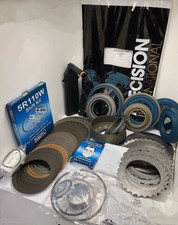
- Burned clutch pack or wrong-year parts: overhaul with parts matched to the build date. Flush the cooler and replace the remote inline filter. Friction material left in the cooler will go straight back into the new unit.
- Refill: Ford's Motorcraft chart lists MERCON LV for the 5R110 TorqShift, including back-service. Set the final level hot on the dipstick.
Then clear codes and road test with the same graph running. Ford's monitor needs 3 bad events to set a clutch code, so a short drive around the block does not prove the repair. Drive it through every gear, warm, with a manual-range coast-down so the coast and low/reverse clutch tests can run.
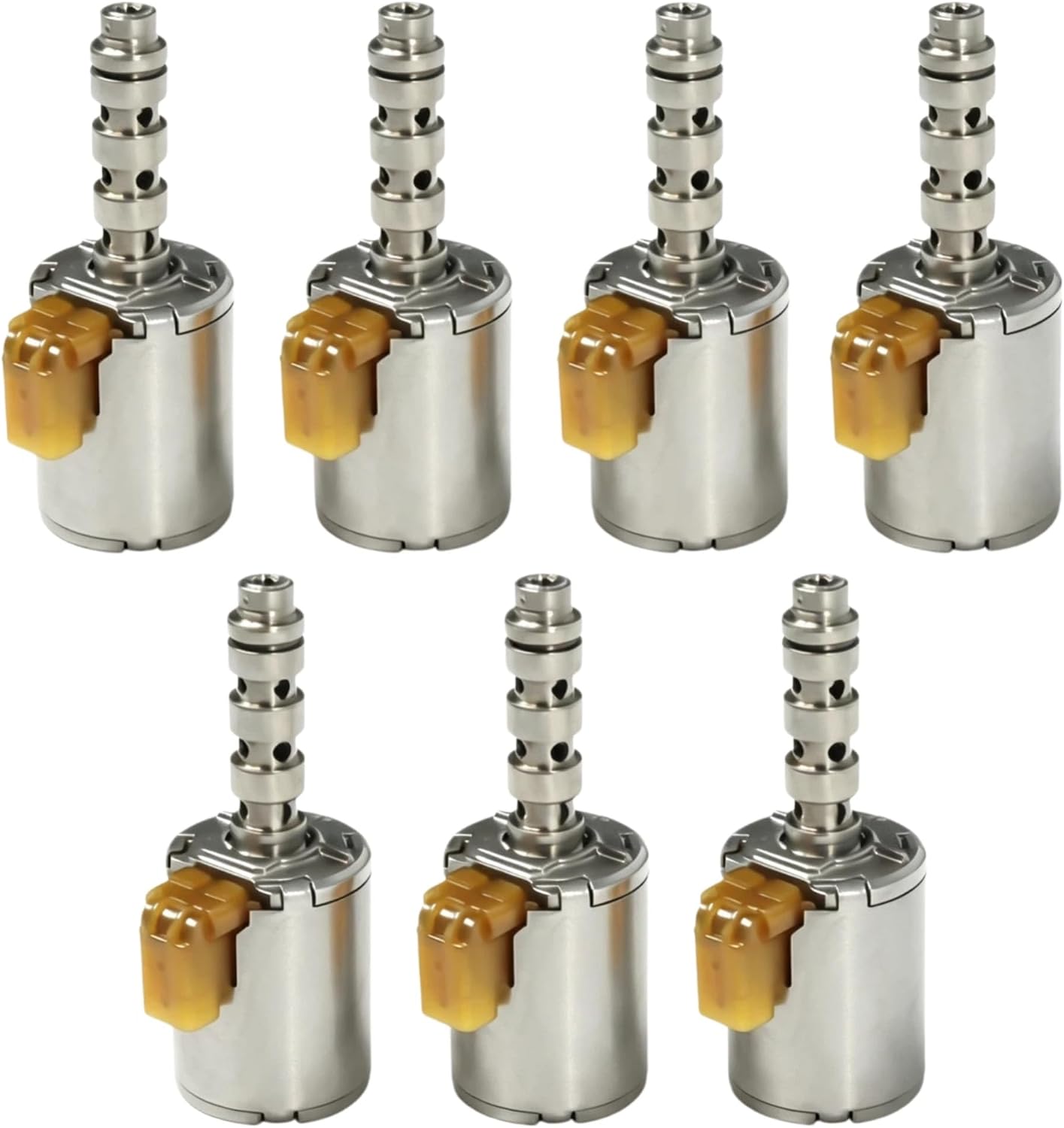
Shop the part for this fix: 5R110W 7-piece master solenoid set
Full TorqShift solenoid set (OEM 3C3Z-7G383AB) with all five clutch solenoids, for when a clutch solenoid has failed and the rest of the set is original.
See the solenoid set at CoreTransmissionPartsPreventing a repeat
Keep the fluid and remote filter on schedule, especially on a tow rig. After any overhaul, check the center support sleeve, confirm the pump has its bleed filter, test every solenoid stem for looseness, and match planetary and one-way clutch parts to the unit's year.
Need parts for this job?
Our 5R110 parts page has solenoid kits, solenoid bodies, clutch modules, planetaries and master rebuild kits for the TorqShift, all on our own checkout.
FAQ
What does P0730 mean on a Ford 5R110W?
P0730 means the PCM calculated a gear ratio that does not match the gear it commanded. ATSG lists it on the 5R110W as a gear ratio error caused by a clutch control solenoid or internal problem. It does not name the gear or the clutch, so the companion codes and the speed sensor data have to tell you that.
Will a new solenoid fix P0730?
Only if a solenoid is the cause. Ford states the 5R110W cannot isolate a shift solenoid from the rest of its clutch system, so a ratio error can just as easily be a worn clutch pack, a leaking seal, a walked center support sleeve or a pump fault. Check the companion code and split the unit with TSS, ISS and OSS before you buy parts.
Why did my 5R110W set P0730 right after a rebuild?
Check the hard parts that went in. Ford changed front planetary tooth counts in 2005 and overdrive planetary tooth counts in 2007, and Transmission Digest notes the 2007 change gave a slight ratio difference. Mixed-year planetaries, a missing pump bleed filter or a mis-positioned center support sleeve can all set ratio codes on a fresh unit.
Can I drive with P0730?
Not for long. A ratio error means a clutch is slipping or not applying, and slip makes heat that burns the friction material and contaminates the fluid. The PCM may also disable gears or go into limp mode. Get it diagnosed before a repairable fault turns into an overhaul.
Related guides
- 5R110W P0741: TCC Stuck Off Causes & Fix
- 5R110W Slipping: Causes and Fix
- 5R110W No Reverse Fix
- 5R110W Won't Shift Into Overdrive
- 5R110W Gear Ratios and Specs
- 5R110W Limp Mode Causes
Sources
- ATSG, Ford 5R110W (TorqShift) technical manual (2004). Backs P0730 as "PCM has detected a gear ratio error" for the clutch control solenoid or internal problem; the 3.09/2.20/1.54/1.09/1.00/0.71 and 2.88 reverse ratios; cold mode 1-2-3-4-6 below about 5 degrees F; the five 40 psi pressure switches and the note that pressure switch input was dropped before 2003 production; the solenoid case connector pins and 4.1-4.7 ohm spec; and 10 N-m solenoid body bolts. ATSG manual (PDF)
- Ford Motor Company, OBD system operation summaries: 2004 MY 6.0L diesel (rev. August 7, 2003) and 2010 MY (rev. April 6, 2009), 5R110W sections. Back the statement that the 5R110W cannot isolate a shift solenoid from its clutch system; clutch-system codes after 3 bad commanded cycles; P2700-P2704 and their replacement by P0751/P0752, P0756/P0757, P0761/P0762, P0766/P0767 and P0771/P0772; the gears each clutch is tested in; overdrive clutch failed off disabling 2nd, 4th and 6th; the TSS-ISS-OSS speed chain; and cold mode. 2004 6.0L summary (PDF, archive.org) / 2010 summary (PDF, archive.org)
- Transmission Digest, Mike Riley, "5R110W Upgrades" (December 2013). Backs the 2005 front planetary tooth count changes (18 to 23, 78 to 101, 42 to 55), the 2007 overdrive planetary tooth count change and resulting slight ratio difference, the OD one-way clutch widened about 0.040 in., and rear planet/low OWC part numbers 9C3Z-7D006B and 9C3Z-7D006AB. transmissiondigest.com
- Transmission Digest, Pete Luban (ATSG), "What the ...!" (September 2010). Backs the diesel F-250 with P2702, delayed Drive engagement, flared 1-2 and flashing Tow/Haul lamp caused by a separated SSPC-C solenoid stem, and the later unit with no intermediate pressure switch. transmissiondigest.com
- Transmission Digest, Wayne Colonna (ATSG): "Missing You" (June 2006) and "Ford 5R110W without second or sixth gear" (October 2024). Back the walked center support sleeve cutting direct clutch oil (no reverse, lost gear forward), and the missing clutch B bleed filter in a reman pump setting P0732, P0756 and P2701, with the pump cover replacement and ATSG bulletin 19-37. "Missing You" / "Without second or sixth gear"
- Ford Customer Service Division, Motorcraft ATF quick reference chart. Backs MERCON LV for the 5R110 TorqShift, including back-service. Ford ATF chart (PDF)