A TorqShift in limp mode is easy to recognize from the driver's seat. The truck pulls away sluggish, as if it started in a high gear, the tach sits low under load, the upshifts stop, and Reverse still works. Owners describe it as "stuck in fifth." Shut the truck off, restart it, and sometimes it drives normally for a few miles before it drops back into the same state.
That behavior is the transmission's failsafe doing its job, and it tells you the problem is electrical until proven otherwise. The 5R110W has no shift valves in the conventional sense. Every clutch is controlled by current from the PCM, so when the PCM stops trusting what it sees, or cannot drive the solenoids at all, the hydraulics fall back to whatever the solenoids produce with zero current. This guide explains why that default is 5th and Reverse, then walks the diagnosis in the order I work it: codes and data, power and grounds, the case connector and internal harness, the sensors, the solenoids, and finally the module.
Why the 5R110W defaults to 5th and Reverse
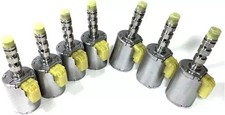
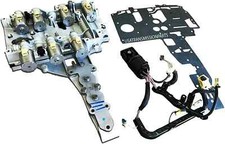
The solenoid body on a 5R110W is not a valve body in the old sense. Per ATSG, it holds seven variable force solenoids, five normally closed pressure switches, the transmission fluid temperature (TFT) sensor, the manual valve and an over-pressurization relief ball, and no other valves. Each clutch pack except the forward clutch has its own solenoid. The forward clutch is applied through the manual valve.
The solenoids come in two types. Transmission Digest, ATSG and Sonnax all describe the same split:
| Solenoid | Controls | Type | Output at 0 amp |
|---|---|---|---|
| PC-A | Line pressure | Inversely proportional | Maximum |
| SSPC-A | Coast clutch | Inversely proportional | Maximum |
| SSPC-D | Direct clutch | Inversely proportional | Maximum |
| SSPC-B | Overdrive clutch | Directly proportional | None |
| SSPC-C | Intermediate clutch | Directly proportional | None |
| SSPC-E | Low/reverse clutch | Directly proportional | None |
| TCC | Converter clutch | Directly proportional | None |
The PCM varies current between 0 and 1 amp. Now take all the current away. Line pressure goes to maximum. The direct clutch and coast clutch get full apply oil. The overdrive, intermediate and low/reverse solenoids and the converter clutch go dead. With the selector in Drive, the manual valve applies the forward clutch, and forward plus direct is 5th gear, the 1.00 ratio. In Reverse the manual valve routes the oil, so the unit still has a reverse. That is why a TorqShift with no solenoid control launches in 5th, never downshifts, has no converter lockup, and feels firm: line pressure is pinned high.
The truck gets into that state in two ways. The first is a real loss of power to the solenoids, from a blown fuse, an open feed, a connector that has backed out, or a module that has shut its drivers off. The second is a deliberate failsafe: the PCM sets a code it considers critical, stops commanding the solenoids and lets the hydraulics fall back. ATSG's line pressure test notes warn that certain sensor failures cause high line pressure and Failure Mode Effect Management (FMEM) actions, and that the electrical faults must be repaired before any pressure test results can be trusted.
Step 1: Pull codes from the engine side too
On most 5R110W trucks the PCM runs both the engine and the transmission, and it uses engine inputs to set shift pressure and schedule. ATSG's DTC chart lists engine-side codes because they change transmission behavior: MAF (P0102, P0103), IAT and ECT range faults, throttle or accelerator pedal position faults (P0121-P0123), crank and ignition faults, and a lost vehicle speed signal from the ABS module (P0500, P0503). Transmission Digest notes that a failed APP sensor makes the transmission run higher-than-normal line pressure to protect itself. So a pedal sensor fault alone can make the truck shift hard, and it can look like a transmission problem.
Write down every code and its freeze frame before you clear anything. Then sort the transmission codes into groups, because the group tells you where to look:
| Codes (per ATSG chart) | What the PCM saw | Where to look first |
|---|---|---|
| P0706, P0707, P0708 | TR-P sensor frequency or duty cycle out of range, circuit fault | TR-P sensor, its connector, feed and ground |
| P0711, P0712, P0713 | TFT stuck, or reading past 315°F or below -40°F | TFT sensor and its circuit in the harness |
| P0715, P0717, P0718, P0720-P0722 | TSS or OSS signal lost, noisy or never seen | Speed sensors, connectors, wiring routed near the exhaust |
| P0730 | Gear ratio error | Mechanical or hydraulic: clutch, pump, stuck solenoid valve |
| P0743, P0748, P0750-P0757, P0960-P0974 | Solenoid circuit open, shorted to ground or power, or solenoid failed on or off | Case connector, internal harness, solenoid coil, PCM driver |
Several solenoid codes at once almost never means several bad solenoids. It points at something they share: the power feed, the case connector or the internal harness. ATSG's case connector pinout shows why. One VPWR pin feeds both PC-A and the TCC solenoid, another feeds SSPC-A and SSPC-B, and each solenoid gets its ground from its own PCM driver pin. Lose one feed and you lose a group of solenoids at the same moment.
Step 2: Battery, fuses and grounds
This step is boring, but it fixes a lot of these trucks. The solenoids are current-controlled. If system voltage sags or a ground has resistance, the PCM cannot hold the current it commands, and it will flag the circuit.
Load-test both batteries, check the fuses that feed the PCM and the transmission, then voltage-drop the grounds. GEARS magazine covered a 5R110 that lost all movement within 100 miles of a rebuild and tied the problem partly to bad chassis grounds. Their test, done with the engine running and measured from the battery ground post to each component: no more than 0.10 V DC at the engine block, frame, cab and transmission case, and under 0.40 V DC while cranking. Anything over that gets the cable cleaned or replaced and the mounting surface taken to bare metal. Do this before you order parts. A new solenoid kit will not fix a bad ground.
Step 3: Case connector and internal harness
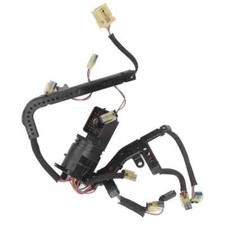
The 5R110W runs everything through one round case connector. Per ATSG, pins 2, 6, 19 and 23 are unused. The rest carry the five SSPC grounds, the TCC and PC-A grounds, the VPWR feeds, the five pressure switch signals, the TR-P signal, ground and feed, and the shared pressure switch and TFT ground. Inside the pan, a molded harness plugs into each solenoid (natural-colored connectors), each pressure switch (black connectors), and separate plugs for the TFT and TR-P sensors.
Things to check:
- The external connector. Look for fluid wicking into the connector, green corrosion, pushed-back pins and a broken locking tab. An intermittent limp mode that clears on a key cycle often turns out to be the connector.
- Wiggle test with the scan tool connected. Watch solenoid circuit status, TFT and TR-P while you flex the harness along the frame and at the case. A reading that drops out, or a code that sets while you move the harness, has found the fault.
- Coil resistance through the case connector. ATSG lists the solenoids at 4.1-4.7 ohms at 72°F measured across their case connector pins, with one solenoid in a 5.1-5.8 ohm range. The pressure switches read about 0.5 ohm closed. If a reading is open or far out of spec through the connector but correct at the solenoid itself, the internal harness is bad.
- The C138E harness on 6.0L trucks. Transmission Digest documented a 2005 F-350 6.0L that stored P0753, P0752, P0973 and P2700. The cause was a leaking water-in-fuel sensor in the fuel/water separator: diesel wicked up the C138E harness along the left frame rail and into the PCM on the driver-side inner fender, which held about a pint of fuel. A PCM and a new sensor (6C3Z-9C264-A) fixed it. On a 6.0L with a spread of solenoid codes, look there before you drop the pan.
- The internal harness under the pan. Look for chafed insulation, cracked connector bodies and terminals that have spread and lost tension.
A note on the pressure switches: ATSG states that use of the pressure switch inputs was dropped from the vehicle calibration before the 2003 model year went into production. The switches are still in the solenoid body and still wired to the case connector, but on production calibrations they are not what triggers limp mode. Sonnax's pressure switch notice says the same thing from the parts side: the computer was never programmed to monitor them, they were removed from late 2004 production on, and a switchless solenoid body or harness works fine in an early truck (Ford Special Service Message 17614).
Step 4: The sensors the PCM cannot shift without
If the codes point at inputs rather than outputs, the transmission is usually fine. The PCM has stopped shifting because it cannot see what the transmission is doing.
TR-P sensor
The TR-P sensor is internal, bolted to the case next to the solenoid body, non-adjustable, and not serviced separately. ATSG describes it as sending the PCM a fixed frequency with a different duty cycle for each of the seven lever positions, with the windows spread from about 7% to about 90%. The PCM uses it for start-in-Park/Neutral, the reverse lamps, line pressure, shift scheduling and TCC. A duty cycle that lands between windows, or jumps when the lever moves, sets P0707 or P0708 and can drop the unit into failsafe. Watch the TR PID while you move the lever slowly through each position. It should step cleanly and hold steady.
TSS, ISS and OSS
Transmission Digest describes the turbine and intermediate speed sensors as Hall-effect sensors reading 30 teeth per revolution off the coast clutch input hub and the overdrive ring gear, and the OSS as a bi-directional, digital-output sensor on the extension housing. Without good turbine and output speed signals, the PCM cannot calculate gear ratio and will not shift. On a road test, graph TSS and OSS against each other. A signal that drops to zero, spikes, or reads noisy at a steady speed is the fault. Before you replace a sensor, check its connector and look for wiring that has melted near the exhaust.
One trap is specific to this unit. Transmission Digest's Wayne Colonna wrote up a 2010 F-450 with a 6.8L V10 that came in with no shifts and a power loss complaint, P0720 and P0722 stored, and every speed sensor PID reading zero. A new OSS did not fix it. The actual fault was broken wires at the TSS/ISS connector, which set no input speed codes at all. Per the ATSG schematic, the TSS/ISS and the OSS share one reference voltage circuit and one ground circuit at the PCM, so on a 5R110W an output speed code does not prove the problem is at the extension housing. Our 5R110W P0720 guide walks through that diagnosis step by step.
TFT sensor
The TFT is a thermistor in the solenoid body. Resistance drops as fluid temperature rises. ATSG's chart runs from about 100k ohms at 32°F down to roughly 0.5-0.8k ohm at 231-266°F. The PCM uses it for cold and hot mode shift strategy and converter lockup timing. Below -15°C (5°F) the unit runs its cold schedule and uses 4th (1.09) instead of 5th, so a TFT that reads falsely cold changes how the truck shifts. An open or shorted TFT sets P0712 or P0713 and puts the truck on a default strategy. After an overnight cold soak, compare the TFT PID with engine coolant temperature. They should read close to each other.
Step 5: The solenoids and valves themselves
When the circuits check out and a single solenoid code keeps coming back, the problem is the solenoid or the valve it controls. The 5R110W is sensitive to fluid condition. Transmission Digest and ATSG both describe the unit as designed around MERCON SP and not interchangeable with MERCON or MERCON V. Later trucks call for MERCON LV, so go by what the dipstick says. Wrong fluid or clutch debris sticks solenoid valves, and a stuck valve can set a "failed on" or "failed off" performance code even though the coil measures correctly.
Replace solenoids as a set when the unit has lived on contaminated fluid, or when you have several performance codes and the wiring is proven good. When you do, clean the pan and magnet, change the filter, flush the cooler, and replace the internal harness if its connectors are brittle. Per ATSG, every solenoid except PC-A can be changed without removing the solenoid body. PC-A requires removing the body.
After any solenoid, valve body or harness work, run a relearn. Transmission Digest's procedure: warm the fluid to 130°F (54°C), then do five Park-to-Reverse, five Drive-to-Reverse, five Reverse-to-Drive and five Neutral-to-Drive engagements, about five seconds apart.
Step 6: When there are no codes at all
This is the case that costs shops money. GEARS magazine published one from a shop working a freshly rebuilt TorqShift. The truck went into failsafe on the highway, locked the rear tires, and set no codes. The shop expected ratio codes and found none, and the unit checked out mechanically. To prove the module, the technician unplugged the transmission harness with the engine running and the transmission in gear. A working module sets solenoid circuit codes right away. None set. The control module was replaced ($450 from the dealer in that case) and the problem was gone. The shop noted they had seen several bad modules cause the transmission to lock up while driving.
That test is worth remembering. If the module will not flag a harness you just unplugged, it is not watching its own outputs, and nothing you replace in the transmission will fix it. Before you condemn the module, confirm its power feeds and grounds under load.
What to tell the customer
Limp mode on a 5R110W is usually not a failed transmission. In rough order of how often I find it: a battery, ground or connector problem; a sensor input (TR-P, TSS/OSS, TFT); a damaged internal or external harness; a stuck or failed solenoid; and now and then the module. A truck in limp mode that still drives in 5th and Reverse, with clean fluid and no ratio codes, has good odds of being fixed without pulling the transmission. A truck with ratio codes, burnt fluid and a pan full of friction material is a different job. For that, see our 5R110W slipping guide.
Shop the part for this fix: 5R110W internal transmission wiring harness (OEM 3C3Z-7G276-AA)
If the wiggle test or the resistance check through the case connector points at the internal harness, this is the harness that connects the case connector to every solenoid, pressure switch, the TFT and the TR-P sensor. For solenoid sets, valve bodies and the rest of the unit, browse the 5R110W range at CoreTransmissionParts.
See the 5R110W internal harness at CoreTransmissionPartsNeed parts for this job?
Our 5R110 parts page carries 5R110W internal wiring harnesses, complete solenoid kits and valve bodies, so you can buy the part for the circuit you traced. Checkout is on site.
FAQ
Why is my 5R110W stuck in 5th gear?
That is the TorqShift failsafe. The line pressure, coast clutch and direct clutch solenoids give maximum pressure at 0 amp, so when the PCM stops driving the solenoids the direct clutch applies with the forward clutch and the truck runs in 5th. Reverse still works through the manual valve. The cause is usually electrical: a code the PCM treats as critical, lost solenoid power, a bad ground or a harness fault.
What codes put a 5R110W into limp mode?
Solenoid circuit codes such as P0743, P0748 and P0750-P0757, speed sensor codes such as P0715, P0717 and P0720-P0722, TR-P sensor codes P0706-P0708, TFT codes P0711-P0713 and the P0730 gear ratio error are the common ones. Engine-side faults like an accelerator pedal position sensor failure can also raise line pressure. Several solenoid codes at once usually point at a shared power feed, the case connector or the internal harness.
Can a bad ground cause 5R110W limp mode?
Yes. The solenoids are current-controlled, so low voltage or a high-resistance ground keeps the PCM from holding its commanded current and it flags the circuits. GEARS magazine gives a limit of no more than 0.10 V DC voltage drop on the engine, frame, cab and transmission case grounds with the engine running, and under 0.40 V DC while cranking.
How do you know if the PCM or TCM is causing limp mode?
In a case published by GEARS magazine, a rebuilt TorqShift went into failsafe with no codes. The technician unplugged the transmission harness with the engine running and in gear, and the module still set no solenoid codes, which proved it was not monitoring its outputs. Replacing the module fixed it. Check module power and grounds first.
Related guides
- 5R110W Slipping: Causes and Fix
- 5R110W Harsh Shift Causes and Fix
- 5R110W Shift Solenoid Symptoms
- 5R110W Won't Shift Into Overdrive: Causes and Fix
- 5R110W Common Problems and Fixes
Sources
- Automatic Transmission Service Group (ATSG), "Ford 5R110W (TorqShift)" technical manual, 2004. Backs the solenoid body contents; the directly and inversely proportional solenoid logic; the FMEM line pressure precaution; the DTC chart; the case connector pin functions and shared VPWR feeds; the 4.1-4.7 ohm solenoid and 0.5 ohm pressure switch values; the pressure switch input being dropped from calibration before 2003 production; the TR-P duty cycle chart; the TFT resistance chart and cold-mode strategy; PC-A requiring solenoid body removal; and the MERCON SP requirement. ATSG manual (PDF)
- Transmission Digest, "Ford 5R110W (TorqShift)." Backs the 0-1 amp solenoid control and which solenoids give maximum pressure at 0 amp; APP sensor failure causing higher-than-normal line pressure; the Hall-effect TSS/ISS reading 30 teeth per revolution and the bi-directional digital OSS; the TFT behavior; and the 130°F engagement relearn. transmissiondigest.com
- Sonnax, "5R110W Solenoid Identification and Functions." Backs the solenoid names, the clutch each controls, and the inverse (PC-A, SSPC-A, SSPC-D) and proportional (SSPC-B, SSPC-C, SSPC-E, TCC) groups. sonnax.com
- GEARS magazine (ATRA), "Ford Torqshift/5R110: A Shot in the Dark." Backs the failsafe lockup with no codes, the unplug-the-harness test that showed the module was not setting solenoid codes, and the module replacement that fixed it. gearsmagazine.com
- GEARS magazine (ATRA), "5R110: A Dead Stop, No More Movement." Backs the bad chassis ground findings and the voltage-drop limits of 0.10 V DC running and under 0.40 V DC cranking. gearsmagazine.com
- Transmission Digest, Wayne Colonna, "Dealing with PCM fault codes on the Ford 5R110W." Backs the 2005 F-350 6.0L with P0753, P0752, P0973 and P2700 caused by diesel from a leaking water-in-fuel sensor wicking up the C138E harness into the PCM, and sensor part number 6C3Z-9C264-A. transmissiondigest.com
- Sonnax, "5R110W Pressure Switches Notice." Backs the PCM never monitoring the pressure switches, their removal from late 2004 production, switchless replacement parts working in early units, and the Ford Special Service Message 17614 reference. sonnax.com
- Transmission Digest, Wayne Colonna, "An Identity Crisis" (December 2019). Backs the 2010 F-450 6.8L case with P0720/P0722, all speed sensors reading zero, a replaced OSS that did not help, and broken TSS/ISS connector wires as the real fault. transmissiondigest.com