Both are called TorqShift and both went behind a Power Stroke in a Super Duty. That is where the overlap ends.
The short version: the 6R140 is not an evolved 5R110W, it is a clean-sheet unit that replaced it. The 5R110W is a redesign of the 4R100 carrying that older architecture forward; the 6R140 is a Lepelletier six-speed Ford designed around the 6.7L Power Stroke. Nothing meaningful crosses between them, and on the 5R110W side, plenty does not even cross between its own model years.
Related reading: our 6R140 TorqShift service guide and the 5R110 TorqShift service guide.


Side by Side
The 6R140 column comes off Ford Component Sales' published OEM spec sheet; the 5R110W column comes from Transmission Digest's coverage at launch. Note that Ford publishes an engine torque figure for the 6R140 and not for the 5R110W, so the four-digit ratings quoted for the older unit are aftermarket numbers, not factory ones.
| Spec | 5R110W | 6R140 |
|---|---|---|
| Introduced | 2003 model year, F-Series and Excursion, 6.0L Power Stroke | Built from 2010 for 2011 model year Super Duty |
| Engines | 6.0L and later 6.4L Power Stroke, plus gas applications | 6.7L Power Stroke and 6.2L gas V8 |
| Lineage | Redesign of the 4R100 | Clean-sheet design |
| Forward speeds | Five nominal, six ratios available depending on hot or cold mode | Six |
| Ratios | 3.09 / 2.20 / 1.54 / 1.09 (cold-mode 4th) / 1.00 / 0.71 | 3.974 / 2.318 / 1.516 / 1.149 / 0.858 / 0.674, reverse 3.128 |
| Geartrain | Carried forward from the 4R100 architecture | Lepelletier powerflow, one simple planetary plus one Ravigneaux |
| Clutches | Coast, overdrive, intermediate, direct, forward, low/reverse | Five packs — three rotating, two brake |
| Max engine torque | Not published by Ford | 935 ft-lbs |
| Fluid | MERCON SP at launch; see the fluid section below | MERCON LV |
| Capacity | — | 4 gallons |
| Control | PCM, solenoid current varied 0 to 1 amp | PCM on gas, separate TCM on diesel; J1939 |
| Weight / length | — | 345 lbs / 30.3 in (769 mm) |
| Converter K factor | — | 125K gas, 97K diesel |
| PTO | Optional; PTO units carry a drive gear on the planet | Optional; driven by I.D. splines in the converter hub |
| Continuous temp | — | 250°F |
The 5R110W Hot and Cold Mode Thing, Explained Properly
This is the most misunderstood part of the 5R110W and it generates a steady stream of no-fault comebacks. The unit is a five-speed with six available ratios, and which set you get depends on fluid temperature. In hot mode it shifts 1-2-3-5-6: fifth is the 1.00 direct ratio, sixth is the 0.71 overdrive, and fourth at 1.09 is skipped entirely.
In cold mode, which the PCM commands when the transmission fluid temperature sensor reads below -15°C (5°F), the overdrive clutch engages in third to give a 1.09 fourth, and the unit shifts 1-2-3-4-6, jumping straight from fourth to overdrive.
So a customer in January reporting that the truck “shifts different when it is cold” is describing designed behavior. Verify TFT is reading correctly before you go further — a sensor stuck low will hold a truck in cold mode strategy in July, and no clutch in the unit is at fault.
How Each One Is Controlled, and Why That Matters at the Scan Tool
The 5R110W valve body was a full redesign at launch. Every clutch pack except the forward clutch gets its own dedicated solenoid and pressure switch, the forward clutch runs off the manual valve, and there are no other shuttle valves in the solenoid body. That is a diagnostician's layout: a failed clutch usually points at one solenoid and one switch. The direction of each solenoid is where techs get burned, because they are not all the same. Per Sonnax:
- SSPC-A — coast clutch, inversely proportional
- SSPC-B — overdrive clutch, directly proportional
- SSPC-C — intermediate clutch, directly proportional
- SSPC-D — direct clutch, inversely proportional
- SSPC-E — low/reverse clutch, directly proportional
- TCC — torque converter clutch, directly proportional
- EPC/PC-A — line pressure, inversely proportional
Current runs 0 to 1 amp from the PCM. On a directly proportional solenoid, 1 amp equals maximum pressure in that circuit. On an inversely proportional one, 0 amps equals maximum pressure. That inversion is why an open circuit on the line pressure solenoid gives you maximum line pressure and a truck that bangs into gear, while an open circuit on the intermediate solenoid gives you nothing at all. Know which is which before you interpret a commanded-versus-actual amperage PID.
Two more items off the Sonnax apply chart: reverse is applied through the manual valve rather than a solenoid, so a no-reverse with good forward gears is a hydraulic hunt, and several applications on that chart are Tow/Haul only, meaning a clutch can sit idle through your whole road test until the customer presses the button.
The 6R140 splits the job differently: Ford specifies the PCM for gas applications and a separate TCM for diesel ones, with J1939 communication and gear lockout, shift pressure adjustment and load reduction in neutral available to body builders. A diesel 6R140 has a module the 5R110W does not, and that module has to know exactly which unit it is bolted to.
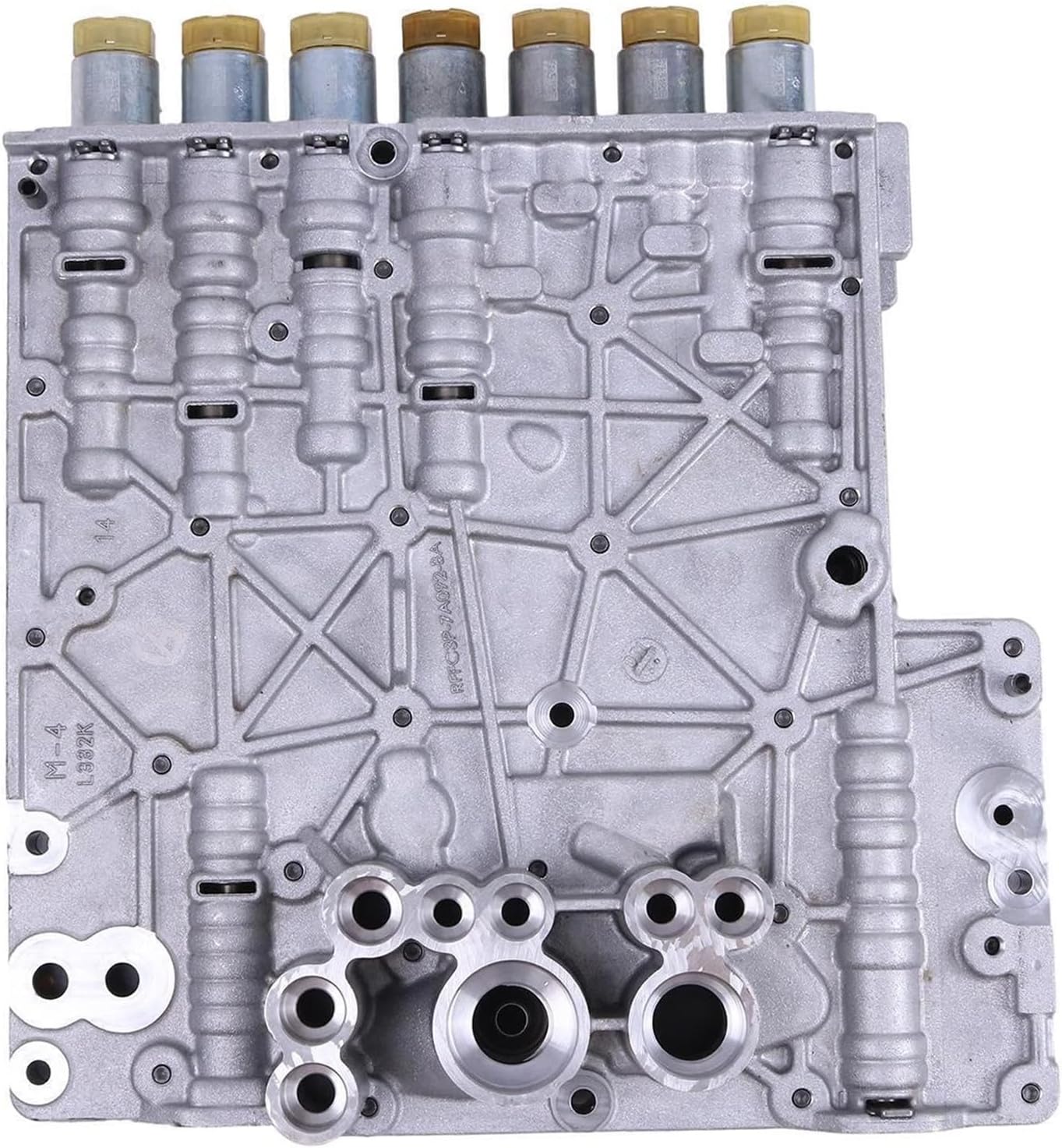
The 6R140 Valve Body and the Plate That Causes a Harsh 5-6
If you rebuild 6R140s, the separator plate is the part that will bite you, and Sonnax has mapped the generations.
First-generation castings, 2011 through 2014 model year, carry a 10 through 13 casting year, rough forging numbers ending in EB, and unnotched plates stamped BC3P-7Z490-EB, -EC, -ED or -EE. Partway through, Ford machined the casting for a third dampener piston in the D low/reverse solenoid output circuit and released the -EE plate with a feed hole for it. Both two- and three-dampener setups exist in that window and you have to match them.
From 2015 model year on, castings end in BA and the plates carry an identification notch: C, CC, V or VV. Three differences matter:
- Cold lube passage. Converter-out oil feeds lube until the thermostat opens at roughly 195°F. Most plates have a large triangular feed, later ones a smaller round hole. On 2017-later diesels the passage is dead: Ford moved the thermostat onto the cooler and plugged the valve body location.
- 2-6 cutback feed. All gas units and 2011-2016 diesels have a hole feeding the 2-6 regulator valve through the 4-5-6 latch valve once the unit is in fourth or above. Ford deleted that hole only on the VV plate, for 2017-later diesels.
- Feed to shift valves. On the V plate only, certain shift valves are fed directly from the pressure regulator valve rather than through the manual valve.
Here is the failure that sends rebuilds back. With the cutback hole present, the 2-6 regulator valve sees a 2.3:1 hydraulic ratio on the 1-2 upshift and 1.24:1 on the 5-6. Delete the hole, as on the VV plate, and it is 2.3:1 for both. Put a VV plate on a unit that wants a C or CC and the 5-6 upshift comes in hard. Ford also narrowed one land on the 4-5-6 latch valve to go with the VV plate. The bore did not change, so the valves physically swap — which is exactly why they get mixed up. Use the VV plate only with the narrow-land latch valve, and only on 2017-later diesel. Unnotched plates fit only EB castings; notched plates fit only BA castings.
The 6R140 Converter Is a Different Animal
Roughly 70 pounds dry. The impeller hub is large and thin-walled with splines in two places: the outside diameter leading edge drives the transmission pump, the inside diameter base engages the PTO. Inspect both surfaces, since the inside is a sealing surface too, and replace the drawn cup needle bearing in the pump every time.
It is a captive clutch converter. To reach the frictions a rebuilder cuts the contoured stamped backing plate out of the front cover, and even then the clutch plate is still sandwiched between riveted steels connected by leaf springs that break. Refixturing and welding that plate back in is the hard part of the job, and it is why a properly rebuilt 6R140 converter is not cheap.
One myth worth killing: a forged billet front cover buys little on this converter. In most units the friction reacts against the inside of a stamped steel cover that flexes and warps. The 6R140 clutch plate reacts against a separate backing plate and never touches the front cover at all. Before paying extra for a billet-cover 6R140 converter, be clear on what it is improving.
Apply strategy is aggressive. Within normal operating temperature the clutch can apply as early as second gear at 18 mph and it cycles often on both upshifts and downshifts, so a customer describing “a shift that is not a shift” at low speed is usually describing normal TCC activity. Scan recordings show brief pulsing at apply, but functionally it is an on/off clutch, and it can fully lock during PTO operation depending on oil temperature.
The 5R110W's Real Problem: Year Matters More Than Model
Ford changed the 5R110W constantly and old-design components are largely gone, which is why “5R110W” is not enough information to order parts. The overdrive one-way clutch, a mechanical diode, gave trouble early. The fix widened it about 0.040 inch, which moved the snap ring groove in the coast clutch drum and forced the first overdrive package: OWC, coast clutch drum and OD sun gear together, gas or diesel alike.
In 2005, everything behind the center support changed. Forward clutch friction spline count went from 90 teeth to 76, front planet pinions from 18 to 23, front ring gear and hub from 78 to 101, and the front sun gear from 42 to 55. The sun gear shell changed with it, and running a first-design rear planet against an 05-up shell can cause interference. The lube dam grew and split into two types: six tabs for gas, four for diesel. The 2003 rear planet should not be reused at all; by 2004 it had been updated to keep the pinion pins from walking out.
In 2007 the front end split four ways by gas versus diesel and PTO versus non-PTO. The gas overdrive OWC has two missing teeth, the diesel a full set. The coast clutch drum is stamped gas or diesel, but the drums are identical — the stamping only tells you which OWC came in it.
Then in late 2008 Ford riveted the low one-way clutch to the rear planet, and that assembly doubles as the low/reverse backing plate with the clutch plates included. Good for the assembly line, expensive in service: replacing a bad OWC means buying iron. The saving grace is that the rear planet and OWC assembly is available on its own for far less than the full package — 9C3Z-7D006B for the five-clutch pack, 9C3Z-7D006AB for the six-clutch. Swap in the updated low/reverse retaining ring while you are in there; the original tended to pop out, the new design has its ends rolled outward.
Need parts for this job?
Valve bodies, solenoid kits, filter and pan gasket kits, deep pans, cooler lines and full rebuild kits for the 6R140, with the year and application splits called out so you order the right one. 5R110W parts are stocked under their own collection.
Shop 6R140 parts →Fluid: The One Place They Nearly Meet
The 6R140 is simple. MERCON LV, 4 gallons.
The 5R110W is the messy one. It launched on MERCON SP, and Ford was blunt that SP was not interchangeable with MERCON or MERCON V and that anything else could cause abnormal operation or failure. Service interval was fluid and bottom pan filter every 30,000 miles regardless of duty cycle, plus the remote cooler line filter each time. That remote filter passes about 10 percent of the fluid through an orifice into a screw-on element and returns it to the rear lube circuit. People miss it.
MERCON SP is long gone from the shelf. Motorcraft's current MERCON LV page lists its do-not-use applications as “MERCON ULV, MERCON V, MERCON SP (except TorqShift)…” — that parenthetical is Ford pointing TorqShift service at LV rather than treating it as a prohibited substitute. Confirm against the owner guide for the truck, then fill it.
One more 5R110W note: it uses an oil-to-air cooler ahead of the radiator, and Ford's guidance is to replace it with any overhaul rather than back-flush it. A cooler full of debris from the failure you just repaired will take out the rebuild.
Two Relearns You Cannot Skip
On the 5R110W, any time the battery is disconnected, the PCM is replaced or the calibration is reflashed, the engagement schedule adaptive strategy has to be rebuilt or the customer returns complaining of firm or harsh engagement. Monitor TFT, warm the fluid to 54°C (130°F), then perform five engagements each, five seconds apart: Park to Reverse, Drive to Reverse, Reverse to Drive, Neutral to Drive. All four sets. On the 6R140 the equivalent trap is the solenoid body strategy: if the calibration ID on the case does not match what the TCM has stored, which happens every time a unit is swapped, shift quality will be wrong and it may set no codes. Reprogram with Ford's FJDS, then reset KAM and the adaptive parameters.
A 6R140 Case Worth Remembering
A Transmission Digest diagnosis published in July 2025 shows how the 6R140's tighter integration with the engine controls cuts both ways. A 2015 F-350 with the 6.7L had a harsh 1-2 shift that survived a replacement transmission, a replacement valve body, two TCMs and a known-good PCM, with no codes stored. Under light throttle the TCM commanded second and the shift arrived four to five seconds later, hard enough to break traction; at three-quarter throttle it shifted normally. An inductive amp clamp on the 1-2 solenoid wire showed the TCM itself was late sending the signal, putting the fault upstream of the transmission, and a strategy reprogram, reflash and KAM reset changed nothing.
The answer was on the engine side. The exhaust back pressure sensor spiked to 474.2 kPa (68.8 psi) under light-throttle acceleration, where anything above about 30 psi is out of range, so the PCM was reading a false high load and shift timing followed it. A Ford EBP sensor brought the maximum to 206.3 kPa (29.9 psi) under heavy acceleration and the complaint disappeared. Before you condemn a 6R140 for a shift quality complaint with no codes, look at the engine load inputs.
So Which Is Stronger, and Can You Swap One?
The 6R140 is stronger and it is the one with an OEM number behind it: 935 ft-lbs of engine torque, 345 pounds, a 30.3 inch case, a 70 pound converter, and a wider ratio spread at both ends — a 3.974 first against the 5R110W's 3.09, a 0.674 sixth against 0.71.
Swapping is not realistic. Different engine families on either end, different control architecture with a separate TCM on the diesel 6R140 that has no 5R110W counterpart, a converter carrying an internal PTO spline set the 5R110W does not have, different case length and different fluid. Anyone doing this is fabricating a driveline and building a harness, not bolting in an upgrade.
The more useful takeaway for a shop: on the 6R140, identify the casting suffix, dampener count and separator plate notch before you order anything. On the 5R110W, identify the model year, engine and PTO status before you order anything. Get either of those wrong and the transmission goes back together fine and comes back anyway.
Still working on the 4R100 the TorqShift replaced?
Plenty of pre-2003 Super Duty trucks are still in service, and the 5R110W is a redesign of that unit. Our sister store stocks the 4R100 Stage-1 master rebuild kit — frictions, steels, gaskets and seals, molded pistons, sealing rings, filter, bushings and thrust washers. To be clear, it fits the 4R100 only; it does not fit a 5R110W or a 6R140.
View the 4R100 master kit →FAQ
Is the 6R140 stronger than the 5R110W?
Yes, and the 6R140 is the only one of the two with a published OEM number behind it. Ford Component Sales lists the 6R140 at 935 ft-lbs maximum engine torque, a 345 lb weight and a 30.3 inch case, and Ford built it as a clean-sheet unit for the 6.7L Power Stroke rather than a reworked older design. The 5R110W is a redesign of the 4R100 and Ford does not publish a comparable public input torque figure for it, so treat the four-digit numbers you see quoted online as aftermarket claims. On the bench the difference shows in the hardware: the 6R140 torque converter alone weighs roughly 70 pounds dry.
Will a 6R140 bolt in place of a 5R110W?
No, and it is not close. The 5R110W lives behind the 6.0L and 6.4L Power Stroke, the 6R140 behind the 6.7L and the 6.2L gas V8, so the engine interface is wrong from the start. Beyond that the control architecture differs: the 5R110W runs its solenoids off the PCM, while Ford specifies a PCM for gas 6R140 applications and a separate TCM for diesel ones. The 6R140 case is 30.3 inches long and its converter carries an internal spline set for the PTO drive that the 5R110W converter does not have. This is a driveline fabrication and wiring project, not a swap.
What fluid does each one take?
The 6R140 takes MERCON LV, and Ford Component Sales lists a 4 gallon fill for the unit. The 5R110W was released in 2003 on MERCON SP, which at the time was explicitly not interchangeable with MERCON or MERCON V. Motorcraft's own MERCON LV page now carves TorqShift units out of its restriction list, phrasing it as do not use where MERCON SP (except TorqShift) is recommended, which is Ford pointing TorqShift service at LV. Check the owner guide for the specific truck before you fill it.
Why does a rebuilt 6R140 come back with a harsh 5-6 upshift?
Most often a separator plate and valve mismatch. Sonnax documents that Ford removed the 2-6 cutback feed hole from the VV plate used on 2017 and later diesels and paired it with a 4-5-6 latch valve that has one narrower land. The plate and valve must be used together. Put a VV plate on the wrong unit and the 2-6 regulator valve sees a 2.3:1 hydraulic ratio on the 5-6 upshift instead of 1.24:1, and the shift comes in hard. Identify the plate by its C, CC, V or VV notch before you assemble.
Why do 5R110W parts not interchange across its own model years?
Because Ford changed the internals repeatedly. The overdrive one-way clutch was widened about 0.040 inch, which moved the snap ring groove in the coast clutch drum. In 2005 the forward frictions went from 90 teeth to 76, front planet pinions from 18 to 23, front ring gear and hub from 78 to 101 and the front sun gear from 42 to 55. In 2007 Ford split the overdrive packages four ways by gas or diesel and PTO. In late 2008 the low one-way clutch was riveted to the rear planet. Order 5R110W hard parts by year and application, never by model alone.
Related guides
- Ford 6R140 TorqShift Problems and Service Guide
- 6R140 Valve Body Wear and the Fix
- 5R110 TorqShift Service Guide
- 5R110 Shift Solenoid Symptoms
- 6R80 vs 6R140: Differences and Interchange
Sources
- Ford Component Sales, LLC — "Ford 6R140: 6-Speed Automatic Transmission Technical Specifications" (OEM spec sheet, PDF). Backs every 6R140 OEM figure used here: 935 ft-lbs maximum engine torque, 345 lb weight, MERCON LV fluid with a 4 gallon capacity, 250°F continuous operating temperature, the 5 degree maximum installation angle, case dimensions of 30.3 x 18.7 x 19.5 inches, converter K factor of 125K gas and 97K diesel, Lepelletier powerflow with one simple planetary and one Ravigneaux gearset and five clutch packs (three rotating, two brake), the gear ratios 3.974 / 2.318 / 1.516 / 1.149 / 0.858 / 0.674 with 3.128 reverse, J1939 communication, the PTO option, and PCM control on gas applications against TCM control on diesel. fordcomponentsalesllc.com (PDF)
- Transmission Digest — "Ford 5R110W ('TorqShift')," Dale England (October 1, 2004). Backs the 5R110W introduction in model year 2003 F-Series and Excursion with the 6.0L diesel, the description of the unit as a redesign of the 4R100, the 3.09 / 2.20 / 1.54 first through third ratios with 1.09 fourth in cold mode, 1.00 fifth and 0.71 sixth, the hot mode 1-2-3-5-6 and cold mode 1-2-3-4-6 shift sequences with the 5°F (-15°C) threshold read off the TFT sensor, the dedicated solenoid and pressure switch per clutch pack with the forward clutch on the manual valve and no shuttle valves in the solenoid body, the 0 to 1 amp PCM solenoid current range, the original MERCON SP fill and its non-interchangeability with MERCON and MERCON V, the 30,000 mile fluid and pan filter interval, the 10 percent bypass remote filter, the oil-to-air cooler replacement guidance, and the post-battery-disconnect engagement relearn at 54°C (130°F). transmissiondigest.com
- Transmission Digest — "5R110W Upgrades," Mike Riley, Technical Editor (December 1, 2013). Backs the 5R110W generational churn section: the overdrive one-way clutch widened roughly 0.040 inch and the repositioned coast clutch drum snap ring groove, the 2007 split into four overdrive packages by gas or diesel and PTO with the gas OWC missing two teeth, the 2005 changes in forward friction spline count from 90 to 76 teeth, planet pinions from 18 to 23, front ring gear and hub from 78 to 101 and front sun gear from 42 to 55, the six-tab gas versus four-tab diesel lube dam, the late 2008 low one-way clutch riveted to the rear planet doubling as the low/reverse backing plate, the redesigned low/reverse retaining ring with ends rolled outward, the NLA 2005 package 5C3Z-7A398SA, and the separately available rear planet and OWC assemblies 9C3Z-7D006B (five-clutch) and 9C3Z-7D006AB (six-clutch). transmissiondigest.com
- Sonnax — "5R110W Solenoid Identification & Functions" (January 1, 2013). Backs the 5R110W solenoid map and clutch application chart: SSPC-A coast clutch and SSPC-D direct clutch as inversely proportional, SSPC-B overdrive, SSPC-C intermediate, SSPC-E low/reverse and TCC as directly proportional, EPC/PC-A controlling line pressure inversely, and the gear-by-gear clutch application including the Tow/Haul-only applications and the reverse clutch applied through the manual valve. sonnax.com
- Sonnax — "Ford 6R140 Separator Plate Identification — How to Identify Changes & Interchangeability," Eric Streed, Sonnax design engineer and TASC Force member (May 11, 2022). Backs the 6R140 valve body and plate generations: EB rough forging castings for 2011-2014 model years with unnotched plates stamped BC3P-7Z490-EB / -EC / -ED / -EE, the third dampener piston added in the D low/reverse solenoid output circuit for 2013-2014 with plate BC3P-7Z490-EE, the 2015 model year move to BA castings with C, CC, V and VV notched plates, the cold lube passage fed by converter-out oil until the thermostat opens at approximately 195°F and the thermostat relocation to the cooler on 2017-later diesels, the 2-6 cutback feed hole removed only on the VV plate with the resulting 2.3:1 versus 1.24:1 hydraulic ratio on the 5-6 upshift, the matching narrow-land 4-5-6 latch valve requirement and the harsh 5-6 upshift that follows a mismatch, the V plate feeding certain shift valves from the pressure regulator valve instead of the manual valve, and the plate interchange chart with Ford service part numbers. sonnax.com
- Sonnax — "How to Identify Ford 6R140 Torque Converter Features & Avoid Application Pitfalls," Steve Jaussaud (July 8, 2022). Backs the converter section: the 6R140 introduced in 2010 for 2011 model year Super Duty gas and diesel applications, the roughly 70 lb dry converter weight, the large thin-walled impeller hub with O.D. splines driving the transmission pump and I.D. splines engaging the PTO system, the drawn cup needle bearing replacement guidance, the captive clutch design requiring the contoured stamped backing plate to be cut out, the riveted steels and breakage-prone leaf springs, the fact that the converter clutch reacts against a separate backing plate and never touches the front cover so a forged billet cover buys little, the BorgWarner segmented double-sided clutch plate, and TCC apply as early as 2nd gear at 18 mph behaving essentially as an on/off clutch. sonnax.com
- Transmission Digest — "Diagnosing a Delayed, Harsh 1-2 Shift in the Ford 6R140 Transmission," Mike Wiggins (July 16, 2025). Backs the diagnostic case study: a 2015 F-350 with 6.7L Power Stroke and 6R140 showing a four to five second delay on a commanded 1-2 shift under light throttle with no stored codes, normal shifts at three-quarter to full throttle, the inductive amp probe on the 1-2 shift solenoid wire proving the TCM signal was late, the solenoid body strategy and calibration ID mismatch corrected with FJDS plus a TCM reflash and KAM reset that did not fix it, line pressure climbing excessively during the delayed shift, and the exhaust back pressure sensor spiking to 474.2 kPa (68.8 psi) at light throttle against a sub-30 psi expectation, with the replacement Ford sensor reading a 206.3 kPa (29.9 psi) maximum under heavy acceleration and the harsh shift gone. transmissiondigest.com
- Motorcraft (Ford Motor Company) — MERCON® LV Automatic Transmission Fluid product page. Backs the current fluid guidance for TorqShift units: the do-not-use list reads "MERCON® ULV, MERCON® V, MERCON® SP (except TorqShift®)...", the TorqShift carve-out being Ford's own indication that MERCON LV is the service fluid for TorqShift applications rather than a prohibited substitute. motorcraft.com