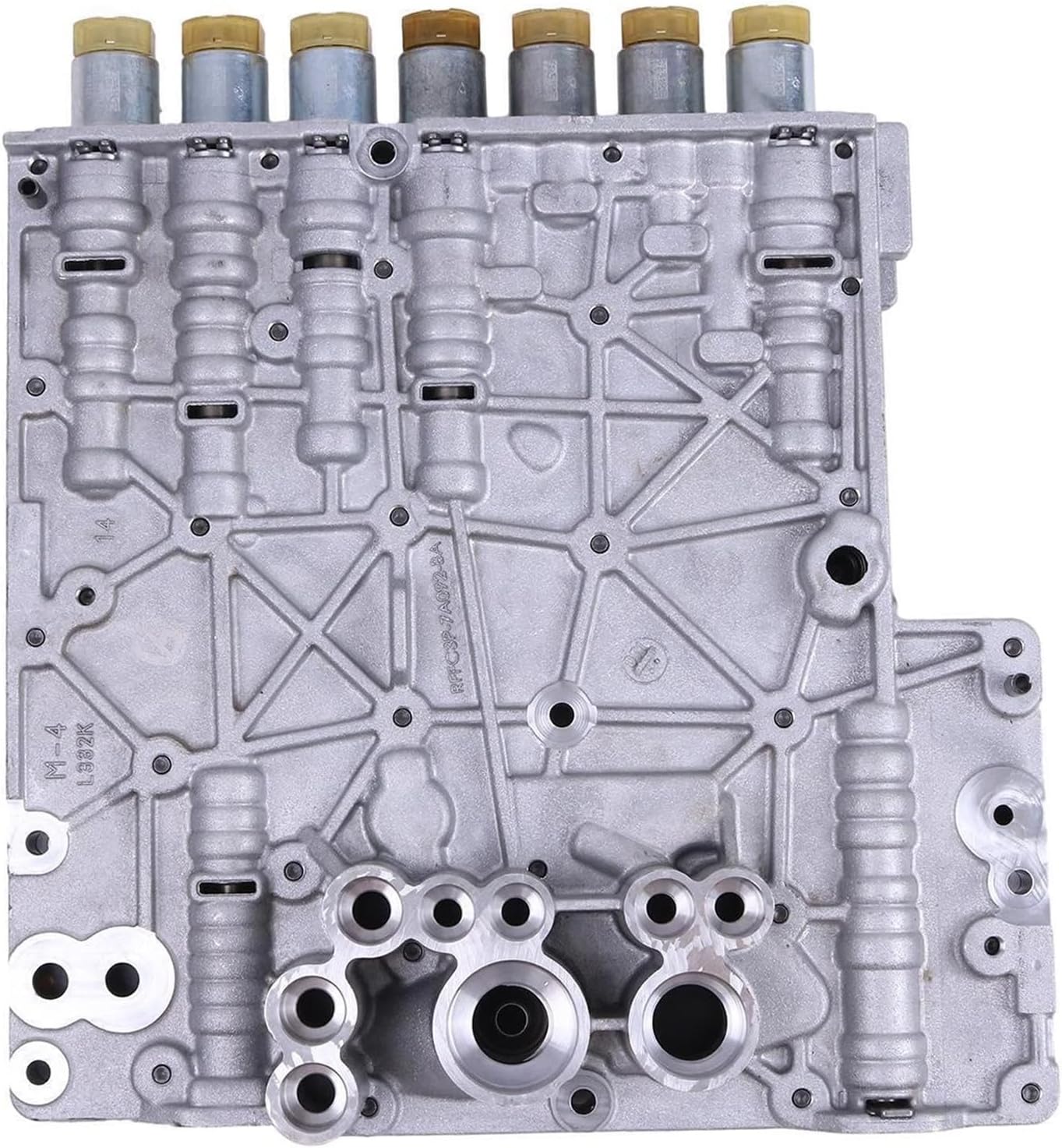
Ford put the 6R140 TorqShift behind the 6.7L Power Stroke starting in early 2010 for the 2011 model year, and it is now in enough F-250s, F-350s, F-450s and F-550s that most shops see one a week. It is a stout unit. It is also an aluminum valve body with steel valves cycling in it several hundred thousand times, and aluminum loses that argument eventually.
Bore wear is the failure nobody codes for. Clearance opens, the bore goes oval, and oil that was supposed to hold a clutch regulator in position bleeds to exhaust instead. The truck flares, or binds, or takes four seconds to find second, and the scan tool has nothing to say about it. That is why these units survive a fluid service, survive a solenoid pack, and sometimes survive a complete overhaul — the valve body got washed, air-checked and bolted back on looking beautiful. Here is how to find it, prove it, and fix it in the right order.

Rule out the impostors first
Four conditions on this unit look exactly like a worn valve body from the driver's seat and cost a fraction as much to repair. Clear all four before you pull anything.
1. Fluid level — and the filter seal that fakes a low level
Sonnax technical communications specialist Jim Mobley documented a 2016 F-550 with PTO that came back 9,000 miles after a full rebuild complaining of intermittent neutral in forward and reverse. Line pressure tested fine. Fluid level tested fine. The break came when the shop owner drove it home, hit an inclined driveway, and watched line pressure fall to 0 psi with the gauge still hooked up — neutral going up the incline, drive again rolling back down.
The cause was the filter seal on the filter snout. When they pulled the filter bolt, the filter dropped into the drain pan with zero resistance from the neck seal. A degraded seal lets the pump suck air any time fluid sloshes away from the pickup, which is exactly what an incline does. A more robust O-ring, and the neutral could not be reproduced. That shop went on to repair multiple trucks with the same story, and it is not unique to the 6R140 — any Ford unit with a round filter intake sealed on the snout can do it. So before anything else: check the level correctly, at temperature, and look at that seal.
2. Line pressure, measured with a real gauge
The 6R140 line pressure spec is 90–260 psi (619–1790 kPa) across the operating range. Put a mechanical gauge on it — a transducer reading in the data stream tells you what the module thinks, the gauge tells you what the pump actually made. Watch it during the bad shift, not just at idle and stall. A delayed shift where line pressure keeps climbing with rpm and then slams the clutch home is a very different fault than a shift that goes soft.
3. A sensor outside the transmission that skews shift timing
Certified Transmission diagnostician Michael Wiggins wrote up a 2015 F-350 6.7L in Transmission Digest that had already been through a valve body, two TCMs, a complete replacement transmission and a known-good PCM. The complaint: a 1-2 shift lagging four to five seconds under light throttle and then hitting hard enough to break traction, normal at three-quarter to full throttle, no DTCs at all.
It was the exhaust back pressure sensor. On the delayed 1-2, EBP spiked to 474.2 kPa (68.8 psi) under light acceleration, where a healthy truck stays well under 30 psi. The PCM read that as heavy load, commanded higher line pressure and revised shift timing to match. A new Ford EBP sensor brought peak readings down to 206.3 kPa (29.9 psi) under hard acceleration and the shift came back clean. If the truck is tuned or deleted, put engine-side PIDs on the screen before you condemn hydraulics.
4. Noise that is not the transmission at all
Ford TSB 18-2265 covers 2018 F-Super Duty trucks built 29-Jan-2018 through 24-Jul-2018 with a 6R140 that howl, flutter or whine, typically in 4th and/or 6th gear, with the noise appearing to come from under the dash near the right side of the steering column. It is noise transferring up the shift cable. The repair is a new shift cable with damper assembly, part number JC3Z-7E395-C, booked at 1.2 to 1.8 hours. That is a very cheap fix to miss on a truck you were about to pull.
Know which valve body is on the bench
The 6R140 valve body and separator plate changed repeatedly, and the plates are not freely interchangeable. Sonnax product support specialist Eric Streed laid out the identification in detail.
First generation, 2011–2014 model year (10 through 13 casting year on the valve body). Rough forging numbers end in EB. Plates have no external ID notches, but carry a Ford engineering number stamped where you can read it: BC3P-7Z490-EB, -EC, -ED or -EE. In 2013–2014, Ford machined a previously blank damper location in the lower valve body to accept a third damper piston in the "D" low/reverse solenoid output circuit, and the matching plate that feeds it is the -EE.
2015 model year and later (14-later casting). Major worm track changes; rough forging numbers end in BA, used through 2019. Four plates fit these castings, identified by a C, CC, V or VV notch cut in the plate.
Two traps live in that group:
- The VV plate. On all gas units and 2011–2016 diesels, a hole in the plate feeds oil through the 4-5-6 latch valve to the 2-6 regulator valve once the unit is in 4th or above. That gives a hydraulic ratio of 2.3:1 on the 1-2 upshift and 1.24:1 on the 5-6. Ford deleted that hole only on the VV plate for 2017-later diesels and simultaneously narrowed one land on the 4-5-6 latch valve. The bore did not change, so the valves swap freely — which is the problem. Run a VV plate with a standard latch valve and you get 2.3:1 on the 5-6 upshift and a harsh 5-6. Use the VV plate only with the narrow-land 4-5-6 latch valve, and only on 2017-later diesel.
- Cold lube passage. This passage feeds converter-out oil to lube until the thermostat opens at roughly 195°F, working with the converter limit valve to meter how much converter-out oil goes to lube. Most plates have a large triangular feed; some later plates use a smaller round one. On 2017-later diesels the passage is dead — Ford moved the thermostat out of the valve body and onto the transmission cooler, and the valve body gets a plug in its place.
Interchange rule: unnotched plates only on EB castings (watch two-damper versus three-damper), notched plates only on BA castings. Never assume a plate that bolts up is the right plate.
The symptom-to-bore map
This is the part worth taping to the bench. Sonnax's 6R140 critical wear area and vacuum test guide maps each valve train to the complaints it produces when it leaks, and to the repair part. Note which repairs need reaming — that decides whether the job stays in-house.
| Valve train | What it looks like in the truck | Sonnax repair |
|---|---|---|
| Forward 1-2-3-4 clutch regulator | Delayed or no forward, slipping gears, ratio and solenoid codes, failsafe, burnt forward clutch, overheated fluid | Valve kit (drop-in and oversized options) |
| Direct 3-5-R clutch regulator | Delayed reverse, 2-3 and 4-5 flare, bind-up, ratio codes between flare and slip, 3rd/5th/Reverse slip, burnt direct clutch | 126740-11K — requires reamer F-126740-TL11 and the VB-FIX fixture |
| Intermediate 2-6 clutch regulator | Burnt intermediate (2-6) clutch, 1-2 shift concerns, 5-6 shift concerns | Valve kit |
| Overdrive 4-5-6 clutch regulator | Burnt overdrive (4-5-6) clutch, 4th/5th/6th gear concerns | Valve kit |
| Low/reverse clutch regulator | Low line pressure, burnt low/reverse clutch, delayed reverse | 126740-27K — requires reamer F-126740-TL27 and VB-FIX |
| TCC apply regulator | TCC codes, TCC cycling and slip, no lockup, overheated fluid, lost fuel economy, low cooler and lube pressure | 126740-15K — requires reamer F-126740-TL15 and VB-FIX |
| TCC apply boost valve | Flare, harsh or soft shifts alongside TCC complaints | 126740-03K (drop-in) |
| TCC charge limit valve | Excess TCC slip, no TCC release, TCC lining failure, excess heat | 126740-01K |
| Line pressure control valve | Pressure control complaints across the board | 126740-08K (oversized) |
| Solenoid feed pressure regulator | Multiple unrelated-looking shift complaints at once — every solenoid is fed off this circuit | 126740-24K (oversized) |
| End plugs, several locations | Pressure loss, burnt clutches, low cooler and lube pressure | 126740-09K external, 126740-05K internal |
| Cooler bypass / thermal element | Overheating, low converter and lube flow, reduced clutch life | 126740-26K bypass blocker (eliminates the OE thermal element that sticks) |
The solenoid feed regulator deserves a second look. The 6R140 does not feed its shift solenoids straight off line pressure — it regulates a controlled feed pressure first, and that regulator rides in an aluminum bore like everything else. When it wears, every solenoid downstream is working from a soft supply, and you chase five symptoms that have one cause.
Sonnax 6R140 Zip Kit Valve Body Repair Kit
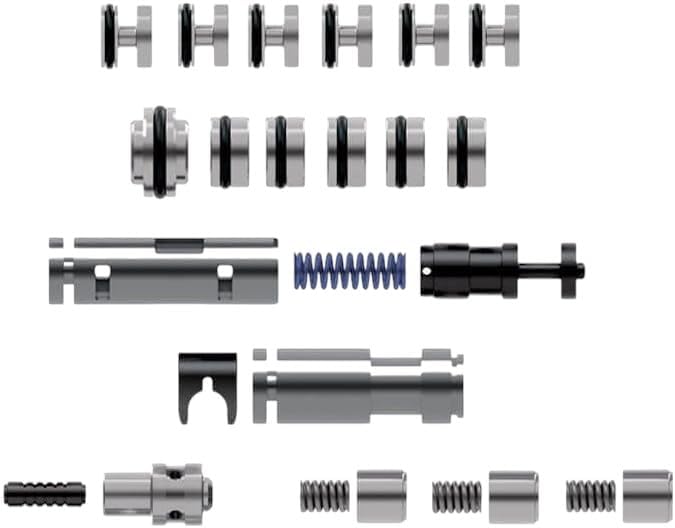
The drop-in kit that seals the main line, solenoid regulator, reverse, clutch control, TCC and solenoid apply circuits — TCC apply boost valve kit, external and internal o-ringed end plugs, three accumulator pistons and springs, converter limit valve with sleeve and spring. No reaming, no special tools.
View kit and specs →Prove it on the bench: vacuum testing
Air checking tells you a circuit is open. Vacuum testing tells you how much it leaks, in a number you can write down and compare — the difference between a guess and a diagnosis. The method, in short:
- Calibrate first. The stand is set so that a complete seal — no leak — reads 25 in-Hg on the gauge. At altitude that ceiling drops; in Denver, full seal may only pull 22 in-Hg. Calibrate to your shop, not to a number you read somewhere.
- Test valves in their rest position unless the guide says otherwise, and pull vacuum at the location the guide arrows point to.
- Worm tracks vary by model year on this unit, but the vacuum test locations do not. One guide covers them all.
- Set your own pass/fail. There is no universal in-Hg spec for a valve bore. Record readings across the units you do, calculate an average for each bore, and set a minimum that matches your warranty exposure. A fleet truck that tows 14,000 pounds deserves a tighter standard than a grocery-getter.
Do this on every 6R140 that comes apart, including the ones that look fine. Clean and worn look identical under the parts washer.
Reused solenoids will undo good valve body work
Sonnax technical specialist Jim Dial has written about this on both the 6R80 and 6R140: these units have a long history of post-overhaul shift complaints where the adapts will not lock in after repeated up- and downshifts, and it traces back to reused solenoids. The variable bleed solenoids drift — they lose their calibration, their banding — and once they do, the numbers stored in the PCM no longer describe the parts in the valve body.
Strategy codes and solenoid body ID codes are on the valve body and on the tag on the case, and they have to be entered into the PCM so it knows which band, 1 through 5, each normally-low and normally-high solenoid falls into. With correct data, relearn can finish in three to five shift cycles. Feed it a solenoid that has drifted from band 3 to band 5 — or to band 1.5 — and the module is calibrating against fiction. The PCM watches for an rpm drop on the turbine speed sensor within a split second of solenoid command, and both flow rate and banding position the clutch regulator valve.
On the 6R140 specifically, Dial points to the 5-6 upshift: solenoid output is routed to the back side of the outboard spool of the 26 clutch regulator valve through the 4-5-6 latch valve, slowing the valve slightly to smooth the transition. That circuit exists only for the 5-6. A slow or overly aggressive solenoid there also changes the release rate of the clutch it controls, so it can throw a flare on one transition and a bind-up on another, inconsistently, until the module gives up adapting.
Practical rules: replace a solenoid with the same band number that came out of that position unless you are programming a new calibration, and record band number, valve body position and normally-high or normally-low status before anything comes off the bench. Then run the relearn drive cycle properly — 20 to 25 stop-and-start cycles, first through sixth and back down.
Fill it right or you will be back in it
The 6R140 uses Mercon LV. The fill procedure that mimics Ford's own, per Sonnax:
- Drain plug or pan only: add 7.8 L (8.2 qt).
- Valve body removed: add 9.7 L (10.2 qt).
- Transmission removed and disassembled: add 15.3 L (16.2 qt).
- Check level with the scan tool showing 91–102°C (196–216°F), and only after two or three extended road tests at operating temperature.
- Top off in 0.24 L (0.5 pint) increments. Then drive it up a 20–30 degree incline, nose first, and confirm it does not go neutral.
Do not overfill. Ford 6- through 10-speeds punish an overfill with aerated, overheated fluid, and overheated fluid is what carries the debris that ovals bores in the first place.
The fix, in order of cost
Zip Kit on light-to-moderate wear. Sonnax 6R140-ZIP is the drop-in route: it seals pressure losses in the main line, solenoid regulator, reverse, clutch control, TCC and solenoid apply circuits with no reaming and no special tools. Contents are the TCC apply boost valve kit, o-ringed end plug kit, internal o-ringed end plug kit, three accumulator pistons and springs, converter limit valve with sleeve and spring, plus a bypass blocker valve and retainer used in some units. If your vacuum numbers are marginal rather than dead, this is the honest repair.
Oversized valve kits when a specific bore has failed hard. The 3-5-R regulator (126740-11K), low/reverse regulator (126740-27K) and TCC apply regulator (126740-15K) all require the matching F-126740-TL reamer plus the VB-FIX fixture. Tooling is the barrier. If you do not own it, price a reman before buying in on a single job; if you do own it, this is where the margin lives.
Reman valve body when several circuits are gone. Sonnax lists a remanufactured 6R140 valve body under F06R140. On a high-mile fleet truck with wear in four or five bores, that is often the faster and more defensible repair.
Whichever path you take, vacuum test again afterward. That is the point of having a number: you can prove the fix worked before the truck leaves.
Keeping it from coming back
- Mercon LV, nothing else. Every orifice, regulator restriction and solenoid flow rate here was calibrated around a low-viscosity fluid. A universal ATF changes the hydraulics the adapts were built on.
- Shorter intervals on trucks that tow. Heat shears fluid, sheared fluid carries debris, debris ovals bores.
- Fix the cooler side. A stuck OE thermal element in the bypass circuit cooks the unit quietly. With overheat history, address it while the valve body is out.
- Replace the filter seal every time. A dollar of rubber stands between your rebuild and an intermittent neutral you will never reproduce in the bay.
Building a 6R140 this week?
Zip Kits, valve bodies, solenoid sets, filter and pan gasket kits, deep pans, cooler lines, Mercon LV, and the air-check and seal-ring tooling to test what you install — shipped from the USA.
Shop 6R140 parts →Sources
- Sonnax — "Ford 6R140 Vacuum Test Guide," November 24, 2015 (guide revised 2026). Backs the entire symptom-to-bore map: the valve trains named (overdrive 4-5-6 clutch regulator, TCC charge control, intermediate 2-6 clutch regulator, forward 1-2-3-4 clutch regulator, direct 3-5-R clutch regulator, low/reverse clutch regulator, TCC apply regulator, TCC apply boost, cooler bypass, converter limit, TCC charge limit and end plugs), the complaint list attached to each, the repair part numbers 126740-11K, -27K, -15K, -03K, -01K, -09K, -26K, the F-126740-TL11 / TL27 / TL15 reamer and VB-FIX fixture requirements, and the note that worm tracks vary by model year while vacuum test locations do not. sonnax.com
- Sonnax — "Ford 6R140: Repairing Elusive Intermittent Neutral Condition," Jim Mobley, June 6, 2022. Backs the 2016 F-550 case history, the failed filter snout seal and the 0 psi line pressure on an incline, the 90–260 psi (619–1790 kPa) line pressure spec, Mercon LV as the required fluid, the 7.8 L / 9.7 L / 15.3 L fill quantities by service level, the 91–102°C (196–216°F) check temperature, the 0.24 L top-off increments, the 20–30 degree incline verification, and the warning against overfilling Ford 6- through 10-speed units. sonnax.com
- Sonnax — "Ford 6R140 Separator Plate Identification: How to Identify Changes & Interchangeability," Eric Streed, May 11, 2022. Backs the 2011 model year introduction alongside the 6.7L diesel, the EB rough forging and unnotched plates for 2011–2014 with engineering numbers BC3P-7Z490-EB/-EC/-ED/-EE, the third damper piston added in 2013–2014 in the "D" low/reverse solenoid output circuit, the BA castings and C/CC/V/VV notched plates for 2015-later, the 2-6 cutback feed with its 2.3:1 and 1.24:1 hydraulic ratios, the VV plate paired with the narrow-land 4-5-6 latch valve and the harsh 5-6 that results from mismatching them, the cold lube passage and roughly 195°F thermostat opening, and the 2017-later diesel move of the thermostat to the cooler. sonnax.com
- Sonnax — "Troubleshooting Ford 6R80 & 6R140 Timing-Related Shift Issues," Jim Dial, August 15, 2022. Backs post-overhaul adapt problems tracing to reused solenoids, variable bleed solenoids losing calibration and banding over time, the strategy and solenoid body ID codes on the valve body and case tag needing entry into the PCM, bands 1–5 on normally-low and normally-high solenoids, relearn completing in three to five shift cycles, the PCM watching for a turbine speed rpm drop within a split second of solenoid command, and the 6R140 5-6 upshift routing solenoid output to the back side of the outboard spool of the 26 clutch regulator valve through the 4-5-6 latch valve. sonnax.com
- Transmission Digest — "Diagnosing a Delayed, Harsh 1–2 Shift in the Ford 6R140 Transmission," Michael Wiggins (Certified Transmission), July 16, 2025. Backs the 2015 F-350 6.7L case: no DTCs, a four-to-five second commanded-to-actual 1-2 delay under light throttle with normal shifts at three-quarter to full throttle, line pressure climbing excessively with rpm during the delayed shift, the exhaust back pressure sensor spiking to 474.2 kPa (68.8 psi) under light acceleration against an expected sub-30 psi, and the replacement sensor peaking at 206.3 kPa (29.9 psi) under hard acceleration with the harsh shift resolved. transmissiondigest.com
- Ford Motor Company — Technical Service Bulletin 18-2265, "6R140 — Howl, Flutter And/Or Whine Noise Typically In 4th And/Or 6th Gear," 29 August 2018 (hosted by NHTSA; supersedes 18-2155). Backs the 2018 F-Super Duty application, the 29-Jan-2018 through 24-Jul-2018 build window, the under-dash noise location near the right side of the steering column, noise transfer through the shift cable as the cause, shift cable part number JC3Z-7E395-C, and the 1.2 to 1.8 hour labor operations. static.nhtsa.gov
- Sonnax — Zip Kit 6R140-ZIP product and technical page. Backs the symptom list the kit addresses (delayed engagement, excess heat, flare shifts and bind-ups, harsh engagement, harsh shifts, slipping gears, TCC apply and release concerns, soft shifts), loss of oil pressure from worn components as the stated cause, the circuits sealed (main line, solenoid regulator, reverse, clutch control, TCC and solenoid apply), the no-reaming drop-in installation, and the kit contents listed in this article. sonnax.com
Shop 6R140 Zip Kits, valve bodies, solenoid kits, filters and pan gaskets, deep pans, cooler lines, Mercon LV, and the tooling to test what you install — shipped fast from the USA.
Shop 6R140 parts →Shop 6R140 parts →