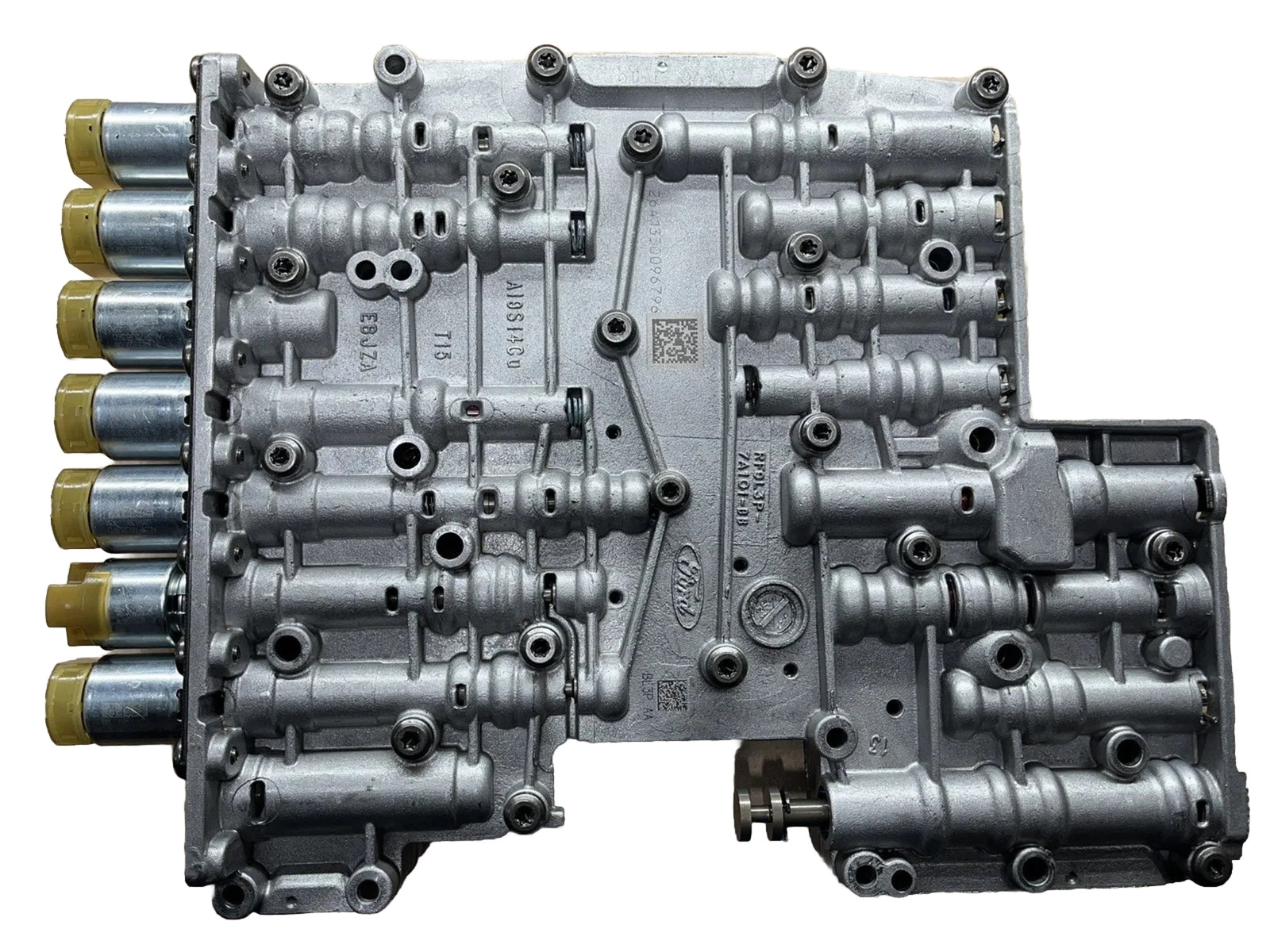
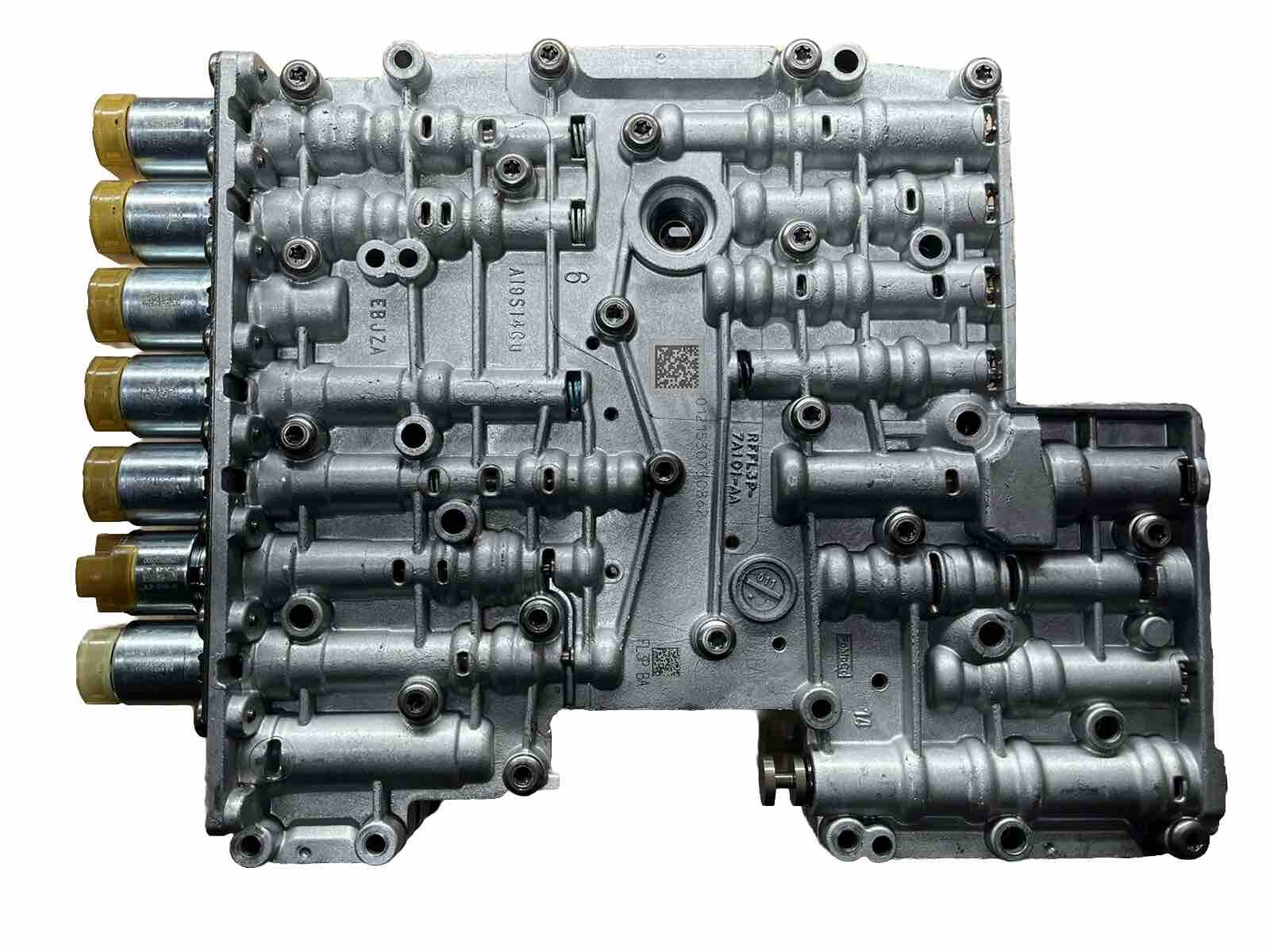
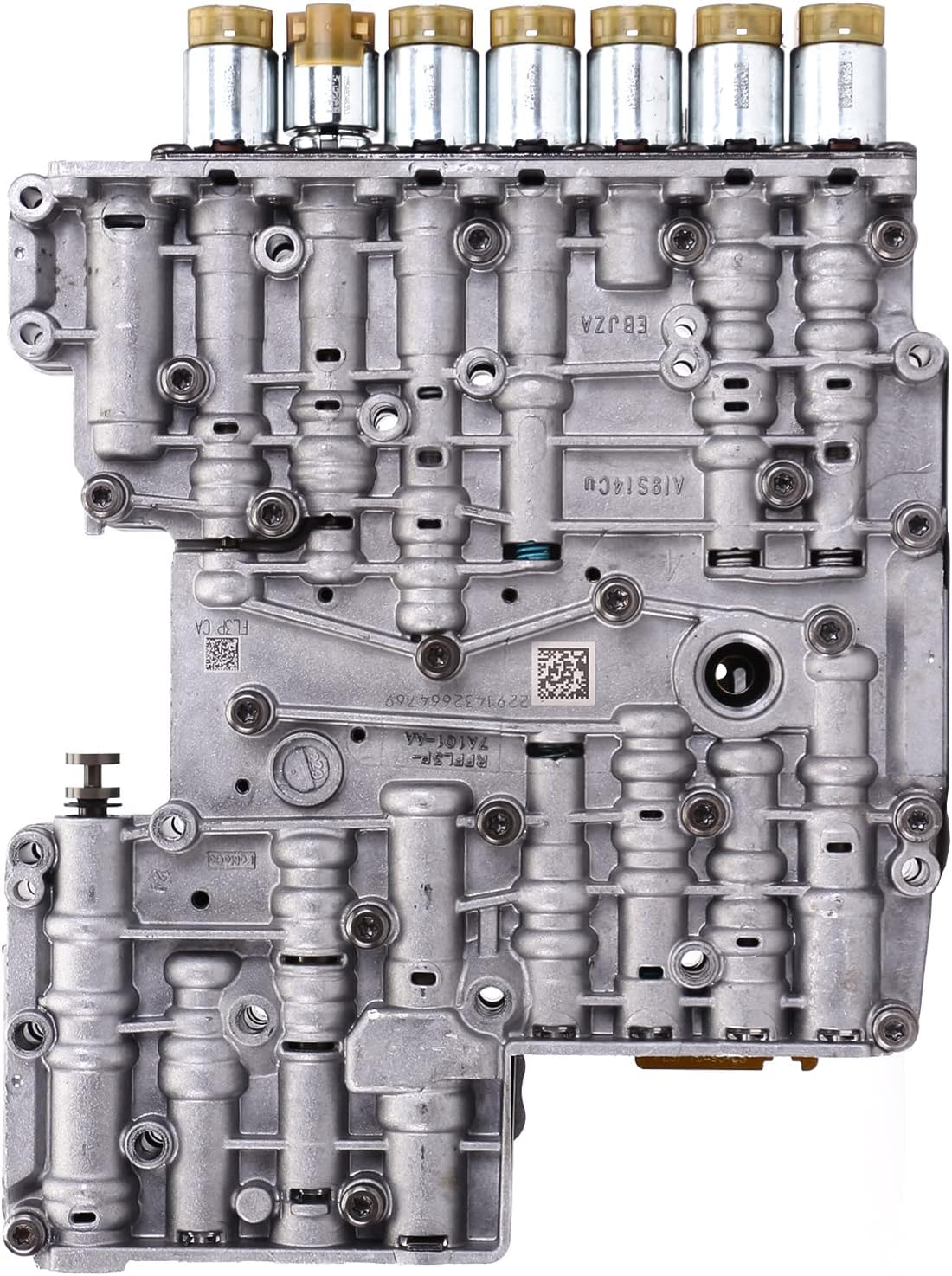
The 6R80 is Ford's licensed build of the ZF 6HP26 — six speeds, ratios of 4.17, 2.34, 1.52, 1.14, 0.87 and 0.69 with a 3.40 reverse, behind everything from a 3.7 V6 F-150 to a Coyote Mustang to a 5.4 Expedition. It is a good unit. What it is not is immune to the thing every aluminum valve body eventually does: the bores wear oval around the steel valves that live in them, clearance opens up, and pressure meant for a clutch goes to exhaust instead.
Bore wear does not announce itself. It sets no code of its own. It shows up as a shift complaint that survives a fluid service, survives a solenoid pack, and sometimes survives a full overhaul because the rebuilder cleaned the valve body, air-checked it, and bolted it back on. Here is how to find it, confirm it before spending money, and fix it.
Rule out the three cheap causes first
Three other things produce overlapping symptoms and cost a fraction as much to fix. Clear these before pulling a valve body.
1. The molded leadframe
The internal wiring harness that carries every solenoid and both speed sensor signals is a molded leadframe, and on early units it fails. Ford covered this in TSB 13-6-8 (superseding 13-4-9), which applies to 2011–2014 Mustang, 2011–2013 F-150 and 2012–2013 Expedition and Navigator with the 6R80 built on or before 4/8/2013. The complaint in the bulletin is a transmission that engages in 5th gear when starting, a lit wrench indicator, a speedometer reading zero and dashes in the odometer, with symptoms clearing after a key cycle. DTC P0720 and P0722 may or may not set. The fix is to replace the molded leadframe on the main control assembly, part number AL3Z-7G276-A. The bulletin specifically notes that solenoid replacement is not required for the procedure.
That "may or may not be stored" line matters. A leadframe with a cracked trace drops a speed signal intermittently, and the PCM's response to a lost speed signal looks like a hydraulic failure from the driver's seat.
2. PCM calibration
On 2015–2017 F-150 with the 6R80, Ford issued TSB 20-2060 (6 March 2020) for an intermittent loss of reverse engagement or a neutral state when shifting from MANUAL 1 or MANUAL 2 to REVERSE at low speed while the vehicle is rolling — with no DTCs set. The stated cause is PCM strategy, and the entire repair is a reflash plus the adaptive learning drive cycle in Workshop Manual Section 307-01, booked at 0.9 hours. If the complaint matches that description, tearing into the valve body is an expensive way to not fix it.
3. Shift solenoid "E" — wrong part in the box
The 6R80 has one on/off solenoid, Shift Solenoid "E", and it got a mid-production design change that catches people swapping parts between units. Per Wayne Colonna in Transmission Digest, transmissions built before Nov. 4, 2010 use a 10.5-ohm solenoid; those built after Nov. 3, 2010 use an 18-ohm solenoid with more coil windings and a PCM driver sized for the higher resistance. The two are not interchangeable. Identify them by snout color — tan is 10.5-ohm, gray is 18-ohm — with blue O-rings on both. Part numbers: 6L2Z-7G484-AA and AL3Z-7G484-B respectively.
Measure it. A DVOM across the terminals takes ten seconds and tells you whether the last person in there put the right one back.
Identify which valve body you actually have
There are two families, and they do not share the parts you would want to share. Get this wrong and you will order a repair kit that physically will not work.
2009–2014. Shares its valve lineup with the 6R60, 6R75 and ZF6HP19/26/32. Pressure regulator repairs use the 95740-01K oversized valve kit and the 95740-03 sleeve — but Sonnax notes those do not fit units built with a 053 separator plate, so check the plate number before ordering.
2015-later (and 6R100). Sonnax product line manager Maura Stafford lays out the identifiers: FL3P rough-forging numbers on both castings, an FL3P separator plate with a new angular cutout, and a large hole in the lower casting beside the clutch A control valve. With no matching hole in the upper casting, that hole connects to voids and serves no purpose. If there is a matching hole in the upper casting beside the low/reverse clutch latch valve, it is an auto start-stop valve body — the case passages changed too, connecting that area to the auxiliary pump.
The one valve train that actually changed is the pressure regulator, which added a fourth size variation to the ZF6HP/6R60/6R80 family. The sleeve carries two identifying grooves, one on the outer face and one on the diameter, and the mating diameter of the PR valve changed as well. Measure both before any bore repair in that circuit. Late-model service parts are the 95740-44 sleeve and 95740-46K oversized PR valve kit.
Symptom-to-bore map
This is the part worth pinning to the wall. Sonnax publishes a valve body layout for the 6R80/6R100 that ties each bore to the complaints it produces. Read it backwards: start with the complaint, land on the bore, then go confirm it.
| Complaint | Suspect bore | Sonnax kit |
|---|---|---|
| Erratic line pressure, flare shifts, harsh shifts, slips in Forward and Reverse, delayed or no Reverse, TCC slip | Pressure regulator (OE valve name SYS.DR-V) | 95740-01K ('09–'14) / 95740-46K ('15-later) |
| Broken parts from excessive line pressure, high or erratic line pressure, restricted converter and lube flow | Pressure regulator sleeve | 95740-03 ('09–'14) / 95740-44 ('15-later) |
| TCC codes, excess TCC slip, cycling RPM, low TCC release pressure, flare shifts, harsh shifts | Bypass clutch control | 95740-13K |
| Excess TCC slip RPM and related codes, harsh TCC apply and release, low TCC release pressure, rough idle in Reverse, overheated converter | Converter release regulator (OE valve name WK-V) | 95740-05K — spring installs inboard |
| Planetary failure, bushing failure, lube failures, overheating, low converter pressure | Lubrication control | 95740-11K |
| Downshift bind-ups, flare shifts, excess clutch overlap and clutch distress | Clutch A control | 95740-09K |
| 5-4 flare, 5-4 neutral, no 4-5, VFS 1/A solenoid control code, delayed Forward, harsh Forward | Clutch A control boost | 95740-21K |
| 6th slip, 2nd slip, clutch failure, poor shift quality, ratio errors | Clutch C regulator (fits 12 locations) | 95740-40K |
| Excess clutch overlap and distress, pressure control out-of-range codes, downshift bind-ups, 1-2 bind-up, 3-2 harsh, coastdown neutral | Clutch D1/E control | 95740-08K |
| Flare shifts, neutral shifts, harsh upshifts, harsh downshifts, gear ratio codes, TCC slip | Solenoid pressure regulator | 95740-17K |
| Downshift clunk, firm shifts, erratic EDS solenoid control and/or EDS codes | EDS accumulator pistons | 95740-15K (7 pistons and springs) |
Two entries deserve emphasis. The solenoid pressure regulator feeds every variable-bleed solenoid in the unit, so when that bore wears, supply pressure sags and every solenoid-controlled clutch gets a sloppy apply — which is why its symptom list reads like the symptom list for the whole transmission. And lubrication control is the bore that quietly kills planetaries and bushings. Second failure, good clutch material, toasted bushings? Look there.
Confirming it on the vehicle
Before the pan comes off, get data. Three things are worth logging on a scan tool that can graph Ford powertrain PIDs:
- TFT (transmission fluid temperature) — log everything else against it. Bore-wear complaints worsen as the fluid thins. A shift that is clean at 100°F and flares at 190°F is a leak that viscosity was covering up. That temperature dependence is the best single tell for bore wear versus a clutch clearance problem, which barely cares about fluid temperature.
- TSS and OSS (turbine and output shaft speed) — divide TSS by OSS at steady cruise and compare against the ratio list above. A commanded 4th holding 1.14 is fine; a commanded 4th sitting at 1.20 and drifting is a clutch not fully applied.
- Converter slip — engine RPM minus TSS with the converter clutch commanded on. Locked and healthy is single digits to roughly 20 RPM. Sustained slip past that, especially slip that cycles, points at the bypass clutch control or converter release regulator bores long before the converter itself.
Note what is not on that list: a line pressure number. The 6R80 runs closed-loop pressure control, so the PCM chases a leaking circuit by raising commanded pressure until it runs out of authority. The gauge can look acceptable while the solenoid works far harder than it should to get there. Watch the duty cycle, not just the pressure.
Confirming it on the bench: vacuum testing
Air-checking a valve body tells you a passage is open. It does not tell you how much clearance a valve has. Vacuum testing does, and it is the only shop-floor method that returns a number you can trend.
The principle is simple: seal a test plate over the valve body, pull vacuum on one bore at a time, and read how much that bore holds. A tight valve-to-bore fit holds vacuum; a worn one leaks it. The value, per Sonnax, is that the test is quantitative and repeatable — you build your own pass/fail standard by recording readings across many units, averaging each bore, then setting a minimum that fits your warranty exposure. There is no universal number handed down from above; a shop writing three-year warranties sets a tighter floor than one doing budget repairs.
For the 2009–2014 6R80 the plate kit is 95740-VTP1, run on the VACTEST-01K stand, and Sonnax publishes free vacuum test guides by unit family showing which locations to test. Two practical notes: clean and dry the valve body completely first, because residual fluid in a bore gives a falsely good reading, and test each bore two or three times — a wandering reading is usually a seal seating problem, not a wandering bore.
While the valve body is off, put the solenoids on a test manifold (95430-VTK) rather than trusting resistance alone. Resistance says the coil is intact. It says nothing about flow rate, and flow rate is what positions a regulator valve.
The fix, in order of cost
Zip Kit first, on a unit with light wear. Sonnax builds two — ZF6-6R60-ZIP for the 2009–2014 6R80, and 6R80L-6R100-ZIP for the 6R100 and 2015-later 6R80. Both are drop-in, sealing pressure losses in the main line, solenoid regulator, reverse, clutch control and solenoid apply circuits without reaming anything. If vacuum readings are marginal rather than bad, this is the honest repair.
Oversized valve kits when a specific bore has failed hard. These require reaming: the VB-FIX fixture plus the reamer for that bore — F-95740-TL* for the pressure regulator, F-95740-TL13* for bypass clutch control, F-95740-TL8* for the clutch A and D1/E control bores, F-95740-TL17* for the solenoid pressure regulator, F-95740-TL40* for the clutch C regulator. Tooling is the barrier to entry; if you do not own it, price the reman route before buying in on one job.
Reman valve body when several bores are gone. Sonnax lists FD6R80-3 for 2015-later units without start-stop and FD6R80-4 for those with it. That distinction matters — the start-stop valve body is not interchangeable, and it is exactly the mistake the casting-hole check above prevents.
There is also a middle path: an upgrade kit combining the commonly worn valve trains into one part number, which is what most shops buy when a 6R80 arrives with a mixed bag of complaints rather than one clean failure.
6R80 / 6R75 / 6R60 / 6R100 Valve Body Upgrade Kit
Covers the high-wear valve trains in one kit for the 6R-series valve body. Fits the 6R60, 6R75, 6R80 and 6R100 family. Confirm your casting family and separator plate number against the identification section above before ordering.
View kit and specs →Do not reuse the solenoids and expect the adapts to settle
This is where good valve body work gets undone. Sonnax technical specialist Jim Dial, writing on 6R80 and 6R140 timing complaints, puts it directly: these units have a history of post-overhaul shift complaints where adapts will not lock in after repeated up- and downshifts, and it traces back to reused solenoids. The variable bleed solenoids lose their calibration — their banding — over time, corrupting the PCM's model for shift control, overlap and adaptation.
Solenoid strategy codes and solenoid body ID codes are stamped on the valve body and on the tag on the transmission case, and they have to be programmed into the PCM so it knows which band, 1 through 5, each normally-low and normally-high solenoid falls into. With that data the PCM can often finish relearn within three to five shift cycles. Feed it a solenoid that has drifted from band 3 to band 5 — or to band 1.5 — and the numbers in the PCM no longer describe the part in your hand.
Dial's 6R80 example is the C/26 clutch regulator valve, unusual in this unit because it does not connect to a latch valve the way most of the other valve trains in the 6R80 and 6R140 do. Its regulating position is set by SSC solenoid output against a balance circuit tied to C/26 clutch apply. A solenoid that is slow or overly aggressive there produces a 1-2 slide or an extremely harsh 1-2 upshift, and because that same solenoid governs the release rate of the clutch it controls, it can also throw a 2-3 flare or a 2-3 that binds up. One drifted solenoid, four symptoms.
So: new or verified solenoids, correct strategy and body ID codes into the PCM, then the adaptive learning drive cycle. Skipping the code entry to save fifteen minutes buys a week of road tests.
Keeping it from coming back
Bore wear is abrasive wear, and abrasive wear is a fluid and filtration problem. Three habits move the needle:
- Mercon LV only. The 6R80 was calibrated around a low-viscosity fluid. A heavier or "universal" ATF changes flow through every solenoid orifice and regulator restriction in the valve body — the same calibration the PCM's adapts were built on.
- Service on time, especially with a trailer behind it. Heat breaks fluid down, and broken-down fluid carries the debris that ovals bores. A truck that tows deserves a shorter interval than the schedule assumes.
- Fix the leak before the second failure. If a 6R80 comes back with the same complaint after a rebuild, odds are the original valve body went back on because it looked clean. Clean and worn look identical. Vacuum test it.
Building a 6R80 this week?
Valve body upgrade kits, lead frames, solenoid sets, filter and pan gasket kits, Mercon LV, and the tools to test what you install — shipped from the USA.
Shop 6R80 parts →Sources
- Sonnax — "Ford 6R80, 6R100 Valve Body Layout," September 16, 2020. Backs the entire symptom-to-bore map: the OE valve names SYS.DR-V and WK-V, the complaint lists tied to the pressure regulator, pressure regulator sleeve, bypass clutch control, converter release regulator, lubrication control, clutch A control, clutch A control boost, clutch C regulator, clutch D1/E control, solenoid pressure regulator and EDS accumulator pistons, all part numbers cited (95740-01K, -03, -05K, -08K, -09K, -11K, -13K, -15K, -17K, -21K, -40K, -44, -46K), the ZF6-6R60-ZIP and 6R80L-6R100-ZIP Zip Kit applications, the F-95740-TL series reamer requirements with VB-FIX, the 95430-VTK solenoid test manifold and the 95740-VTP1 vacuum test plate, the 053 separator plate caveat, and the spring-inboard note on 95740-05K. sonnax.com
- Sonnax — "Spotting the Changes to Ford 6R80 '15-Later Valve Bodies," Maura Stafford, November 6, 2019. Backs the 2015-later identification method: FL3P rough-forging numbers on the upper and lower castings, the FL3P separator plate with the new angular cutout, the non-functional hole in the lower casting beside the clutch A control valve, the matching upper-casting hole beside the low/reverse clutch latch valve that identifies an auto start-stop valve body connected to the auxiliary pump, and the fourth pressure regulator valve and sleeve size variation with its two identifying grooves and changed mating diameter. sonnax.com
- Ford Motor Company — Technical Service Bulletin 13-6-8, "6R80 Transmission High Gear Engagement From A Stop," online publication date June 7, 2013 (hosted by NHTSA). Backs the affected vehicles and 4/8/2013 build-date cutoff, the 5th-gear engagement / wrench indicator / zero speedometer / dashed odometer symptom set, DTCs P0720 and P0722, the molded leadframe replacement as the correction, part number AL3Z-7G276-A, and the note that shift solenoid replacement is not required. Supersedes TSB 13-4-9. static.nhtsa.gov
- Ford Motor Company — Technical Service Bulletin 20-2060, "6R80 Transmission - Intermittent No Engagement/Neutral State During Manual Shift to Reverse Events With No DTCs," 06 March 2020 (hosted by NHTSA). Backs the 2015–2017 F-150 application, the MANUAL 1 / MANUAL 2 to REVERSE while rolling complaint with no DTCs set, PCM software strategy as the stated cause, and the repair being a PCM reprogram plus the adaptive learning drive cycle per Workshop Manual Section 307-01 at 0.9 hours. static.nhtsa.gov
- Transmission Digest — "Ford 6R80 shift solenoid 'E' resistance change: How to tell the difference," Wayne Colonna, April 30, 2024. Backs Shift Solenoid "E" as the unit's only on/off solenoid, the 10.5-ohm value for transmissions built before Nov. 4, 2010 and 18 ohms for those built after Nov. 3, 2010, the added coil windings and matched PCM driver, the statement that the two are not interchangeable, tan versus gray snout identification with blue O-rings on both, and service part numbers 6L2Z-7G484-AA and AL3Z-7G484-B. transmissiondigest.com
- Transmission Digest — "Ford 6R80 & 6R140: Troubleshooting timing-related shift issues," Jim Dial (Sonnax TASC Force), August 11, 2022. Backs post-overhaul adapt problems tracing to reused solenoids, variable bleed solenoids losing calibration and banding over time, solenoid strategy and body ID codes on the valve body and case tag needing to be programmed into the PCM, bands 1–5 on normally-low and normally-high solenoids, relearn completing in three to five shift cycles, the PCM watching for an RPM drop on the turbine speed sensor within a split second of solenoid command, and the C/26 clutch regulator valve having no latch valve connection with its regulating position controlled by SSC solenoid output and a balance circuit tied to C/26 apply — producing a 1-2 slide or harsh 1-2 upshift and a 2-3 flare or bind-up. transmissiondigest.com
Shop 6R80 valve body upgrade kits, lead frames, solenoid sets, filters, Mercon LV, and the tools to test what you install — shipped fast from the USA.
Shop 6R80 parts →Shop 6R80 parts →