A harsh-shifting TorqShift is a different job from a slipping one. With a slip you are hunting for lost pressure or a burned clutch. With a harsh shift the clutches are usually fine; something is telling them to apply too hard, too fast, or at the wrong time. That something can be the PCM doing exactly what it was programmed to do, a solenoid that has lost control of its pressure, a worn valve in the bore, or a truck that was simply topped off with the wrong fluid.
This guide works the complaint the way I do on a Super Duty before I pull a pan: pin down which shift is harsh, rule out the fluid and the adaptive strategy, check whether the PCM is intentionally running high line pressure, then go after the solenoid or valve that controls the clutch involved. The solenoid logic and relearn procedure come from Transmission Digest's TorqShift coverage, the fluid and relearn behavior from Ford's 2009 Super Duty owner guide, the valve wear from Sonnax, and the field cases from GEARS magazine. Everything is listed under Sources at the bottom.
First, name the harsh shift
"Harsh" covers four different complaints on a 5R110W, and each points somewhere different:
- Harsh engagement into Drive or Reverse from Park or Neutral.
- Harsh upshifts in every gear, which points at line pressure being too high everywhere.
- One harsh shift, like a hard 2-3 or 3-5, which points at the solenoid and clutch for that shift.
- Harsh converter clutch apply, a bump at cruise speed with no gear change, which is the TCC circuit, not a shift at all.
Road test with a scan tool and record it. Watch commanded gear, turbine speed, output speed, TCC command and the PC-A (line pressure control) solenoid command. A recording lets you see which event actually hit hard. GEARS published a case on a 2006 F-350 where the complaint came in as a 2-3 flare and the recorded data showed it was really the 3-5 shift. Owners often misname the shift. Recorded data settles it.
Step 1: Fluid type and level
The TorqShift is sensitive to fluid. Transmission Digest's launch coverage says the unit was designed for MERCON SP, that SP is not interchangeable with MERCON or MERCON V, and that any other fluid can cause abnormal operation or failure. Ford later moved it to MERCON LV. The 2009 F-250/350/450/550 owner guide lists Motorcraft MERCON LV (XT-10-QLV) for the 5R110 with an approximate capacity of 17.5 quarts (16.6 L) including the remote filter element. The requirement for a given truck is printed on the dipstick. Use what the stick calls for.
Fluid friction properties change how quickly a clutch grabs. A unit topped off with MERCON V or a generic multi-vehicle fluid can shift firm and bind on the overlap even when everything else is healthy. In the GEARS F-350 case, the shop found aftermarket direct clutches, a molded piston and non-factory fluid in the unit. The repair was OE-spec direct clutches, a new direct drum piston and the factory fluid. If you do not know what is in the pan, drain it and refill with the correct MERCON before chasing anything else.
Check the level hot, in Park, engine running, per the dipstick. Overfill aerates the fluid, and aerated fluid makes apply pressure inconsistent. Low fluid usually causes flares and delays, but a unit that is starving on some shifts and catching on others can feel harsh too.
Step 2: Was the battery disconnected or the PCM reflashed?
This is the cheapest fix on the list, and it is often missed. The 5R110W adapts its engagement and shift pressures over time. Ford's owner guide says that after a battery disconnect the transmission has to relearn its shift strategy, that this can take several upshifts and downshifts, and that slightly firmer shifts may occur during the learning process.
Engagements are the harsh complaint most tied to lost adaptives. Transmission Digest gives the procedure to prevent firm or harsh engagements after a battery disconnect or PCM reflash:
- Warm the transmission fluid to 130°F (54°C).
- Perform five Park-to-Reverse engagements.
- Perform five Drive-to-Reverse engagements.
- Perform five Reverse-to-Drive engagements.
- Perform five Neutral-to-Drive engagements, each about five seconds apart.
Do this after any valve body, solenoid or harness repair too. A fresh repair judged before the relearn will feel wrong, and you may end up replacing a good part.
Step 3: Is the PCM raising line pressure on purpose?
If every upshift and every engagement is hard, check the engine side before the transmission. Transmission Digest states that a failed accelerator pedal position (APP) sensor makes the transmission run higher-than-normal line pressure to protect itself, which causes harsh upshifts and harsh engagements. The PCM has no reliable throttle input, so it raises pressure to avoid slipping a clutch.
Pull engine codes as well as transmission codes. An APP fault, a pedal-sensor wiring issue or any failure that costs the PCM a trustworthy torque estimate can cause firm shifts with nothing wrong in the transmission. Fix the input first and the shifts come back.
Tuned trucks are the other case. The PCM sets shift pressure from its torque model. If an engine tune changes delivered torque without matching transmission tables, shift pressure no longer fits the load. GEARS put it plainly in the F-350 case: the modified engine and transmission together created the problem. Ask about tunes before you condemn hard parts.
Step 4: Line pressure too high in every gear
When the inputs check out and it is still harsh everywhere, look at the PC-A solenoid. Transmission Digest describes the line pressure control solenoid (PC-A) as inversely proportional: the PCM varies current between 0 and 1 amp, and 0 amp gives maximum pressure. So anything that stops current reaching PC-A gives the truck full line pressure: an open coil, a broken or chafed harness, a bad connector, or a failed driver in the PCM. Every engagement and every shift gets hard.
GEARS explains the other side of the circuit: PC-A sends boost oil to the pressure regulator valve, and without that boost the regulator makes only about 11-15 psi. That is why a PC-A that is stuck or contaminated can go either way. If it sticks toward full output you get harsh shifts. If it sticks low you get delayed engagements and slipping.
How to check it:
- Compare commanded PC-A current against what the pressure gauge shows. A line gauge that stays high while the PCM is commanding lower pressure points to the solenoid, the harness or the regulator valve.
- For context, GEARS notes that the PCM raises line pressure to about 175 psi during each shift. High pressure during a shift is normal. High pressure at a steady light-throttle cruise is not.
- Measure the solenoid. GEARS gives about 4.5 ohms for 5R110 solenoids. An open or shorted coil fails the check. A good reading does not clear a solenoid, because the common 5R110 failure is the valve sticking in the solenoid snout.
- Look over the internal and external harness. GEARS documents melted wiring near the exhaust causing incorrect solenoid behavior.
Step 5: One shift is harsh, the rest are fine
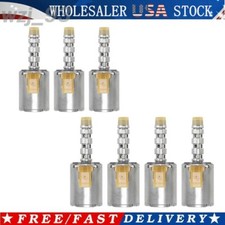
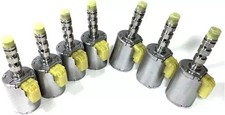
The TorqShift makes single-shift complaints easier to trace than older Fords. Per Transmission Digest, each clutch pack except the forward clutch has its own solenoid and pressure switch in the solenoid body. The forward clutch is applied through the manual valve.
| Solenoid | Clutch it controls | Type | Max pressure at |
|---|---|---|---|
| PC-A | Line pressure | Inversely proportional | 0 amp |
| SSPC-A | Coast clutch | Inversely proportional | 0 amp |
| SSPC-B | Overdrive clutch | Directly proportional | 1 amp |
| SSPC-C | Intermediate clutch | Directly proportional | 1 amp |
| SSPC-D | Direct clutch | Inversely proportional | 0 amp |
| SSPC-E | Low/reverse clutch | Directly proportional | 1 amp |
| TCC | Converter clutch | Directly proportional | 1 amp |
Source: Transmission Digest, "Ford 5R110W (TorqShift)." For which clutches are applied in each gear, see the clutch chart in our 5R110W slipping guide.
The table tells you what an electrical fault will do. An inversely proportional solenoid (SSPC-A or SSPC-D) that loses current applies its clutch at full pressure, so the result is a slam or a bind-up, not a slip. A directly proportional solenoid that loses current drops its clutch, so the result is a flare or a missing gear. If one shift is harsh, find the clutch that comes on during that shift, then check the solenoid that controls it.
Mechanical sticking causes most of these. GEARS reports that 5R110 solenoid valves stick in the snout. A valve that hangs partly open feeds its clutch early or too hard. On an intermittent bind in Drive, GEARS recommends replacing the overdrive solenoid (SSPC-B) and the coast clutch solenoid. To confirm a suspected overdrive solenoid on a bind-up, they swap SSPC-B with the TCC solenoid, which is also directly proportional. If the fault moves to the converter clutch, the solenoid is bad.
GEARS also gives a useful quick test for any bind-up complaint. With the engine off, if the truck rolls freely in both directions, the bind is hydraulic, meaning a solenoid or valve applying a clutch it should not. If the truck will not roll, suspect a mechanical problem inside the unit.
Using the pressure switches
Transmission Digest describes the switches as normally closed and says they open when solenoid control pressure goes above 40 psi. On units that have them, a switch that shows pressure in a gear where its clutch should be off tells you the solenoid or valve is leaking pressure into that circuit, which is a classic cause of harsh overlap. Sonnax also offers a pressure switch O-ringed end plug kit for loss of shift solenoid control pressure and shift concerns. That leak can make shifts soft, or erratic when combined with adaptive corrections.
Step 6: Harsh converter clutch apply
If the bump comes at steady cruise with no ratio change, it is the torque converter clutch. The TCC solenoid is directly proportional (1 amp = maximum apply pressure), so first confirm the PCM is ramping current rather than stepping it. If the command looks smooth and the apply is still harsh, the problem is in the valve body.
Sonnax ties harsh TCC apply to bore wear at the converter pressure limit valve. Its valve body layout lists harsh apply, soft apply, TCC codes, TCC slip, erratic apply pressure, excess converter pressure and TCC lining failure for this valve, with kit 36940-06K as the fix. The same worn bore can make the apply harsh one day and slip the next, so a truck with both complaints is not unusual. Sonnax also lists the TCC control plunger valve (36940-01K) for TCC slip, cycling, overheating and P0741. On a high-mileage valve body, check both.
Harsh TCC apply ruins the converter clutch lining over time. Fix the valve before you install a new converter, or the new lining will fail the same way.
The fix, by cause
| What you found | Fix |
|---|---|
| Wrong or mixed fluid | Drain and refill with the MERCON printed on the dipstick; set level hot; relearn |
| Harsh after battery disconnect, reflash or repair | Engagement relearn at 130°F: five each P-R, D-R, R-D, N-D |
| Harsh everywhere with APP or engine torque codes | Repair the engine input first; recheck shift quality |
| Harsh everywhere, high line pressure, no engine faults | PC-A solenoid, its harness or connector; check PCM output |
| One harsh shift or bind-up | Solenoid for that clutch; clean or replace; consider the full solenoid set on high mileage |
| Harsh or erratic TCC apply | Converter pressure limit valve (Sonnax 36940-06K) or a remanufactured valve body |
| Aftermarket clutches or pistons with a tuned engine | OE-spec parts matched to the calibration, or a calibration that matches the hard parts |
If the unit was run hard with high line pressure for a long time, check the cooler circuit and the pan for debris before you blame the new solenoid for a repeat failure. The solenoids in this unit do not tolerate contamination.
Shop the part for this fix: Sonnax 5R110W converter pressure limit valve kit (36940-06K)
If the harsh bump is the converter clutch and the TCC command looks right, this is the Zip Valve kit Sonnax specifies for bore wear at the converter pressure limit valve. For PC-A and shift solenoids, valve bodies and the rest of the unit, browse the 5R110W range at CoreTransmissionParts.
See the converter pressure limit valve kit at CoreTransmissionPartsNeed parts for this job?
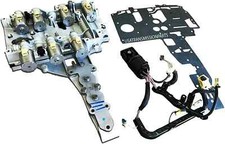
Our 5R110 parts page carries 5R110W pressure control solenoids, complete solenoid kits, valve bodies and internal harnesses, so you can buy the part for the circuit you traced. Checkout is on site.
FAQ
Why does my 5R110W shift hard?
Start with the fluid type and level, then ask whether the battery was disconnected or the PCM reflashed, because lost adaptives cause firm shifts until the unit relearns. If every shift is harsh, check for an accelerator pedal position sensor fault, which makes the PCM run higher line pressure on purpose. After that, look at the PC-A line pressure solenoid and its wiring.
What is the 5R110W relearn procedure?
Warm the fluid to 130F (54C), then perform five Park-to-Reverse, five Drive-to-Reverse, five Reverse-to-Drive and five Neutral-to-Drive engagements, about five seconds apart. Transmission Digest gives this procedure for use after a battery disconnect or PCM reflash to prevent firm or harsh engagements.
Can a bad pressure control solenoid cause harsh shifts on a 5R110W?
Yes. The PC-A line pressure solenoid is inversely proportional, so 0 amp gives maximum line pressure. An open coil, damaged harness or failed PCM driver leaves it at full pressure and every shift and engagement gets harsh. A PC-A valve sticking in the snout can cause the same thing.
What causes a harsh torque converter lockup on a 5R110W?
If the TCC current command ramps normally, Sonnax points to bore wear at the converter pressure limit valve, which causes harsh or soft apply, erratic apply pressure and eventually lining failure. Their 36940-06K kit is the fix. Repair the valve before installing a new converter.
What fluid does a 5R110W use?
Launch-era units called for MERCON SP, and Ford's 2009 Super Duty owner guide lists Motorcraft MERCON LV (XT-10-QLV) with about 17.5 quarts including the remote filter. The dipstick of each truck shows its requirement. Wrong or mixed fluid can change clutch apply feel and cause firm shifts.
Related guides
- 5R110W Slipping: Causes and Fix
- 5R110W Shift Solenoid Symptoms
- 5R110W Common Problems and Fixes
- 5R110W Won't Shift Into Overdrive: Causes and Fix
- 5R110W TorqShift Service Guide
Sources
- Transmission Digest, "Ford 5R110W (TorqShift)." Backs the APP sensor failure causing higher-than-normal line pressure with harsh upshifts and engagements; the PC-A, SSPC-A through E and TCC solenoid assignments and their directly/inversely proportional current logic; one solenoid and pressure switch per clutch except forward; the switches opening above 40 psi; the 130°F engagement relearn; and the MERCON SP launch requirement. transmissiondigest.com
- Ford Motor Company, "2009 F-250/350/450/550 Owner's Guide" (3rd printing). Backs the relearn after battery disconnect with slightly firmer shifts during learning, and the 5R110 capacity of 17.5 qt (16.6 L) with remote filter using Motorcraft MERCON LV XT-10-QLV. The live fordservicecontent.com PDF intermittently 403s under a browser user agent, so this cites the archived copy. web.archive.org (PDF)
- Sonnax, "Ford 5R110W Valve Body Layout." Backs the converter pressure limit valve kit (36940-06K) for harsh or soft TCC apply, erratic apply pressure, excess converter pressure and lining failure; the TCC control plunger valve kit (36940-01K) for TCC slip, cycling and P0741; and the pressure switch end plug kit (36940-17K) for loss of solenoid control pressure. sonnax.com
- GEARS magazine (ATRA), Bill Brayton, "Ford Torqshift Delayed Engagements and Bindups." Backs PC-A boost oil to the pressure regulator (about 11-15 psi without it), melted harness near the exhaust, the engine-off roll test, the SSPC-B/TCC solenoid swap, and replacing the overdrive and coast solenoids for an intermittent bind. gearsmagazine.com
- GEARS magazine (ATRA), Jarad Warren, "Ford 5R110: Money in Your Pocket." Backs 5R110 solenoid valves sticking in the snout and the approximately 4.5 ohm solenoid resistance. gearsmagazine.com
- GEARS magazine (ATRA), Jesse Zacarias, "Case Study of a 2006 Ford F-350 5R110W Transmission, 2-3 Flair." Backs the PCM raising line pressure to about 175 psi during each shift, recorded data showing a 3-5 problem reported as 2-3, and the aftermarket clutches, molded piston, non-factory fluid and modified engine behind the complaint. gearsmagazine.com