The 5R110W TorqShift has been behind every 6.0L and 6.4L Power Stroke Super Duty, the Excursion, and the 5.4L and 6.8L gas trucks and chassis cabs for well over a decade, so most of us have had one on the bench more than once. It is a strong box when it is healthy. But it has a short list of failures that show up over and over, and nearly every one of them traces back to a handful of design weak spots that Ford revised during production.
This is the list I work from when a 5R110W comes in: what fails, why it fails, how it shows up on the road and the scan tool, and what actually fixes it. The design history and part numbers come from Transmission Digest's 5R110W coverage and Sonnax's technical data; fluid specs come from Ford's own Motorcraft chart. Everything is listed under Sources at the bottom.
Know what you are working on first
The 5R110W launched in 2003 as a redesign of the 4R100, per Transmission Digest. It is a five-speed that can run six forward ratios. Below about 5°F (-15°C) fluid temperature it runs a cold-mode shift strategy that uses a 2.20 second gear and a 1.09 fourth. Once warm, it runs hot mode: 1st (3.09), 2nd, 3rd (1.54), 5th (1.00) and 6th (0.71). If a customer tells you the truck "shifts different when it is cold," that is often the design working, not a fault.
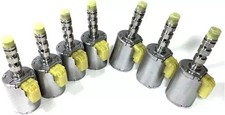
Control is entirely electronic. There are seven variable force solenoids, and they do not all behave the same way:
| Solenoid | Controls | Type |
|---|---|---|
| PC-A | Line pressure | Inversely proportional (max pressure at 0 amp) |
| SSPC-A | Coast clutch | Inversely proportional |
| SSPC-B | Overdrive clutch | Directly proportional (max pressure at 1 amp) |
| SSPC-C | Intermediate clutch | Directly proportional |
| SSPC-D | Direct clutch | Inversely proportional |
| SSPC-E | Low/reverse clutch | Directly proportional |
| TCC | Converter clutch | Directly proportional |
That split matters in diagnosis. An inversely proportional solenoid that loses its circuit fails to full pressure, so a dead PC-A gives you harsh, max-line-pressure shifts rather than slipping. A directly proportional solenoid that loses its circuit fails to zero, and the clutch it feeds will not apply.
Also note the year. Ford made enough internal changes in 2005, 2007 and late 2008 that "a 5R110W part" is not one part. Get the model year and engine before you order anything, gas versus diesel especially.
Problem 1: Direct clutch burns up
This is the big one. The direct clutch carries torque in the upper gears, so on a truck that tows it lives under load at highway speed. Sonnax attributes the failures to OE design shortcomings: not enough clutch capacity, poor heat dissipation, and flexing of the apply and backing plates, which gets worse when someone raises line pressure to "fix" a slip.
Symptoms: a flare on the 2-3 or 3-5 upshift, slipping in 5th or 6th under load, and burnt fluid with dark friction material in the pan. On a scan tool you will usually find gear ratio error codes rather than electrical faults, and TFT climbing fast when towing.
Fix: Replace the direct clutch pack, and while you are in there, add capacity. Sonnax's high capacity direct clutch kit (36965-01K) adds one OE-thickness friction and one steel, and uses thicker apply and backing plates. Sonnax rates that as a 25 percent increase in holding capacity, with more steel in the pack to soak up heat. Inspect the direct drum and piston too.
One warning from a real case. A Gears magazine case study on a 2006 F-350 with two rebuilds and two PCMs behind it found the "2-3 slip" was really a 3-5 flare. The unit had aftermarket direct clutches, a molded piston in the direct drum, non-factory fluid, and a shift kit that raised line pressure. Going back to factory-spec direct clutches, replacing the molded piston and refilling with the correct ATF cured it. More pressure is not a substitute for clutch capacity, and it tends to flex the plates Sonnax is warning about.
Problem 2: Low/reverse retaining ring walks out
This one catches people who have never seen it. When the truck moves in Reverse, the low/reverse pressure plate can move slightly in the case radially. That movement gradually walks the retaining ring out of its groove, per Sonnax. When the ring comes out, the pressure plate hammers the case lugs.
Symptoms: reverse slip, then no Reverse, and no manual 1st, since the low/reverse clutch holds both. By the time the customer notices, the case lugs are often damaged, which can turn a clutch job into a case replacement.
Fix: Transmission Digest notes Ford released a revised ring with rolled outward ends. Sonnax's 36885 ring is wider, slightly thicker and stiffer than the OE rings, with more outward tension, and replaces both the waved (gas) and flat (diesel) OE versions. On any 5R110W that is open, I treat the ring as a replace-every-time part and check the case lugs and groove with a light before assembly.
Problem 3: Low one-way clutch failure in cold weather
The low one-way clutch on the rear planet is lube-sensitive. Transmission Digest traced the failures to a production change: starting in 2008, Ford dropped the external bypass filtration system in favor of a new sump filter, and that reduced the unit's ability to keep the rear planet lubed when it is very cold. Warm weather hides it. The first hard freeze exposes it.
Symptoms: a no-move or neutral condition in 1st after a cold start, grinding from the rear of the case, and metal in the pan. If a truck quit in January and was fine all summer, look here.
Fix: Ford released two pump designs to address lubrication. Per Transmission Digest, 9C3Z-7A103A is for units with the filter-bypass system and retrofits back to 2003, and 9C3Z-7A103B is for non-bypass units. The non-bypass pump cover has a notch cut into one worm track so oil can cross at all times. Match the pump to the filtration system on the truck. Then confirm cooler flow and that the cooler-line thermal bypass works before winter, because a stuck thermal bypass starves the same circuit.
Problem 4: Overdrive one-way clutch and rear planet
The early overdrive one-way clutch (a mechanical diode) had enough trouble that Ford widened it by roughly 0.040 inch, per Transmission Digest. In 2007 Ford split it into gas and diesel versions, and in late 2008 made the OWC permanently attached to the rear planet, which eliminated the planet thrust washers. There was also a 2004 rear planet update to stop pinion pins from walking out.
The practical point is interchange. The rear planet/OWC assembly is 9C3Z-7D006B for five-clutch low/reverse packs and 9C3Z-7D006AB for six-clutch packs. Gas trucks use a 5-pack (5.4L) or 6-pack (6.8L) low/reverse; diesels use a 6-pack. Put the wrong assembly in and the clutch clearance and lube pattern are wrong from day one.
Problem 5: Sticking solenoids and shift quality complaints
A lot of "5R110W needs a rebuild" trucks actually have a solenoid valve sticking in its bore. Debris from worn clutches, or just varnish from old fluid, hangs up the small valve in the solenoid snout. The result is erratic, harsh or late shifts and pressure-related codes, often intermittent.
Before condemning the set, check the basics: correct fluid level and type, TFT reading sensibly, and each solenoid circuit's resistance against the service data. Remember which solenoids fail high and which fail low (the table above). If the fluid is clean and the clutches are sound, a solenoid set or a reman valve body is usually the fix. If the pan is full of friction material, the solenoids are a symptom and the clutches are the problem.
Read the code before you read the solenoid. Per the ATSG 5R110W manual, every solenoid in the set should measure 4.1-4.7 ohms at 72 degrees F through the case connector, and the TCC solenoid sits on pins 7 (VPWR, shared with line pressure PC-A) and 8 (PCM-controlled ground). Ford's OBD system operation summary splits the converter clutch codes cleanly: P0740 open, P0742 short to ground and P0744 short to power are electrical, while P0741 (stuck off) and P2758 (stuck on, non-MIL) are functional. An electrical code sends you to the harness and connector first; a functional code sends you to the hydraulics. Our 5R110W P0742 guide walks through the pin checks.
Problem 6: Fluid mistakes
The early 5R110W was filled with MERCON SP, and Transmission Digest is blunt that it is not interchangeable with MERCON or MERCON V. Ford's current Motorcraft fluid chart authorizes back-servicing the 5R110 TorqShift with MERCON LV for a complete refill or top off. So the choices are the factory SP fill on early trucks, or MERCON LV. MERCON V, universal "multi-vehicle" fluid and bottled additives are not on the list.
Ford's service interval is 30,000 miles (48,000 km), per Transmission Digest. The filtration is also different from most units: there is a remote filter that sees about 10 percent of flow, and the oil-to-air cooler cannot be back-flushed. After any major failure, replace the cooler rather than trying to flush the debris out of it, or the next unit inherits the last one's metal.
After the repair: the relearn
This step gets skipped constantly. After a battery disconnect, a PCM reflash, or any valve body or clutch work, the adaptive shift tables need to relearn. Transmission Digest gives the procedure: warm the fluid to 130°F (54°C), then do five engagements each of Park to Reverse, Drive to Reverse, Reverse to Drive and Neutral to Drive. Then road test through all gears with light and moderate throttle. A fresh rebuild that "shifts funny" for a week often just never got relearned.
The short version
- Flare on 2-3 or 3-5, slip in 5th/6th: direct clutch. Add capacity; do not just crank pressure.
- Reverse slip or no Reverse / no manual 1st: low/reverse retaining ring. Check the case lugs.
- No-move in 1st on a cold morning, 2008-up especially: low one-way clutch and lube. Match the pump to the filter system.
- Erratic or harsh shifts with clean fluid: solenoids or valve body.
- Always: MERCON SP or LV, new cooler after a failure, and a relearn.
Shop the part for this fix: 5R110W direct clutch balance piston
The direct clutch is the 5R110W's most common failure. If you are into the direct drum, this is the balance piston for it. More 5R110W parts, including pump seals, filter kits and speed sensors, are at CoreTransmissionParts.
See the balance piston at CoreTransmissionPartsNeed parts for this job?
Our 5R110W parts page has master rebuild and overhaul kits by year, solenoid kits, pumps, reman valve bodies, filter kits and coolers for the TorqShift. Checkout is on site.
FAQ
What is the most common 5R110W failure?
The direct clutch. Sonnax attributes it to limited clutch capacity, poor heat dissipation and flexing apply and backing plates, and it shows up as a flare on the upshift into the upper gears or slipping under load. Adding capacity with an extra friction and steel and stiffer plates addresses it; raising line pressure does not.
Why does my 5R110W have no reverse?
A common cause is the low/reverse retaining ring walking out of its case groove. Radial movement of the pressure plate in Reverse works the ring loose, and the result is reverse slip, then no Reverse and no manual 1st. Case lugs are often damaged by then, so inspect the case before reusing it.
Why did my 5R110W fail in cold weather?
On 2008-up units Ford replaced the external bypass filtration with a sump filter, which reduced rear planet lubrication in extreme cold and led to low one-way clutch failures. Ford released revised pumps, 9C3Z-7A103A for bypass-filter units and 9C3Z-7A103B for non-bypass units, to keep oil flowing at all temperatures.
What fluid does the 5R110W use?
Early trucks were filled with MERCON SP, which is not interchangeable with MERCON or MERCON V. Ford's current Motorcraft chart authorizes back-servicing the 5R110 TorqShift with MERCON LV for a complete refill or top off. Ford's interval is 30,000 miles.
Do I need to relearn a 5R110W after repairs?
Yes. After a battery disconnect, reflash or internal repair, warm the fluid to 130F and do five engagements each of Park to Reverse, Drive to Reverse, Reverse to Drive and Neutral to Drive, then road test through all gears. Skipping this is a common reason a fresh repair shifts poorly.
Related guides
- 5R110W Rebuild Wear Points
- 5R110W Shift Solenoid Symptoms
- 5R110 TorqShift Service Guide
- 5R110W vs 4R100: The Differences
- 6R140 vs 5R110W: The Differences
Sources
- Transmission Digest, "Ford 5R110W TorqShift." Backs the 2003 launch as a 4R100 redesign, hot/cold mode gear ratios, the seven solenoids and which are directly vs inversely proportional, MERCON SP not interchangeable with MERCON or MERCON V, the 30,000-mile interval, the remote filter at about 10 percent flow, the non-flushable oil-to-air cooler, and the 130°F relearn engagements. transmissiondigest.com
- Transmission Digest, "5R110W Lubrication Concern: Warm Weather, No Problem, but Winter's Coming." Backs the low one-way clutch failures, the 2008 change from bypass filtration to a sump filter, pumps 9C3Z-7A103A and 9C3Z-7A103B, the notched worm track, and the cooler-flow/thermal-bypass check. transmissiondigest.com
- Transmission Digest, "5R110W Upgrades." Backs the overdrive OWC width increase, the 2007 gas/diesel split, the late-2008 OWC-to-rear-planet change, the 2004 rear planet update, the revised low/reverse ring, rear planet part numbers 9C3Z-7D006B and 9C3Z-7D006AB, and gas versus diesel low/reverse clutch counts. transmissiondigest.com
- Sonnax, "Low/Reverse Retaining Ring 36885." Backs the ring walking out of its groove from pressure plate radial movement, damaged case lugs, reverse slip, no Reverse and no manual 1st, and the wider, stiffer replacement for waved and flat OE rings. sonnax.com
- Sonnax, "High Capacity Direct Clutch Apply Piston Kit 36965-01K." Backs the direct clutch failure causes (capacity, heat, plate flex) and the 25 percent capacity increase from one added friction and steel with thicker plates. sonnax.com
- Ford Motorcraft, "Automatic Transmission Fluid Quick Reference Chart." Backs Ford's authorization to back-service the 5R110 TorqShift with MERCON LV for complete refill and top off. fcsdchemicalsandlubricants.com (PDF)
- Gears Magazine (ATRA), "Case Study of a 2006 Ford F-350 5R110W Transmission 2-3 Flair." Backs the real-world 3-5 flare traced to aftermarket direct clutches, a molded direct drum piston, raised line pressure and non-factory fluid, and the factory-spec repair. gearsmagazine.com
- ATSG, Ford 5R110W (TorqShift) technical manual (2004). Backs the 4.1-4.7 ohm solenoid resistance at 72 degrees F and the TCC solenoid case connector pins 7 (VPWR shared with PC-A) and 8 (PCM-controlled ground). ATSG manual (PDF)
- Ford Motor Company, On Board Diagnostic system operation summary (2016 MY), Torque Converter Clutch Check Operation. Backs P0740 open, P0742 short to ground and P0744 short to power as electrical TCC codes, and P0741 stuck off and P2758 stuck on (non-MIL) as functional codes. Ford OBD summary (PDF, archive.org)