These two Ford five-speeds look like twins on the bench, and that is exactly how shops get into trouble with them. A 5R55S and a 5R55W share the same case, the same servos, and a lot of the same iron. But they do not carry the same overdrive planetary and they do not interchange as a straight swap. Order the wrong one, or pull a used unit off a shelf because the numbers "look close," and you end up with gear-ratio codes and a comeback. Here is how to keep them straight, what differs inside, and the failures that put both on your bench.
For more on Ford automatics, see our Ford transmission hub.
What the Letters Mean
The naming convention is not random. The W is a wide-ratio unit and the S is a synchronous-shift unit. Both are rear-wheel-drive five-speeds in the 5R55 family, and both were built to handle a similar torque range, but the S is the later, refined design with shift logic tuned to overlap the apply and release events more cleanly. That is why an S feels crisper through the gears than a W does.
There is a third letter in this family you need to know about: the 5R55N. It came first, from roughly 1999 to 2002, in the Jaguar S-Type (3.0/4.0L), Lincoln LS, and Ford Thunderbird. Per Sonnax, the N was replaced by the S in the Lincolns and T-Birds for 2003, while the W showed up in Explorers and Mountaineers for 2002-2003 before giving way to the S in the 2004-2005 window on those platforms. The N is the odd one out for interchange, which I will come back to.
Applications and Years at a Glance
5R55W (wide ratio): Ford Explorer, Explorer Sport Trac and Mercury Mountaineer, 2002-2003 per Sonnax, before the S took over those trucks for 2004-2005. That truck-and-SUV use is what the wide spacing was for. Note that the Ranger is not a W application: Ranger automatics of this era are the unrelated 4R44E/5R55E family.
5R55S (synchronous): Ford Mustang V6 and GT (2005-2010), Ford Thunderbird (2003-2005), Lincoln LS (2003-2006), and Lincoln Aviator. These are the car applications, where the tighter 2nd-gear step and the deeper overdrive suit the driveline.
5R55N (the ancestor): 1999-2002 Jaguar S-Type, Lincoln LS, and Thunderbird. If you are working on an early LS or T-Bird, confirm whether you have an N or an S before you order anything.
Gear Ratios: Where They Split
This is the part that matters for interchange, so pay attention to which gears change and which do not. First, third, fourth, and reverse are identical between the S and the W:
- 1st: 3.22 (both)
- 2nd: 2.41 (W) vs 2.29 (S)
- 3rd: 1.54 (both)
- 4th: 1.00 (both)
- 5th / overdrive: 0.75 (W) vs 0.71 (S)
- Reverse: 3.07 (both)
The 2nd-gear and overdrive differences trace directly back to the overdrive planetary. Per Sonnax's identification work, the W uses a 24-tooth overdrive sun gear and the S uses a 38-tooth overdrive sun gear. That is not a calibration difference you can flash away, it is hard parts. The taller W overdrive (0.75) drops highway RPM less than the S (0.71), and the wider W 2nd gear gives a more truck-friendly step off the line. Mix the planets between units and the computer sees a ratio it does not expect, which lands you a P0732/P0733/P0735 family code on the affected gear.
Shop 5R55S parts →
How to Tell Them Apart on the Bench
Start with the vehicle, the door label and the transmission tag. Per Ford's 5R55W/S diagnosis manual, the transmission code sits in the TR box next to AXLE on the certification label on the driver's door post: R for the 5R55W, V for the 5R55S on the 2002 Explorer and Mountaineer. The case also carries a service identification tag. Letter codes vary by platform, so our 5R55S identification guide walks through the Mustang and later Explorer codes too. That paperwork is the fastest and most reliable ID, because the S and the W are close enough externally that a glance will fool you. If you need to confirm on the unit itself, the most useful physical tell separates the N from the W/S: per Sonnax, the N has two cast bosses just behind the intermediate servo cover (the one nearest is tapped for PCC), while the W/S has only a single boss for the PCC pressure port. You can feel that difference even with the unit in the vehicle.
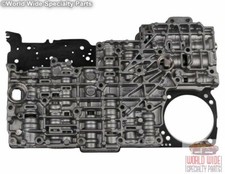
Drop the pan and it gets clearer. The N carries a base plate similar to a 4R70W covering the lower valve body, along with a reverse-pressure (RP) switch. The W/S solenoid assembly has no RP switch terminals and the circuits are routed differently. Between the W and the S specifically, the case and servos are shared, so your confident separation comes from the overdrive planetary tooth count and the vehicle application, not from a quick external look.
Solenoids and Valve Body
Both the W and the S use the same control strategy, and it helps to know it before you start throwing solenoids at a complaint. As Jesse Zacarias laid out in Transmission Digest, the unit runs four on/off shift solenoids, one pulse-width-modulated solenoid for TCC control, and three variable-force solenoids (PCA, PCB, PCC). The four shift solenoids align the valves in the valve body; the three VFS then control the rate of apply and release for the clutch packs and for the intermediate and overdrive bands. In Park, Reverse, Neutral, and Drive the shift solenoids hold the same state, so engagement quality in those ranges is really the VFS doing the work.
The solenoid manifold is a trap for interchange. It appears to swap between the N, W, and S, but per Sonnax the critical pieces are the base plate and the filter. Mix those and the unit will lose reverse, lose TCC apply, and lose solenoid oil pressure. Match the base plate and filter to the unit family, always.
The solenoid pack itself is split by model year, not by W versus S. ATRA's 2013 seminar material gives the Ford numbers: 2002-03 Ford W or S and 2003 Lincoln take 1L2Z-7G391-AG, while 2004-on Ford and 2004-06 Lincoln take the later pack, with Ford recommending the updated 9L2Z-7G391-A. ATRA measured about a 4 psi difference in PCA output at 0.6 amp between packs, enough to cause flare shifts. The same ATRA material shows PCB, through VFS2, directly applying the overdrive servo, and Pete Luban of ATSG notes in Transmission Digest that trouble in that circuit sets P0732 and P0735 together, since the overdrive band makes both 2nd and 5th. That is why a W or S that won't shift into overdrive gets its 2nd gear checked first.
The Failures That Actually Bring Them In
Servo Pin Bore Wear (Both Units)
This is the classic 5R55 job. The overdrive and intermediate servo apply pins ride in bores machined right into the case, and constant pin oscillation wears those bores out. Per Sonnax, once the pin bore wears, apply oil leaks into the barrel area of the case, which hurts shift timing and band apply pressure; as wear increases, release oil cross-leaks into the apply circuits and exhausts at the shift valves. The symptom list is a dead giveaway: 1-2, 2-3, and 4-5 flares, gear loss, codes P0732/P0733/P0735, and burned band lining. Because both servos are charged from the release side in reverse, worn pin bores also show up as delayed reverse. The fix is not a new case, it is reaming the bore true and installing a wear-resistant sleeve, which Ford also addressed with a measure-and-sleeve procedure in TSB 09-12-12. Sonnax also notes these units are prone to foaming the sump fluid from excess exhaust and valve body wear, which pushes fluid out the vent and gives you a false low-fill reading, so do not chase a "leak" until you rule that out.
Valve Body and Case Bore Wear (Both Units)
Before you blame a servo or a solenoid, look at the valve body. Per Sonnax, the TCC modulator bore and the main regulator bore tend to wear first because they cycle the most, followed by the VFS 1, 2, and 3 modulator bores. As those wear, they cannot deliver full clutch and servo pressure. The adaptive strategy hides it for a while, the PCM keeps compensating, and then you finally get gear-ratio codes or outright slip. The tell here is that a new solenoid does not fix it, because the valve, not the solenoid, is the leak. A wet air test through the circuits is how you find the worn bores instead of guessing.
Front-Planet Bearing Failure (5R55W Only)
This one is specific to the W and it is a big reason Ford moved to the S. Per Ed Lee's Transmission Digest write-up, the front-planet bearing in the W is especially failure-prone: the center of the bearing cage on the sun-gear side gets stamped out, and that eventually leads to catastrophic failure. When it goes fully, replacement is the only option, and the service planet is a Ford part (p/n 2L2Z-7A398-AA). If you catch it early and the planet-side race is still good, the article documents a repair using a bearing from the RE4F02A (it sits between the stator support and direct drum) plus a 700-R4/4L60-E front endplay shim to make up the 0.020-inch difference. This is a good example of why "close enough" between a W and an S bites you: the planet and sun gear were not carried over to the S.
TCC Slip and Converter Failure (Both Units)
Excess TCC slip, converter failure, and converter noise are common complaints. Per Sonnax, converter release oil is limited to 130 psi by the converter regulator valve, and the TCC solenoid pressure is supposed to be capped at 72 psi by the solenoid regulator valve. If that regulator bore is worn on the inboard end, pressure keeps climbing at the modulator sleeve, and while more pressure reduces slip it can also deflect the TCC piston and kill the converter. A small back-pressure valve holds 8-12 psi on the release oil to help control slip and lube. Diagnose the hydraulics before condemning the converter.
Fluid: MERCON V, and Which One
Both units call for MERCON V, roughly 12.7 quarts total dry fill per the Ford service data. The important detail is which MERCON V. Per Sonnax, the early factory MERCON V used before about May 2005 degraded solenoids in the 5R55E/N/W/S family. Ford released an interim additive package (4L2Z-19B546-AB, fluid XL-11, bulletin FSA 04B22) and then resolved it with a revised MERCON V, XT-5-QM, in the black quart bottle. When you service one of these, get every trace of the old fluid out, prime the VFS solenoids with fresh fluid and pull it through with vacuum before install, and run an adaptive relearn afterward, since these post-2002 Ford units learn their shift pressures. Skip the relearn and a perfectly good rebuild will shift like garbage until it re-adapts on its own.
One more field note from the Transmission Digest coverage: a tick or rattle that rises with engine speed on these is often the inspection plate between the block and bellhousing flexing, not something internal. Ford went to a new-style plate with foam insulation to stop it. Do not tear into a transmission over a noise that lives on the outside of it.
The Interchange Rules, Plainly
- W to S is not a straight swap. They share the case and a lot of hard parts, but the overdrive planetary and sun gear differ (24-tooth W vs 38-tooth S), which changes 2nd and 5th and will set gear-ratio codes if mixed. The calibration is also vehicle-specific.
- Replace like-for-like, matched to the vehicle. Order by the tag and the application, not by "it looks the same."
- The N is the outlier. Only a few parts interchange with the W/S, and installing N parts (especially the solenoid base plate and filter) into a W/S creates problems like lost reverse and lost TCC apply.
- Do not mix solenoid base plates or filters across N/W/S even though the manifold looks common.
Get those four rules right and these are honest, rebuildable units. Get them wrong and you will chase a ratio code you built into the job yourself.
Building a 5R55S or 5R55W this week?
Servo bore sleeves and the reaming fixture, solenoid bodies and filters, overdrive planetaries, valve body components, and MERCON V — matched to your unit and shipped from the USA.
Shop 5R55S parts →Frequently Asked Questions
How do I tell if I have a 5R55S or a 5R55W?
Start with the vehicle. A 2005-2010 Mustang, a 2003-2005 Thunderbird, or a Lincoln LS/Aviator uses the synchronous 5R55S. A 2002-2003 Explorer or Mountaineer uses the wide-ratio 5R55W, and 2004-on Explorer and Mountaineer five-speeds are the 5R55S (the earliest LS/T-Bird/Jaguar S-Type units are the related 5R55N). Confirm with the TR code on the driver door-jamb label (Ford uses R for the 5R55W and V for the 5R55S on the 2002 Explorer) and the transmission tag, and remember the two share a case and swap almost identically on the outside, so the tag and the vehicle are your real ID, not a glance at the unit.
What is the actual difference between the S and the W?
S stands for synchronous shift and W stands for wide ratio. First, third, fourth, and reverse are the same in both (3.22, 1.54, 1.00, 3.07). The W runs a taller 2nd (2.41) and a taller overdrive (0.75) on a 24-tooth OD sun gear; the S runs a closer 2nd (2.29) and a deeper overdrive (0.71) on a 38-tooth OD sun gear, with shift logic tuned for smoother, more synchronized changes.
Will a 5R55S interchange with a 5R55W?
Not as a straight swap. They share the case and many hard parts, but the overdrive planetary and sun gear differ (24-tooth W versus 38-tooth S), which changes 2nd and 5th ratios and will set gear-ratio codes if mixed, and the calibration is vehicle-specific. Replace like-for-like, matched to the vehicle. The earlier 5R55N is even further apart and shares only a few parts with the W/S.
What fluid does a 5R55S or 5R55W take and how much?
MERCON V, roughly 12.7 quarts total dry fill. Use the revised MERCON V (Ford XT-5-QM); the early MERCON V used before mid-2005 was linked to solenoid degradation, and Ford issued an interim additive to address it. A pan drop and filter takes far less than the full fill, so verify level warm at the fill plug rather than trusting a quart count.
Sources
- Sonnax — "Figuring Out the 5R55 Alphabet," Bob Warnke, September 19, 2007. Backs the meaning of the W (wide) and S (synchronous), the 24-tooth W vs 38-tooth S overdrive sun gear, the N/W/S application years, the one-boss vs two-boss and RP-switch identification, the solenoid base plate/filter interchange warning, the valve body/case bore wear order (TCC modulator and main regulator first), the TCC pressure limits (130 psi release, 72 psi solenoid, 8-12 psi back-pressure), and the early MERCON V solenoid-degradation problem with additive 4L2Z-19B546-AB (XL-11) and revised fluid XT-5-QM. sonnax.com
- Sonnax — "5R55N/S/W Overdrive & Intermediate Servo Pin Bore Sleeve Kit (56361J-01K)." Backs the servo pin bore wear failure: apply oil leaking into the case barrel, release oil cross-leaking into apply circuits and exhausting at the shift valves, delayed reverse from both servos being charged on the release side, the 1-2/2-3/4-5 flares, gear loss, codes 732/733/735, band lining failure, sump foaming and false fill readings, and the ream-and-sleeve case-salvage repair. sonnax.com
- Transmission Digest — "A Fix for 5R55W Front-Planet Bearing Failure," Ed Lee (Sonnax TASC Force), 2006. Backs the 5R55W-specific front-planet bearing failure (bearing cage stamped out on the sun-gear side leading to catastrophic failure), the Ford service planet part number 2L2Z-7A398-AA, the RE4F02A bearing substitution with a 700-R4/4L60-E shim, and the fact that the planet and sun gear were not carried over to the S. transmissiondigest.com
- Transmission Digest — "Understanding the 5R55S/W Initial Engagements," Jesse Zacarias, November 1, 2012. Backs the solenoid architecture (four on/off shift solenoids, one PWM TCC solenoid, three variable-force solenoids PCA/PCB/PCC), the role of the shift solenoids in aligning the valve body and the VFS in controlling apply/release rate, and the common complaints of harsh forward/reverse engagement, delayed engagements, 3-4 flare, and bind-up. transmissiondigest.com
- Ford 5R55W service manual (transmission service specifications). Backs the MERCON V fluid requirement and the 12.7-quart total capacity, and the caution against using other fluids to avoid chatter/squawk. at-manuals.com
- ATRA — 2013 Technical Seminar, "Ford 5R55W/S Erratic Transmission Operation" (pp. 112-120). Backs the solenoid pack part-number break by model year (1L2Z-7G391-AG early; 4L2Z-7G391-AA and updated 9L2Z-7G391-A later), the 4 psi PCA output difference at 0.6 amp, and PCB/VFS2 directly applying the overdrive servo and coast clutch. atracom (PDF)
- Transmission Digest — "False Pretenses," Pete Luban (ATSG). Backs PCB affecting 2nd and 5th and the paired P0732/P0735 ratio codes on a no-2nd/no-5th 5R55W. transmissiondigest.com
- Ford service information via Mitchell1 — "2002 Automatic Transmissions 5R55W/S Diagnosis" (Explorer/Mountaineer). Backs the door-label TR code location and letter codes (R = 5R55W, V = 5R55S), the service identification tag on the case, and the S (synchronous) and W (wide ratio) definitions. Ford/Mitchell diagnosis (PDF)