P0741 and P0742 tell you the converter clutch is stuck off or stuck on. Neither code tells you why, and the fix for a clutch that won't lock is nothing like the fix for one that won't release, even though both can land on a ticket as the same vague complaint: "shudders at speed" or "feels like it's dragging at a stop." This is the 5R55W's torque converter clutch (TCC) circuit explained from the hydraulics up — the solenoid, the modulator valve, and the pressures that actually move it — plus a scan-tool and bench decision tree for sorting a lockup complaint before parts get ordered.
Why lockup exists and what the 5R55W does differently
A torque converter couples the engine to the transmission through fluid, not a solid connection, and that coupling always slips a little even when everything is healthy. Every bit of that slip turns into heat instead of forward motion. The torque converter clutch is a friction disc that clamps directly against the converter cover, turning the fluid coupling into a mechanical one and killing that loss — which is the entire reason it exists.
The 5R55W is the unit Ford ran behind the 2002-2003 Explorer and Mercury Mountaineer, replaced by the mechanically similar 5R55S starting in 2004, per Sonnax's own identification guide for the family. Both share the same basic TCC architecture: a pulse-width-modulated (PWM) solenoid that doesn't clamp the clutch directly, but instead varies a signal pressure that positions a TCC modulator valve, which in turn meters how fast and how firmly the converter clutch applies. That's the same current-to-pressure-to-valve-position logic Ford uses throughout this valve body — the PCM doesn't flip switches, it drives current through pressure control solenoids that stroke valves against springs. GEARS Magazine's bench write-up of a 2006 5R55W with a delayed-forward-engagement complaint shows the pattern clearly on a different circuit: the PCM drives pressure control solenoid B at about 0.5 amps to stroke the forward engagement valve against its spring, while a second solenoid raises pressure on the opposing side to control when the valve opens mainline to the forward clutch. The TCC circuit runs on that same logic, just with its own dedicated solenoid and modulator valve.
The hydraulic path: solenoid, modulator valve, and the pressures that matter
Here's what each piece in the TCC apply circuit is doing, and where Sonnax's own technical documentation says it wears:
| Component | Job in the circuit | Pressure / documented wear |
|---|---|---|
| TCC solenoid (PWM) | Varies signal pressure that strokes the TCC modulator valve | Output is capped at 72 psi by the solenoid regulator valve |
| TCC modulator valve (plunger + sleeve) | Positions against solenoid signal pressure to meter converter apply pressure and TCC slip rate | Sleeve ID wears from constant PWM oscillation; a worn sleeve shifts plunger force onto the inner modulator valve and cuts apply pressure |
| Converter regulator valve | Limits converter release oil | Capped at 130 psi |
| Back pressure valve | Holds back pressure on release oil to help control TCC slip rate and lube flow | Runs roughly 8-12 psi |
Once the TCC does apply, it's running on modulated line pressure — commonly 160-250 psi or more on this family — as converter apply pressure. That's fine when the bores are tight. When the solenoid regulator valve's bore wears, pressure at the modulator sleeve climbs past spec, and Sonnax ties that directly to TCC piston deflection and converter failure, not just a soft lockup feel.
Two bores wear first and are worth a visual check before anything else comes apart: the TCC modulator bore and the main regulator bore, per Sonnax's numbering of the valve body. The VFS modulator bores wear too, with cycle rate, and that wear shows up as reduced clutch and servo pressure — gear ratio codes or slippage that techs often blame on the TCC solenoid or a worn servo pin bore when the real culprit is upstream in the VFS valves. Rule those out before you condemn the TCC circuit on a unit that's also throwing ratio codes.
Symptoms: stuck-off vs. stuck-on
Stuck off (P0741)
The clutch is commanded to lock but won't hold. You'll see slip at cruise speed, an RPM that flares slightly when you ease into the throttle at 45+ mph with lockup commanded, climbing fluid temperature, and a highway fuel economy number that's worse than it should be. Ford's service information confirms that a TCC solenoid failed in the OFF position simply means the converter clutch will not engage, and that P0741 (TCC engagement error) only sets after the malfunction is detected five times consecutively, so an intermittent slip can go a while without a code (Ford 5R55W/S Diagnosis, source 6). This is the pattern behind code P0741; see our dedicated 5R55W P0741 guide for the full code-specific diagnostic walkthrough.
Stuck on (P0742)
The opposite problem: the clutch won't release when it should. Without the fluid coupling to fall back on, the truck bucks, shudders or stalls at idle and at a stop, and it lugs hard on deceleration instead of coasting smoothly. This sets code P0742 and generally traces to a solenoid or modulator valve holding signal pressure applied even when the PCM commands release. See our dedicated 5R55W P0742 guide for that code's specific diagnostic steps.
Scan tool diagnosis: reading slip and duty cycle
The converter clutch is never a simple on/off device. GEARS Magazine's walkthrough of diagnosing TCC slip on a comparable PWM-solenoid platform puts it plainly: the clutch is always slipping somewhere between roughly 5% and 95% depending on speed and load while the PCM works it toward full lockup, and scan data worth trusting shows actual slip, desired slip, and TCC status (open, open-slip, slip, or slip-open) side by side, not just a commanded-on flag. The exact RPM thresholds and timers that trip a code are calibration-specific to each model and model year, but the logic that GEARS documents generalizes: a code sets when actual slip deviates from desired slip by a set margin, sustained and repeated across a handful of drive cycles, while the solenoid is commanded into slip or lockup mode.
On the road, that logic turns into a usable test. With the transmission warmed up, drive gently on a mild grade above 45 mph with lockup commanded and ease into the throttle. Watch slip speed — or compute it yourself as engine RPM minus turbine/input RPM if your scan tool doesn't expose a direct slip PID — alongside the lockup solenoid's commanded duty cycle:
- Duty cycle pinned near 100% with slip climbing as you add throttle is the stuck-off, slipping-clutch pattern. The solenoid is doing its job; the clutch isn't holding.
- Duty cycle commanded down toward 0% (braking, deceleration) while slip stays near zero is the stuck-on pattern. The clutch isn't releasing when it should.
Log both values through a full warm-up drive rather than a single snapshot. Sonnax and GEARS both note that TCC faults on PWM-solenoid units can be intermittent and only show up after sustained highway driving, so a two-minute test in the shop parking lot can miss it. If the duty cycle the scan tool reports doesn't match what you read back-probing the solenoid command wire with a meter, you're looking at a PCM, wiring or connector problem rather than a hydraulic one — chase that before you touch the valve body.
Bench and hydraulic checks when scan data points to the valve body
When the electrical side checks out and the pattern still points to the TCC circuit, these are the next steps, in order:
- Command the solenoid independent of the PCM. Sonnax's technical breakdown of the 5R55 family describes testing TCC apply by grounding the correct solenoid pin (pin 14 in their write-up) or by using a shift box — verify you've identified the right wire on your harness before grounding anything. If the clutch applies correctly on a direct command but not under normal PCM operation, the fault is upstream of the solenoid.
- Ohm the TCC solenoid at the case connector. Ford's procedure measures from terminal 3 (the common feed) of the transmission 16-pin connector to terminal 14, the TCC solenoid; spec is 9-16 ohms, and any reading under 5 ohms from terminal 14 to chassis ground means a shorted solenoid body (source 6). Ford also has you command TCC on and off with the scan tool and listen for the solenoid click before condemning the wiring.
- Visually check the two bores that wear first. The TCC modulator bore and the main regulator bore show wear before anything else in this circuit, per Sonnax, and a visual inspection catches obvious scoring without a full vacuum test.
- Vacuum-test the modulator valve and solenoid regulator valve. This confirms bore condition at the ports that actually carry TCC apply and release pressure, rather than relying on a visual pass alone.
- Check the VFS bores if ratio codes or slippage ride along with the TCC complaint. Wear there reduces clutch and servo pressure independent of the TCC circuit and gets misdiagnosed as a TCC or servo pin bore problem more often than it should.
The fix: solenoid, modulator kit, or converter
Which part actually needs to change depends on where the fault landed:
Electrical solenoid failure. If resistance testing is out of spec or the solenoid doesn't respond to a direct ground/activation command, replace it. A bad coil won't respond no matter how clean the hydraulics are.
Modulator sleeve or bore wear. Sonnax's 56947J-03K TCC Modulator Plunger Valve Kit is built specifically for this wear pattern on the 5R55W and 5R55S: it addresses sleeve ID wear from constant PWM solenoid oscillation that shifts plunger force onto the inner modulator valve and cuts apply pressure. Sonnax lists the symptoms it resolves as slip codes, high TCC slip RPM under increasing load, overheated fluid, and general converter apply/release concerns — which lines up with a stuck-off complaint that scan data confirms is hydraulic rather than electrical.
Fluid history. If the truck's fluid history is unknown and it predates roughly May 2005 production, be aware of the documented early-Mercon-V fluid issue Sonnax covers across the 5R55E, 5R55W, 5R55S and 5R55N family. Ford's interim fix was an additive package (fluid XL-11, part 4L2Z-19B546-AB) under bulletin FSA 04B22, later superseded by a revised Mercon V formulation. Whatever you refill with, it has to carry a real MERCON V license: Ford's own Motorcraft MERCON V data sheet lists license M5091101 and a typical viscosity of 7.5 cSt at 100 C with a 205 viscosity index, and a converter clutch that is already slipping does not need a thinner, off-spec fluid making it worse. Degraded original fluid is also harder on a replacement solenoid, so a fluid and filter service is a reasonable first move alongside any TCC repair — see our 5R55W fluid change cost breakdown for what that job actually involves. One more detail worth knowing before you install a new solenoid: Sonnax notes that replacement VFS solenoids ship primed with fluid but can lose that prime from handling, so fill the circuit and pull it through with vacuum before installing rather than bolting it in dry.
The converter itself. If the clutch disc inside the converter has physically failed — glazed, warped, or broken apart — no solenoid or valve body repair restores lockup. That's a converter replacement, and it should be the last thing confirmed, after the solenoid and valve body have been tested and ruled out.
Shop the part for this fix: 5R55W shift solenoid block
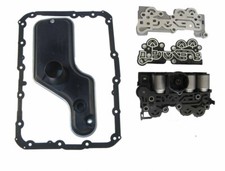
The TCC solenoid lives in the shift solenoid block on 2002-up Explorer applications. When testing points to the solenoid rather than the modulator valve, this is the part. More 5R55W parts are in the full CoreTransmissionParts collection.
See the shift solenoid block pack at CoreTransmissionPartsNeed parts for this job?
Our 5R55 parts page has the 5R55W TCC solenoid, the full solenoid kit, valve bodies, and the pump and clutch hardware for units that end up needing more than a solenoid. Checkout is on site.
FAQ
What does TCC lockup mean on a 5R55W?
TCC stands for torque converter clutch, a friction disc inside the converter that can clamp directly against the converter cover so the engine and transmission input spin as one solid unit instead of coupling through fluid. On the 5R55W, a pulse-width-modulated solenoid varies a signal pressure that positions a TCC modulator valve, which meters how fast and how firmly that clutch applies, per Sonnax's technical breakdown of the 5R55 family. Locking the clutch removes the slip that always exists in a fluid coupling, which is where the fuel economy and heat benefit comes from.
Why won't my 5R55W torque converter lock up?
Electrical and hydraulic causes split the complaint. Electrically, the solenoid itself can fail or the PCM/wiring can fail to command it. Hydraulically, the TCC modulator plunger valve sleeve wears from constant PWM solenoid oscillation, which Sonnax documents as the cause of high TCC slip, slip codes and reduced converter apply pressure on 5R55W and 5R55S units. Low fluid, degraded fluid or a converter with a worn-out clutch disc can also prevent lockup. This is the stuck-off pattern behind code P0741; see our dedicated 5R55W P0741 guide for the full code-specific walkthrough.
Can a 5R55W run with the TCC stuck on?
Not comfortably. A converter clutch stuck applied removes the fluid coupling that lets the engine idle while the vehicle is stopped, so the truck will buck, shudder or stall at idle and at a stop, and it will lug hard on deceleration instead of coasting smoothly. This sets code P0742 and generally traces to a solenoid or modulator valve that is holding signal pressure applied even when the PCM commands release. See our dedicated 5R55W P0742 guide for the diagnostic steps specific to that code.
What causes high TCC slip on a 5R55W that hasn't set a code yet?
The most common cause Sonnax documents is wear at the inner diameter of the TCC modulator plunger valve sleeve from constant oscillation by the pulse-width-modulated solenoid. As the sleeve wears, plunger force shifts onto the inner modulator valve and converter apply pressure drops, which shows up as rising slip under load, overheated fluid and a soft lockup feel well before slip crosses the threshold that sets a P0741. The valve bore just inward of the sleeve wears quickly too, so Sonnax's repair kit addresses both in one service.
Does the Mercon V fluid type matter for TCC lockup on a 5R55W?
Yes. Ford specifies Mercon V for the 5R55W, but Sonnax documents that early Mercon V produced before roughly May 2005 caused fluid-related problems across the 5R55E, 5R55W, 5R55S and 5R55N family, serious enough that Ford issued an interim additive package under bulletin FSA 04B22 before releasing a revised Mercon V formulation. Degraded original fluid is also harder on a replacement solenoid, so a fluid and filter service is a reasonable first step on any 5R55W with a TCC complaint and unknown fluid history.
Related guides
- 5R55W P0741: Torque Converter Clutch Stuck Off Causes & Fix
- 5R55W P0742: Torque Converter Clutch Stuck On Causes & Fix
- 5R55W Fluid Change Cost: Parts, Labor and the Right Way to Do It
- 5R55W Overheating: Causes and Prevention
- Ford 5R55S / 5R55W Problems: Servo Bore Wear, Delayed Reverse, and the Fixes That Hold
Sources
- Sonnax — "Figuring Out the 5R55 Alphabet." Backs the 5R55W (2002-2003 Explorer/Mountaineer) and 5R55S (2004-up) applications, the TCC solenoid output capped at 72 psi by the solenoid regulator valve, converter release oil capped at 130 psi by the converter regulator valve, the 8-12 psi back pressure valve controlling TCC slip and lube pressure, the 160-250+ psi modulated line pressure that becomes converter apply pressure, the TCC modulator bore and main regulator bore as the first wear points, VFS modulator bore wear and its gear-ratio-code symptoms, the solenoid pin 14 ground test for commanding TCC apply independent of the PCM, the early-Mercon-V fluid problem and Ford bulletin FSA 04B22 / additive XL-11 (4L2Z-19B546-AB) / revised Mercon V XT-5-QM, and the solenoid prime-loss note for replacement VFS solenoids. sonnax.com
- Sonnax — 56947J-03K TCC Modulator Plunger Valve Kit, product and application page. Backs the TCC modulator plunger valve sleeve wear mechanism from constant PWM solenoid oscillation, the resulting shift of plunger force onto the inner modulator valve and reduced converter apply pressure, and the documented symptoms: slip codes, high TCC slip RPM under increasing load, overheated fluid, and converter apply/release concerns on 5R55W and 5R55S units. sonnax.com
- GEARS Magazine (ATRA) — "Going Nowhere Fast… 5R55W Delayed Forward Engagement," September 2017. Backs the PCM's current-controlled pressure control solenoid architecture on the 5R55W, specifically pressure control solenoid B driven at about 0.5 amps to stroke the forward engagement valve against its spring while a second solenoid raises opposing pressure to control valve timing — the same general apply logic the TCC circuit uses with its own dedicated solenoid and modulator valve. gearsmagazine.com
- GEARS Magazine — "Back on the Bench," December 2020 (NAG-1/722.6 P0741 TCC slip diagnostic methodology). Backs the general principle that a torque converter clutch is always slipping somewhere between roughly 5% and 95% depending on speed and load while under PCM control, the use of actual slip, desired slip and TCC status together as reliable scan data, the code-setting logic of actual slip deviating from desired slip by a sustained, repeated margin while the solenoid is commanded into slip or lockup mode, and the back-probing method for separating an electrical command fault from a mechanical one. Thresholds and timers are calibration-specific per platform; this article documents the diagnostic method rather than 5R55W-specific values. gearsmagazine.com
- Ford Motor Company — Motorcraft MERCON V Automatic Transmission Fluid, Product Data Sheet. Backs the MERCON V license number M5091101 and the product typicals cited in the fluid section (7.5 cSt at 100 C, 33.2 cSt at 40 C, viscosity index 205). fcsdchemicalsandlubricants.com (PDF)
- Ford Motor Co. service information (Mitchell reprint) — 2002 Ford Explorer, "5R55W/S Diagnosis." Backs the TCC solenoid failure modes (stuck ON: rough running and stall at low idle; stuck OFF: no TCC engagement), the DTC chart entries for P0740/P0743, P0741 and P1740, the five-consecutive-failure requirement for P0741, and the TCC solenoid resistance of 9-16 ohms between 16-pin connector terminals 3 and 14 with the under-5-ohm short-to-ground limit. 5R55W/S Diagnosis (PDF)