P0742 is "Torque Converter Clutch Circuit Stuck On," and unlike most transmission codes it usually announces itself before the scan tool does. The customer describes it as a stall. They come off the highway, roll up to the light, and the engine bogs, shudders and dies as the vehicle stops. Restart it, drive off, and everything seems fine until the next stop.
That is the converter clutch refusing to release. Lock the clutch and the engine crankshaft is tied directly to the transmission input, so the fluid coupling that lets an idling engine sit still while it is in gear is gone. Bring the wheels to zero and the engine gets dragged toward zero with them. The PCM watches the same thing electronically: it commands release, waits for slip between engine RPM and turbine shaft speed to reappear as road speed drops, and sets P0742 when the slip never comes back. Exact thresholds vary by calibration, but the logic is always the same, and it is why P0742 is a mechanical complaint carrying an electrical name.
On a 5R55W, the reason the slip does not come back is almost never the solenoid.
What Actually Holds the Clutch On
Writing in Transmission Digest, Jesse Zacarias lays out the control set on this unit: four on/off shift solenoids that align valves in the valve body, three variable force solenoids (PCA, PCB and PCC) that manage apply and release rate for the clutch packs and the intermediate and overdrive bands, and one pulse width modulated solenoid dedicated to torque converter clutch control. That single PWM solenoid is the entire electrical side of the story.
Here is the part that matters for a stuck-on condition. Sonnax's Bob Warnke describes the circuit in detail: with the clutch released, converter release oil holds the TCC piston off the cover, supplies charge pressure, and then flows to the cooler, coming off the converter regulator valve limited to 130 psi. On the apply command, solenoid oil goes to the modulator sleeve and to the end of the TCC control valve, and that solenoid pressure is supposed to be limited to 72 psi by the solenoid regulator valve. Once the TCC control valve strokes, release oil is redirected to the cooler circuit and modulated line pressure becomes the converter apply pressure — whatever line is available, which Warnke puts at 160 to 250 psi and up.
Read that as a release problem instead of an apply problem and P0742 makes sense immediately. Releasing the clutch is not a matter of the solenoid pushing the piston off the cover. It is a matter of the TCC control valve returning to its rest position so release oil gets back behind the piston. If that valve does not come back, the PWM solenoid can command zero all day and the clutch stays applied. The solenoid is not driving the piston. It is only asking the valve to move.
There is one more piece worth knowing: a back pressure valve that maintains 8 to 12 psi on the release oil to assist in controlling TCC slip and lube pressure. That small standing pressure is part of what unseats the clutch cleanly.
Cause 1: The TCC Control Valve Hung in Its Bore
This is the number one cause of P0742 on a 5R55W, and Sonnax documents it precisely. On the oversized TCC control valve kit listing, the stated cause is valve and bore wear due to oscillation and contamination, and Sonnax describes the TCC control valve as the converter oil switch valve, ultimately directing converter apply or release oil. A switch valve that cannot switch back leaves the converter permanently in apply.
Two mechanisms produce that. Debris is the obvious one: a valve body full of clutch material and aluminum from a unit that has been slipping will side-load or jam a spool. The subtler one is casting bore wear, where cross-leakage between the apply signal circuit and the converter feed circuit means signal oil never fully exhausts and the valve sits stroked on residual pressure the solenoid cannot dump.
Sonnax's listed symptoms for that bore — TCC lining failure, overheated converter, low cooler flow and damaged valve body casting — describe exactly what a stuck-on clutch does to the rest of the transmission while the customer is still driving it to your shop.
Sonnax oversized TCC control valve kit 56947J-05K → or browse all 5R55W parts
Cause 2: Modulator Circuit Wear Feeding Residual Apply Pressure
The TCC modulator plunger and its sleeve sit upstream of the control valve, and they never stop moving. Sonnax attributes wear at the inside diameter of the plunger valve sleeve to constant oscillation by the pulse width modulated TCC solenoid. The plunger force is transferred onto the inner modulator valve, which feeds line to the apply circuit and sets slip rate.
Most of the time that wear shows up as too little apply pressure and a slip code. But wear is leakage, and leakage does not always subtract. When the sleeve and the bore inward of it are worn enough to cross-feed, line pressure can bleed into the modulated apply circuit even when the solenoid is commanding zero. That residual pressure keeps the control valve loaded, and the clutch stays on. Sonnax specifically warns that the valve bore inward of the TCC modulator sleeve wears rapidly, which is why inspecting the sleeve alone is not enough.
Warnke's inspection order for this valve body is worth committing to memory: for a quick read on the condition of a 5R55W or 5R55S valve body, start with the TCC modulator bore, then the main regulator bore. Those wear first because they are the most active, and the cycle rate climbs hardest in city traffic — which is exactly the duty cycle of the vehicles that show up with a stalling complaint.
Cause 3: Solenoid Regulator Overpressure
This one is the reason a P0742 sometimes follows a previous repair. Solenoid pressure to the modulator sleeve is supposed to cap at 72 psi. Warnke's warning is direct: if that limit is altered, or if the solenoid regulator bore is worn at the inboard end, pressure keeps climbing at the modulator valve sleeve. Higher pressure reduces slip, which looks like a win on a scan tool, but it can deflect the TCC piston and destroy the converter.
An overpressured signal circuit is also a circuit the solenoid has a harder time exhausting. If somebody installed a shift kit or modified this circuit chasing a slip complaint, and the truck came back stalling at stops, look there before you look at the converter.
Cause 4: The Solenoid Assembly Itself
The PWM solenoid does fail, and it fails sticky more often than it fails open. When a valve body is contaminated enough to hang the TCC control valve, the same debris is sitting in the solenoid screen, so replacing the block pack without addressing the bore wear is a partial repair. One related trap: the 5R55N, 5R55W and 5R55S solenoid assemblies look interchangeable and are not. Warnke calls out the base plate and the filter as the critical pieces, and notes that if the base plate or filter are mixed, the unit will lose reverse, TCC apply and solenoid oil pressure. That is a loss-of-apply failure rather than a stuck-on one, but on any unit somebody has been into before, check what base plate is on it before you start chasing hydraulics that are fine.
Diagnosing It In the Vehicle
Confirm the stall is the converter clutch
Graph engine RPM and turbine shaft speed together and do a normal deceleration from cruise down to a stop. On a healthy unit, slip reappears well before the vehicle stops and the two traces separate. With P0742 present, the traces stay locked together right down into the stall. That single graph rules out an idle-quality or fuel complaint before you touch the transmission. It also separates P0742 from its opposite number, P0741, where the traces never come together in the first place.
Take the command away
With the vehicle stopped, brake applied and the engine trying to stall in gear, unplug the transmission solenoid connector. That removes current from the PWM TCC solenoid. If the stall condition clears, the hydraulic circuit is capable of releasing and the fault is upstream in the electrical command or in the solenoid itself. If nothing changes, the valve is stuck and no amount of solenoid work will fix it. Warnke's caution applies here: disconnecting the solenoid wiring puts the transmission at maximum line pressure, so make the test brief and do not sustain high RPM, because the servos and seals see excessive pressure.
Watch cooler flow
Because apply redirects release oil to the cooler, cooler flow is a direct window into what the TCC control valve is doing. Get the unit to operating temperature first — the thermal element in the converter-out circuit only starts to open around 125 degrees Fahrenheit, and below that the fluid is circulated internally for lube with essentially no external cooler flow to read. Once it is hot, a normally functioning circuit shows a flow spike when lockup is commanded and settles back when it is released. A circuit stuck in apply does not settle back. Warnke also notes the flip side: if the TCC modulator bore, the TCC control valve bore or the solenoid gasket leaks, the change in flow is very subtle, so a nearly flat response is itself a finding.
Wet air test the valve body
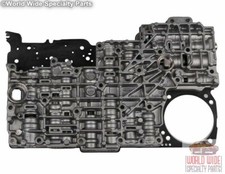
This is the test that ends the argument, and it can be done with the transmission still in the vehicle. Drop the pan, remove the solenoid base plate and reattach it over the separator plate, then inject ATF along with low air pressure of 40 to 60 psi into the circuits. A valve body in good condition strokes its valves with no excessive leakage past them and no bubbling from the exhaust slots. Leakage around a valve or an exhaust slot is bore wear you can see. Sonnax also publishes a 5R55W/S vacuum test guide that maps every critical bore on this casting, including the TCC control valve and plunger assembly, the converter clutch back pressure valve and the TCC modulator, with the part number assigned to each.
One diagnostic trap specific to this valve body: excessive leakage anywhere in it aerates the fluid, and aerated fluid vents from the breather and gives a false high level and erratic pressure readings. If the level and the pressures both look strange on a unit with a converter clutch complaint, that is a symptom of the same wear, not a second problem to chase.
The Fix
- TCC control valve bore worn or the valve hanging — oversized TCC control valve kit 56947J-05K, which requires tool kit F-56947J-TL2 to recondition the casting. One valve covers the 5R55N, 5R55W and 5R55S, and Sonnax notes the modulator sleeve and inner modulator valve must be inspected at the same time for probable bore wear.
- Modulator plunger sleeve worn, bore still serviceable — drop-in plunger valve kit 56947J-01K at OE ratio, or 56947J-03K for an increased ratio that gives a firmer, quicker lockup.
- TCC modulator bore worn — TCC modulator valve kit 56947J-15K with tool kit F-56947J-TL15. It ships two springs; the white shorter spring is the 5R55W and 5R55S calibration and the plain longer spring is for the 5R55N. Get that choice right.
- Contaminated solenoid assembly — replace the block pack and its filter as a set, and verify you have the correct W/S base plate rather than an N unit.
- Converter — replace it only after the valve body proves out, and expect to when the clutch has been dragging long enough to cook the lining.
Fluid and reassembly
Fill spec is MERCON V, and the history behind that matters on this family. Warnke documents that the factory fill in the 5R55E, W, S and N prior to May 2005 was an early MERCON V that degraded and took solenoids with it. Ford's interim answer was additive package 4L2Z-19B546-AB under bulletin FSA 04B22, with the final resolution being a revised MERCON V. If any trace of the questionable fluid is left behind during a service, the service life of the next solenoid is reduced. Plan on roughly 12 to 13 quarts to fill dry; a pan and filter service returns only about five of them, because most of the fluid stays in the converter, cooler and valve body.
Two assembly notes. If you install a replacement solenoid assembly, prime it: the VFS solenoids are tested and shipped with fluid, but the lubricant drains off in handling, so fill the circuits with fresh MERCON V and pull fluid through the solenoid with vacuum before it goes in. And Ford units built after 2002 use adaptive strategy, so perform a relearn with any solenoid service.
Need parts for this job?
Valve body kits, TCC valve kits, solenoid block packs, filters, bands and full rebuild kits for the 5R55 family — shipped fast from the USA.
Shop 5R55 parts →Why These Units Keep Doing This
The 5R55W went into a lot of Explorers and Mountaineers, and those vehicles are old enough now that every valve body you open has two decades of PWM cycling in it. The complaint volume is documented: NHTSA's Office of Defects Investigation has 1,408 owner complaints on file for the 2004 Explorer, and 477 of them name POWER TRAIN among the affected components — roughly a third of everything owners reported on that model year, across every system on the vehicle.
The pattern behind that number is the one this article walks through: a single PWM solenoid cycling a plunger and a control valve in an aluminum casting, thousands of times per drive cycle, for twenty years. The bores wear, and Sonnax notes these complaints often show up at relatively low mileage even when everything else in the unit is fine. Three habits keep P0742 from coming back:
- Air test or vacuum test the TCC circuit on every 5R55W that comes apart, even when the complaint is something else entirely. The TCC modulator bore wears first on this casting, so it is already partway gone on most units by the time you see them.
- Fix the bore, not just the valve. A new OE valve in a worn casting restores nothing, because the casting is the part that wore.
- Get the contamination out. Contamination is half of the stated cause of TCC control valve failure, and a valve body reassembled over debris will hang the same valve again.
FAQ
Why does my Explorer stall when I stop if it has code P0742?
Because the converter clutch never let go. When the torque converter clutch is applied, the engine and the transmission input are mechanically tied together, so the fluid coupling that normally lets the engine keep idling while the wheels stop is gone. Roll to a stop in gear with the clutch still locked and the engine gets dragged down toward wheel speed, which is zero. That is why P0742 usually shows up as a stall or a hard shudder at the stop sign rather than as a shift complaint.
Is P0742 on a 5R55W an electrical problem or a hydraulic one?
On this unit it is far more often hydraulic. The 5R55W uses a single pulse width modulated solenoid for converter clutch control, and releasing the clutch depends on the TCC control valve returning to its rest position so release oil gets back behind the piston. If that valve is hung by a worn casting bore or by debris, the solenoid can command full release and nothing moves. Sonnax names valve and bore wear due to oscillation and contamination as the cause of TCC control valve failure on the 5R55N, 5R55W and 5R55S.
How do I tell a stuck TCC valve from a bad solenoid pack on a 5R55W?
Take the command away and see if the clutch releases. With the engine idling in gear and the vehicle stopped, unplugging the transmission solenoid connector removes current from the PWM TCC solenoid, so a circuit that is capable of releasing will release and the stall condition clears. If the engine still gets dragged down with the connector off, the apply oil is not coming from the solenoid and the fault is downstream in the valve body. Keep that test brief, because Sonnax warns that disconnecting the solenoid wiring drives the transmission to maximum line pressure.
Can a stuck-on converter clutch damage the transmission?
Yes, and it does it through heat and through the cooler circuit. Applying the clutch redirects converter release oil to the cooler, so a valve stuck in the apply position leaves the converter charge and lube circuit in a state it was never meant to hold at idle and at low speed. Sonnax lists overheated converter and low cooler flow among the symptoms of TCC control valve bore wear on this family, alongside TCC lining failure.
Do I have to replace the torque converter to fix P0742?
Not automatically, and doing it first is how shops buy this job twice. If the lining has already been cooked by a clutch that would not release then the converter has to go, but the worn bore that held the valve stroked is still in the casting and will do the same thing to the replacement. Prove the valve body strokes and holds pressure first, using a wet air test or a vacuum test on the TCC circuit, then decide about the converter.
Sources
- Sonnax — "Figuring Out the 5R55 Alphabet," Bob Warnke, September 19, 2007. Backs the hydraulic circuit and every pressure figure here: converter release oil holds the TCC piston off the cover and comes from the converter regulator valve limited to 130 psi; TCC solenoid pressure is supposed to be limited to 72 psi by the solenoid regulator valve, and a bore worn at the inboard end lets that pressure climb and deflect the TCC piston; once the TCC control valve strokes, release oil is redirected to the cooler and modulated line pressure of 160 to 250 psi and up becomes converter apply pressure; the back pressure valve maintains 8 to 12 psi on release oil; the TCC modulator bore and main regulator bore wear first due to activity; the wet air test with the solenoid base plate reattached over the separator plate at 40 to 60 psi; the thermal element opening near 125 degrees Fahrenheit and the subtle cooler flow change when TCC bores or the solenoid gasket leak; the warning that disconnecting solenoid wiring produces maximum line pressure; mixing the N and W/S solenoid base plate or filter costing reverse, TCC apply and solenoid oil pressure; and the pre-May-2005 MERCON V fluid problem, interim additive 4L2Z-19B546-AB under bulletin FSA 04B22, VFS solenoid priming with vacuum, and the post-2002 adaptive relearn. sonnax.com
- Sonnax — Oversized TCC Control Valve Kit 56947J-05K, product and cause data. Backs the primary cause section: the stated cause is valve and bore wear due to oscillation and contamination; the TCC control valve is the converter oil switch valve, ultimately directing converter apply or release oil; listed symptoms include TCC lining failure, overheated converter, low cooler flow and damaged valve body casting; one replacement valve fits 5R55N, 5R55W and 5R55S; the kit requires tool kit F-56947J-TL2; and the modulator sleeve and inner modulator valve must be inspected for probable bore wear. sonnax.com
- Sonnax — TCC Modulator Plunger Valve Kit 56947J-01K, product and cause data. Backs the modulator circuit section: wear at the inside diameter of the TCC modulator plunger valve sleeve is caused by constant oscillation of the pulse width modulated TCC solenoid; the plunger force is transferred onto the inner modulator valve, which feeds line to the apply circuit and controls slip rate; the valve bore inward of the modulator sleeve wears rapidly and must be inspected; and 56947J-01K is OE ratio while 56947J-03K provides an increased ratio for firmer, quicker lockup. sonnax.com
- Sonnax — Ford 5R55W/S Vacuum Test Guide, February 21, 2013. Backs the bore map and the repair table: the critical wear areas on the 5R55W/S casting, including the TCC control valve and plunger assembly, the converter clutch back pressure valve and the TCC modulator valve and sleeve, with the part assigned to each — 56947J-05K with tool F-56947J-TL2, TCC modulator valve kit 56947J-15K with tool F-56947J-TL15, and plunger kits 56947J-01K and 56947J-03K — plus the lower valve body identification numbering that locates those bores in the casting. sonnax.com
- Transmission Digest — "Understanding the 5R55S/W Initial Engagements," Jesse Zacarias, November 1, 2012. Backs the control architecture: the 5R55S/W contains four on/off shift solenoids whose main function is to align valve body valves, three variable force solenoids (PCA, PCB and PCC) that control the rate of apply and release of the clutch packs and the intermediate and overdrive band, and one pulse width modulated solenoid that controls the torque converter clutch. transmissiondigest.com
- NHTSA Office of Defects Investigation — owner complaint database, 2004 Ford Explorer. Backs the complaint-volume figures: the database returns 1,408 owner complaints for the 2004 Explorer, of which 477 list POWER TRAIN among the affected components. Figures retrieved September 8, 2026. api.nhtsa.gov