"Limp mode" is a customer word. On a 6L45 it is a list of specific things the transmission control module stops doing, and that list is written down. Knowing exactly what the TCM commands when it defaults is what turns a vague "it won't shift" into a two-gear diagnosis, because the gears you are left with tell you which monitor tripped.
Here is the part most techs never get told. Per the ATRA Gears breakdown of the 6L45/6L50/6L80/6L90 default logic, when the module sets P2723 (Clutch Pressure Control Solenoid 5, 1-2-3-4, Stuck Off) it limits the transmission to Reverse and 5th gear only. When it sets P2724 (same solenoid, Performance/Stuck On) it limits you to 2nd gear if output speed is below 1,400 RPM, and 4th gear if output speed is 1,400 RPM or greater — with no upshift. Both codes also request reduced engine torque, command maximum line pressure, freeze the transmission adaptives, and inhibit grade braking, neutral idle, manual up/down, TAP up/down and Tow/Haul.
So a 6L45 that will only pull away in what feels like a tall gear and never upshifts is not "in limp." It is telling you the 1-2-3-4 clutch circuit failed a ratio test. That is a hydraulic answer, not an electrical one, and it points at one specific part far more often than at the module.

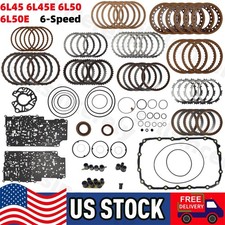
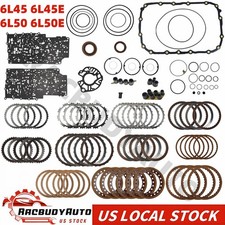
What the 6L45 actually is, and why that matters here
The 6L45 is RPO MYA. Its siblings are the 6L50 (MYB), 6L80 (MYC) and 6L90 (MYD). All four share the architecture: a transmission electro-hydraulic control module — the TEHCM — bolted to the valve body inside the pan, carrying the TCM, the shift and pressure control solenoids, the fluid pressure switches and the temperature sensor in one assembly. There is no external TCM to backprobe and no case connector where you can isolate one solenoid circuit at a time.
The 6L45 is the smallest of the family and shows up behind smaller engines, including BMW-badged versions of the same gearbox. That size difference is not cosmetic: the upper valve body is unique by RPO, which becomes a real trap after a repair. And because you cannot separate "commanded" from "delivered" electrically on this unit, the diagnostic strategy is fixed: read what the module restricted, then prove the hydraulics with a gauge and a scan tool, in that order.
The solenoid and clutch chart you should have on the bench
Before chasing a default, know what the unit is supposed to be doing. This is the 6L45–6L90 clutch and solenoid application table. Shift solenoids 1 and 2: "ON" means energized/pressurized. Pressure control solenoids: "ON" means pressurized. N.L. is normally low, N.H. is normally high.
| Gear range | Shift Sol 1 | Shift Sol 2 | PC Sol 5 1-2-3-4 (N.L.) | PC Sol 4 2-6 (N.L.) | PC Sol 2 3-5-Rev. | PC Sol 3 4-5-6 (N.H.) | Clutches applied |
|---|---|---|---|---|---|---|---|
| Park | ON | ON | OFF | OFF | OFF | ON | Low/Reverse (no load) |
| Reverse | ON | OFF | OFF | OFF | ON | ON | 3-5-Reverse + Low/Reverse |
| Neutral | ON | ON | OFF | OFF | OFF | ON | Low/Reverse (no load) |
| D-1st, engine braking | ON | ON | ON | OFF | OFF | ON | 1-2-3-4 + Low/Reverse, sprag holding |
| D-1st | OFF | ON | ON | OFF | OFF | OFF | 1-2-3-4, sprag holding |
| D-2nd | OFF | ON | ON | ON | OFF | OFF | 1-2-3-4 + 2-6 |
| D-3rd | OFF | ON | ON | OFF | ON | OFF | 1-2-3-4 + 3-5-Reverse |
| D-4th | OFF | ON | ON | OFF | OFF | ON | 1-2-3-4 + 4-5-6 |
| D-5th | OFF | ON | OFF | OFF | ON | ON | 3-5-Reverse + 4-5-6 |
| D-6th | OFF | ON | OFF | ON | OFF | ON | 2-6 + 4-5-6 |
Read the 1-2-3-4 column. It is applied in every forward gear from 1st through 4th. That is why a single leak in that circuit takes out the bottom half of the transmission and lands you in the P2723/P2724 default gears listed above.
Cause 1: The number 1 check ball
This is the one to check first on a 6L45 with a no-forward, slipping-forward or falls-out-of-gear-when-cold complaint, and it is the one most often skipped.
The mechanism: the number 1 check ball sits in the upper valve body and is part of the 1-2-3-4 clutch circuit. Drive 1-6 fluid seats the ball against the spacer plate, then enters the 1-2-3-4 clutch feed circuit to apply that clutch for 1st gear. If the ball does not seal, clutch pressure exhausts at the clutch select #2 valve and the 1-2-3-4 clutch never gets a solid apply.
The balls wear because turbulence in the valve body pocket spins them and the soft ball material erodes. ATRA reports them shrinking from.250 in. down to.180 in. or less, then sticking in the plate — or in bad cases blowing straight through it. A ball that still looks round can already be too small to seal the hole.
Transmission Digest documented exactly this on a 2010 Cadillac CTS AWD 3.0L with a 6L45: reverse worked, forward did not, the pan was clean with no debris, and the shop initially chased the known AWD output-shaft-to-transfer-case spline fretting failure. The transfer case came off and the splines were fine. The number 1 check ball had disintegrated enough to let feed oil leak past to the exhaust at clutch select valve 2. Codes on that complaint are P2723 or P2728 (Clutch PC Solenoid 5 Performance), and it is often temperature sensitive — no move cold, moves once it warms. Inspect that ball before you order a TEHCM or split the case for the low one-way clutch, and replace all of the check balls while you are in there, not just the failed one.
Cause 2: Why the code you need never sets
P2723 will not run its test unless a long list of enable conditions is true at the same time. From the GM criteria published by ATRA:
- Ignition voltage 9 to 32 V
- Engine speed 400 to 7,500 RPM
- Transmission fluid temperature warmer than −6.6°C (20.1°F)
- Transmission output speed greater than 67 RPM
- Accelerator pedal position greater than 0.5 percent, signal valid
- Internal mode switch not equal to Default, high-side driver enabled
- A long list of other DTCs not set, including P0716, P0717, P0722, P0723, P1915, P0300–P0308, P0171/P0172/P0174/P0175 and P042E
- Incorrect 1-2-3-4 gear ratio, three times
Two practical consequences. First, a misfire code, a lean code or a speed sensor fault blinds the ratio monitor entirely — so a 6L45 can be badly slipping the 1-2-3-4 clutch and store nothing useful. Second, a marginal battery or charging fault that drops you under 9 volts stops the monitor and can look identical to a transmission problem.
Scan tool work that pays: graph ISS, OSS and engine RPM on a road test and compute ratio yourself instead of trusting the gear PID. Watch TFT, because the cold-side cutoff at 20.1°F explains a lot of winter "no codes" complaints. And record freeze frame before you clear anything — the first code that sets suppresses the tests that would have found the second one.
Cause 3: TEHCM pressure switches
The 6L45 family uses fluid pressure switches inside the TEHCM, and they do two jobs: tell the module which range is selected, and give it clutch timing feedback. Each clutch regulator valve (1-2-3-4, 2-6, 3-5-Reverse, R1/4-5-6), when at rest, routes pressure to its switch so the module knows that clutch is released. The module reads gear selection from the open/closed pattern and measures clutch apply time by watching switch movement against input speed change.
Those switches are normally-closed and they have a real failure rate. Sonnax reports that when one fails you typically get one or more of P0752, P0872, P0877 and/or P0989, and the vehicle may drop into limp mode. On teardown, failed switches show up as waffled or delaminated films — high pressure and debris compromise the seal, which then lets contamination reach the piston and contacts. That does not automatically mean an expensive TEHCM: film and seal rebuild kits exist for the 6L45/6L50/6L80/6L90 (Sonnax 124740-70K, with install tooling 124740-TL70). Inspect before you quote a module.
6L45 filter and pan gasket kits, TCC regulator valve kits, pressure switch install tooling, shift kits and DEXRON-VI — shipped from the USA.
Shop 6L45 parts →Cause 4: Valve bore wear, and the two valves that cause failsafe
Two bores on this family are worth vacuum testing on every job.
The actuator feed limit (AFL) valve — ID #209 in the upper valve body — regulates the oil supply feeding every control solenoid. Sonnax lists AFL bore wear as a cause of solenoid performance codes, wrong gear starts, harsh or soft shifts and clutch failure: the shortest path from a worn aluminum bore to a code that reads electrical. The oversized replacement is 104740-12. Quick check from Sonnax — if the unit shifts through the gears on the rack, an AFL problem is generally not your issue.
The TCC regulator apply valve in the lower valve body is the other one. Wear there is listed as causing P0741 and P0742, failsafe mode, overheated fluid, high TCC slip RPM and harsh TCC apply, addressed with 104740-46K or 104740-07K. On a 6L45 that defaults only after it gets hot, this valve and the converter feed limit valve (104520-11, tied to P0218/P0741) belong on your short list. One caution while you are in there: the exhaust backfill pressure relief valve (#206) plug is set at a precise depth at the factory. Do not remove it.
Sonnax 6L45/6L50/6L80/6L90 TCC regulator valve kit (104740-46K)
The oversized valve for the bore that Sonnax ties to P0741, P0742 and failsafe mode. Restores TCC apply and regulation without a valve body swap.
View the kit →Cause 5: Line pressure, read as a signature
Get a gauge on the unit early. On this family the pressure readings are diagnostic on their own:
- Stuck at roughly 60–68 psi with no RPM rise at all, and no different unplugged: the TEHCM line pressure solenoid is stuck in exhaust mode. Stop there.
- Below 30 psi at idle: suspect a missing pressure regulator boost valve retaining roll pin in the pump. There may be some movement, but it will not be normal.
- No line pressure and no movement: a missing pump pressure relief ball and spring. This one turns up in rebuilt pumps.
- Line pressure normal but nothing works right: that is the tell for a mechanical or check ball problem, not a pressure control problem. Stuck clutch select valves, a stuck 1-2-3-4 or 3-5-R clutch regulator valve, an out-of-place number 1 or number 5 check ball, and a wrong separator plate all read normal on a gauge.
- Erratic, RPM-random pressure: a stuck compensator feed regulator valve, which is fed by line pressure and also causes delayed engagement, chattering shifts or downshift clunks.
Cause 6: The wrong part after a repair
If the 6L45 went into default right after a valve body or TEHCM job, the odds shift hard toward a parts mismatch.
Per GM Service Bulletin 16-NA-130, upper valve bodies on this family are unique by transmission RPO, and installing the wrong one gives no Reverse and no 2nd gear — and in some cases the ISS and OSS signals go missing too. That combination reads like a wiring or module failure and is not. The identification is physical: each upper valve body has four posts labeled A, B, C and D on the top side, and the post corresponding to the correct RPO is milled off. A milled A post means MYA, which is your 6L45. B is MYB/6L50, C is MYC/6L80, D is MYD/6L90.
Other post-repair defaults worth knowing: separator plate mismatches (the Type 1 plate, part #24245720, uses seven check balls; a Type 2 plate on a Type 1 body gives no Forward, and the Type 1 plate on a Type 2 body gives no 3rd and no Reverse, both with normal line pressure); clutch select valves or springs installed backwards, which costs you Forward, Reverse or both — valves go in first, springs outboard; and a TEHCM filter gasket left out, which gives no movement with low or no pressure.
An incorrect part number or an incorrectly programmed TEHCM also causes no movement or no upshift, so verify the part number and program file match the VIN. During OE programming or a relearn, a temporary no-move can occur: pull the scanner, remove the key, open and close the driver door, wait 15 to 20 minutes, and it is usually good.
Cause 7: The 2018 TEHCM capacitor window
One narrow but real electronic cause. ATRA documented a Bosch capacitor issue internal to the TEHCM that could disturb microprocessor operation on 2018 model year units with build dates 7209 (July 28, 2017) through 7262 (September 19, 2017), covering 6L45 (MYA), 6L50, 6L80, 6L90 and the Gen. 1 6T70/75/80 family. Read the build date from positions five through eight of the 13-digit number below the QR code on the TEHCM.
Symptoms in that window include no forward or reverse, hard shifts, stalling, hesitation, tie-ups, and default limp modes of reverse/3rd, 2nd only, or 2nd/4th. Associated DTCs include P0562, P0742, P0776, P0796, P0965, P0969, P2714, P2715, P2719 and P2762. If a unit in that build window is throwing a scattered, unrepeatable code set, check the date code before you tear anything down.
The order that actually works on a 6L45
- Write down which gears you have. Reverse and 5th only points at P2723. Stuck in 2nd below 1,400 RPM output and 4th above it points at P2724. Both point at the 1-2-3-4 clutch circuit.
- Battery, grounds, charging. Below 9 volts the monitors do not run.
- Pull codes from every module and record freeze frame before clearing.
- Gauge the line pressure against the signature list above.
- Graph ISS, OSS and engine RPM on a road test and compute ratio manually.
- Drop the pan and read the debris. Clean fluid with a no-forward complaint points at the check ball, not the clutches.
- Inspect check balls #1 and #5, then vacuum test the AFL, TCC regulator and clutch regulator bores.
- Only then consider the TEHCM — and if it was recently serviced, verify the upper valve body milled post matches MYA first.
Most 6L45 defaults are wear problems that got electrical names. The check balls shrink, the aluminum bores open up, the pressure switch films fail, and the module reports the result as a solenoid code.
Working a 6L45 this week?
Filter and pan gasket kits, TCC regulator valve kits, pressure switch install tooling, shift kits and DEXRON-VI — all in one place, shipped from the USA.
Shop 6L45 parts →Tooling note: this diagnosis needs a scan tool that will graph ISS and OSS together and read TCM data, not just pull codes. If you are shopping, look at bidirectional scan tools with GM transmission live data.
Related reading: our 6L80 limp mode guide, how to check line pressure, and reading transmission live data.
Sources
- Gears Magazine (ATRA) — Steve Garrett, "What's Old Is New Again: 6L45/6L50/6L80/6L90 No Forward, Slips Moving Forward." Backs the RPO map (6L45 = MYA, 6L50 = MYB, 6L80 = MYC, 6L90 = MYD); the number 1 check ball's location in the upper valve body and its role in the 1-2-3-4 clutch circuit fed by Drive 1-6 fluid; wear from.250 in. to.180 in. or less; the exhaust path at clutch select valve 2; the full P2723 enable conditions (9–32 V, 400–7,500 RPM, TFT warmer than −6.6°C/20.1°F, output speed above 67 RPM, APP above 0.5 percent, IMS not defaulted, listed DTCs not set, three occurrences); and the P2723/P2724 default actions including the Reverse-and-5th restriction and the 1,400 RPM output speed split for 2nd versus 4th. gearsmagazine.com
- Sonnax — "GM 6L45/50, 6L80/90 No Movement Conditions: Analysis & Repair Tips," Jim Mobley, March 8, 2023. Backs the 60–68 psi flat line pressure signature of a line pressure solenoid stuck in exhaust and the "unplugged is no different" test; the below-30-psi missing boost valve roll pin; the missing pump pressure relief ball and spring; separator plate #24245720 with seven check balls and the Type 1 versus Type 2 mismatch symptoms; clutch select valves and springs installed backwards; the TEHCM filter gasket omission; the stuck compensator feed regulator valve; the number 1 and number 5 check ball conditions; the AFL rack-test tip; and the incorrectly programmed TEHCM plus the 15 to 20 minute post-programming wait. sonnax.com
- Sonnax — "GM 6L45, 6L50, 6L80, 6L90 Vacuum Test Guide" (rev. 06-11-26). Backs the complete clutch and solenoid application chart reproduced above, including the shift solenoid and pressure control solenoid states for every range and the normally-low/normally-high designations; the valve ID numbers (#206 exhaust backfill pressure relief valve with the factory-set plug, #209 actuator feed limit valve); the AFL wear symptom list (solenoid performance codes, clutch failure, wrong gear starts, harsh/soft shifts) and part 104740-12; the TCC regulator apply valve symptom list (P0741, P0742, failsafe mode, overheated fluid, high TCC slip RPM, harsh TCC apply) and parts 104740-46K and 104740-07K; and the converter feed limit valve part 104520-11 with codes P0218/P0741. sonnax.com
- Sonnax — "Under Pressure: Shift Quality & Pressure Switches in TEHCM Applications," October 27, 2014. Backs the two functions of the TEHCM pressure switches (gear selection and clutch timing); the normally-closed design and the clutch regulator valve routing that opens each switch at rest; the failure DTC set P0752, P0872, P0877 and P0989 with possible limp mode; the waffled and delaminated film failure mode caused by high pressure and debris; the four clutch regulator valves (1-2-3-4, R1/4-5-6, 2-6, 3-5-Reverse); and the availability of pressure switch rebuild kit 124740-70K with install tool kit 124740-TL70 for the 6L45–6L90 family. sonnax.com
- General Motors Service Bulletin 16-NA-130 (May 2016), "No Reverse, No Second After Upper Valve Body Replacement," via NHTSA. Backs the fact that upper valve bodies are unique by transmission RPO across 6L45/6L50/6L80/6L90 (RPOs MYA, MYB, MYC, MYD); the symptom set after installing the wrong one (no Reverse, no 2nd, and in some cases missing ISS and OSS signals); and the identification method — four posts labeled A, B, C and D on the top of the upper valve body, with the post corresponding to the correct RPO milled off (milled A = MYA). static.nhtsa.gov
- Transmission Digest — Beau Hansen, "Common Problems With Uncommon Solutions: 6L45 No-Move or Slipping Forward," April 4, 2022. Backs the 2010 Cadillac CTS AWD 3.0L case: the known output-shaft-to-transfer-case spline fretting failure on this application and why it was ruled out; clean fluid with no pan debris; the disintegrated number 1 check ball leaking feed oil to exhaust at clutch select valve 2; the temperature-sensitive slip/delay symptom in the forward ranges; and the associated codes P2723 and P2728. transmissiondigest.com
- Gears Magazine (ATRA) — "Now, What Do I Do? 6L50/80/90, 6T70/75/80, Propulsion Issues." Backs the 2018 model year TEHCM capacitor issue: the Bosch capacitor internal to the TEHCM affecting microprocessor operation, the build date range 7209 (July 28, 2017) through 7262 (September 19, 2017), the 13-digit number below the QR code with positions five through eight giving the build date, the affected units including 6L45 (MYA), and the symptom and DTC list (P0562, P0742, P0776, P0796, P0965, P0969, P2714, P2715, P2719, P2762; default limp modes of reverse/3rd, 2nd only, and 2nd/4th). gearsmagazine.com