A 6L80 in limp mode is not a diagnosis. It is the transmission control module telling you it already found something it could not live with, gave up on normal shift scheduling, and locked the unit into a fixed state so the customer can get off the highway. The useful question is never "why is it in limp." It is "what did the TEHCM see first, and what did it stop testing once it saw it."
That second half is where most 6L80 limp diagnoses go sideways. GM's own OBD monitor tables for the 6L80/6L90 make it explicit: nearly every clutch and shift solenoid performance monitor carries the enable conditions "Default Gear Option is not present = TRUE" and "Default Gear Action = FALSE," plus "Input Speed Sensor fault = FALSE" and "Output Speed Sensor fault = FALSE." Once the unit drops into default gear action, or a speed sensor fault goes pending, the module stops running the tests that would have told you which clutch is slipping. Your code set is a snapshot of the first failure, not the whole transmission.
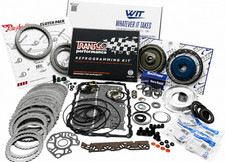
Why the 6L80 fails differently than a 4L60E
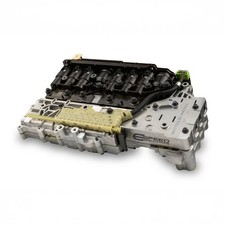
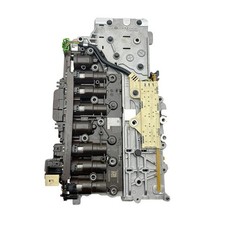
The 6L80 (RPO MYC) and its heavy-duty sibling the 6L90 (MYD) put the transmission control module, the shift and pressure control solenoids, the fluid pressure switches and the fluid temperature sensor into one assembly bolted to the valve body inside the pan. That assembly is the TEHCM. There is no external TCM to backprobe and no solenoid connector at the case to unplug one circuit at a time. As the Gears technical staff put it, you have no back-probe capability on these circuits, so you verify command versus result with a pressure gauge instead of a meter.
That one design decision drives the whole strategy. You cannot separate "the module commanded it" from "the hydraulics did it" electrically on this unit. You separate them hydraulically, with a gauge on the mainline port and the scan tool commanding pressure.
Cause 1: Speed sensor faults, and the shared supply that fools people
The most common trigger for a 6L80 dropping into default is a lost or corrupted input or output speed signal. Without both, the module cannot calculate gear ratio, and without ratio it cannot verify a single shift. GM's thresholds are specific enough to test against:
- P0716 (Input Speed Sensor Performance): sets when the input speed sensor drops by 881.75 RPM or more with a fail time of 0.8 seconds. One-trip code. This is a dropout monitor, not a plausibility monitor, which is why an intermittent sensor sets it and a slipping clutch usually does not.
- P0717 (Input Speed Sensor Circuit Low Voltage): Fail Case 1 is input speed below 32.625 RPM for 4.5 seconds while engine torque is at or above 50 N·m and vehicle speed is at or above 16 km/h (10 mph). In other words, the truck is clearly moving under load and the module is reading nothing.
- P0722 (Output Speed Sensor Circuit Low Voltage): raw output speed at or below 35 RPM for 4.5 seconds with throttle position above 8 percent.
Now the part that saves you a sensor. P0717 has a second fail case: it also sets when P0722 is already test-failed and input speed is below 653.125 RPM, and the enable condition on that branch reads "Controller uses a single power supply for the speed sensors = 1." Both sensors share one supply. P0717 and P0722 together points at that supply, the connector, or the module — not at two sensors dying on the same afternoon.
What to do: graph Input Speed Sensor (RPM), Output Speed Sensor (RPM) and Engine Speed (RPM) together on a road test. In a converter-locked cruise, input speed should sit within a few RPM of engine speed. Divide input by output in a steady gear and compare against the 6L80 ratio set: 4.027, 2.364, 1.532, 1.152, 0.852, 0.667. GM's second-gear verification window in the P0756 monitor is 2.2458 to 2.4822, which brackets 2.364 exactly — that is the same math the module runs. A clean sweep with a momentary drop to zero is wiring or a connector. A signal that reads but reads wrong under load is usually debris on the magnetic pickup tip, and that debris is clutch material already in the pan.
Cause 2: Clutch stuck-off codes, and the intrusive test behind them
The 6L80 clutch performance codes are not passive. Take P0776 (Pressure Control Solenoid B Stuck Off, C35R). Per GM's monitor description, the module first watches for gearbox slip of 400 RPM or more in steady-state third gear, waits out a table-based neutral timer, then runs an intrusive shift, commanding fourth gear, and evaluates whether fourth is attained within a table-based enable time. Three third-gear fail counts, or a C35R clutch fail counter of 14, and the code matures. P2723 (Pressure Control Solenoid E Stuck Off, C1234) works the same way from first gear, commanding second.
So the complaint of "it shifted weird, then went to limp" is often the module running its own test rather than the transmission failing at that instant. It also means the code names the clutch, not the cause. Three mechanical causes to check before ordering a TEHCM:
- 3-5-R drum weld cracked. Sonnax lists a broken or cracked 3-5-R drum weld as a no-Reverse or slipping-Reverse condition along with third and fifth gear issues. That is the exact clutch P0776 points at.
- Number 1 check ball. The Gears writeup on 6L45/6L50/6L80/6L90 no-forward and slipping-forward conditions traces it to the number 1 check ball in the upper valve body, part of the 1-2-3-4 clutch circuit. The ball wears from 0.250 in. down to 0.180 in. or smaller, sticks in the plate, or goes missing; clutch pressure then exhausts at the number 2 clutch select valve and the 1-2-3-4 clutch never applies. Codes are P2723 or P2724, and sometimes there are none at all. Check the ball before condemning the module or pulling the unit for the low one-way clutch.
- 1-2-3-4 piston cracked or snap ring unseated. Sonnax notes the OE 1-2-3-4 piston has a high enough failure rate that most shops replace it on every repair with a heavy-duty aftermarket piston.
Cause 3: Line pressure, and the number that tells you where to stop
Put the gauge on the mainline port before you take anything apart. Two readings settle a large share of 6L80 default conditions:
- Flat 60 to 68 psi with no rise as you raise RPM. Sonnax identifies this as a TEHCM line pressure solenoid stuck in exhaust mode, and adds the detail that makes it a real test: unplugged is no different. If disconnecting the module does not change the reading, the hydraulic side is not commanding anything and you are looking at the solenoid or its circuit, not a worn bore.
- Below 30 psi at idle. Sonnax attributes this to a missing pressure regulator boost valve roll pin in the pump. The vehicle may still move, but nothing about it will be normal.
Two traps live in this circuit. First, the main pressure regulator valve on the 6L80 family lives in the pump, not the valve body, so pressure symptoms caused by regulator bore wear cannot be fixed by swapping a valve body. Second, separator plate mismatches produce codes that look electrical: a Type 2 plate on a Type 1 valve body gives no Forward, and the Type 1 plate (#24245720, seven check balls) on a Type 2 valve body gives no third and no Reverse. In both cases line pressure reads normal, which is exactly why they get misdiagnosed.
On the electronic side, P0873 (Transmission Fluid Pressure Sensor C Circuit High Voltage) sets when CB26 hydraulic pressure reaches 700 kPa (about 101 psi), a table-based delay expires, and the switch still reports the pressurized position; the counter needs 15 fail counts, one per clutch transition. That code is a switch-versus-hydraulics disagreement, and it will put you in default while the hydraulics are actually fine.
6L80 and 6L90 pressure regulator valve kits, valve body upgrade kits, filters, pressure switch tooling and drum leak testers — shipped from the USA.
Shop 6L80 parts →Cause 4: Voltage, before anything else
One number repeats on nearly every 6L80 monitor: ignition voltage at or above 8.5996 volts and at or below 31.999 volts. Below that floor the monitors do not run. A marginal battery, corroded ground or charging fault can behave exactly like a transmission in default and set nothing useful, or scatter unrelated one-trip codes across one key cycle. Several monitors also require "High-Side Driver is Enabled = TRUE" — the module has to see its own output stage alive before it will judge the transmission.
Load-test the battery, check both grounds and confirm charging voltage before you spend an hour graphing PIDs. If the vehicle also throws U0101 (Lost Communication with TCM) across the ECM, BCM and ABS, you have a power, ground or serial data problem, not a transmission problem.
Cause 5: The internal mode switch
P1915 (Internal Mode Switch Does Not Indicate Park/Neutral During Start) is a range-signal fault, and GM's criteria are a sequence rather than a threshold: initial engine speed at or below 50 RPM for 0.25 seconds, then engine speed between 50 and 480 RPM, then final engine speed at or above 525 RPM with transmission input speed at or above 200 RPM for a fail time of 1.25 seconds, with output speed at or below 90 RPM. That is a cranking event with the PRNDL reading something other than Park or Neutral.
When the range signal defaults, the module does not know what range the driver selected and will not schedule shifts on a guess. Other monitors list "PRNDL state defaulted" and "IMS Fault Pending" as disable conditions, so an IMS problem blinds downstream tests too. Verify the manual shaft, selector cable adjustment and range PID before touching the valve body.
Cause 6: Heat and the thermal bypass valve
GM Service Bulletin 22-NA-182 covers 6L80, 6L90, 8L90, 10L80, 10L90 and 10L1000 vehicles with harsh shift, shudder, surge, stall, neutral/flare, transmission overheating or high fluid temperature, and it replaced PIP5792E. Two facts from it are worth keeping on the board:
- A twisted cooler line on a low-mileage vehicle is a documented cause. Inspect it before condemning the unit; underbody panels often have to come off to see the line clearly.
- The thermal bypass valve on the 6L80 and 6L90 opens at 158°F (70°C) and is external to the transmission. On the 8L90 it is 194°F; on most 10-speeds it sits in the valve body and opens at 143°F. Because the 6L80 TBV is external, you can test it without opening the unit.
Heat is a limp cause in its own right: degraded fluid changes apply timing enough to trip the 400 RPM slip thresholds above. The 6L80 is a DEXRON-VI unit, and GM developed that specification around this transmission's clutch-to-clutch operation. Substituting an older DEXRON is not a neutral decision.
The order of operations that actually works
- Battery and grounds first. Confirm you are above the 8.6 V monitor floor with the engine running and under load.
- Pull all modules, not just the TCM. U-codes reframe the whole job.
- Record freeze frame before clearing anything. The first code suppresses the tests that would have found the second one.
- Gauge the mainline port. Flat 60-68 psi with no rise, unchanged when unplugged, ends the diagnosis at the pressure control circuit. Below 30 psi at idle points at the pump.
- Graph ISS, OSS and engine RPM on a road test. Compute ratios against 4.027 / 2.364 / 1.532 / 1.152 / 0.852 / 0.667. Both speed sensor codes together means suspect the shared supply.
- Drop the pan and read the debris. Clutch material on the speed sensor pickups explains intermittent signals. The number 1 check ball gets inspected here, before anything gets ordered.
- Only then decide on the TEHCM. If you replace it, verify the part number and program file match the VIN. Sonnax lists an incorrectly programmed TEHCM as a cause of no movement and no upshift, and notes that a temporary no-move condition during programming or relearn often clears after key off, door open and close, and a 15 to 20 minute wait.
Keeping a 6L80 out of default
Most 6L80 default conditions are second-order: something wore, made debris, and the debris took out a sensor signal or a check ball. Fluid and heat control are the levers. Keep DEXRON-VI in it, keep cooler flow honest, and inspect the cooler lines on trucks that tow. If the unit has been apart, replace all the check balls instead of reusing them, use the heavy-duty 1-2-3-4 piston, and verify the separator plate matches the valve body type before the pan goes back on.
Working a 6L80 this week?
Pressure regulator valve kits, valve body upgrade kits, filters and gaskets, drum leak testers, pressure switch install tooling and DEXRON-VI — all in one place, shipped from the USA.
Shop 6L80 parts →Related reading: our 6L80 service guide, how to check line pressure, and reading transmission live data.
Sources
- General Motors — "11 OBDG07 TRANS Diagnostics," 6L80/6L90 Common Section (OBD-II monitor summary tables). Backs every DTC threshold in this article: P0716 input speed drop of 881.75 RPM with a 0.8 second fail time; P0717 Fail Case 1 (below 32.625 RPM for 4.5 seconds at 50 N·m and 16 km/h) and Fail Case 2 with P0722 test-failed below 653.125 RPM on a single shared speed sensor supply; P0722 output speed at or below 35 RPM for 4.5 seconds above 8 percent throttle; P0756 second-gear ratio verification window of 2.2458 to 2.4822; P0776 and P2723 intrusive-shift logic with the 400 RPM gearbox slip threshold, 3 gear fail counts and 14 clutch fail counts; P0873 at 700 kPa CB26 pressure with 15 fail counts; P1915 cranking sequence and the 1.25 second fail time; the 8.5996 to 31.999 volt ignition voltage enable window; and the "Default Gear Action = FALSE," "Default Gear Option is not present," "PRNDL state defaulted" and "IMS Fault Pending" enable and disable conditions. gsi.ext.gm.com
- General Motors Service Bulletin 22-NA-182 (March 2024), via NHTSA. Backs the bulletin number and scope (6L80, 6L90, 8L90, 10L80, 10L90, 10L1000 with harsh shift, shudder, surge, stall, neutral/flare and overheating), the replacement of PIP5792E, the twisted cooler line cause on low-mileage vehicles, and the thermal bypass valve opening temperatures: 158°F (70°C) external on 6L80/6L90, 194°F on 8L90, 143°F in the valve body on most 10-speeds. static.nhtsa.gov
- Sonnax — "GM 6L45/50, 6L80/90 No Movement Conditions: Analysis & Repair Tips," Jim Mobley, March 8, 2023. Backs the 60 to 68 psi flat line pressure signature of a line pressure solenoid stuck in exhaust mode and the "unplugged is no different" test, the below-30-psi-at-idle missing boost valve roll pin, separator plate #24245720 with seven check balls and the Type 1 versus Type 2 mismatch symptoms, the incorrectly programmed TEHCM as a no-movement cause and the 15 to 20 minute post-programming wait, the cracked 3-5-R drum weld, and the high failure rate of the OE 1-2-3-4 piston. sonnax.com
- Gears Magazine (ATRA) — "What's Old Is New Again: 6L45/6L50/6L80/6L90 No Forward, Slips Moving Forward." Backs the RPO designations (6L80 = MYC, 6L90 = MYD), the number 1 check ball in the upper valve body as part of the 1-2-3-4 clutch circuit, the wear from 0.250 in. to 0.180 in. or smaller, the exhaust path at the number 2 clutch select valve, the P2723 and P2724 association, and the recommendation to replace all check balls. gearsmagazine.com
- Gears Magazine (ATRA) — "6L80/6L90: Issues That Could Drive You Crazy." Backs the absence of back-probe capability on these circuits and the pressure-gauge-versus-command diagnostic method on the passenger-side mainline port, plus the overheating contributors (fluid level, incorrect fluid, TCC apply and slip, contaminated coolers, sticking cooler bypass valves). gearsmagazine.com
- Gears Magazine (ATRA) — "Rise and Fall: 6L80/6L90 Pressure Issues." Backs the pressure regulator valve living in the pump cover rather than the valve body, the variable-displacement vane pump design, and the pressure control solenoid residing in the TEHCM. gearsmagazine.com