P0742 and P0741 sit next to each other in the code list and get treated like the same job. They are opposites, and on a Ford 6R80 they are opposites in a way that changes the entire diagnostic path. P0741 says the converter clutch would not lock when asked. P0742 says it will not let go.
That second one is the more alarming complaint to drive. A 6R80 with a converter clutch that stays applied acts like a manual transmission with the clutch pedal welded up: it bucks at low speed, shudders as you slow, and eventually stalls the engine at a stop sign. Owners describe it as the truck dying at red lights. Plenty of those trucks get a converter thrown at them when the actual fault is a valve the size of a pencil stub.
The short version: The 6R80 converter clutch is released by pressure, not applied by it. The circuit ZF calls WK holds the friction ring off the converter cover, and the TCC solenoid locks the converter by dumping that pressure toward zero. So P0742 means WK pressure is not coming back when release is commanded. That points at the bypass clutch control valve, the converter release regulator valve, a solenoid stuck in its vented state, or the solenoid feed regulator, plus the fluid level and condition underneath all of it. One case-mounted pressure tap settles which.
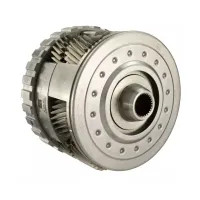
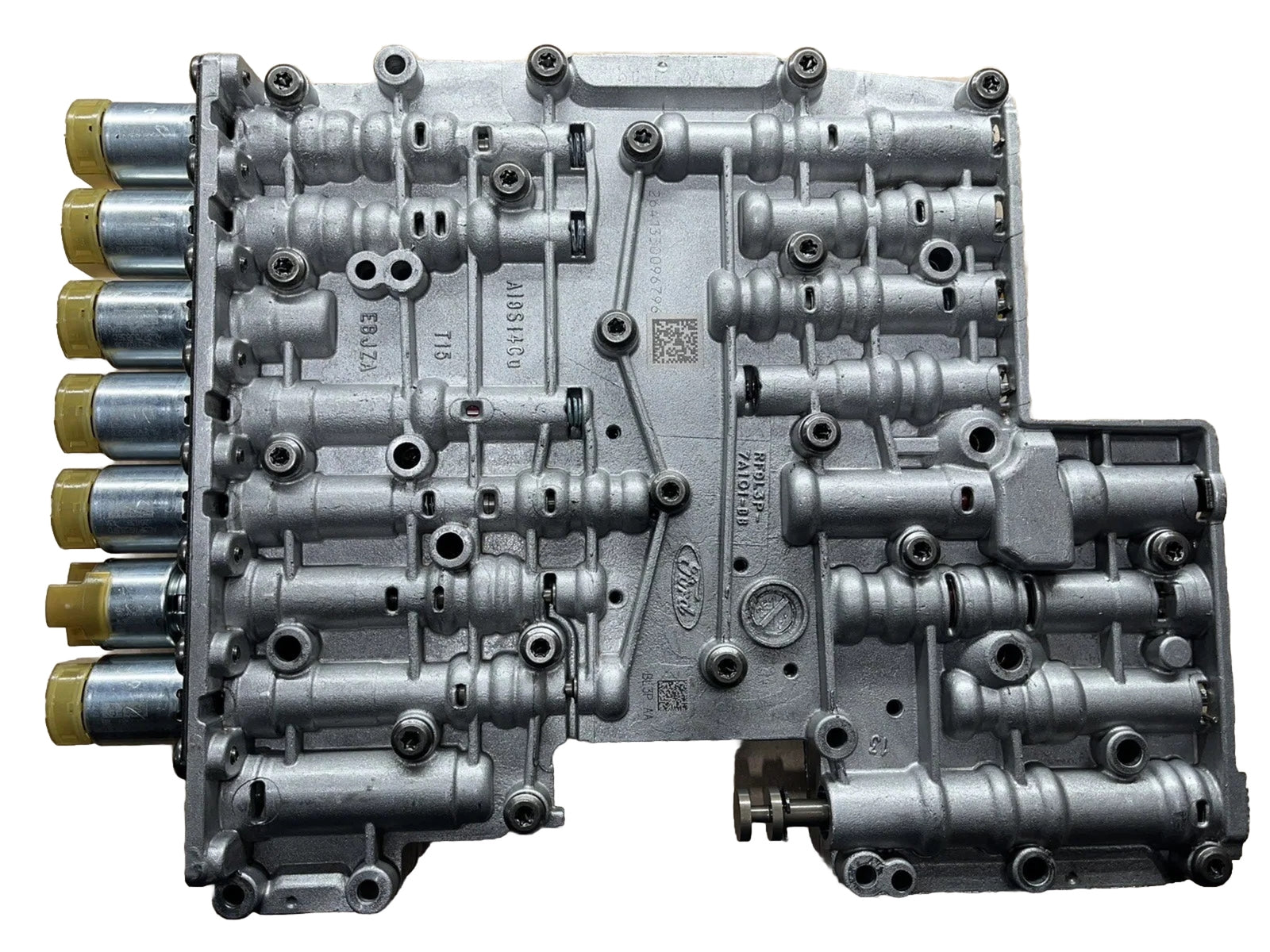
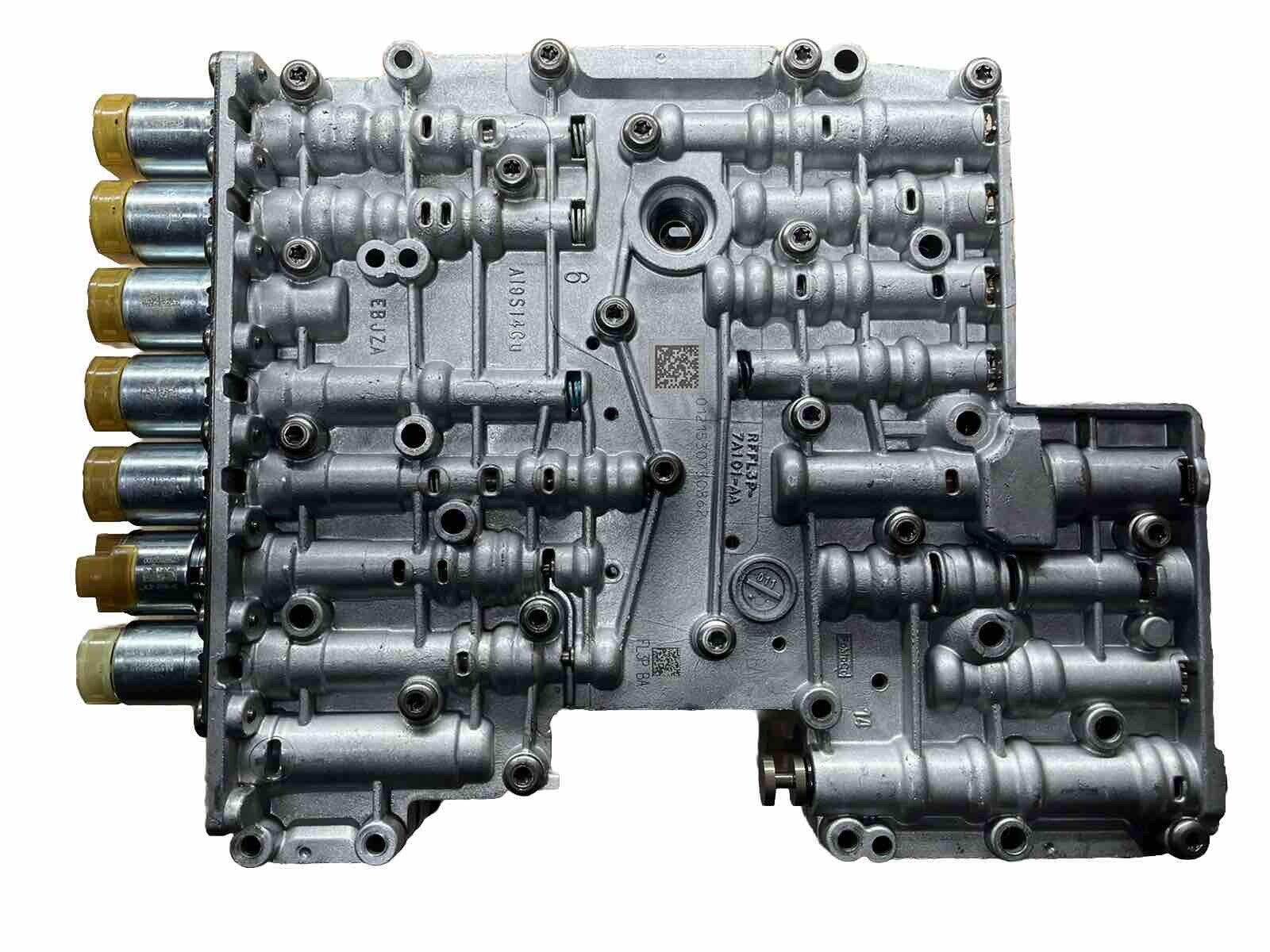
The Inverted Logic That Makes P0742 Confusing
The 6R80 is Ford's licensed build of the ZF 6HP26, and the converter control is ZF's. That is why the good literature on this circuit is written in ZF valve names, and why the valve body in front of you uses them.
WK is short for a very long German word for the hydrodynamic torque converter, and in this unit it names the release circuit. Sonnax technical vice president Bob Warnke describes it directly: WK corrals the oil pressure that disengages the clutch piston from the cover. Pressure in that circuit gets between the friction ring and the cover and pushes them apart. Apply is what happens when the module takes that pressure away.
The TCC solenoid is normally vented, or normally open. As commanded amperage rises, apply increases and WK pressure falls. Chart those two against each other on a scan tool and a gauge and the relationship is a straight line you can watch happen.
Now flip it. If the solenoid sticks in its vented state, or a valve sticks in the position that dumps WK to sump, the clutch is applied and nothing the module does will release it. The PCM commands release, watches engine RPM stay pinned to turbine RPM, and stores P0742. It is a hydraulic verdict, and hydraulic verdicts are settled with a gauge.
Symptoms That Actually Point at Stuck On
Before you pull anything apart, sort the complaint. These are the ones that mean the clutch is not releasing, rather than generic converter trouble:
- Stalls when coming to a stop, particularly with the brake applied, and particularly once the unit is warm. The engine restarts fine and idles fine in Park or Neutral.
- Shudder or heavy chugging below about 25 mph, worse under light load, because the engine is being lugged through a locked converter.
- Harsh 2-1 coast downshifts and harsh forced 3-2 events. This one gets misdiagnosed constantly. The 6R80 is supposed to release the converter for those shifts. Sonnax is specific: if WK does not increase beyond roughly 2 to 5 psi during a 2-1 or forced 3-2, the shift lands on a locked clutch and feels harsh. No amount of clutch or accumulator work fixes that.
- Rough idle in Reverse, and only in Reverse. Per Sonnax, if the rough idle is Reverse-only and WK is low, on the order of 50 to 60 psi, the converter clutch is not releasing properly because of a low pressure source or a pressure loss. If WK is normal and it still idles rough, check the engine mounts before you condemn the converter lining.
- Overheated fluid after highway driving, since a clutch that is dragging rather than fully locked or fully released generates heat with nowhere to send it.
Step One: Fluid Level, Type and the 125-Degree Trap
Do this before you touch a gauge, because it is free and it is a real cause.
The 6R80 takes MERCON LV. Ford's own Customer Service Division fluid application chart lists LV for the 6R80 in the F-150, Expedition, Mustang, Navigator and Transit. Ford bulletin 13-6-4, which covers a 3.7L and 6R80 converter whine complaint, calls out the fluid by service part number: XT-10-QLV, MERCON LV Automatic Transmission Fluid. MERCON V, MERCON SP and universal fluids are not substitutes, and viscosity in this unit directly affects how the WK circuit bleeds and how the valves damp.
Then the fill trap, which causes more converter clutch complaints on this unit than any single part. The 6R80 carries a thermal element in the converter circuit ahead of the case outlet, the same idea Ford used on the 5R55W and 5R110W. Below roughly 125°F, that element sends converter oil back to the bushings instead of out to the cooler. Sonnax's warning is blunt: service one of these without letting converter oil temperature rise enough to open the element, and the cooler never fills, so the unit is low after the first drive cycle. A 6R80 that was filled cold and is now a quart or two down will misbehave at the converter clutch with nothing wrong inside it.
Check level hot, at the temperature the workshop manual specifies, on a level vehicle. Fluid that is dark, smells scorched, or carries clutch fuzz has already answered part of the question.
Step Two: The WK Pressure Test
Both ZF and Ford give the case exactly one pressure tap, and it happens to be the one you want. It sits on the driver side of the bell housing, just above the cooler lines. ZF cases stamp the fitting AUF WK. Ford left it unmarked, but it is the same port on the same circuit.
Two setup notes that will save you a trip. The fitting uses a 10 x 1.00 mm ZF thread, so you need an adapter or a modified ZF5/ZF6 pressure plug drilled to take a 90-degree fitting. And you have to read all the way down to zero, so leave the 500 psi line-pressure gauge in the drawer. WK never exceeds about 80 psi (5.5 bar). Use an accurate 100 psi gauge, or better, a 100 psi transducer you can graph beside scan data.
Healthy ranges, per Sonnax's published figures:
| Condition | Expected WK pressure | Reading it |
|---|---|---|
| Engine running, cold, clutch released | 70 to 75 psi (4.8 to 5.1 bar), instant and steady on start | Clutch is being held off the cover. Immediate pressure is what makes idle smooth |
| At operating temperature, clutch released | 65 to 68 psi (4.5 to 4.7 bar) | Normal warm bleed-down of the release circuit |
| Selecting Reverse | Dips sharply to about 50 psi (3.4 bar), returns to 65 to 75 | Normal. Line pressure is priority oil, converter charge is secondary |
| TCC commanded on, at temperature | 0 to 2 psi (0 to 0.13 bar) | Zero is full apply. 1.5 to 2 psi is a deliberate sliver of slip for NVH |
| Coast 2-1 or forced 3-2 downshift | Should rise above 2 to 5 psi | If it does not, the shift occurs on a locked clutch and feels harsh |
The P0742 test is the fourth row read backwards. Get the truck to temperature, let the converter clutch apply so WK drops to zero, then command it off, or simply lift and coast down toward a stop while watching the gauge. WK should climb back to the mid-60s. If it stays near zero with the solenoid commanded off, the clutch is stuck applied hydraulically and you have your answer without dropping the pan.
Cross-check it on the scanner while you are there. With WK at zero, engine RPM and turbine or input RPM should be identical. Some tools also report torque converter amplification, which should read zero once the clutch is fully applied. If those two RPM values stay locked together while WK is supposed to be back up at 65 psi, that is a mechanically stuck clutch, not a sensor problem.
Step Three: Which Valve Is Holding It
If WK will not come back, the fault is upstream in the valve body or the pump. Sonnax names the players in this circuit, and there are only a handful worth vacuum testing:
- Bypass clutch control valve (WD-V) — this is the switch for the whole circuit. Sonnax's own failure description for oversized kit 95740-13K is that as the bore wears, converter clutch apply slows and release pressure will not vent properly. Its published symptom list includes TCC codes, excess TCC slip, cycling RPM, low TCC release pressure, harsh shifts, flare shifts, rough idle in Reverse and an overheated converter. That list is a near word-for-word match to a stuck-on complaint. It applies across 6R60, 6R75, 6R80 both generations, 6R100 and ZF6HP19/26/32 Gen. 1, and the repair takes tooling F-95740-TL13 with the VB-FIX fixture.
- Converter release regulator valve (WK-V) — it regulates lube pressure and sets the timing of clutch apply and release. Sonnax states that significant bore wear here can allow release or apply pressures to leak to sump. Release pressure leaking to sump is precisely a clutch that cannot let go. The oversized fix is kit 95740-05K, tooling F-95740-TL5.
- Solenoid pressure regulator valve (DR.REO-V) — it feeds regulated pressure to every solenoid including the TCC solenoid. A worn bore here pushes all solenoid output either too high or too low, which can hold the TCC solenoid effectively vented.
- Main pressure regulator valve (SYS.DR-V) — line pressure is priority oil, so wear here starves converter feed and skews everything downstream.
- Lubrication control valve (SCHM-V) — it controls fluid exiting the converter, so it shapes what WK does on the return side.
Vacuum test those bores. Sonnax's guidance for this family is that they are commonly worn, and the choice is to service them or fit a remanufactured valve body. While the body is out, seal the end plugs, especially the ones between the shift valves and solenoids, since they work loose and leak the circuit, and replace the accumulator dampers, because solenoid output turns erratic and harsh as they fail.
Step Four: The Solenoid, and Why Ohms Lie
The TCC solenoid in this family does fail, but Sonnax makes the point that mechanical rather than electrical failure is the common culprit across all of the regulating solenoids in these units. Wear and contamination stop the solenoid from moving; the coil reads fine on a meter the whole time. That is why a resistance check so often clears a solenoid that is the actual fault. Vacuum test them instead.
One identification detail matters if you are replacing anything. Per Transmission Digest, the 6R80's single on/off solenoid, Shift Solenoid "E", changed design partway through production. Units built before Nov. 4, 2010 use a 10.5 ohm solenoid with a tan snout, service number 6L2Z-7G484-AA. Units built after Nov. 3, 2010 use an 18 ohm solenoid with a gray snout, service number AL3Z-7G484-B. The o-rings are blue on both, so the snout color and the ohm reading are your only field tells. They are not interchangeable — the driver circuit is matched to the resistance. Mixing them creates a new fault on top of the one you came in with.
If the solenoid pack is genuinely the fault, replace the set rather than one piece. These are calibrated parts, and a single fresh solenoid against six aged ones gives you a unit with two different personalities.
6R80 7-Piece Transmission Solenoid Kit (2007-2014)
If the vacuum test condemns the TCC solenoid, this is the full seven-piece set for the 6R80 valve body rather than a single solenoid, which is how these should be replaced. Cross-references OEM AL3P-7G276-AF. Confirm your build date and Shift Solenoid "E" resistance before ordering.
View the 6R80 solenoid kit →If the Code Showed Up Right After a Rebuild
A converter clutch code that appears immediately after an overhaul is usually an assembly miss, not a worn part. Transmission Digest documented a 2015 Transit 150 that set P0741 along with P1744 after a build, and the cause was the forward-most sealing ring on the 4-5-6 clutch housing and input shaft, which the builder had simply left off. That assembly takes three sealing rings.
That case is P0741 rather than P0742, but the lesson transfers exactly: the converter clutch circuit runs through the input shaft, and a missing or damaged ring there rewrites what WK does. If your P0742 is post-overhaul, count the rings on that shaft and check the bushings at the "E" clutch interface and the pump stator before you go hunting valve bores. Sonnax calls those bushings critical to converter control and notes that they fail notoriously and cause TCC concerns, shift quality complaints and ratio errors.
Preventing the Repeat
Once it is fixed, the things that keep it fixed are unglamorous. Use MERCON LV and nothing else. Fill it warm enough to open the thermal element so the cooler actually takes its share. Service the fluid on a real interval rather than believing the fill-for-life label, because the mechanical solenoid and valve failures behind P0742 are wear and contamination failures, and contamination is a fluid problem. If you had the valve body out, use the oversized valve kits rather than reinstalling worn OE valves in a reamed bore and hoping.
Need parts for this job?
Solenoid kits, valve body repair kits, filter and pan gasket sets, MERCON LV and master rebuild kits for the Ford 6R80, all in one place.
Shop 6R80 parts →Shop the part for this fix
Core Transmission Parts stocks the solenoids, valve bodies and hard parts this repair calls for, with OEM cross-references listed on each part.
Browse transmission solenoids at CTP →FAQ
Why does a 6R80 stall at a stop with P0742 stored?
Because the converter clutch is still mechanically locked when the truck comes to a halt. On a 6R80 the clutch is held off the cover by release pressure in the WK circuit, so if that pressure never comes back the clutch stays applied and the engine is tied directly to a stopped driveline. It stalls for the same reason a manual car stalls if you brake to zero without the clutch pedal. That is the single most useful symptom for separating P0742 from P0741.
What WK pressure means a 6R80 converter clutch is stuck on?
With the clutch commanded off at operating temperature, WK should sit at roughly 65 to 68 psi, and around 70 to 75 psi cold. If the scan tool shows the TCC solenoid commanded off and WK is still down near zero to a few psi, the clutch is hydraulically stuck applied. Sonnax also notes that a low WK of about 50 to 60 psi with a rough idle only in Reverse points at a converter clutch that is not releasing properly.
Can a stuck-on converter clutch cause harsh shifts on a 6R80?
Yes, and it is a commonly missed symptom. The 6R80 is supposed to release the converter on a coast 2-1 downshift and on some high-throttle 3-2 events. Per Sonnax, if WK does not climb past roughly 2 to 5 psi during those events, the shift happens on a locked converter clutch and feels harsh. Chasing that harshness as a clutch or accumulator problem is wasted work if WK never rises.
Is the TCC solenoid normally open or normally closed on a 6R80?
It is normally vented, also called normally open. As commanded amperage climbs, converter clutch apply increases and WK release pressure drops toward zero. That polarity matters for P0742, because a solenoid that fails stuck in its vented state keeps dumping the release circuit and holds the clutch applied whether the module wants it or not. A resistance check often passes on one of these, since the failures in this family are usually mechanical rather than electrical.
Which fluid does a Ford 6R80 take, and can the wrong fill cause P0742?
MERCON LV. Ford's own fluid application chart lists LV for the 6R80 across the F-150, Expedition, Mustang, Navigator and Transit, and Ford bulletin 13-6-4 calls out Motorcraft XT-10-QLV by part number. The wrong viscosity changes how fast the WK circuit bleeds and how the valves damp, so a universal or MERCON V fill absolutely shows up as converter clutch complaints. Fill level matters too, because the 6R80 thermal element keeps oil out of the cooler until about 125 degrees F.
Sources
- Sonnax — "Six Ways from Sunday: Diagnosing ZF6 & Ford 6R60/80 TC-Related Drivability Concerns," Bob Warnke, March 23, 2016. Backs the WK release-circuit description, the single case pressure tap on the driver side of the bell above the cooler lines and its AUF WK label, the 10 x 1.00 mm ZF thread, the 80 psi ceiling and the 100 psi gauge recommendation, the cold 70 to 75 psi / hot 65 to 68 psi / Reverse dip to 50 psi / applied 0 to 2 psi ranges, the 2 to 5 psi threshold on 2-1 and forced 3-2 downshifts, the Reverse-only rough idle at 50 to 60 psi WK, the normally vented TCC solenoid behavior, the SYS.DR-V, WK-V, WD-V, SCHM-V and DR.REO-V root-cause list, the mechanical rather than electrical solenoid failure mode, the loose end plugs and accumulator dampers, the "E" clutch and pump stator bushings, and the 125 degree F thermal element fill warning. sonnax.com/tech_resources/325
- Sonnax — Oversized Bypass Clutch Control Valve Kit 95740-13K product and application data. Backs the WD-V OE valve name, the failure description that as the bore wears the clutch apply rate slows and release pressure will not vent, the published symptom list (TCC codes, excess TCC slip, cycling RPM, low TCC release pressure, flare shifts, harsh shifts, rough idle in Reverse, overheated converter), the applications covering 6R60, 6R75, 6R80 2009-2014, 6R80 2015-later, 6R100 and ZF6HP19/26/32 Gen. 1, and the F-95740-TL13 and VB-FIX tooling requirement. sonnax.com/parts/2677
- Sonnax — Oversized Converter Release Regulator Valve Kit 95740-05K product data. Backs the WK-V OE valve name, its role in lube pressure regulation and converter clutch apply/release timing, the statement that significant bore wear can allow release or apply pressures to leak to sump, the symptom list including harsh TCC apply and release and low TCC release pressure, and the F-95740-TL5 tooling. sonnax.com/parts/2671
- Transmission Digest — "Ford 6R80 shift solenoid 'E' resistance change: How to tell the difference," Wayne Colonna, April 30, 2024. Backs the Nov. 4, 2010 build-date split, the 10.5 ohm versus 18 ohm resistance values, the tan versus gray snout identification with blue o-rings on both, the statement that the two are not interchangeable, and service part numbers 6L2Z-7G484-AA and AL3Z-7G484-B. transmissiondigest.com/ford-6r80-shift-solenoid-e-resistance-change-difference
- Transmission Digest — "Ford 6R80 DTC P0741: Cause and Correction," Wayne Colonna, April 29, 2026. Backs the 2015 Transit 150 post-overhaul case that set P0741 with P1744, the missing forward-most sealing ring on the 4-5-6 clutch housing and input shaft as the cause, and the requirement for three sealing rings on that assembly. transmissiondigest.com/ford-6r80-dtc-p0741-cause-correction
- NHTSA / Ford Motor Company — Technical Service Bulletin 13-6-4, "3.7L Engine and 6R80 Transmission — Whine Noise on Acceleration," covering 2013 Mustang and 2012 F-150 built 4/1/2012 through 7/1/2012. Backs the Motorcraft XT-10-QLV MERCON LV fluid part number specified for the 6R80, along with torque converter BR3Z-7902-C, converter pump seal 6L2Z-7A248-AA and torque converter nut W714689-S437 (4 required). static.nhtsa.gov/odi/tsbs/2013/SB-10053083-4324.pdf
- Ford Customer Service Division, Chemicals & Lubricants — Automatic Transmission Fluid Application Chart (US). Backs MERCON LV as the specified fluid for the 6R80 across the Expedition, F-150, Mustang, Navigator and Transit applications. fcsdchemicalsandlubricants.com/quickref/atf2US.pdf
- Sonnax — Ford 6R80 (2009-2014) transmission parts and symptom index. Backs the documented 6R80 symptom categories used to sort this complaint, including harsh TCC apply and release, low TCC release pressure, excess TCC slip, overheated converter, rough idle in Reverse and bushing failure. sonnax.com/units/277-6r80-2009-2014