A 700R4 that will not move is one of the few transmission complaints where the customer's description is almost useless and the selector lever is almost everything. "It won't go" can mean a quart of fluid, a cracked flexplate, a sprag that freewheels both ways, or an input housing that has let go of its shaft. The difference between those is a lot of money, and on a unit with no PCM and no trouble codes, the only way to sort it out without pulling the transmission is to work the ranges one at a time and put a gauge on it.
This guide is about the vehicle that sits there at idle with the selector in gear and does nothing, or moves in some ranges and not others. If it engages after a pause, that is a different problem covered in our 700R4 delayed engagement guide. If it moves forward but has no reverse, see the 700R4 no reverse guide.
How the 700R4 gets power to the wheels
You cannot read the range test without knowing what each range applies, so here is the short version. Sonnax's powerflow breakdown of the 700R4/4L60 lays it out: in Overdrive-range 1st, the forward clutch is applied and the low roller clutch holds the reaction carrier. Power from the forward clutch reaches the input sun gear through the input sprag (GM also calls it the forward sprag), a one-way clutch that locks in drive and freewheels on coast. The forward clutch stays on in 2nd and 3rd, and in 3rd Sonnax describes power flowing "through the input housing, forward clutches, input sprag and 3-4 clutches."
The manual ranges change that. Sonnax states that in manual 1 the low and reverse, forward and overrun clutches are all applied, and that in manual 2 and manual 3 the overrun clutch is applied for engine braking. The overrun clutch sits in parallel with the input sprag: when it applies, it locks the input sun gear to the input housing and the sprag no longer has to carry the load. Likewise, the low and reverse clutch applied in manual 1 sits in parallel with the low roller clutch and holds the reaction carrier whether the roller clutch is working or not.
One detail matters specifically on a 700R4 versus a later 4L60-E. Sonnax's documentation for its 4L60-E heavy-duty 2-3 shift valve notes that when the 4L60-E family evolved from the 700-R4, "the overrun clutch is no longer applied in 1st and 2nd when accelerating from a stop in D3." In other words, an original 700R4 applies the overrun clutch from a stop in the D (third) position, which the later electronic units do not. That changes where a failed sprag will and will not drive, as you will see below.
Step 1: Do the boring checks first
Every one of these causes a total no-movement condition in all ranges, and every one of them is cheaper than a teardown.
- Fluid level. The pump draws from the pan through the filter. A unit several quarts low, or a cracked filter neck or torn filter seal letting air in, can lose prime and build little or no pressure. Check it warm, running, on level ground. Pre-2006 GM transmissions like the 700R4 are covered by GM's ATF Type III(H) recommendation for older units, according to GM's own service guidance; do not top off with DEXRON ULV, which GM says "is not a suitable replacement" for the older fluids.
- Manual linkage. Pull the shifter through the gate and watch the lever on the side of the case. A broken bushing or a disconnected rod will leave the manual valve parked in Neutral no matter what the column indicator says.
- Flexplate and converter. With the inspection cover off, have a helper bump the engine and watch whether the converter turns with the flexplate. A cracked flexplate around the crank bolts, or converter bolts that have backed out, will spin the engine and leave the converter sitting still. Listen for a ticking or scraping sound that rises with RPM.
- Driveline. Lift the drive wheels, put it in gear at idle, and watch the driveshaft. If the driveshaft turns but the wheels do not, the problem is in the axle, not the transmission.
Step 2: Put a gauge on it
A line pressure gauge on the case tap is the single fastest way to split a hydraulic problem from a mechanical one, and on a 700R4 it is the only electronic-free substitute for a scan tool. Read it in Park, then in Drive and Reverse at idle, and compare against the factory specification for your model code rather than against a number someone quoted on the internet.
- Little or no pressure in every range: the pump is not turning or not getting fluid. Recheck level and filter, then look at the pump drive. A converter that was never fully engaged with the pump drive lugs during installation, a broken converter hub, or a failed pump gear set all land here. This is the classic result after a transmission swap where the converter was pulled up to the flexplate before it was seated.
- Normal pressure but no movement anywhere: the hydraulics are fine and something mechanical has broken. Stripped converter turbine splines, a stripped or broken input shaft, or a broken output shaft or output carrier spline are the usual suspects. Pull the pan; a sheared spline almost always leaves shiny steel on the magnet.
- Normal pressure, drives in some ranges and not others: go to the range test below. This is where most real-world no-movement 700R4s end up.
Step 3: The range test
With the pressure confirmed, put your foot on the brake and try each position in turn: Overdrive, D, 2, 1 and Reverse. Note which ones produce a pull against the brake. The pattern you get points at one component, because each range adds a different clutch in parallel with the one-way devices.
| Drives in | Does not drive in | Most likely cause |
|---|---|---|
| D, 2, 1 and Reverse | Overdrive only | Input (forward) sprag freewheeling or installed backwards. The overrun clutch carries the load in the manual ranges. |
| 1 and Reverse | Overdrive, D and 2 | Low roller clutch not holding the reaction carrier. Manual 1 applies the low and reverse clutch to hold it instead. |
| Reverse only | All forward ranges, including 1 | Forward clutch: burned pack, cut piston seals, or a leaking feed through a cracked input housing. |
| Nothing | Every range | Fluid, linkage, pump drive, flexplate, or a broken spline or shaft (see Step 2). |
Drives in the manual ranges, not in Overdrive: the input sprag
This is the most common partial-movement pattern on the 4L60 family, and Transmission Digest describes the exact test bench techs use for it: when there is no movement from a stop, shift into manual low. In that article's words, "If there is now movement, the forward sprag is bad because the overrunning clutch holds the sprag," and if it still will not move, the forward clutch is the problem.
GM documented the same failure in bulletin 08-07-30-027, which covers the 4L60 (700R4), 4L60-E, 4L65-E and 4L70-E. The bulletin's version of the symptom is no movement in Drive or Third with normal operation in Second, First and Reverse, caused by a damaged forward sprag assembly. That wording reflects the later electronic units, where the overrun clutch is not applied from a stop in D3. On an original 700R4, which does apply the overrun clutch in D from a stop, expect the truck to drive in D as well and fail only in Overdrive. Transmission Digest's article on troubleshooting one-way clutches confirms the 700 behavior: placing the unit in the D or 3 range applies the overrun clutch.
Once the unit is apart, the bulletin's test is simple. Hold the outer race and turn the input sun gear. With the sun gear facing up, it should rotate counterclockwise only. If it turns both ways, the sprag elements have rolled over or the race surfaces are worn; if it will not turn either way, the sprag is jammed or installed in the wrong direction. Replace the sprag and both races together, since a failed sprag brinells and scuffs the race surfaces it rides on. A sprag assembled backwards during an overhaul is common enough that it is the first thing to check on a freshly rebuilt unit that drives in 1 and 2 but not in Overdrive.
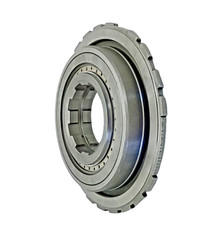
700R4 Sprag Clutch
A direct-fit sprag for the 700R4. Compare it to the sprag you pulled before installing, check the element direction against the races, and replace the races at the same time.
View the 700R4 sprag clutch →Drives only in manual 1: the low roller clutch
If the vehicle refuses Overdrive, D and 2 but moves in manual 1, the low roller clutch is not holding the reaction carrier in 1st. Manual 2 still relies on the roller clutch to launch in 1st, so it fails too; manual 1 adds the low and reverse clutch, which does the job the rollers cannot. Transmission Digest uses the same reasoning on one-way clutches in general: if the vehicle moves in manual low but not in the other forward ranges, the low roller clutch was not holding. Look for broken springs, flat-spotted rollers, and a worn or cracked race. Because the low and reverse clutch also holds in Reverse, a unit with this failure will usually still back up normally.
Reverse works, no forward in any range: the forward clutch
When manual 1 does not help, both the sprag and the roller clutch have been bypassed and the truck still sits, which leaves the forward clutch itself. The pack may be burned to the steels, the piston seals may be cut or hardened so the piston never strokes, or the apply oil may be leaking before it gets there. One leak path specific to this family is the input housing: Sonnax notes the GM 4L60-series input drum "is known to crack where the input shaft is pressed into it," which is also where the overrun clutch rides. A crack there bleeds off forward and overrun apply oil, and a housing that fully separates from the shaft takes out drive in every range.
An air check of the forward clutch circuit with the valve body off will tell you whether the piston is holding pressure before you commit to pulling the unit. A dull thud and clean release means the piston is sealing; a hiss from the input area means seals or a cracked housing.
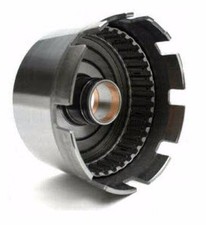
700R4 Input Drum
If the input housing is cracked at the shaft or the forward clutch area is damaged, replacing the drum is the repair. Match the year range to the forward piston style in your unit.
View the 700R4 input drum →Fixing it so it stays fixed
A sprag or roller clutch that let go did not fail in isolation. Burned forward clutch material, sprag debris and race metal end up in the converter and the cooler, and they will chew up a fresh sprag in short order if they are left there. Plan on a full overhaul with new frictions, seals and filter, a replaced or professionally cleaned converter, and a flushed cooler and lines. On high-torque builds, the same Sonnax documentation that explains the 4L60-E's reduced input-section capacity is a reminder that the input sprag is the weak link once horsepower goes up; on a 700R4 that still applies the overrun clutch from a stop in D, launching in D rather than Overdrive under heavy load takes the sprag out of the torque path.
Before you install the rebuilt unit, confirm the converter is fully engaged with the pump drive. You should feel it drop through distinct steps as it engages the input shaft, stator shaft and pump, and it should sit back from the flexplate before you bolt the bell housing up. A converter pulled up to the flexplate before it is seated will break the pump on the first start, and you will be back at Step 2 with zero pressure.
FAQ
Why will my 700R4 not move in Drive or Reverse?
When nothing drives in any range, start with the things that feed every circuit at once: fluid level, the shift linkage, and whether the pump is actually turning. Low fluid, a disconnected or misadjusted manual linkage, a converter that is not engaged with the pump drive, a cracked flexplate, or stripped turbine or input shaft splines all cause a total no-movement condition. A line pressure gauge on the case tap separates them quickly: near-zero pressure means a fluid or pump problem, while normal pressure with no movement means something mechanical in the drive path has broken.
My 700R4 moves in 1 and 2 but not in Overdrive. What failed?
That pattern points at the input sprag, also called the forward sprag. In Overdrive the forward clutch drives through the input sprag in 1st, 2nd and 3rd, so a sprag that freewheels in both directions leaves the unit in neutral. In the manual ranges the overrun clutch is applied, which locks the input sun gear to the input housing and bypasses the sprag, so the truck drives. A sprag installed backwards during a rebuild produces the exact same symptom.
What does it mean if a 700R4 only moves in manual 1?
If the vehicle will not move in Overdrive, D or 2 but drives in manual 1, the low roller clutch is not holding the reaction carrier in 1st gear. Manual 1 applies the low and reverse clutch alongside the roller clutch, so the clutch pack does the holding job the failed roller clutch cannot. Transmission Digest describes this same manual-low test as the way to confirm a one-way clutch that is not holding.
Can low transmission fluid cause a 700R4 to not move at all?
Yes. The pump needs a steady supply of fluid at the filter pickup to build the line pressure that applies the forward clutch and the reverse clutches. A unit that is several quarts low, or one with a cracked filter neck or torn filter seal pulling air, can lose prime and produce little or no pressure, especially on a cold start or on an incline. Check the level warm and running on level ground before condemning anything internal.
How do I test a 700R4 input sprag once it is out?
GM bulletin 08-07-30-027, written for the 4L60 (700R4) family, says to hold the outer race in one hand and turn the input sun gear with the other. With the input sun gear facing up, the sun gear should rotate counterclockwise only. If it turns both ways or will not turn either way, remove a retaining ring and inspect the sprag elements and both races, since a failed sprag usually damages the race surfaces too.
Sprags, input drums, pumps and complete rebuild kits for the 700R4 and 4L60 — shipped fast from the USA.
Shop 700R4 parts →Related 700R4 guides
Sources
- Sonnax — "The Evolution of Automatic Transmissions Part 2: Inner Workings of Hydraulic Planetary Transmissions." Backs the 700R4/4L60 powerflow: forward clutch and low roller clutch in 1st, the input sprag in the 3rd-gear power path, the low and reverse, forward and overrun clutches applied in manual 1, and the overrun clutch applied for engine braking in manual 2 and 3. sonnax.com
- Sonnax — Heavy Duty 2-3 Shift Valve 77754-41, product technical page. Backs the statement that when the 4L60-E evolved from the 700-R4, the overrun clutch was no longer applied in 1st and 2nd from a stop in D3, reducing the torque capacity of the input section and the input sprag. sonnax.com
- Transmission Digest — "Diagnosing Shifting Issues." Backs the manual-low test for no movement from a stop: movement in manual low means the forward sprag is bad because the overrun clutch holds it; no movement means the forward clutch. transmissiondigest.com
- Transmission Digest — "Troubleshooting One-Way Clutches." Backs the logic that movement in manual low but not in the other forward ranges means the low roller clutch is not holding, and that placing a 700 in the D or 3 range applies the overrun clutch. transmissiondigest.com
- Sonnax — Input Drum Reinforcement Kit 77733-02K, product technical page. Backs the GM 4L60, 4L60-E, 4L65-E and 4L70-E input drum being known to crack where the input shaft is pressed in, where the overrun clutch rides, and the forward piston compatibility note. sonnax.com
- GM / ACDelco — "Use the Right Transmission Fluid," GM Service Insights. Backs ATF Type III(H) as the fluid for 2005-and-earlier GM automatics originally specified for DEXRON, DEXRON II or DEXRON III, and the warning that DEXRON ULV is not a suitable replacement. gmserviceinsights.com
Also referenced: GM service bulletin 08-07-30-027 (June 2008), "No Movement in Drive or Third," covering 4L60 (700R4), 4L60-E, 4L65-E and 4L70-E forward sprag diagnosis and the input sun gear rotation test.