A customer calls and says his 700R4 went into limp mode. The symptom is real — stuck in one gear, will not shift out of it — but the words are borrowed from a transmission he does not have. A 700R4 has no limp mode: no control module falling back to a default gear, no fault strategy, no code to pull. On a 4L60E, a no-upshift complaint starts with a scan tool and a wiring diagram. On a 700R4, it starts with a tachometer, a pressure gauge and a set of gear ratios.
Why there is no limp mode to find
GM introduced the 700R4 in 1982 and renamed the unit 4L60 in 1989, eight years into production. The auxiliary valve body arrived in 1987, and 1993 was the last year for most 700R4/4L60 applications — the same year the electronically controlled 4L60E appeared. Per the Sonnax build guide, the valve body is the biggest difference between the two families: the 700R4 uses a cast iron valve body with a throttle cable and a mechanical governor determining shift points, while the 4L60E uses an aluminum valve body with computer-controlled solenoids actuating the shifts.
Everything that decides when a 700R4 shifts is hydraulic. Vehicle speed arrives as governor pressure, throttle load arrives as throttle valve (TV) pressure, and the shift valves split the difference. So when a 700R4 is stuck, something hydraulic or mechanical broke, and the job is identifying which from the outside before you pull it.
Step one: find out which gear it is actually stuck in
Most people guess wrong here, and the guess sends the whole diagnosis sideways. A truck at 55 mph turning 2,100 RPM is in third; at 3,000 RPM it is stuck in second. Two completely different repairs, separable from the driver's seat with a tach.
The 700R4 ratios are 3.06:1 in first, 1.44:1 in second, 1.00:1 in third and 0.70:1 in fourth. With the converter's maximum 2.0:1 multiplication, first gives an overall 6.12:1 at launch. Use the standard cruise formula:
Engine RPM = (MPH × axle ratio × trans ratio × 336) ÷ tire diameter in inches
Take a 3.42 axle on a 30-inch tire at 55 mph: fourth works out to about 1,475 RPM, third about 2,105, second about 3,035. First would be over 6,400, so a truck that pulls to highway speed is never stuck in first. Run that math before touching anything. If the tach says third, you are missing fourth; if it says second, you are missing third and fourth. That one number cuts the possible causes roughly in half.
The apply chart is the diagnosis
Once you know which gears are gone, the powerflow names the component:
- First (3.06:1) — forward clutches applied, reaction carrier held.
- Second (1.44:1) — forward clutches plus the 2-4 band, which holds the reverse input drum. The drum is tanged to the sun shell, and the shell is splined to the reaction sun gear, so all three lock together.
- Third (1.00:1) — forward clutches plus the 3-4 clutches, 2-4 band released. Direct drive.
- Fourth (0.70:1) — 2-4 band applied and 3-4 clutches applied together.
Read the overlaps and the answer falls out. No second, no fourth, no reverse, with first and third fine means everything you lost runs through the 2-4 band and the sun shell — the classic "stuck in third" 700R4. Second and third fine, no fourth puts it on the 3-4 clutch or the band apply in fourth. All the shifts present but very late at every throttle opening is governor or TV pressure, not a friction element.
Transmission Digest publishes a road test for the second case that works on a 700R4 exactly as it does on a 4L60E, because the gear train is the same: shift to manual second, bring it to roughly 40 mph, then shift to overdrive and let off the gas. If you still have a second-gear ratio where fourth should be, the 3-4 clutch is not holding — the forward clutch and the 2-4 band are still doing their jobs, which is why it falls back to a second-gear ratio instead of neutraling.
Cause 1: the TV cable, and it is not a kickdown cable
First thing to check on any 700R4 complaint, and the cause of more dead 700R4s than everything else combined. The TV cable does not just move shift points — it sets throttle pressure, which sets line pressure. A cable that is loose, binding, or set by somebody who thought it was a detent cable means the unit is applying clutches with pressure it does not have, and the 3-4 clutch and 2-4 band pay for it. The ATRA/GEARS procedure, followed exactly:
- Engine off, disconnect the cable at the carburetor or throttle body. Have someone hold the pedal down and confirm the throttle actually opens all the way, before adjusting anything.
- Pull the cable end and confirm it moves smoothly both directions. If it does not, the cable is damaged or the TV plunger and internal linkage are binding inside. Fix that first.
- Hold the release button, push the inner jacket all the way back toward the bracket, reconnect, hold the pedal down, release the button, let the throttle return to idle. Mark the cable. That is the coarse adjustment.
- Road test at light throttle. The 1-2 should land around 15 mph, the 2-3 around 28 mph. Late shifts mean pulling the adjuster forward a few clicks; early shifts mean pushing it back toward the bracket.
- Verify the full-throttle 2-1 downshift. Accelerate light, and the instant it makes the 1-2, floor it. It must drop to first. Do not deliver the vehicle without that downshift — back the cable off one click at a time until you have it, regardless of where the shift speeds landed.
That last step is the one people skip, and it is what tells you the TV plunger is reaching full stroke. There is a longer write-up on TV cable adjustment, line pressure and the 3-4 clutch if you are chasing a repeat burn.
Cause 2: the governor
The governor is the 700R4's speedometer as far as the hydraulics are concerned, and almost nobody inspects it. Sonnax describes the operation clearly: it is fed constant pressure from the pump, and as it spins, centrifugal force acts first on the larger, heavier primary weights. Those push outward, move the internal valve, close the exhaust port and raise governor pressure. Once speed forces the primary weights all the way out they stop affecting shift timing, and the smaller secondary weights take over — being lighter, they are less affected by centrifugal force and handle the finer adjustments at higher speeds.
That two-stage design is why governor faults are so specific. Weights varnished or hung up: pressure never rises and shifts go very late or never arrive at any throttle opening. Weak or broken weight spring: shifts arrive early or hunt, worse in the upper range where the secondary weights should be working. Worn governor valve: late or no upshift, and no upshift after a kickdown, because the valve leaks off the pressure it should regulate. Chewed driven gear: no governor pressure at all — find out what the debris was before replacing the gear.
Bench check it in five minutes: pull the governor, wash it, confirm every weight swings freely and returns under its own spring, and slide the valve in its bore — no drag, no step you can feel. Inspect the gear teeth for missing or rolled-over material.
Cause 3: valve body and pump circuits
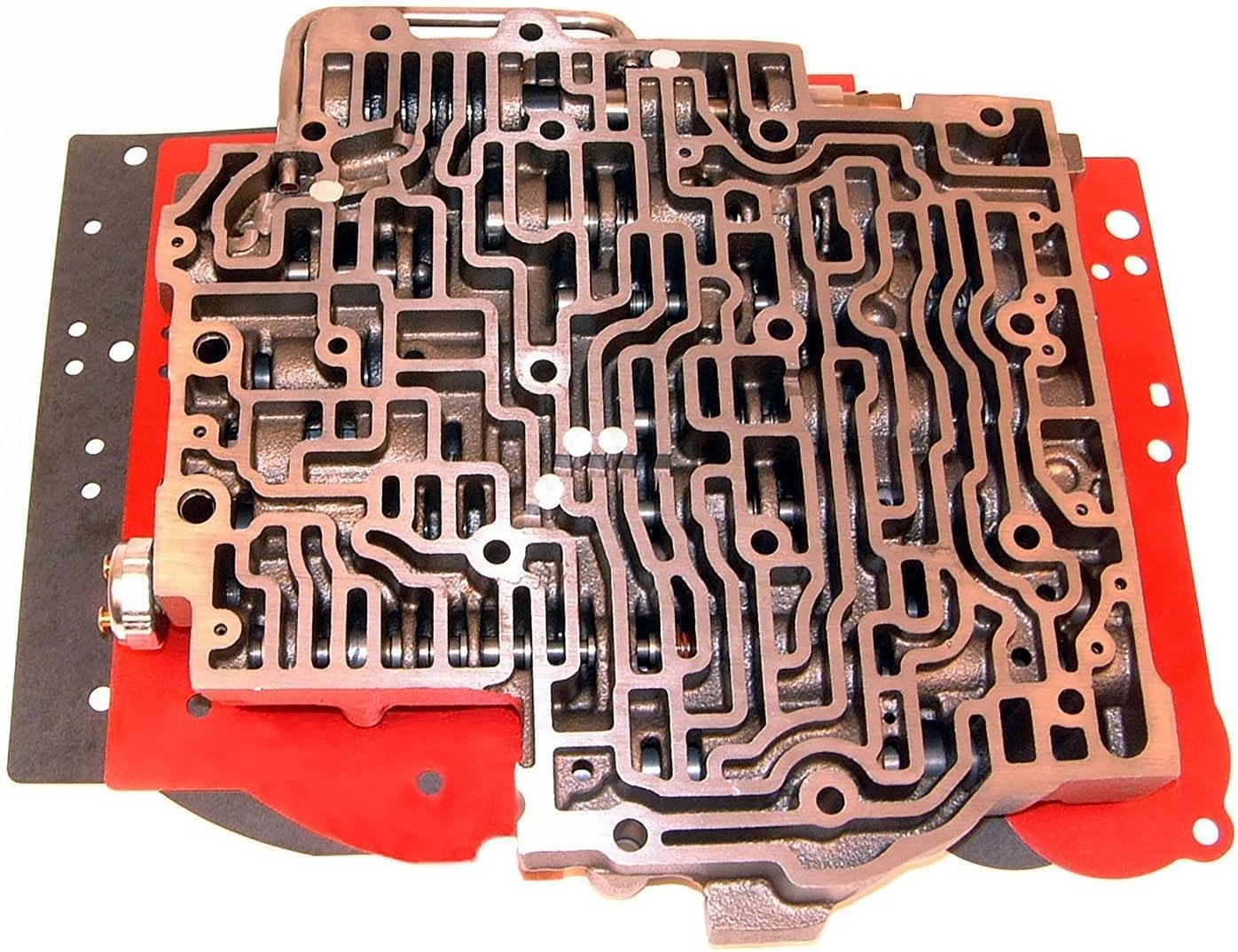
A cast iron valve body does not wear like an aluminum one, which fools people into skipping it. The problem on a 700R4 is not the iron — it is the aluminum TV sleeve running against a steel plunger, and the boost valves that never stop moving. The Sonnax valve body layout for the 4L60 (700R4) maps that wear straight to the complaint:
- Throttle valve (77968-02, oversized 77968) — low line rise, pin bore wear, soft upshifts, early upshifts, premature 3-4 clutch failure, 3-4 clutch and band failure. The oversized valve is not compatible with early '82–'90 aluminum-sleeved units, so identify the pump cover before ordering.
- TV plunger spring (77968-01K) — low throttle pressure, low line pressure.
- TV boost valve kits (77917-02K at.423" bore, 77917-03K and 77917-471 at.471", 77917-04K and 77917-500 at.500") — soft slide shifts, burned 3-4 clutch, reduced band life. Larger bore diameters produce more line rise.
- Pressure regulator valve (oversized 77917-06) and main spring (77917-08) — erratic line pressure, low line rise, clutch slippage, excess pump noise, 3-4 clutch failure.
- Reverse boost valve kit (K77898, K77898A) — low reverse boost, delayed reverse, low line pressure, poor upshift in manual low.
- Pump slide pivot pin (65797), pump spring spacer (77917-RV) — low or high line pressure, erratic line pressure.
- Accumulator valve train kits (77777M-K at.341", 77777L-K at.330") — 1-2 bang at light throttle, reduced 2-4 band life. '87-and-later auxiliary valve body units only; M goes in heavy vehicles, L in light and medium.
Vacuum test before you decide
Guessing at bore wear is how you do the same job twice. Vacuum testing gives you a number. Sonnax's reference points: a perfect vacuum with no leakage measures 29.9 in-Hg (it changes with elevation), an extremely good circuit might approach 22–23 in-Hg, and a severely worn bore can read as low as 8 in-Hg. They recommend a 3 CFM pump for valve body work.
Check the boost valves every time — throttle pressure changes keep them constantly moving in their sleeves, so they wear first. Pass/fail is specific to your stand, pump, gauge and altitude, so log readings per port and build your own standard. And do not seal off the neighboring port that supplies the air the test needs, or you will read a false high vacuum and pass a worn bore.
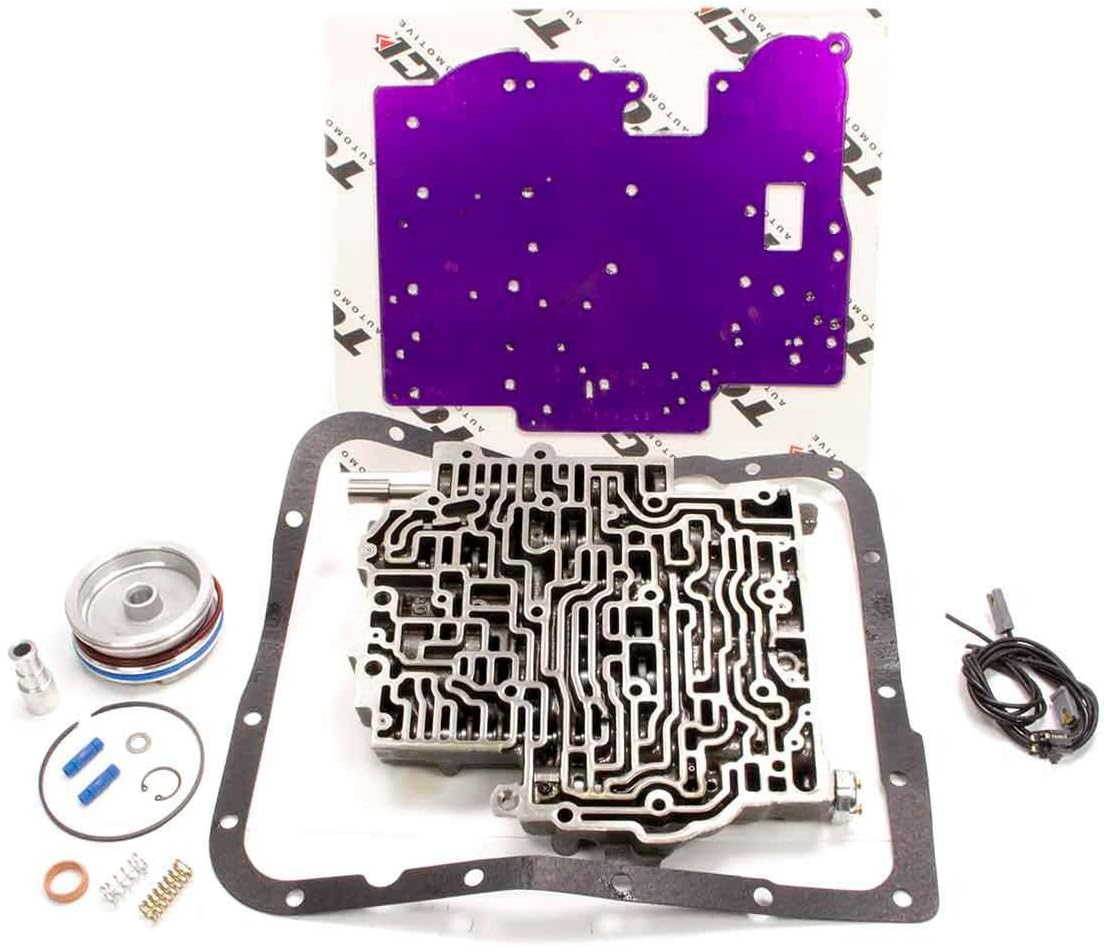
TransGo SK 700 Shift Kit, GM 700R4 / 4L60 (1982-1993)
The correction kit for the hydraulic side of a 700R4 that shifts late, slips the 3-4, or burns the band. Addresses the TV and shift valve circuits without a full valve body rebuild, and it is the standard next move once you have cleared the cable and the governor.
View in the shop →Cause 4: the sun shell
First and third present, no second, no fourth, no reverse: stop diagnosing. The 2-4 band holds the reverse input drum, the drum is tanged to the shell, and the shell is splined to the reaction sun gear — so when the shell strips its splines or breaks its hub, every gear that depends on holding the sun gear disappears at once. Transmission Digest describes the same failure on the 4L60E: the sun gear breaks away from the sun shell, you lose second, fourth and reverse, and the shell has to be replaced.
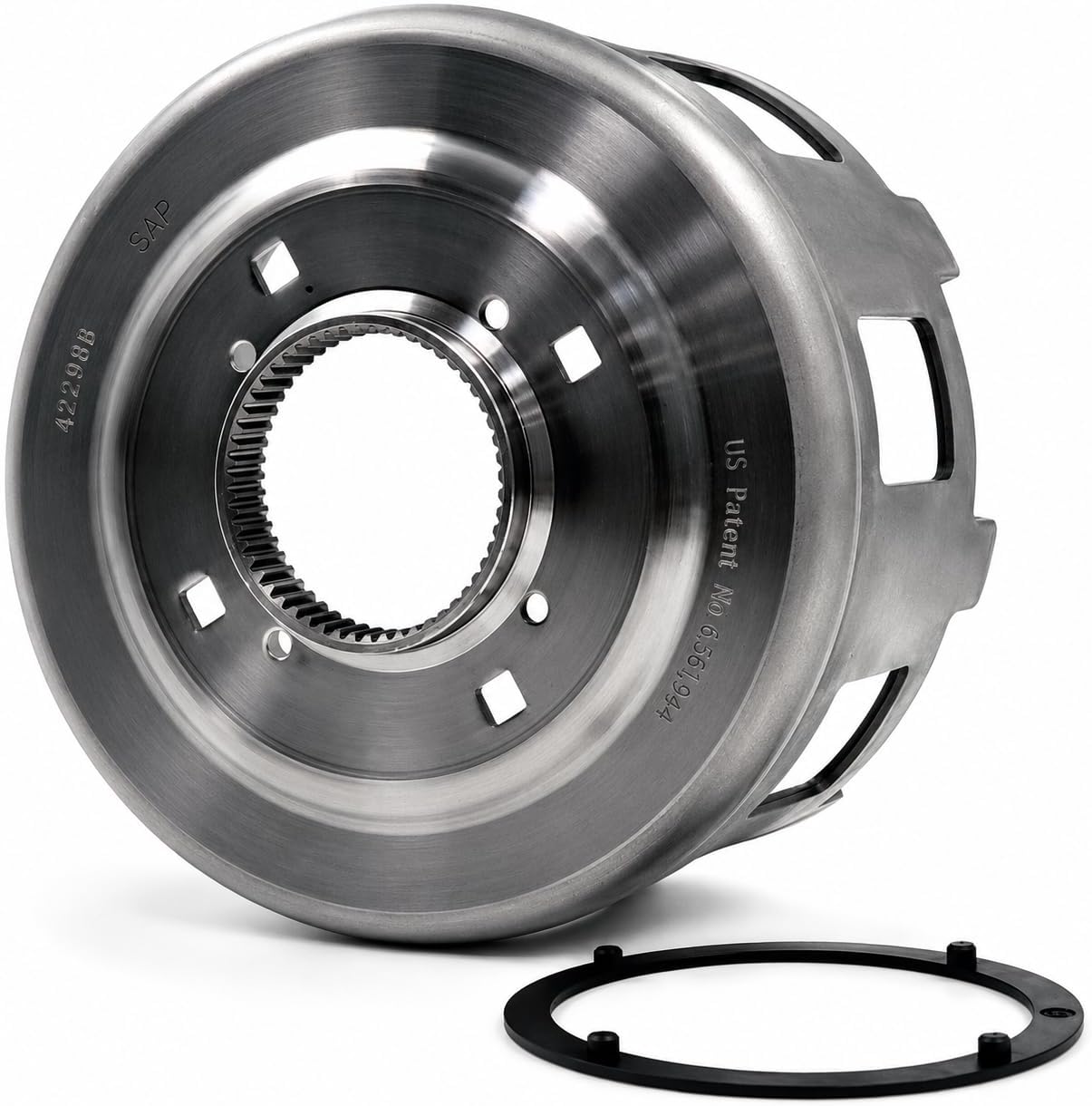
OE shells and thicker aftermarket shells share a chronic secondary problem: failure of the rear planetary bearing. The Sonnax SmartShell kit (77749-02K) addresses it with a larger bearing and a custom roller clutch race that re-route thrust loads through the carrier and bypass the captured bearing entirely, rather than just adding material to the shell. On a truck that tows, that bearing is what gets you back on the hook a year later.
Drop the pan on your way in. Shell material looks like curled steel shavings and spline chips, not the fine clutch dust from a burned pack.
Cause 5: burned 3-4 clutch (and why it burned)
A 700R4 that pulls first and second, then flares or holds a second-gear ratio where third and fourth belong, has a 3-4 clutch that is not holding. That is the symptom. The cause is almost never the clutch pack.
Count how many parts in the Sonnax list above name "3-4 clutch failure" as the complaint they fix: the throttle valve, the oversized throttle valve, the TV boost valves, the pressure regulator valve. Every one lives in the throttle-pressure-to-line-pressure path. A 3-4 clutch burns because line pressure did not rise with throttle, and the clutch was asked to hold torque on apply pressure meant for a light-throttle cruise. Sonnax also lists a shortened TV link (77872-01) for low line rise, soft shifts and 3-4 clutch and band failure — a cable geometry fix rather than a valve fix. Replace the clutches, but reinstall without correcting the pressure rise and you have scheduled the same repair about a year out.
Cause 6: the one electrical thing
The TCC solenoid is the only electrical device inside a stock 700R4, and it cannot cause a missing gear. Losing lockup raises cruise RPM and fluid temperature, and it makes customers say the transmission "will not shift into fourth" when fourth is working fine — so confirm four forward gears by ratio before tearing anything down. When lockup genuinely is the fault, Sonnax maps it: no lockup, falling out of lockup when hot, or fluid blown out the fill tube point at the TCC apply valve (77805-K); an overheated converter or loss of lube oil points at the TCC solenoid snout (77942-01K). On carbureted, non-computer trucks the command runs through a four-pin case connector fed by the brake switch and a vacuum switch, so check those before the pan comes down.
The order I actually work one
- Fluid level and condition — engine running, at temperature, in Park. Burnt fluid changes the plan.
- Road test with a tach — run the RPM math, write down exactly which gears are missing.
- TV cable — smooth pull, full throttle at the carburetor or throttle body, coarse adjust, road test to the 15 and 28 mph targets, verify the full-throttle 2-1.
- Line pressure gauge — idle in Drive, then the rise as the cable comes to full travel. No rise is a hydraulic fault, not an adjustment fault.
- Pan down — spline chips versus clutch lining versus band friction tells you which cause above you are in.
- Governor out — wash it, check the weights and valve, inspect the gear.
- Valve body off and vacuum tested at the TV, boost and pressure regulator circuits before anyone quotes a rebuild.
Seven steps, and only the last two require the unit to come apart. On a transmission with no diagnostic port, that ordering is the whole game.
One habit prevents most repeats: set the TV cable every single time you touch the transmission, the cable, the carburetor or the throttle body. Sonnax sells a TV cable corrector kit (AS1-01K) for engine-swap cases where the bracket geometry itself is wrong, and a TV plunger spring (77968-01K) that acts as an anti-stick spring on the throttle valve. And if the unit came apart from a burned clutch, flush the cooler and lines before the rebuild goes in — debris left in a cooler circuit will find the new clutch pack faster than any adjustment error.
700R4 shift kits, sun shells, 2-4 bands, servos, TV cables, governors and the bench tools to install them — shipped fast from the USA.
Shop 700R4 parts →Sources
- Sonnax — "700-R4 (4L60) Performance Transmission Build Guide," Gregg Nader, February 26, 2021. Backs the 1982 introduction, the 1987 auxiliary valve body, the 1989 rename to 4L60 and 1993 as the last year for most models; the cast iron valve body with throttle cable and mechanical governor determining shift points versus the 4L60E's aluminum body with solenoids; and the TV cable corrector kit AS1-01K, TV plunger spring 77968-01K and SmartShell 77749-02K part numbers. sonnax.com
- Sonnax — "The Evolution of Automatic Transmissions Part 2: Inner Workings of Hydraulic Planetary Transmissions." Backs the 3.06:1, 1.44:1, 1.00:1 and 0.70:1 gear ratios and the 6.12:1 overall with 2.0:1 converter multiplication; the element-by-element powerflow including the 2-4 band holding the reverse input drum tanged to the sun shell and splined to the reaction sun gear; and the governor's primary and secondary weight operation, exhaust port closure and pressure rise with speed. sonnax.com
- Sonnax — "GM 4L60 (700-R4) Valve Body Layout," October 7, 2021. Backs every part number and symptom pairing in the valve body section: throttle valve 77968-02 and oversized 77968 with the '82–'90 aluminum sleeve incompatibility note, TV plunger spring 77968-01K, TV boost valve kits 77917-02K/.423", 77917-03K and 77917-471/.471", 77917-04K and 77917-500/.500", pressure regulator valve 77917-06 and spring 77917-08, reverse boost valve K77898 and K77898A, pump slide pivot pin 65797, pump spring spacer 77917-RV, shortened TV link 77872-01, accumulator valve train kits 77777M-K/.341" and 77777L-K/.330", and the TCC parts 77805-K, 77942-01K and 77918S-K. sonnax.com
- Sonnax — "Vacuum Testing for Leakage," January 22, 2011. Backs the vacuum test numbers: 29.9 in-Hg for a perfect vacuum and its variation with elevation, 22–23 in-Hg for an extremely good circuit, as low as 8 in-Hg for a severely worn bore; the 3 CFM pump recommendation; the instruction to always check boost valves because throttle pressure changes keep them constantly moving; the shop-specific nature of pass/fail standards; and the false-high-reading warning about sealing off the neighboring supply port. sonnax.com
- Transmission Digest — "Diagnosing Shifting Issues." Backs the manual-second-to-overdrive road test at roughly 40 mph and the conclusion that a second-gear ratio where fourth belongs means the 3-4 clutch is not holding while the forward clutch and 2-4 band still are; and the sun gear breaking away from the sun shell causing the loss of second, fourth and reverse. transmissiondigest.com
- GEARS Magazine (ATRA) — "A Look Back: Adjusting the THM700-R4 Throttle Valve Cable." Backs the full TV cable procedure: verifying full throttle at the carburetor or throttle body with the cable disconnected, confirming smooth cable travel before adjusting, the coarse adjustment sequence, the 1-2 at about 15 mph and 2-3 at about 28 mph light-throttle targets, the click-by-click correction direction, and the mandatory full-throttle 2-1 downshift verification before delivery. gearsmagazine.com
- Sonnax — "SmartShell Heavy Duty Reaction Shell Kit, 77749-02K." Backs the spline stripping and hub breakage failure modes in OE and thicker aftermarket shells, the chronic rear planetary bearing failure, and the larger bearing plus custom roller clutch race that re-route thrust loads through the carrier to bypass the bearing. sonnax.com