The 722.9 is Mercedes-Benz's seven-speed 7G-TRONIC automatic, built on the NAG2 (New Automatic Gearbox 2) platform that replaced the five-speed 722.6 starting in the early-to-mid 2000s. It ended up behind nearly every rear-drive and 4MATIC Mercedes built for over a decade: C-Class, E-Class, S-Class, CLS, CLK, SLK, GL, ML, R-Class, and the Sprinter van. If you have been searching "9G-Tronic problems" and landing on 722.9 forum threads, stop -- the nine-speed unit is a different transmission entirely (the 725.0), and that mix-up is the single most common way people end up putting the wrong fluid in a 722.9.
Instead of recycling the usual forum folklore, this guide works from four Mercedes-Benz factory bulletins, all archived publicly through NHTSA, plus one documented shop case study. Each one addresses a complaint that actually brings 722.9 vehicles into the bay: fluid misidentification, torque converter shudder that factory engineering says isn't the torque converter, a harsh Park-to-Drive bump, and AWD binding after a rebuild.
Fluid Identification: The Two Generations That Will Burn You
Mercedes-Benz bulletin S-B-00.40/89d (revision d, November 6, 2013) lays out exactly what changed and when. 722.9 units built before June 21, 2010 take red ATF 134, specification sheet BeVo 236.14, part number A 001 989 68 03. Units built after that date take FE ATF 134, a blue fluid under BeVo 236.15 (part A 001 989 78 03), when paired with engine codes 113, 152, 156, 157, 275 or 279. Later 722.9 units without those engines run on BeVo 236.15 or 236.16 (part A 001 989 78 03 or A 001 989 92 03). The bulletin is explicit on one point: these oils must never be mixed, and separate filling equipment has to be used for each.
If you don't have clean production records, Mercedes gives a visual way to tell the two generations apart at the pan. Pre-change pans (up to June 21, 2010) have round-form dimples and a black or white overflow pipe inside the pan. Post-change pans are 5mm deeper, have oval-form dimples, and use a green overflow pipe. Xentry DAS (version 05/2010 with add-on 1476 or later) will also flag the correct gear oil spec before it reads out transmission temperature, so if you have Star Diagnosis access, let the scan tool confirm it rather than assuming based on model year alone.
One more identification trap: the "9G-Tronic" name gets used loosely online, but it refers to the 725.0 nine-speed, a different transmission that the same bulletin lists as requiring BeVo 236.16 only, and the seven-speed hybrid 724.2 takes 236.15. None of these three fluids are interchangeable with each other. Confirming which unit and which fluid generation you actually have, before the first top-off, is the cheapest problem-prevention step in this entire article.
Humming, Droning or Shudder? Don't Jump to the Torque Converter
Shudder and droning complaints are usually diagnosed as torque converter lockup clutch wear, and on a lot of transmissions that's the right call. On the 722.9, Mercedes-Benz bulletin LI27.10-P-057361 (June 10, 2014) says that's frequently the wrong call. The bulletin covers complaints of humming, droning, vibrations, shuddering, jolting or slip -- the kind of symptom set that points at a torque converter -- and states that NAG2 transmissions built from transmission sequence number 1,515,055 onward (after November 2007) already have an optimized torque converter installed. For units at or past that sequence number, replacing the torque converter is documented as not effective for these symptoms.
The bulletin's actual remedy, before any converter work, is a short checklist: limit the transmission to first gear and see if the complaint is still present; check the propeller shaft for excessive resistance and work through the related driveline bulletins (LI35.31-P-056961 and LI22.10-P-056910); check the wheels and swap them diagonally if there's any doubt about tire condition or balance; and check whether a transmission oil change was performed recently, since the wrong fluid generation (see above) can itself produce shudder-like symptoms. Only after ruling those out does converter work make sense on a post-2007-sequence unit. Treating every hum or shudder as a converter swap on these transmissions is how a shop eats a comeback.
Harsh Park-to-Drive Engagement: Usually Not a Parts Problem
A hard bump or clunk when shifting out of Park into Drive feels like a mechanical problem, and the instinct is to suspect the valve body or a worn clutch pack. Mercedes-Benz bulletin LI27.50-P-049281 (version 8, September 22, 2020, covering transmission variant 722.993 and others) attributes this specifically to friction coefficient fluctuations in the B2 disk pack, and the documented fix is a relearn procedure, not a replacement part.
The relearn sequence from the bulletin: start the engine cold and shift five times from N to R, then five times from N to D while warming the transmission to 40°C and exceeding 30 mph at least once during that warm-up. Repeat five N-R and five N-D shifts, this time warming to 70°C while again exceeding 30 mph at least once. Finish with a final five N-R and five N-D cycle. The bulletin notes to stay in each gear range for at least five seconds during the sequence. No disassembly, no parts. If a 722.9 has a harsh P-D bump and otherwise shifts fine through the gear range, this adaptive relearn is the correct first step, and it costs nothing but shop time.
AWD Binding on Turns After a Rebuild: Check the Tires First
Wayne Colonna documented a 722.9 case in Transmission Digest that is worth knowing before you second-guess your own rebuild work. A 2010 Mercedes E350 with a 722.9 came into the shop with a grinding noise from worn AWD unit bearings. The transmission was rebuilt with new bearings and a new viscous clutch. After the rebuild, the vehicle came back with a complaint of binding on turns and around corners -- the kind of symptom that looks like a bad viscous clutch or a transfer case problem straight out of the gate.
It wasn't. The correct OEM fluid had been used and the driveshaft checked out fine. The tires were brand new, and all four were the same size front and rear. That was the problem: the vehicle's own door sticker specified different tire sizes front and rear, and running a matched set created the same rolling-circumference mismatch across the AWD system that a worn viscous clutch would. Before chasing a transfer case or AWD unit complaint on a 722.9 vehicle, check the door sticker against what's actually mounted. A $150 mistake at the tire shop can look exactly like a $2,000 drivetrain failure.
The Adaptation Counter: What Star Diagnosis Is Telling You
Mercedes-Benz bulletin S-B-27.00/124 (October 3, 2012) covers a smaller but useful diagnostic detail. Starting with Star Diagnosis DVD 09/12, the adaptation counter for gear adaptation is indicated both acoustically and visually across "cold," "warm," and "hot" temperature states via a frequency counter, on model series as of model 204 that are compatible with Xentry Diagnostics. In practice, this is the tool telling you whether the transmission is still working through its own shift adaptation values rather than presenting a hard fault. Before condemning a valve body or clutch pack for a shift-quality complaint, check where the adaptation counter actually sits across all three temperature states -- a unit mid-adaptation after a battery disconnect, fluid service, or relearn (see the P-D section above) can feel rough temporarily without anything being broken.
"Lifetime Fill" Is a Marketing Term, Not a Spec
Mercedes-Benz sold the 722.9 as filled for life. The fluid specification bulletin alone shows that claim doesn't hold up well: the fluid requirement changed at a hard production cutoff in mid-2010, and a transmission built after that point needs a different fluid depending on which engine it's paired with. That is not the profile of a fluid that never needs attention -- it's the profile of a factory that kept revising what the internals actually required. On a used 722.9 with unknown service history, a fluid and filter service with the correctly identified generation of ATF is cheap preventive maintenance against a documented failure mode (fluid mismatch) rather than a worn part.
FAQ
Is the 722.9 the same as the "9G-Tronic"?
No, and this mix-up causes real fluid mistakes. The 722.9 is Mercedes-Benz's seven-speed 7G-TRONIC (NAG2 platform). The nine-speed unit is a completely different transmission, the 725.0, which Mercedes-Benz's own fluid bulletin lists as requiring BeVo 236.16 fluid only. If you search for "9G-Tronic" symptoms and apply them to a 722.9, you are reading about the wrong gearbox.
How do I know which ATF my 722.9 needs?
Check the production date and, if unsure, look at the oil pan shape rather than guessing. Per Mercedes-Benz bulletin S-B-00.40/89d, 722.9 units built before June 21, 2010 use red ATF 134 (BeVo 236.14, part A 001 989 68 03). Units built after that date use blue FE ATF 134 (BeVo 236.15, part A 001 989 78 03) if paired with engine codes 113, 152, 156, 157, 275 or 279, or BeVo 236.15/236.16 otherwise. The two generations cannot be mixed. Visually, pre-change pans have round-form dimples and a black or white overflow pipe; post-change pans are 5mm deeper with oval-form dimples and a green overflow pipe.
My 722.9 shudders or hums under light throttle. Is it the torque converter?
Not necessarily, and replacing the converter first is how shops waste money on this complaint. Mercedes-Benz bulletin LI27.10-P-057361 states that for NAG2 transmissions built from sequence number 1,515,055 onward (after November 2007), an optimized torque converter is already installed, and converter replacement does not resolve humming, droning, vibration, shudder or jolting on these units. The bulletin's remedy is to check the issue in first gear only, inspect the propeller shaft for excessive resistance, check whether tires were swapped or rotated, and confirm whether the fluid was recently changed, before any converter work.
Why does my 722.9 engage harshly from Park to Drive?
Mercedes-Benz bulletin LI27.50-P-049281 attributes this to friction coefficient fluctuation in the B2 disk pack, and the documented remedy is a relearn, not a parts replacement. The procedure runs the transmission through five N-R and five N-D shift cycles cold, warms it to 40°C while exceeding 30 mph at least once, repeats the N-R/N-D cycles, warms it to 70°C with another pass over 30 mph, then repeats the cycles a final time. No valve body or clutch work is called for in the bulletin.
Does the 722.9 really have lifetime fluid?
Mercedes-Benz marketed the 722.9 as filled for life, but the fluid specification itself changed at least twice during the transmission's production run, which tells you the factory was still refining what the unit needed internally. Given that mixing the wrong generation of ATF is an actual documented failure mode, a fluid and filter service on a used 722.9 of unknown history is cheap insurance against a problem that started as a fluid mismatch rather than a worn part.
Working on a 722.9 this week?
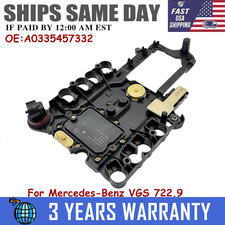
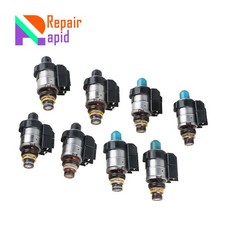
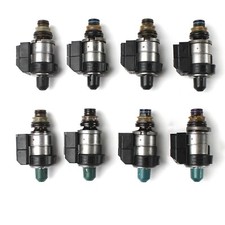
Valve bodies, solenoid kits, pumps, master rebuild kits, and the correct ATF for both fluid generations — all in one place, shipped from the USA.
Shop 722.9 parts →Sources
- Mercedes-Benz USA — Star Bulletin S-B-00.40/89d, "Operating Fluid Specification Changes for Automatic Transmission," November 6, 2013 (archived via NHTSA). Backs the two 722.9 fluid generations split at production date June 21, 2010, the BeVo 236.14/236.15/236.16 specifications and MB part numbers A 001 989 68 03, A 001 989 78 03 and A 001 989 92 03, the engine-code-dependent fluid assignment, the no-mixing rule, and the oil pan visual identification (dimple shape, pan depth, overflow pipe color). static.nhtsa.gov
- Mercedes-Benz AG — Technical Bulletin LI27.10-P-057361, "Humming, droning, vibrations, shuddering, jolting, slip," June 10, 2014 (archived via NHTSA). Backs the torque converter sequence number cutoff of 1,515,055 (after November 2007), the statement that converter replacement is not effective for these symptoms past that cutoff, and the diagnostic checklist (first-gear isolation, propeller shaft resistance check, wheel/tire check, recent fluid change check). static.nhtsa.gov
- Mercedes-Benz AG — Technical Bulletin LI27.50-P-049281, "Harsh engagement when changing gear range from P to D," version 8, September 22, 2020 (archived via NHTSA). Backs the B2 disk pack friction coefficient fluctuation cause and the full N-R/N-D relearn procedure with 40°C and 70°C warm-up stages and the 30 mph minimum speed requirement. static.nhtsa.gov
- Mercedes-Benz USA — Star Bulletin S-B-27.00/124, "Additional Adaptation Counter Indicator," October 3, 2012 (archived via NHTSA). Backs the Star Diagnosis DVD 09/12 adaptation counter indicator feature across cold/warm/hot temperature states and its model-204-and-up, Xentry-compatible scope. static.nhtsa.gov
- Transmission Digest — "Mercedes 722.9 AWD binding around corners," Wayne Colonna, July 31, 2024. Backs the shop case study of a 2010 E350 722.9 AWD rebuild, the binding-on-turns complaint with new bearings and a new viscous clutch, and the root cause of a front/rear tire size mismatch against the vehicle's own door sticker. transmissiondigest.com