Every pressure-testing habit you built on a 4L60E works against you on a GM 8L90. There is no convenient case tap to hang a gauge on, the scan tool number you are used to trusting is a solenoid command rather than a transducer reading, and the one fitting on a replacement valve body that actually looks like a test port will dump your line pressure on the floor if you take it out. So the question is not "what should the gauge read." The question is how you establish whether this unit is making the right pressure when the tools you would normally reach for are either missing or lying to you.
The short version: Line pressure on an 8L45/8L90 should peak at roughly 315 psi. Sonnax has measured units running above 415 psi, which is enough to crack the valve body casting in the worm tracks and shatter drums. The failure is almost always a worn pressure regulator valve lineup plus a blow-off spring calibrated too high — not a bad pump and not a bad solenoid. Diagnosis is a vacuum test on the bench, not a gauge on a road test.
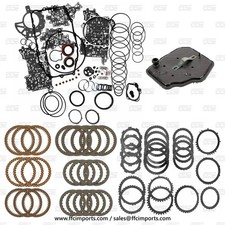
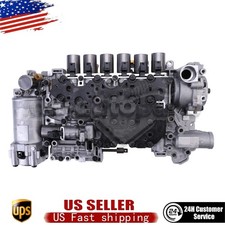
How the 8L90 Makes Pressure
The 8L90 (RPO M5Q, M5X, and MQE for 2019) and its smaller sibling the 8L45 (M5T, M5N) run nine solenoids on the valve body: seven variable-force pressure control solenoids and two three-port on/off solenoids. All of them are current-controlled and all of them measure 4.5 to 5.5 ohms, per Gears Magazine's teardown of the 8L90 solenoid strategy. That resistance figure is your first sanity check with a meter, and it is the same for every one of them — there is no "this one should read different."
The line pressure control solenoid is normally high, which trips people up. Normally high means increasing solenoid current decreases output pressure and flow. So a solenoid that has lost its command, or a circuit that has gone open, defaults toward maximum pressure rather than minimum. Failsafe on this unit is second gear and reverse.
Here is the part that matters for diagnosis: none of these solenoids move a clutch. Sonnax makes the point directly — the VFS solenoids are low-flow devices whose only job is to supply enough signal pressure to stroke a related control valve. The control valves do the heavy lifting of routing line pressure into the clutch circuits. In one case, that related valve is the pressure regulator valve itself. Every one of those seven VFS circuits also carries a small signal accumulator piston that damps flow instability so the shift feels right.
Because the solenoids are low flow, a leak anywhere in that signal path has an outsized effect. A few thousandths of wear in a signal accumulator bore bleeds off enough signal oil that the control valve never fully strokes. On the line pressure circuit, that means the pressure regulator valve never gets told to move to its lower-pressure position — and pressure runs away.
The Numbers That Matter
| Specification | Value | Why you care |
|---|---|---|
| Line pressure, peak (normal) | ~315 psi | Design target; Sonnax parts hold max in the 300–315 psi band |
| Line pressure observed on failing units | 415+ psi | Cracks valve body worm tracks, shatters drums |
| OE blow-off spring calibration | Over 400 psi in some cases | The safeguard itself is set too high to protect the casting |
| Solenoid resistance (all nine) | 4.5–5.5 ohms | Fast meter check before you pull anything |
| Adaptive relearn fluid temp window | 131–198°F (55–96°C) | Outside this range the relearn will not start |
| TCC shudder temp window | 122–158°F (50–70°C) | Where a true converter shudder shows itself |
| True TCC shudder frequency | 23–28 Hz | Separates converter shudder from a driveline vibration |
| Fluid | Mobil 1 Synthetic LV ATF HP, GM P/N 19417577, blue label | Black bottle and gray label HP are earlier formulations |
Two of those rows deserve emphasis. The 315 psi peak is the design intent, and the 415 psi figure is what Sonnax actually measured in evaluation units. That gap is not a rounding error, it is a casting failure waiting to happen. And the OE blow-off spring — the part whose entire job is to be the last line of defense — has been found calibrated over 400 psi in some circumstances, which means it lets the transmission see pressures nothing inside it was designed for before it ever opens.
Do Not Pull the Plug That Looks Like a Test Port
This one costs people a full day. New OE valve bodies carry a plug bolted into a hole in the casting that is not present on the original valve body. Some GM techs call it a test port. Sonnax lists it as Condition 5 in their no-move / no-pressure troubleshooting: if that plug is removed, it leaves a huge leak that dumps line pressure. It is not a pressure tap. Nothing threads into it. A unit that came out of the box fine and has no pressure after a valve body swap is the classic presentation.
The same article documents the other assembly-side causes worth ruling out before you condemn a pump:
- Pressure regulator valve assembled backwards. The inner shuttle boost valve and its bushing must face inboard for boost. Installed outboard, you get low or no pressure. This produces no code and looks exactly like a dead pump.
- Pump never primed. The off-axis chain-driven pump is marketed as self-priming and in the field it frequently is not. Sonnax's bench prime: valve body face down in a clean drain pan, manual valve in Park (first land flush with the casting), funnel into the pump suction, fill with ATF, then spin the pump shaft clockwise with a 1/2 in. chuck electric drill.
- Stop-start valve body on a non-stop-start vehicle. Creates a leak at the rear of the valve body where the stop-start accumulator would normally attach.
- Missing 1-2-7-8-R case seal. Left out entirely more often than you would think. It lives in the case underneath the valve body, and the 8L45 and 8L90 use different seals.
- No movement right after fast learn or J2534 programming. Pull the key, get out, shut the doors, come back in 15 minutes. It usually resolves itself.
Why the Scan Tool Will Not Settle This
Sonnax has been blunt about this for years, and it applies squarely to the 8L90: some scan tools show a pressure command that gets mistaken for data from a transducer. Most transmissions have no pressure transducer input to the controller at all — what you are reading is the module's command to the pressure control solenoid. If everything is healthy, that command and a real gauge will agree. The moment the pump, the regulator valve, or the blow-off spring is the problem, they diverge, and the scan tool keeps showing you a number that looks fine.
Put plainly: on an 8L90, a normal-looking commanded pressure does not rule out 400+ psi of actual line pressure. The regulator valve is leaking so badly it cannot stroke to the low-pressure position, the controller commands what it always commands, and the casting is the thing that finds out.
The Test That Actually Works: Vacuum Testing the Valve Body
Because there is no practical live line tap and the scan tool reports a command, real 8L90 pressure diagnosis happens on the bench with a vacuum tester. Low vacuum at a given test location means bore or valve wear at that location.
Testing the signal accumulator pistons
Sonnax's method: test each signal accumulator piston with the spring still in the piston, and place the test port opening in the center of the spring. In their experience, the S3 and S4 locations are generally the worst. Since these are the low-flow signal circuits, wear here translates directly into control valves that do not stroke fully.
The solenoid-to-piston-to-complaint mapping is the most useful diagnostic table published on this unit:
| VFS solenoid | Control | Signal accum. piston | Complaint it drives |
|---|---|---|---|
| Line Pressure | NH | S6 | Low line pressure, slipping and burnt clutches, various shift complaints |
| TCC | NL | S7 | Converter apply/release complaints, burnt converter |
| 2-3-4-6-8 | NH | S4 | 2nd, 3rd, 4th, 6th, 8th gear |
| 1-3-5-6-7 | NL | S3 | 1st, 3rd, 5th, 6th, 7th gear |
| 4-5-6-7-8-Reverse | NH | S5 | 4th–8th gear, reverse |
| 1-2-7-8-Reverse | NH | S1 | 1st, 2nd, 7th, 8th gear, reverse |
| 1-2-3-4-5-Reverse | NL | S2 | 1st–5th gear, reverse |
Work that table backwards from the complaint. A burnt-clutch, low-pressure unit points at the line pressure solenoid circuit and the S6 piston. A 5th-and-7th-gear complaint points at 1-3-5-6-7 and S3. This is how you avoid the expensive default answer.
That default answer matters financially. GM does not sell the solenoids separately, and swapping a single solenoid out of a core unit would invalidate the PUN flow-rate data the TCM uses to control shifts. So shift and solenoid codes routinely get "fixed" with a complete new valve body. Checking seven signal accumulator bores first is a cheap test that frequently makes a four-figure part unnecessary.
Testing the pressure regulator lineup
On a rebuild, Sonnax's recommendation is not conditional: replace the pressure regulator lineup and the line pressure blow-off spring every single time. Excessive leakage at the regulator valve prevents it from stroking to the lower pressure position, which is what produces runaway pressure. And depending on how worn the bore is, a shuttle valve without O-rings may not seal that leakage well enough to matter.
Sonnax 8L45/8L90 Shift Zip Kit
Drop-in valve body repair kit for the 8L45/8L90 — addresses the worn bores behind harsh shifts, slipping, and pressure loss without reaming.
See the kit →If You Are Hanging a Gauge Anyway
On any unit with a usable tap, the rules Sonnax lays out still apply and they apply double at 8-speed pressures. Use a gauge rated for more pressure than the maximum you expect — if a failing 8L90 can hit 415 psi, a 300 psi gauge is a projectile. Take pressures during a road test, not on the lift, because you cannot load the transmission on a hoist the way the road does. Keep the gauge outside the vehicle, taped to the windshield or held by a helper. Route the hose away from exhaust, driveshafts, and fan blades, and tie the hood down if it has to sit ajar.
Finishing the Job So It Stays Fixed
Pressure work on an 8L90 is not done when the valve body goes back on.
Program the PUN or TUN. If the valve body was replaced, the TCM needs the new part unique number from that valve body. If the transmission was replaced, it needs the new transmission unique number off the case. These values tell the TCM the actual solenoid flow rates it is working with, and the adaptive baselines are derived from them. Skip it and you get shift complaints the adapts are structurally unable to correct.
Run the relearn properly. Fluid temperature has to be between 131°F and 198°F or the relearn will not start. The coast-down adapts are the hard part — lightly accelerate to 65 mph, then decelerate to 25 mph with the brake lightly applied, and repeat ten times. If you make a mistake partway through, expect a harsh 1-2 or 3-1 complaint. And if one specific shift is still wrong afterward, relearn only the clutches involved in that shift rather than starting the whole process over.
Use the current fluid. GM bulletin 18-NA-355 (April 2020) covers shake and shudder during light-throttle acceleration between 25 and 80 mph on 8L45 and 8L90 units across the Silverado, Sierra, Camaro, Corvette, Colorado, Canyon, Yukon, Escalade, ATS, CTS, and CT6. The root cause turned out to be the fluid: the earlier HP formulation was hygroscopic, and absorbed moisture changed its friction dynamics. The fix is a full exchange — the bulletin has the shop fill the TransFlow machine with 20 quarts of the new blue-label Mobil 1 Synthetic LV ATF HP. The bulletin also warns that intermixing other fluid types or aftermarket additive packages leaves the new fluid too dilute to work. Note that a fluid-related shudder can take up to 400 miles of driving to fully clear, and that replacing the torque converter on later applications has been found ineffective.
One more field note worth keeping: running DEXRON VI in one of these instead of the HP fluid produces genuinely strange shift behavior. If a unit shows up with bizarre shifts and someone has serviced it recently, verify what went in before you start pulling it apart.
What Prevents the Next One
The 8L90's pressure problems are hydraulic wear problems, and they concentrate in two places. Replace the pressure regulator lineup and the blow-off spring on every rebuild — the OE blow-off calibration is not a reliable safety net. Vacuum test all seven signal accumulator bores before condemning a valve body, and pay extra attention to S3 and S4. Get the fluid right, program the PUN or TUN, and run the relearn in the temperature window. Do those things and the casting never sees 415 psi in the first place, which is the only version of this repair that stays fixed.
Sources
- Sonnax — "Watch Out for High Pressure in GM 8L45, 8L90 Valve Bodies," Chris Leach, Sonnax TASC Force. Backs the ~315 psi normal peak line pressure, the 415+ psi measured on failing units, cracked valve body worm tracks and catastrophic drum failure from runaway pressure, the worn pressure regulator valve lineup and mis-calibrated blow-off spring (over 400 psi in some circumstances) as root cause, the point that a shuttle valve without O-rings may not seal a worn bore, and the recommendation to replace the PR lineup and blow-off spring on every rebuild. sonnax.com
- Sonnax — "Troubleshooting GM 8L45, 8L90 No Move & No Pressure Conditions," Jim Mobley, Sonnax TASC Force. Backs the new-OE-valve-body test port plug that dumps line pressure if removed, the pressure regulator inner shuttle boost valve and bushing needing to face inboard, the bench pump prime procedure (manual valve in Park with first land flush, funnel in pump suction, 1/2 in. chuck drill clockwise), the stop-start valve body mismatch leak, the omitted 1-2-7-8-R case seal, the 15-minute key-out reset after fast learn or J2534 programming, and failsafe gears being 2nd and Reverse. sonnax.com
- Sonnax — "Diagnosing 8L45 & 8L90 Shift Complaints: Always Check the VFS Solenoid Circuits." Backs the seven VFS solenoids as low-flow signal devices that stroke related control valves (including the pressure regulator valve), the signal accumulator piston in each VFS circuit and the aluminum bore wear it causes, the vacuum test method (spring left in the piston, test port centered in the spring), S3 and S4 as the worst locations, the NL/NH definitions, the full solenoid-to-piston-to-complaint chart reproduced above, and the fact that GM does not sell the solenoids separately because replacing one alters the PUN programming. sonnax.com
- GM Service Bulletin 18-NA-355, April 2020 (hosted by NHTSA). Backs the bulletin number and date, the subject (shake and/or shudder during light throttle acceleration between 25 and 80 mph at steady speed), the affected 8L45/8L90 brands, models and RPO codes, TCC shudder as the cause, the 20 quarts of blue-label Mobil 1 Synthetic LV ATF HP loaded into the DT-45096 TransFlow machine, and the warning that intermixing other fluids or aftermarket additive packages produces a low concentration of new fluid and unsatisfactory results. static.nhtsa.gov
- Gears Magazine (ATRA) — "What is Causing that? A Look at the GM 8L90's Most Common Concerns," October 2019. Backs the 8L90 RPO codes M5Q, M5X and MQE and the 8L45 codes M5T and M5N, the 131–198°F (55–96°C) adaptive relearn temperature window, the coast-down relearn procedure (65 mph to 25 mph with light brake, ten repetitions) and the harsh 1-2 / 3-1 result of doing it wrong, relearning only the affected clutches for a single-shift complaint, the PUN/TUN programming requirement, the 122–158°F shudder temperature window, the 23–28 Hz true TCC shudder frequency, the hygroscopic fluid root cause, fluid P/N 19417577 with the blue label, the up-to-400-mile clearing period, and the observation that DEXRON VI in place of HP fluid produces bizarre shifts. gearsmagazine.com
- Gears Magazine (ATRA) — "8L90 Solenoid Strategies," January/February 2018. Backs the nine solenoids on the 8L90 valve body (seven variable force pressure control plus two three-port on/off), the 4.5–5.5 ohm resistance across all of them, current-flow control, which solenoids are normally high versus normally low, the S8 default control and S9 1-2-3-4-5-reverse boost on/off solenoids, and the PUN/TUN reprogramming requirement through GM's TIS2Web SPS after replacing a transmission, valve body, solenoids, or TCM. gearsmagazine.com
- Sonnax — "Transmission Pressure Gauge: A Diagnostic Tool." Backs the distinction between a scan tool pressure command and actual transducer data, the caution that a commanded pressure on the scanner does not mean the transmission is producing it, and the pressure testing rules used above (gauge rated above expected maximum, test during a road test rather than on the lift, keep the gauge outside the vehicle, route the hose away from heat and moving parts, secure the hood). sonnax.com