The C3 and the A4LD come up together on old Mustangs, Pintos, Rangers and Bronco IIs. Usually someone wants overdrive in a car that left the factory with a three-speed, or a parts counter has handed over the wrong kit. The two units are related. The A4LD keeps the C3-style three-speed layout and adds an overdrive section and two PCM-driven solenoids. Ford's own spec tables show the family resemblance: many of the same snap ring part numbers, the same band adjusting method and a long list of identical case torques.
This guide puts the factory numbers side by side. It covers what is inside each unit, how each is controlled, fill and fluid, band adjustment, clutch counts and clearances, end play, torques, and what a swap involves. The C3 numbers come from Ford's 1975-76 Car Shop Manual and the A4LD numbers from Ford's 1993 workshop manual. Sources are listed at the bottom.
Quick Answer: What Changed From C3 to A4LD
- Gears: the C3 is a three-speed with no converter lockup. The A4LD is a four-speed overdrive with a lockup converter. ATRA lists the A4LD at 2.47, 1.47, 1.00 and 0.75, with reverse at 2.10 [4].
- Controls: the C3 is fully hydraulic, run by the governor, the vacuum diaphragm and the valve body. The A4LD still shifts 1-2 and 2-3 that way, but the PCM controls the 3-4 shift solenoid and the converter clutch solenoid [2].
- Bands: the C3 has one adjustable band, the front (intermediate) band, backed off 1-1/2 turns. The A4LD has two adjustable bands, overdrive and intermediate, and each is backed off 2 turns [1][3].
- Fill: Ford lists the C3 at 8 qt in a 2300 Mustang and the A4LD at 9.7 qt in a 1993 2.3L Mustang [1][3].
- Fluid: Ford's 1993 manual calls for MERCON (WSP-M2C185-A) in the A4LD [3].
What Is Inside the C3
Ford's 1975-76 manual describes the C3 as a three-speed automatic with a torque converter, a planetary gear train, two multiple-disc clutches, a one-way clutch and a hydraulic control system. It applies to the Mustang, Pinto and Bobcat with the 2300cc and 2800cc engines [1]. The two clutches are the forward clutch and the reverse-and-direct (high) clutch. The front band holds second gear, and a rear band handles low and reverse. The rear band's servo sits under the rear servo cover.
Ford is blunt about service: "The only adjustment required on the C-3 transmission is on the front band" [1]. The rear band has no external adjuster. In the low-reverse servo inspection steps, Ford tells you to check the band and struts for distortion "except C3", because the C3 rear band does not use struts the way the C4's does [1].
The C3 times its shifts from the governor, which reads vehicle speed, and the vacuum diaphragm, which reads engine load. Ford notes that every C3 in the Mustang, Pinto and Bobcat uses a dual-area diaphragm with both ports connected to manifold vacuum. Other Fords with dual-area diaphragms are plumbed differently, and Ford warns that wrong routing will cause malfunctions or failures [1]. If a C3 shifts late and harsh, check the vacuum plumbing before you touch the valve body.
What the A4LD Adds
The A4LD keeps the hydraulic 1-2 and 2-3 control and adds an overdrive section, an overdrive band, an overdrive clutch and a lockup converter. Ford's 1993 workshop manual calls it a four-speed automatic overdrive transmission with a lockup torque converter. The PCM controls the 3-4/4-3 shift through a 3-4 shift solenoid, and it locks and unlocks the converter clutch through a TCC solenoid [2].
A few operating details from Ford are worth knowing on a road test [2]:
- The shift into overdrive drops engine rpm by about 25 percent.
- The converter clutch can apply in third gear in D and in fourth in overdrive. On a light-throttle run that can feel like five shifts.
- Flooring the pedal above roughly 40 mph forces a downshift to second. Below roughly 30-35 mph it forces first.
- The PCM holds the converter unlocked on tip-in and tip-out, braking, closed throttle, a cold engine, very heavy throttle and low engine speed.
The A4LD still uses a vacuum diaphragm, but the 1993 2.3L Mustang uses a single-area unit, 83DT-7A377-D1B (83DT-7A377-A2D for high altitude) [3]. Do not carry C3 vacuum routing over to an A4LD, or the other way around.
Specs Side by Side
All C3 figures are from Ford's 1975-76 Car Shop Manual, Part 17-03 [1]. All A4LD figures are from the specifications in Section 07-01A of the 1993 Mustang workshop manual [3].
Fluid capacity
C3: 8 U.S. qt (6-1/2 imperial) in the 2300 Mustang. After installing the transmission, Ford says to pour in five quarts, run the engine and top up. After pan or valve body work, start with three quarts. A4LD: about 9.7 U.S. qt (9.2 L) dry capacity, including the cooler and lines. Check the level hot, and do not overfill; Ford prints that warning in capitals.
Band adjustment
Both units use the same method. Discard the old locknut and fit a new one. Tighten the adjusting screw to 10 ft-lb, back it off, then hold the screw and torque the locknut to 35-45 ft-lb. Only the back-off differs. The C3 front band goes back exactly 1-1/2 turns, set with Ford's preset click wrench T71P-77370-A. On the A4LD, the overdrive band and the intermediate band each go back two turns [1][3]. Using the C3 figure on an A4LD leaves both bands tighter than Ford specifies.
Clutch packs
C3 2300: the forward clutch has 4 steels and 4 frictions at 0.055-0.083 in. clearance, and the high clutch is 4/4 at 0.051-0.079 in. C3 2800: 5/5 forward and 5/5 high at the same clearances [1]. A4LD 2.3L: forward 5/5 at 0.055-0.083 in., reverse/high 4/4 at 0.051-0.079 in., plus a 3/3 overdrive clutch [3]. The clearance targets carried over unchanged, so the clutch drums are close relatives.
Selective snap rings
The snap rings show the shared design most clearly. Ford lists the same forward clutch snap rings for both units: E860115-S through E860118-S, 0.0539, 0.0681, 0.0819 and 0.0961 in. thick, 4.925 in. diameter. Ford also lists the same E860126-S through E860129-S series for the C3 high clutch and for the A4LD overdrive and reverse/high clutches [1][3]. The two manuals give slightly different diameters for that second series, 5.161 in. in 1975 and 5.122 in. in 1993. Measure the ring you remove instead of assuming it matches.
End play
C3 transmission end play is 0.007-0.032 in., set with selective thrust washers 74DT-7D014-AA through -EA. A4LD front end play is tighter at 0.007-0.025 in., set with washers F0TZ-70014-A through -G, and the A4LD adds a separate rear #4 selective washer [1][3]. Maximum torque converter end play is 0.044 in. for a new or rebuilt C3 converter and 0.060 in. for a used one. The A4LD limits are 0.023 in. new and 0.050 in. used.
Torques that changed
- Oil pan to case: C3 12-17 ft-lb, A4LD 8-10 ft-lb.
- Main control (valve body) to case: C3 7-9 ft-lb, A4LD 71-97 in-lb.
- Converter to flywheel: C3 27-37 ft-lb, A4LD 20-34 ft-lb.
Several torques did not change: transmission to engine at 28-38 ft-lb, converter housing to case at 27-39, extension housing to case at 27-39, the inner manual lever nut at 30-40, the outer downshift lever nut at 7-11, and the band locknuts at 35-45 [1][3]. Over-tightened A4LD pan bolts are a common cause of seeps, so do not use the C3 pan figure on an A4LD.
Diagnosing the A4LD Electronics
A C3 has nothing electrical to test beyond the neutral switch. When an A4LD will not shift into fourth or will not lock up, test the electrical side before you drop the pan. Ford's pinpoint tests call for 26-40 ohms on the 3-4 shift solenoid and the same on the TCC solenoid. The internal harness should read under 0.5 ohm end to end, with no continuity to ground on any wire [2].
The PCM also needs good inputs before it will command fourth or lockup. Ford lists the coolant temperature sensor, brake on/off switch, ignition rpm signal (PIP), throttle position sensor and vehicle speed sensor. A failure of any one can cause no 3-4 shift or no lockup. The EEC-IV codes to look for are 116, 117 and 118 (coolant sensor), 536 (brake switch), 452 (speed sensor) and 121-125 or 167 (throttle position) [2]. Ford's TCC road test is only valid with coolant between 128 F and 240 F. On a light-throttle run at about 10 in. Hg of vacuum, the transmission should shift 1-2-3-4 and then lock the converter [2].
Hydraulic complaints get the same workup on both units: a vacuum source on the diaphragm, a pressure gauge on the case and a stall test. Ford lists the 1993 2.3L Mustang A4LD stall speed at 2,495-2,885 rpm with a 10-1/4 in. converter. Never hold stall for more than 5 seconds [2][3].
Weak Spots to Fix on Either Rebuild
Pump and bellhousing bushing. Sonnax lists its bimetal finish-in-place bellhousing/pump cover bushing, 56001X, for the A4LD and its 4R and 5R descendants. Its dimensions are a 1.741 in. housing bore, a 1.615 in. shaft and a 0.630 in. width. Sonnax sells it to cure repeat front seal leaks, worn pump bushings and worn converter hubs [6]. A worn bushing lets the converter hub move, and that will ruin a new front seal quickly.
4.0L converter pilot and crank spacer. This applies to A4LD trucks with the 4.0L. A Transmission Digest article by Sonnax's TASC Force explains how the brittle powdered-metal crank spacer wears and lets the converter run out of alignment. In 1997 Ford went from a 0.083 in. flexplate to a 0.106 in. part, F1TZ-6375-BA, and the long-pilot converter is the one to run [5]. No C3 was built behind that engine, but an A4LD swapped into an older chassis brings the problem with it.
Bands. Ford's method is torque, then back off; never adjust by feel. On both units, Ford says to discard the old locknut and fit a new one every time [1][3]. If an A4LD overdrive band takes far more than the specified turns to snug down, pull the pan and inspect the band and drum before adjusting anything.
Can You Swap an A4LD in Place of a C3?
It can be done, but it is not a straight bolt-in. The A4LD needs a computer that can drive the 3-4 shift solenoid and the TCC solenoid. That computer in turn needs the coolant temperature, throttle position, vehicle speed and brake switch inputs its strategy depends on [2]. Without them the A4LD runs as a three-speed with no lockup, and the swap gains nothing. The overdrive section also adds length, so measure the driveshaft and crossmember position before committing. The vacuum plumbing has to match the A4LD's single-area diaphragm [3], not the C3's dual-port manifold routing [1]. Fill it to the A4LD capacity with MERCON, set both bands to two turns and use the A4LD pan torque.
Which One Should You Keep?
For a stock car that sees short trips, a healthy C3 is simple and easy to diagnose: one band adjustment, no solenoids and no computer. For highway driving, the A4LD's 0.75 overdrive and lockup converter bring a real drop in cruise rpm, at the cost of more parts and electronic control. Either one will last if the rebuild covers the basics: tight valve body bores, the correct band back-off for that unit, a fresh pump bushing, correct vacuum routing, and the right fluid checked hot on the dipstick.
A4LD rebuild kits at CoreTransmissionParts
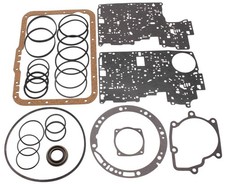
Rebuilding an A4LD or its 4R44E successor? CoreTransmissionParts carries master rebuild and overhaul kits. Confirm A4LD or 4R44E, and the year, before you order.
Shop rebuild kits at CoreTransmissionParts →Need parts for this job?
An overhaul kit catalogued for the 1985-1995 A4LD run, plus bushing drivers for the pump and extension housing bushings, all with secure checkout.
Shop A4LD / 4R44E parts → 1985-1995 overhaul kit →FAQ
Is the A4LD based on the C3?
Yes. The A4LD keeps the C3-style three-speed with a forward clutch, a reverse/high clutch, an intermediate band and a rear band, and adds an overdrive band, an overdrive clutch and a lockup converter. Ford lists the same forward clutch snap rings (E860115-S to E860118-S) for both units, and many case torques are identical.
How many quarts does a C3 and an A4LD take?
Ford lists the C3 at 8 U.S. quarts in a 2300 Mustang, with 5 quarts to start after an install and 3 quarts after pan service. The 1993 2.3L Mustang A4LD is about 9.7 quarts dry, including the cooler. Set the final level hot on the dipstick and do not overfill.
How do you adjust the bands on a C3 versus an A4LD?
On both, fit a new locknut, tighten the adjusting screw to 10 ft-lb, back it off, then hold the screw and torque the locknut to 35-45 ft-lb. The C3 front band backs off 1-1/2 turns. The A4LD overdrive and intermediate bands each back off 2 turns.
What fluid does the A4LD use?
Ford's 1993 A4LD specifications call for MERCON, WSP-M2C185-A, and the fluid check page lists Motorcraft XT-2-QDX or -DDX (E4AZ-19582-B) or equivalent. Check it at operating temperature, about 150-170 F.
Can I swap an A4LD into a car that had a C3?
Yes, but you need a computer that drives the 3-4 shift solenoid and the TCC solenoid and has the coolant, throttle, speed and brake switch inputs. Without that it runs as a three-speed with no lockup. Check driveshaft length and crossmember position, and plumb the vacuum for the A4LD single-area diaphragm.
Sources
- Ford Motor Company, 1975-1976 Car Shop Manual, Volume V Chassis (FPS 365-126-76A), Part 17-03 C3 Automatic Transmission (archived scan). Backs the C3 description and its Mustang/Pinto/Bobcat 2300/2800 applications; the front band as the only adjustment (10 ft-lb, back off 1-1/2 turns, tool T71P-77370-A); the rear band without struts; the dual-area diaphragm routing; the 8 qt refill and the 5 qt and 3 qt service fills; clutch plate counts and clearances; selective snap rings and thrust washers; transmission and converter end play; and the C3 torque table. archive.org
- Ford Motor Company, 1993 Mustang Workshop Manual, Section 07-01A A4LD: Description, Operation, Electronic Controls and Diagnosis. Backs the PCM control of the 3-4 and TCC solenoids; TCC inhibit modes; the 25 percent overdrive rpm drop; WOT downshift speeds; PCM inputs and EEC-IV codes; the 26-40 ohm solenoid and 0.5 ohm harness tests; the TCC test temperature window; and the road test and stall test procedures. description, operation, electronic controls, pinpoint tests, diagnosis
- Ford Motor Company, 1993 Mustang Workshop Manual, Section 07-01A A4LD: Specifications and Fluid Check. Backs the A4LD torque table; the 2-turn overdrive and intermediate band back-off; clutch counts and clearances; selective snap rings and thrust washers; transmission and converter end play; vacuum diaphragm part numbers; the 2,495-2,885 rpm stall speed; the 9.7 qt capacity; MERCON WSP-M2C185-A; and the XT-2-QDX/DDX fluid and level check. specifications, fluid check
- ATRA, Automatic Transmission Gear Ratio Chart (bulletin 2006-01_58, PDF). Backs the A4LD ratios of 2.47, 1.47, 1.00 and 0.75, and reverse at 2.10. ATRA (PDF)
- Transmission Digest, Gregg Nader (Sonnax TASC Force), "A4LD/4R44E: Ford 4.0-Liter Crank-Spacer Puzzle". Backs the powdered-metal crank spacer wear, the 0.083 in. to 0.106 in. flexplate change (F1TZ-6375-BA) and the long converter pilot. transmissiondigest.com
- Sonnax, "Ford 4R44E, 5R44E, 4R55E, 5R55E Valve Body Layout". Backs the 56001X bellhousing/pump cover bushing dimensions and A4LD fitment, and the A4LD-listed retaining pin 56947-11. sonnax.com
Shop at CoreTransmissionParts →