The C4 vs C6 question usually shows up on the bench as a core with no paperwork. A Mustang, Falcon or early Bronco owner wants to know if the C6 out of a parts truck will take more abuse. A truck owner with a tired C6 wonders if the lighter C4 is good enough. Both are Ford three-speed automatics from the same era, they shift alike, and they look alike from ten feet away. Inside, they hold first and reverse in two different ways, and that one design choice explains most of the difference in strength.
The specs below come from Ford's own 1975-76 Car Shop Manual (Group 17, the C4 and C6 sections) and the 1987 Ford light truck shop manual, both scanned on archive.org. Upgrade-part details come from Sonnax. Everything is listed under Sources.

The Short Version
| Item | Ford C4 | Ford C6 |
|---|---|---|
| Duty rating | Medium duty: sixes, small-blocks, light cars | Heavy duty: big-blocks, trucks, diesel and towing |
| Forward ratios | 2.46 / 1.46 / 1.00 (commonly published) | 2.46 / 1.46 / 1.00 (commonly published) |
| Holds low and reverse with | Low-reverse band and servo | Multi-plate low-reverse clutch |
| Bands | Two: intermediate and low-reverse | One: intermediate only |
| Converter housing | Separate, bolted to the case | Cast into the case |
| Band adjustment (Ford) | 10 ft-lb, back off 1-3/4 turns (intermediate) and 3 turns (low-reverse) | 10 ft-lb, back off 1-1/2 turns (intermediate) |
| Refill capacity, 1975-76 cars | 7-1/4 to 10-1/4 qt by model | 12-1/4 qt, all models |
| Transmission end play | 0.008-0.042 in | 0.008-0.044 in |
Everything in the table except the gear ratios and duty rating comes straight from the Ford 1975-76 Car Shop Manual specification pages for each unit [1]. The ratios are the commonly published Ford figures for both units, and they are why a C4-to-C6 swap is never a gearing decision.
The Real Difference: Band vs Clutch for Low and Reverse
Both units use a Simpson gearset with a forward clutch, a reverse-high clutch, an intermediate band and a one-way clutch for first. Ford describes the C4 as a torque converter, planetary gear train, "two multiple disc clutches, a one-way clutch" and a hydraulic control system [1]. The low-reverse band is what holds the rear planet carrier in manual low and reverse.
The C6 drops that second band. Ford's description is plain: "Only one (intermediate) band is used in the C6 transmission" [1]. The C6 holds the reverse carrier with a multi-plate low-reverse clutch instead, and Ford notes that the fixed splines for the low-reverse clutch steels are cast integrally into the case, along with the converter housing [1]. The 1987 truck manual has the low-reverse pack going in with a wave plate next to the piston, then alternating steels and frictions [2].
Why that matters on the street: a band wraps a drum and holds with a narrow strip of friction. A clutch pack spreads the load over several full plates. Reverse with a heavy trailer, or a hard launch in manual low, puts the most torque the transmission ever sees through that one holding member. On a C4, that load lands on a band and a small servo. On a C6, it lands on a clutch pack splined into a heavy case. That is the main reason Ford built the C6 for big-block cars and trucks.
Clutch plate counts from Ford
The plate counts are closer than most people think. Ford's 1975-76 tables list these by model code [1]:
- C4 forward clutch: 3 steels and 4 frictions (PEB), or 4 steels and 5 frictions (PEA, PEE, PEF). Free pack clearance 0.025-0.050 in.
- C4 reverse-high clutch: 3 and 3 (PEB) or 4 and 4 (PEA, PEE, PEF). The light-car PEJ codes run as few as 2 steels and 2-3 frictions.
- C6 forward clutch: 2 steels and 3 frictions (PGD, PJA) or 3 and 4 (PGB, PJC, PJD).
- C6 high clutch: 3 and 3 on most codes, 4 and 4 on later PJC suffixes.
- C6 low-reverse clutch: 4 and 4 (PJA, PGD) or 5 and 5 (PGB, PJC, PJD).
So a heavy-car C4 actually carries more forward-clutch plates than some C6 codes. The C6's edge is the low-reverse clutch, a bigger case and heavier hard parts, not a bigger plate count everywhere. When you rebuild either one, count what came out and match the kit to the model code on the tag. Do not assume.
Identifying the Unit on the Car
The fastest check under the car is the band adjusters. A C4 has two external adjusting screws, one for each band. A C6 has only the intermediate band adjuster. The second check is the bellhousing: on a C4 the converter housing is a separate piece bolted to the case, while the C6 converter housing is part of the case casting [1].
For the exact model, read the tag. On both units Ford puts the identification tag under the lower front intermediate servo cover bolt. The first line shows the model prefix and suffix, and a number after the suffix means internal parts were changed after production started [1]. C4 prefixes in the 1975-76 manual start with PE (PEA, PEB, PEE, PEF, PEJ), and C6 prefixes with PG or PJ (PGB, PGD, PJA, PJC, PJD) [1]. That prefix is what parts catalogs key on.
Service Specs Side by Side
Band adjustment
Both units adjust from outside the case, and Ford uses a pre-set 10 ft-lb click wrench for both. Remove and throw away the old locknut, put on a new one, run the adjusting screw to 10 ft-lb, then back it off exactly [1]:
- C4 intermediate band: 1-3/4 turns.
- C4 low-reverse band: 3 full turns.
- C6 intermediate band: 1-1/2 turns. The 1987 truck manual still gives the same 1-1/2 turns [2].
Ford's C6 section calls the intermediate band "the only adjustment on the transmission" [1]. A C4 that slips or flares into reverse, or into manual low, gets its low-reverse band checked first. A C6 with the same complaint means pulling the pan and looking at the low-reverse clutch, because there is nothing to adjust.
End play and converter checks
Ford lists C4 transmission end play at 0.008-0.042 in, and the C6 at 0.008-0.044 in, both set with selective thrust washers [1]. Turbine and stator end play on the converter is 0.023 in max new or rebuilt and 0.050 in max used for the C4, and 0.021 in max new and 0.040 in max used for the C6 [1]. Check end play before teardown. It tells you whether the thrust washers and bushings are worn before the unit is apart.
Fluid and capacity
Ford's 1975-76 refill table lists the C4 at 7-1/4 qt in Pinto, Bobcat and Mustang applications, 7-3/4 to 8-3/4 qt in Maverick, Comet, Granada and Monarch, and 10-1/4 qt behind the 351 in Torino, Montego, Cougar, Elite and full-size cars. The C6 is 12-1/4 qt for all models [1]. When filling a dry transmission and converter, Ford says to start with 5 qt in a C4 and 8 qt in a C6, then set the level on the dipstick [1].
Fluid type depends on the year. Early C4 and C6 units were filled with Ford's Type F friction-modified fluid, which SAE paper 680037 documents as Ford's fill-for-life ATF of that era [5]. By 1987, Ford's C6 overhaul procedure calls for soaking new frictions in DEXRON II Series D (ESP-M2C166-H, XT-2-QDX) [2]. Follow the owner manual or dipstick marking for the year. Do not mix Type F into a later unit just because it is a C6, and do not assume a 1960s C4 wants modern fluid without checking what is in it.
Shop the part for this fix: C6 master rebuild kit
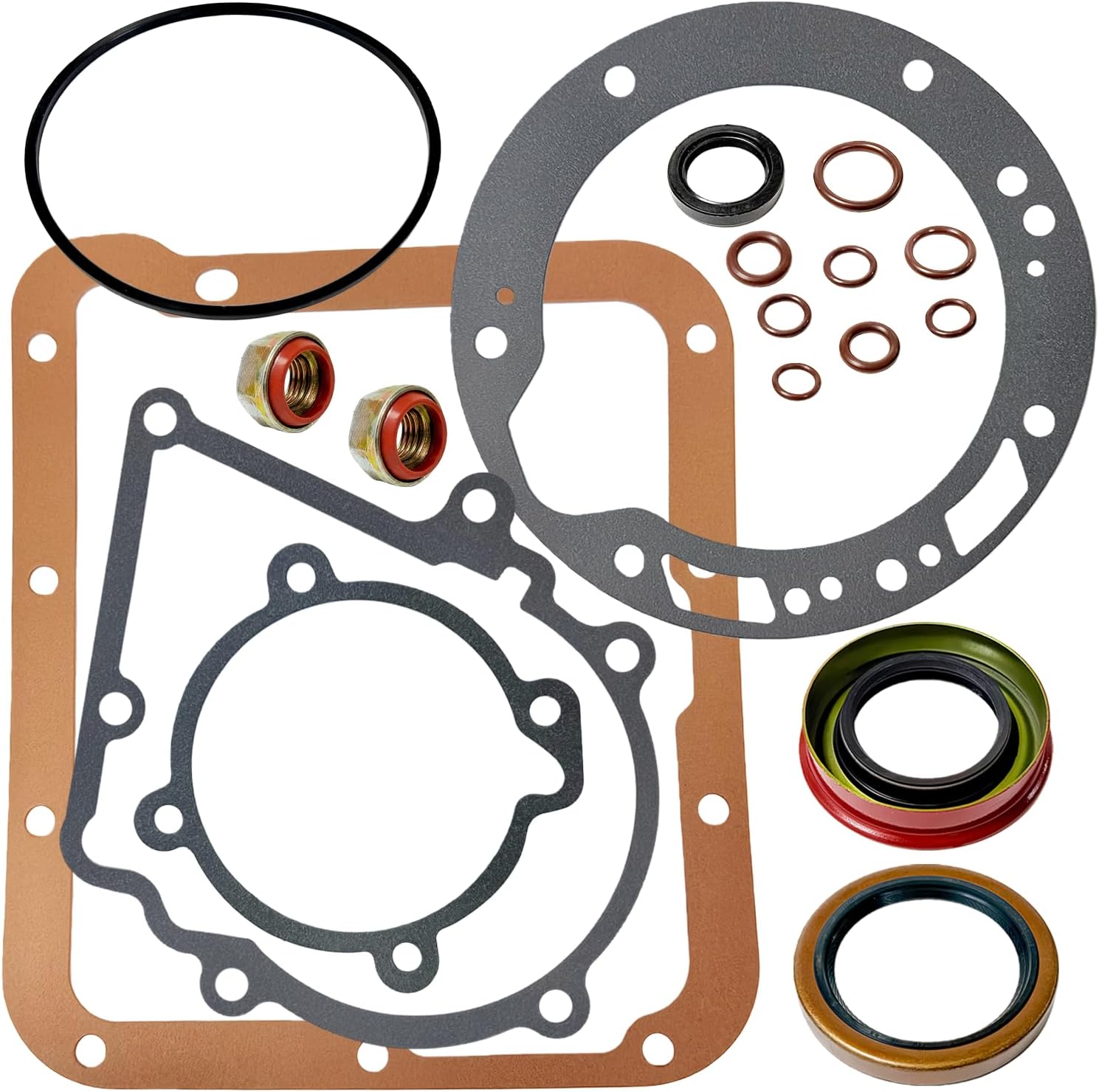
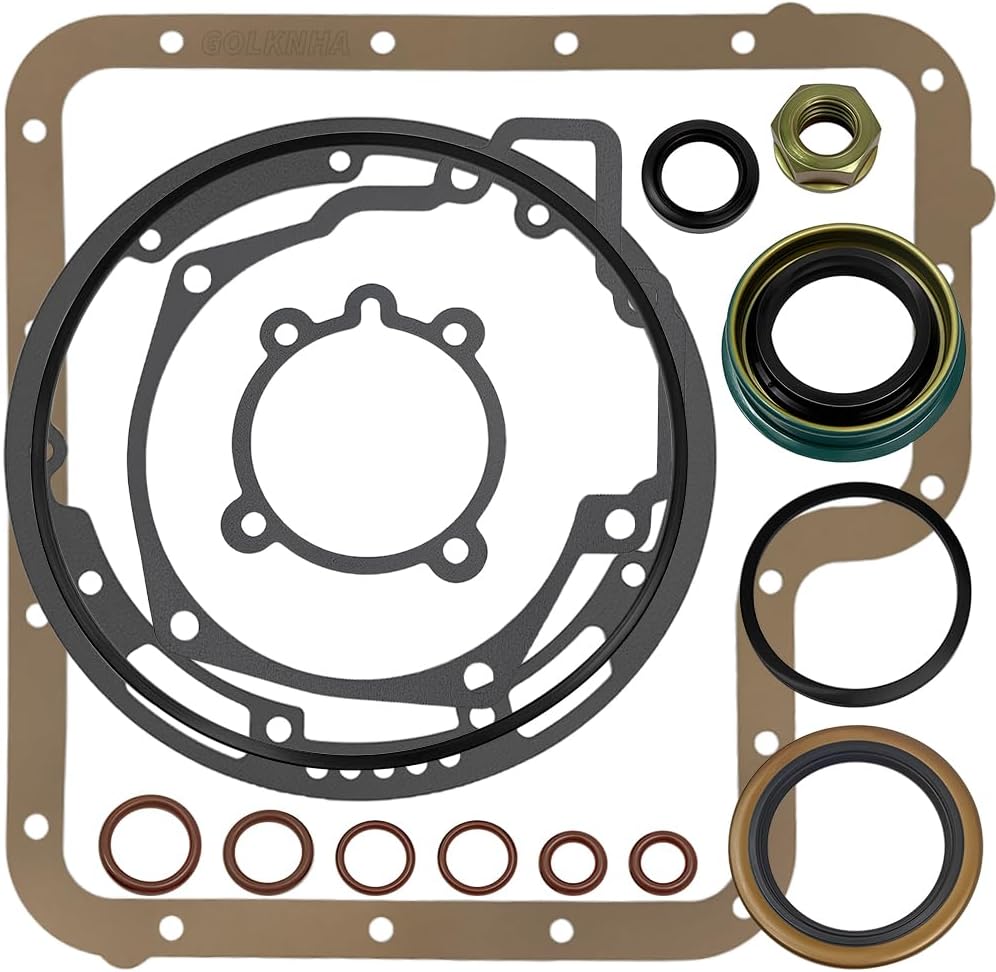
Rebuilding a tired C6 instead of swapping? This master kit covers the 1976-1996 C6 with gaskets, seals and frictions in one box. C4 and other Ford kits are in the CTP rebuild kits collection.
View the C6 master rebuild kit →Browse all transmission rebuild kits.
Where Each One Fails
C4:
- Intermediate band and servo. The stock servo has limited apply area, so a C4 behind more power tends to flare on the 2-3 shift and wear the band. Ford used different intermediate servo covers by engine, identified A, B and R in the 1975-76 manual [1]. Sonnax sells a "C" ratio servo kit (K13259C) for the C4 and C5, which it describes as the largest in the C4 servo family, giving more holding power and firmer 1-2 and 2-3 shifts [3].
- Low-reverse band. Out of adjustment or worn, it shows up as slip in reverse or manual low. Check the 3-turn adjustment before condemning the unit.
- Light-duty codes. The PEJ codes Ford built for small cars have the thinnest clutch packs in the table [1]. A light-car core is the wrong starting point for a V8 build.
C6:
- Intermediate band. It is the only band, and it holds second gear. Sonnax sells a 2-1/4 in extra wide band (S026968) with heavy-duty friction for 1966-later C6 units, and an "R" ratio servo piston kit for mid-1968 and later units [4].
- Low-reverse clutch. Burned low-reverse plates give slip in reverse and manual low. The fix is in the pan and the case, not an adjustment.
- Weight and parasitic loss. The C6 is a big, heavy unit, and in a light car it costs some performance that a C4 does not. That is a real reason people choose the C4 for drag cars.
Swapping a C4 for a C6
Because the ratios match, a swap is about fit and strength. Plan for:
- A C6 case with the correct bellhousing pattern for the engine. The C4's bolt-on converter housing made it easy to change patterns. The C6 housing is part of the case [1], so the core has to match the engine family.
- A converter, flexplate and starter that match the C6.
- A different crossmember position and driveshaft length, because the C6 is longer.
- Shift linkage, kickdown linkage and cooler lines for the C6.
- The output yoke. C4 and C6 output shafts are not the same, so the driveshaft slip yoke changes too.
So Which One Should You Run?
Run the C4 in a light car with a six or a mild small-block, or in a drag car where weight and rotating mass matter and the builder will upgrade the servo, band and clutch packs. It is the lighter and freer-revving unit, and with the right parts it is strong enough for a lot of street small-blocks.
Run the C6 in anything that tows, any truck, any big-block, and any car that will see hard launches or heavy reverse loads. Its low-reverse clutch and heavier case are made for that job. If you have a stock C4 that keeps failing in reverse or manual low behind a big engine, the C6 is the cleaner fix.
Need parts for this job?
C4 and C6 reseal kits, valve bodies, shift kits, Type F fluid and bench fixtures for both units. Secure checkout on our site.
Shop C4 and C6 parts →Frequently Asked Questions
Is a C6 stronger than a C4?
Yes, in stock form. The C6 is the heavy-duty unit: it holds low and reverse with a multi-plate low-reverse clutch instead of the C4's low-reverse band, and Ford put it behind big-block cars and trucks. A built C4 can live behind a strong small-block, but a stock C6 starts with more holding capacity.
How can I tell a C4 from a C6 under the car?
Count the band adjusters. A C4 has two, one for the intermediate band and one for the low-reverse band. A C6 has only the intermediate band adjuster on the left side of the case. Both carry a Ford ID tag under the lower front intermediate servo cover bolt, which gives the model prefix and suffix.
Do the C4 and C6 have the same gear ratios?
The forward ratios are commonly published as 2.46, 1.46 and 1.00 for both, so a swap does not change how the car pulls in the forward gears. The swap is about holding capacity, weight and fitment, not gearing.
How much fluid does a C4 or C6 take?
Ford's 1975-76 car shop manual lists the C4 at 7-1/4 to 10-1/4 qt depending on the car and engine, and the C6 at 12-1/4 qt for all models. On a dry unit Ford says to start with 5 qt in a C4 or 8 qt in a C6 and then set the level on the dipstick.
Can I adjust the bands on a C4 or C6 without pulling the pan?
Yes, both adjust from outside the case. Ford torques the adjusting screw to 10 ft-lb, then backs it off 1-3/4 turns for the C4 intermediate band, 3 turns for the C4 low-reverse band, and 1-1/2 turns for the C6 intermediate band. Use a new locknut each time.
Sources
- Ford Motor Company — 1975-1976 Car Shop Manual, Volume V Chassis (FPS 365-126-76A), Group 17: Part 17-01 General Service, Part 17-05 C4 and Part 17-10 C6 Automatic Transmission. Backs the C4 description (two multiple disc clutches and a one-way clutch), the "only one (intermediate) band" C6 statement, the integral C6 converter housing and low-reverse clutch splines, the ID tag location and model codes, the 10 ft-lb and 1-3/4 / 3 / 1-1/2 turn band settings, the clutch plate tables, the end play and converter specs, the refill capacities, the 5 qt and 8 qt dry-fill figures, and the A/B/R intermediate servo covers. archive.org (Ford manual scan)
- Ford Motor Company — 1987 Bronco, Econoline and F-Series Light Truck Shop Manual A, Section 17-10 C6 Automatic Transmission. Backs the C6 intermediate band setting of 1-1/2 turns in 1987, the low-reverse clutch assembly order with the wave plate next to the piston, and DEXRON II Series D (ESP-M2C166-H, XT-2-QDX) for soaking new frictions. archive.org (Ford manual scan)
- Sonnax — C4/C5 "C" Ratio Servo Kit K13259C, and the Sonnax Ford C4 unit page. Backs the C ratio servo as the largest in the C4 servo family, with more holding power and firmer 1-2 and 2-3 shifts. sonnax.com / sonnax.com C4 unit
- Sonnax — C6 Extra Wide Band S026968, and the Sonnax Ford C6 unit page. Backs the 2-1/4 in heavy-duty intermediate band for 1966-later C6 units and the "R" ratio servo piston kit for mid-1968 and later units. sonnax.com / sonnax.com C6 unit
- SAE International — Technical Paper 680037, "ATF-Type F Keeps Pace with Fill-for-Life Requirements." Backs Type F as Ford's fill-for-life automatic transmission fluid of the C4 and C6 era. saemobilus.sae.org