The C6 ran from 1966 into the 1996 model year behind everything from big-block Thunderbirds to 460 Econolines, and Ford changed the fluid it called for more than once in that span. So the two questions every C6 owner asks, how much and what kind, have answers that depend on the vehicle and the year the unit was built. Here is what Ford's own documents say, and how to figure out which rule applies to the unit in front of you.
Short version: 12.0 quarts total in a 2WD truck or van, 13.5 quarts in a 4x4, and whatever fluid is stamped on the dipstick. The details below explain why a pan service takes far less than that, and why putting the wrong one of the two Ford fluids in a C6 is a real problem. Sources are numbered and listed at the bottom.
C6 fluid capacity by vehicle
Ford published C6 refill capacities in its owner guides. The two late-production guides that still cover the C6 give these numbers:
| Vehicle (Ford owner guide) | C6 capacity | Fluid Ford lists |
|---|---|---|
| 1996 F-150/250/350 and Bronco, 4x2 | 12.0 qt (11.4 L) | Motorcraft MERCON, XT-2-QDX |
| 1996 F-150/250/350 and Bronco, 4x4 | 13.5 qt (12.8 L) | Motorcraft MERCON, XT-2-QDX |
| 1996 Econoline and Club Wagon | 12.0 qt (11.4 L) | Motorcraft MERCON, XT-2-QDX |
| 1975-76 Ford and Mercury cars, all C6 models (Ford car shop manual) | 12-1/4 qt (10-1/4 Imp. qt) | See the fluid section below |
The 1975-76 car figure comes from the Ford Car Shop Manual's C6 specification page, which lists one refill capacity for every car model, against 7-1/4 to 10-1/4 qt for the lighter C4 depending on car and engine [9]. The same manual tells you how to start a dry unit: put 8 quarts into a dry C6 and converter, then bring it to the mark using the dipstick check [9].
The F-Series figures come from Ford's 1996 F-150/250/350 and Bronco owner guide [1]. The Econoline figure comes from the 1996 Econoline owner guide, which lists the C-6 at 12.0 quarts next to the 4R70W at 13.9 and the E4OD at 15.7 [2]. Both guides carry the same footnote on the transmission line: always use the automatic transmission fluid dipstick to determine the exact fluid requirement [1][2].
The 4x4 number runs 1.5 quarts higher than the 4x2 and the van. The pan and valve body are the same C6 parts either way, which is why a pan service takes about the same amount on any of them. The difference shows up only on a dry fill after a rebuild.
Older cars and trucks with a C6 will be in the same neighborhood, but do not read these numbers as exact for a 1968 Galaxie or a 1979 F-250. Converter size, cooler size and aftermarket deep pans all move the number. Treat the table as the ballpark and the dipstick as the answer.
Total fill vs what a pan service takes
That 12.0 or 13.5 quart figure is a dry fill: empty case, empty converter, empty cooler and lines. You will only ever put that much in after a rebuild. A service leaves a lot behind.
- Torque converter. The converter holds a big share of the total. On a fresh install, B&M's C6 instructions say to pour 1 quart into the converter before it goes on the input shaft [7], which keeps the pump from running dry on first start. The rest of the converter fills once it is running.
- Initial fill after an install. The same B&M procedure starts with 5 quarts through the dipstick tube, then adds fluid with the engine running until the level is right [7].
- Pan drop. A standard C6 pan with no drain plug gives up the fluid in the pan and some from the valve body. In the shop, a pan-and-filter service on a stock pan usually takes 5-7 quarts to bring back to the full mark. Buy 8 so you are not short.
If you want most of the old fluid out, B&M notes that Ford converters have drain plugs lined up with access holes in the flexplate [7]. Pull the converter plug and you are much closer to the full-capacity number. Otherwise, two pan services a few hundred miles apart do a decent job of diluting old fluid. Our C6 fluid change cost guide covers the pan service itself, filter kits and the band adjustment you should do while the pan is off.
Which fluid: Type F, CJ, H or MERCON
This is the part that trips people up, because "C6" does not tell you the fluid. The year the unit was built does. ATRA's Gears Magazine laid out Ford's fluid history [5]:
| Ford spec | Introduced | What changed |
|---|---|---|
| Type F, ESW-M2C33-F | 1967 | Written as a "lifetime" fill that would never need changing. No friction modifier |
| Type CJ, M2C138-CJ | 1974 | Second-generation factory fill with more friction modifier for smoother shifts |
| Type H, ESP-M2C166-H | 1980s | Released to calm driveline vibration from the C5's centrifugal lock-up converter |
| MERCON | 1987 | Service fluid spec matching Type H performance |
| MERCON V | Later; MERCON licenses ended 2007 | Replaced MERCON in service. Ford ended all MERCON licenses in favor of MERCON V in 2007 |
Ford's own overhaul procedure shows the Type H era on the C6. The 1987 light truck shop manual tells the builder to soak new composition plates for the low-reverse clutch for fifteen minutes in DEXRON II Series D (ESP-M2C166-H, XT-2-QDX) before installing them [10]. That is the same ESP-M2C166-H spec as Type H in the table above.
By the last C6 model year, Ford's lubricant tables for both the F-Series and the Econoline list the C6 automatic transmission with Motorcraft MERCON Automatic Transmission Fluid, part XT-2-QDX, specification MERCON [1][2]. The Econoline table lists that same XT-2-QDX MERCON for the power steering reservoir too [2].
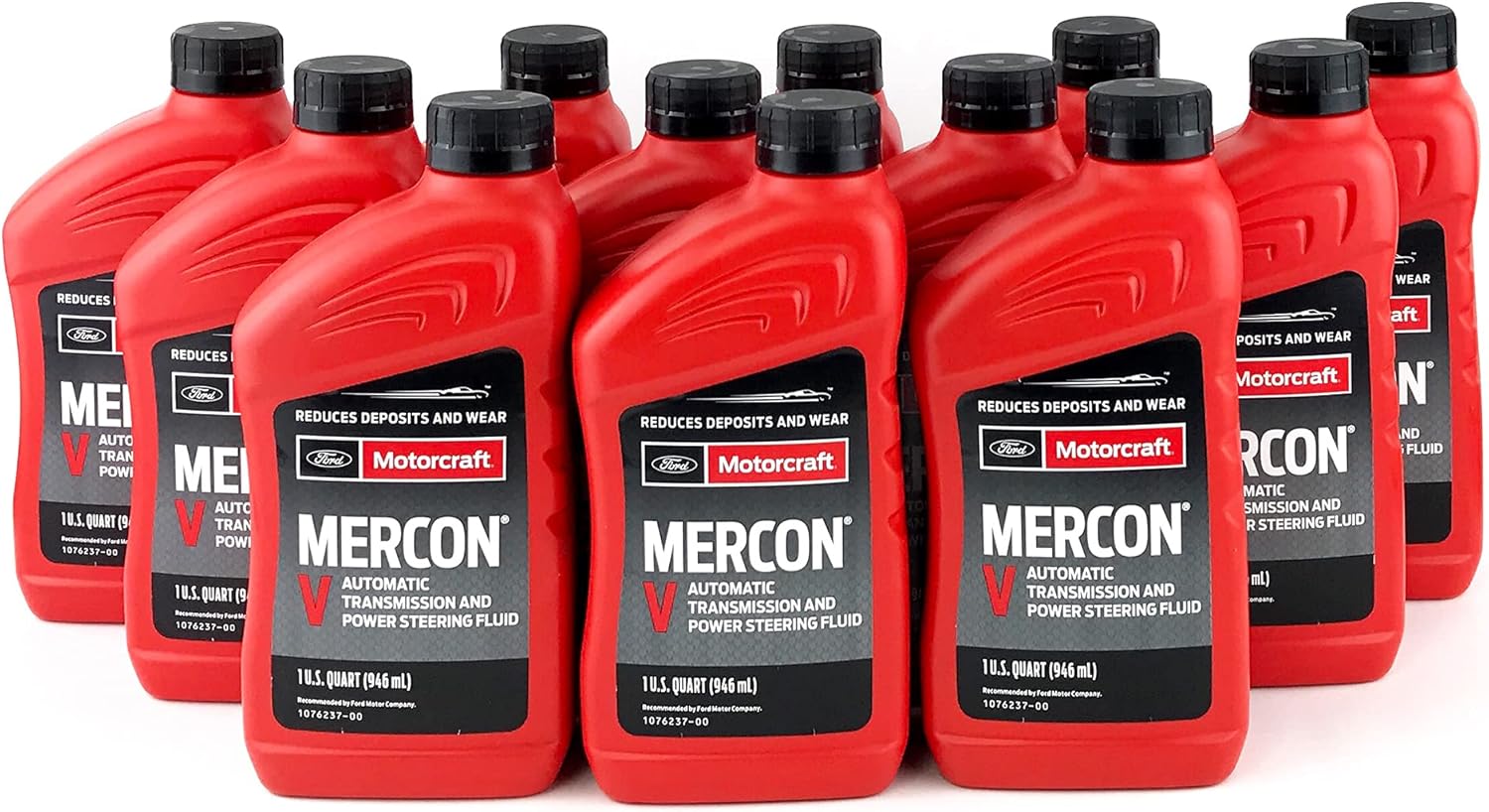
Plain MERCON is no longer made, so a late C6 gets MERCON V. Ford's Motorcraft MERCON V product sheet says it is for systems previously serviced with MERCON, and also says not to use it where Type F is recommended [3].
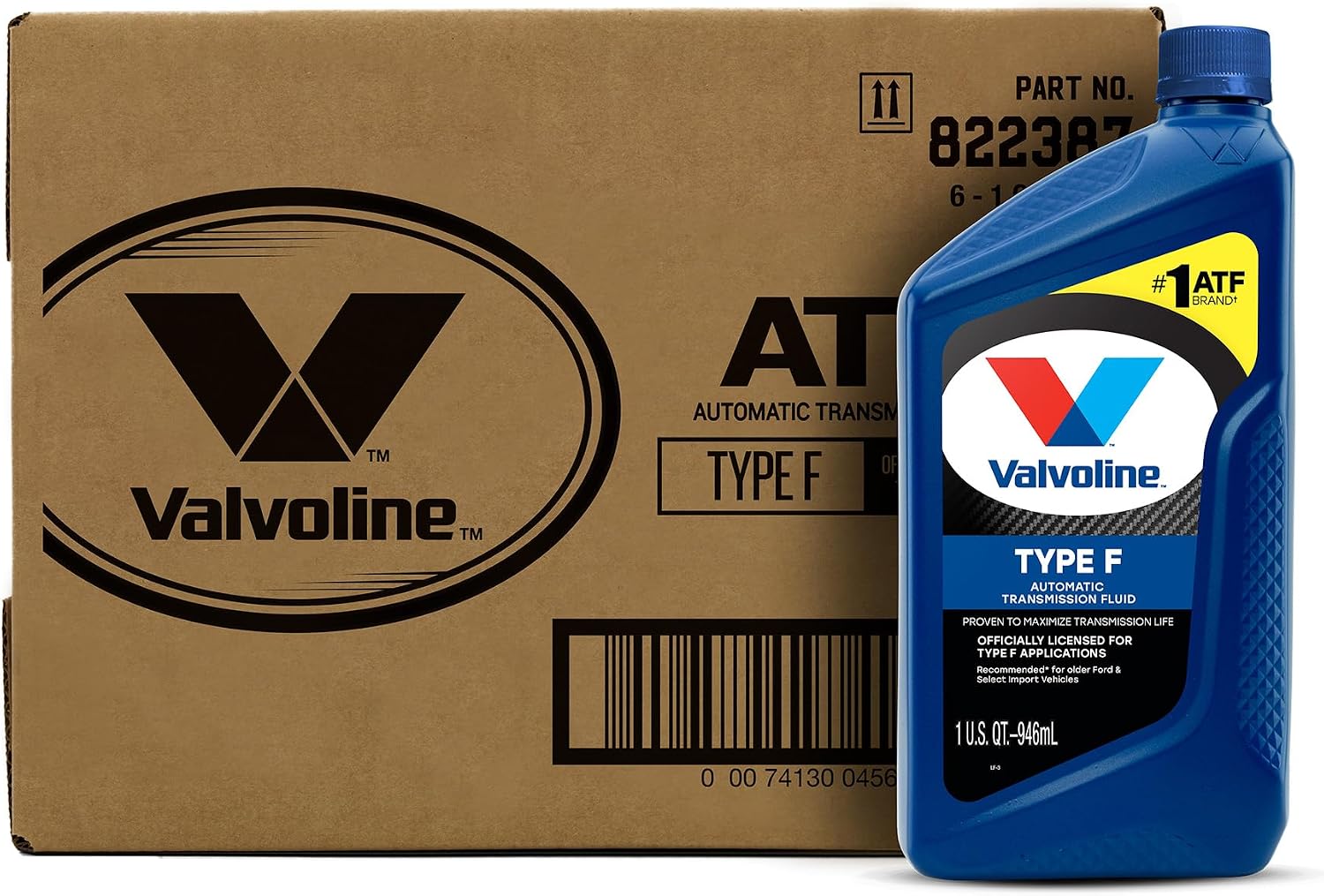
Early C6 units are the other side. Ford still sells Motorcraft Type F, part XT-1-Q1F, spec ESW-M2C33-F, and says it is recommended for Ford automatic transmissions built in the 1970s and earlier. Ford's sheet also says not to use it in newer transmissions that require MERCON V or later MERCON fluids [4].
Why the two fluids are not interchangeable
Gears Magazine points out that nearly all ATFs contain friction modifiers except those made for some Ford transmissions [5]. Type F is the unmodified one. It lets the clutch packs and band grab harder and quicker, and the friction material in a unit built for Type F was chosen to work with that grip.
Put a friction-modified MERCON V in a Type F unit and the shifts get softer and longer. On a tired C6 that can show up as a slipping or flaring 1-2 shift, which is hard on the intermediate band. Go the other way and put Type F in a unit built for CJ or MERCON, and you get a harsher, more abrupt shift and more shock loading on the band, clutches and driveline. Neither choice ruins a transmission in a day, but both work against the unit.
A lot of people put Type F into later C6 units on purpose to firm up the shifts. That is a shift-feel choice, not a fix. If the unit is slipping on the correct fluid, fluid is not the cure. See our C6 common problems guide.
How to tell which fluid your C6 needs
Work down this list and stop at the first one you can trust.
- The dipstick. Ford's owner guides say the fluid type is stamped on the dipstick, and to confirm it before adding any fluid [1][2]. If the original dipstick is still in the tube, that stamp is Ford's answer.
- The transmission identification tag. C6 units carry a metal ID tag under the lower front intermediate servo cover bolt, with the model prefix and suffix (PGB, PGD, PJA, PJC, PJD and so on) and the build date code [9]. Use it to date the transmission itself, not the truck. C6 transmissions get swapped constantly, so a 1985 truck can easily be running a 1974 unit or the reverse.
- The build year of the unit. Units built in the Type F era, the early 1970s and before, should get Type F. Owners on Ford enthusiast forums commonly date the C6 friction-material and fluid change to a mid-1976 production cutover, ahead of the 1977 model year [8]. From that point on, the unit was built for CJ, then H, then MERCON, and gets MERCON V today.
- A rebuilt unit. If the C6 has been rebuilt, the friction material in it is whatever the builder used. Ask, or check the paperwork. Many builders fill a rebuilt C6 with MERCON V regardless of the case date, and if that is what the unit was built and broken in on, stay with it.
If you truly cannot tell, look at how it has been running. A unit that has shifted well for years on what is in it is telling you something. Match what is already in there rather than switching fluid type in the middle of its life.
Checking the level correctly
The C6 has no fill plug and no computer to tell you anything. The dipstick is the only gauge you have, so read it right. Ford's own C6 technician training said the fluid has to be at normal operating temperature for an accurate reading, and to run the engine at fast idle, about 1200 rpm, until it gets there [6]. Ford's 1996 owner guides spell out the rest [1][2]:
- Normal operating temperature is 150-170°F (66-77°C), after about 20 miles of driving. If it is above 50°F outside, you can check without the full drive.
- Park on level ground, start the engine, move the selector through every range, then latch it in Park with the parking brake set. Leave it running.
- Hot, the level belongs in the crosshatched area. Not driven, with outside temperature above 50°F, it belongs between the holes.
- Add fluid in 1/2-pint (0.25 L) increments through the filler tube. Ford says not to drive the vehicle if the level is below the bottom hole and outside temperature is above 50°F.
- After towing, sustained high speed or hot-weather city driving, shut the engine off for about 30 minutes before checking.
Overfilling is not a safety margin. B&M warns that too much fluid causes foaming, shift problems and fluid pushed out the vent [7]. A C6 that is spitting fluid from the vent after a service has usually been overfilled or checked cold.
Deep pans, coolers and capacity
A deep aftermarket pan adds capacity and usually a drain plug, which makes future services cleaner. If you add one, the factory capacity numbers no longer apply, and the dipstick may need to be matched to the pan. Fill to the dipstick, not to a number.
An auxiliary cooler adds fluid volume too, and it is the single best thing you can do for a C6 that tows. If the transmission is ever replaced or rebuilt, B&M says to flush and flow-check the cooler and lines, and to replace any auxiliary cooler, because debris trapped in them will contaminate the new unit [7].
Shop the part for this fix: C6 filter and gasket kit
There are two C6 filter kits, split by build year. CoreTransmissionParts stocks the OEM 60906 filter and gasket kit for 1975-1996 units and the 60905 kit for 1966-1974 units, so match the kit to the build year of the transmission.
View the 1975-1996 C6 filter kit at CoreTransmissionPartsEarlier unit? The 1966-1974 C6 filter kit is the one to get.
Need parts for this job?
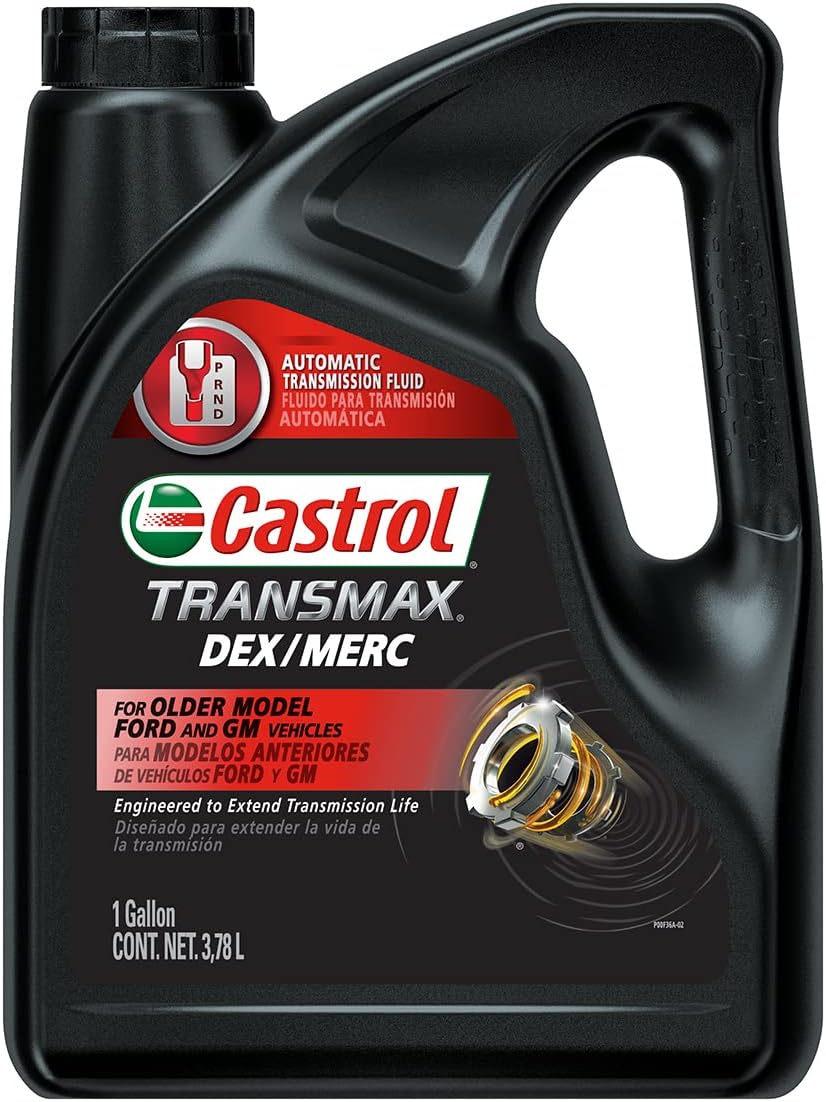
Our parts shop carries Motorcraft MERCON V, a MERCON-rated Castrol and Valvoline Type F on our own checkout, along with C6 rebuild kits and valve bodies. Read the dipstick before you order: Type F for early units, MERCON V for everything built for CJ, H or MERCON. For a side-by-side of Ford fluid specs, see our transmission fluid spec chart.
FAQ
How many quarts of transmission fluid does a Ford C6 hold?
Ford lists the C6 at 12.0 quarts (11.4 L) in 1996 4x2 F-Series trucks and in the 1996 Econoline, and 13.5 quarts (12.8 L) in 4x4 F-Series trucks. Those are total dry-fill numbers including the torque converter. A pan drop only replaces part of that, so plan on roughly 5-7 quarts and finish with the dipstick.
What type of transmission fluid does a C6 use?
It depends on when the unit was built. Early C6 transmissions were designed around Ford Type F, while later units moved to Type CJ, Type H and then MERCON. By 1996 Ford specified Motorcraft MERCON (XT-2-QDX) for the C6. Today MERCON V replaces MERCON, and Motorcraft Type F (XT-1-Q1F) is still sold for units that call for it.
Can I use MERCON V in a C6 that calls for Type F?
Ford says no. Its Motorcraft MERCON V product sheet says not to use it where Type F is recommended, and the Type F sheet says not to use Type F where MERCON V is required. Type F has no friction modifier and grips harder, so swapping one for the other changes how the clutches and band apply.
How do I tell which fluid my C6 needs?
Start with the dipstick. Ford's owner guides say the fluid type is stamped on it. If the dipstick has been replaced or is unreadable, go by the transmission's identification tag and build date rather than the vehicle's title year, since C6 units are often swapped between trucks.
Related guides
Sources
- Ford Motor Company, 1996 F-150/250/350 and Bronco Owner Guide: Checking the Automatic Transmission Fluid, Refill Capacities and Lubricant Specifications. Backs the C-6 capacities of 12.0 qt (11.4 L) 4x2 and 13.5 qt (12.8 L) 4x4, the dipstick footnote, Motorcraft MERCON XT-2-QDX for the C6, the fluid-type stamp on the dipstick, and the level check procedure. The original fordservicecontent.com host now blocks automated requests with a 403, so this cites a November 2025 archived capture of the same Ford PDF. web.archive.org
- Ford Motor Company, 1996 Econoline and Club Wagon Owner Guide: Refill Capacities (p. 354), Lubricant Specifications (p. 358) and Checking the Automatic Transmission Fluid (pp. 323-324). Backs the C-6 capacity of 12.0 qt (11.4 L) vs 13.9 qt for the 4R70W and 15.7 qt for the E4OD, Motorcraft MERCON XT-2-QDX for the C6, the 150-170°F check temperature and 1/2-pint add increments. The original fordservicecontent.com host now blocks automated requests with a 403, so this cites a November 2025 archived capture of the same Ford PDF. web.archive.org
- Ford Customer Service Division, Motorcraft MERCON V Automatic Transmission and Power Steering Fluid product sheet. Backs MERCON V for systems previously serviced with MERCON and the warning not to use it where Type F is recommended. fcsdchemicalsandlubricants.com
- Ford Customer Service Division, Motorcraft ATF Type F (XT-1-Q1F, ESW-M2C33-F) product sheet. Backs Type F for Ford automatics built in the 1970s and earlier, and the warning not to use it where MERCON V or newer MERCON fluids are required. fcsdchemicalsandlubricants.com
- Pat Burrow, "Fluid Matters," Gears Magazine (ATRA). Backs the Type F (1967), CJ (1974), Type H and MERCON (1987) history, the 2007 end of MERCON licensing in favor of MERCON V, and the note that nearly all ATFs contain friction modifiers except some Ford fluids. gearsmagazine.com
- Ford Motor Company, The C6 Automatic Transmission, Registered Technician Programmed Instruction Book (Forel Publishing reprint, sample pages). Backs the requirement to check fluid at normal operating temperature, warmed at a fast idle of about 1200 rpm. forelpublishing.com
- B&M (Holley), installation instructions for B&M transmissions replacing the Ford C6 (114202/114203). Backs the 1 quart converter pre-fill, 5 quart initial fill, running level check, overfill warning, Ford converter drain plugs and cooler flush guidance. documents.holley.com
- Ford Motor Company, 1975-1976 Car Shop Manual, Volume V Chassis (FPS 365-126-76A), Part 17-01 General Transmission Service, Part 17-05 C4 and Part 17-10 C6 Automatic Transmission. Backs the 12-1/4 qt C6 refill capacity for all 1975-76 car models, the 7-1/4 to 10-1/4 qt C4 comparison, the 8 quart dry-fill start for a C6, and the ID tag location and model prefixes. archive.org (Ford manual scan)
- Ford Motor Company, 1987 Bronco, Econoline and F-Series Light Truck Shop Manual A, Section 17-10 C6 Automatic Transmission. Backs the instruction to soak new low-reverse composition plates in DEXRON II Series D (ESP-M2C166-H, XT-2-QDX) for fifteen minutes. archive.org (Ford manual scan)
[8] The mid-1976 C6 friction-material and fluid cutover date is as reported by owners on Ford enthusiast forums, not a Ford document. Treat it as a guide and confirm against your unit's tag and dipstick.