The short answer: a 4R70W takes MERCON V, and Ford lists the dry-fill capacity at 13.2 L (13.9 quarts) in both the F-150 and the Crown Victoria. The police and handling package Crown Vic is listed lower, at 12.1 L (12.8 quarts). Those numbers come straight out of Ford's owner guides, and they're the right place to start. They are not the number you'll pour in on a pan drop, though, and the dipstick has the final say over any capacity chart.
This guide covers what Ford actually specifies, how the MERCON-to-MERCON V change affects older units, how much fluid to expect on each kind of service, the hot-check procedure, and when the fluid really needs changing. Every spec here is tied to a Ford or industry source listed at the bottom.


The Ford spec: MERCON V
Ford's 2003 F-150 owner guide makes the distinction clearly. In the same truck line, the 4R100 automatic calls for Motorcraft MERCON ATF (part XT-2-QDX), while the 4R70W calls for Motorcraft MERCON V ATF, part XT-5-QM, meeting the MERCON V specification. The 2003 Crown Victoria guide lists the same fluid for its 4R70W.
Both guides carry the same warning footnote from that era: MERCON and MERCON V are not interchangeable, and do not mix them. The Crown Vic guide also tells you where to look when you're unsure: the fluid requirement is printed on the transmission dipstick or dipstick handle. On a used unit that has had a transmission swapped in, that stamp is the tiebreaker, not the model year of the car.
What about early 4R70W units that called for MERCON?
This is where people get tangled up, because the old "don't mix" warning is still printed in millions of glove boxes. The history, per GEARS Magazine (the ATRA technical publication):
- Ford released the MERCON specification in 1987, largely to deal with torque converter clutch shudder that the DEXRON fluids of the day didn't solve.
- MERCON V came next, developed for modulated and continuously slipping converter clutches, with new tests aimed at anti-wear performance and anti-shudder durability.
- Before 2007, the MERCON V spec was revised to be backward compatible with MERCON, and in 2007 Ford ended all license agreements for MERCON in favor of MERCON V.
Ford's own service parts literature matches that. The Motorcraft MERCON V product page lists it for Ford, Lincoln and Mercury vehicles that require MERCON V or MERCON type fluid, including transmissions previously serviced with MERCON. So an early 4R70W with a MERCON dipstick gets MERCON V today. You can't buy licensed MERCON anymore anyway.
Ford put that in writing for the service trade. Technical Service Bulletin 06-14-4 (2006, superseding TSB 01-15-7) is titled "MERCON ATF is being replaced by MERCON V ATF as a service fluid," and its application list covers the 4R70W years directly: 1980-1997 Crown Victoria, Grand Marquis and Town Car, 1981-1997 Mustang and Thunderbird, 1993-1997 Mark VIII and 1981-2003 F-150. Per the bulletin, transmissions that require MERCON can be serviced with MERCON V, MERCON or a dual-labeled MERCON/MERCON V fluid, and MERCON would no longer be manufactured after July 1, 2007. The same bulletin carries the one-way caution: a unit that requires MERCON V should still get only MERCON V or a dual-labeled fluid, never plain MERCON. It also says not to use ATF supplements, additives, treatments or cleaning agents.
What not to put in it
Motorcraft says MERCON V is not for applications calling for MERCON LV, MERCON SP, MERCON ULV, Type F or CVT chain-type fluid. The reverse applies too: those fluids aren't the spec for a 4R70W. LV and ULV are for later Ford six- and ten-speeds, and Type F is for the old pre-MERCON units. If a customer's truck has been getting whatever universal jug was on sale, that's worth writing on the repair order.
Ford's owner guides also say not to use supplemental transmission fluid additives, treatments or cleaning agents, warning they can affect operation and damage internal components. A shift that only feels right with a bottle of additive in it points to a mechanical problem, and the additive just delays the diagnosis.
What MERCON V actually is
The Motorcraft MERCON V product data sheet gives the typical properties. These are handy when you're comparing a licensed aftermarket fluid against the factory fluid:
| Property (Motorcraft MERCON V typicals) | Value |
|---|---|
| MERCON V license number | M5091101 |
| Viscosity at 100°C | 7.5 cSt |
| Viscosity at 40°C | 33.2 cSt |
| Viscosity at -20°C / -40°C | 1,100 cSt / 10,000 cSt |
| Viscosity index | 205 |
| Flash point (COC) | 196°C (385°F) |
| Pour point | below -48°C (-54°F) |
| Specific gravity at 60°F / density | 0.863 / 7.19 lb per gallon |
Current Motorcraft part numbers are XT-5-QMC (quart, sold in cases of 12), XT-5-5Q3M (5-quart jug) and XT-5-DMC (55-gallon drum). If you're using another brand, look for an actual MERCON V license number on the bottle, not just "suitable for use in" language.
Capacity: the Ford numbers and what they mean
| Application (Ford owner guide) | Fluid | Listed capacity |
|---|---|---|
| 2003 F-150, 4R70W automatic | MERCON V (XT-5-QM) | 13.2 L (13.9 qt) |
| 2003 Crown Victoria, 4R70W | MERCON V | 13.2 L (13.9 qt) |
| 2003 Crown Victoria, Police or Handling Package | MERCON V | 12.1 L (12.8 qt) |
| For comparison: 2003 F-150, 4R100 (4x2 / 4x4) | MERCON (XT-2-QDX) | 16.1 L (17.0 qt) / 16.7 L (17.7 qt) |
Read Ford's footnote before you trust any of those numbers. The Crown Victoria guide says the figure is only an approximate dry-fill capacity. Some applications vary with cooler size and whether the car has an in-tank cooler, and the final amount should be set by the dipstick's normal operating range. In other words, 13.9 quarts is roughly what a dry case, empty converter and empty cooler take after an overhaul. It is not what you add after draining the pan.
What you'll actually add on each service
- Pan drop and filter: most of the fluid stays in the converter, cooler and lines. In my bay, a 4R70W pan-and-filter service usually takes back somewhere around 5 to 6 quarts. That's a shop number, not a Ford spec. Start with less than you drained and work up with the dipstick.
- Overhaul with a new or drained converter: plan on the full Ford figure, 13.9 qt (12.8 qt on police and handling package cars), then correct it with a hot check.
- Aftermarket deep pan or added cooler: both add volume. The Ford chart won't cover it. Fill by the dipstick.
Because a pan drop only replaces part of the fluid, a unit with badly oxidized fluid may need a second service a few hundred miles later to get the concentration of fresh fluid up. That is also why I don't recommend "flushing" a neglected high-mileage unit with a machine as a first step. If the old fluid is full of friction material, get the pan down and look at the debris before you decide what the unit needs.
How to check the level correctly
Most 4R70W level complaints are really checking errors. Ford's procedure from the Crown Victoria owner guide:
- Drive about 30 km (20 miles), until the fluid is at normal operating temperature of 66-77°C (150-170°F). If the vehicle has been worked hard (sustained high speed, hot-weather city traffic or towing), shut it off for about 30 minutes to let the fluid cool before checking.
- Park on a level surface and set the parking brake.
- With your foot on the brake, start the engine and move the shifter through every range, giving each gear time to engage.
- Latch the shifter in Park and leave the engine running.
- Pull the dipstick, wipe it with a clean lint-free rag, reinstall it fully seated, then pull it again and read it.
The dipstick has two zones. The upper band is for fluid at 150-170°F, and the lower band is for fluid at ambient temperature, 50-95°F (10-35°C). Ford allows a check without driving if it's above 50°F outside, but warns that adding fluid at that point can cause an overfill once the unit warms up. If you add fluid, do it in 250 ml (1/2 pint) steps through the filler tube and recheck each time.
If you have a scan tool, watch transmission fluid temperature instead of guessing from miles driven. Twenty miles in January and twenty miles towing in August put the fluid in very different places.
Low versus high
Ford says not to drive the vehicle if the level is at the bottom of the dipstick with ambient temperature above 50°F. Low fluid lets the pump draw air, and that shows up as slipping and delayed engagement.
Overfill is the one that gets ignored. Ford's guide says levels above the safe range can cause shift and engagement concerns and possible damage, and that excess fluid should be removed. It also notes that a high reading can be caused by overheating. So if the stick reads high on a unit nobody has touched, check for a cooler or converter problem before you start pulling fluid out.
How often to change it
Ford's 2003 scheduled maintenance guide lists a fluid change on the normal schedule only for the AX4S, 4F50N, 4R100 and 4F27E. For everything else with a dipstick, including the 4R70W, the normal schedule says to inspect the fluid level. Under special operating conditions, Ford calls for changing the automatic transmission fluid every 30,000 miles. Those conditions are:
- Towing a trailer or using a camper or car-top carrier
- Extensive idling or low-speed driving over long distances, such as delivery, taxi, patrol car or livery use
- Driving on dusty or unpaved roads
- Off-road operation
On a bench, that's the right way to think about it. Most 4R70W trucks that come through my door have towed something, and a lot of the Panther-platform cars were fleet, police or livery vehicles. That's severe service. At this age, I treat every 4R70W as a 30,000-mile unit unless I know its history.
When fresh fluid won't fix it
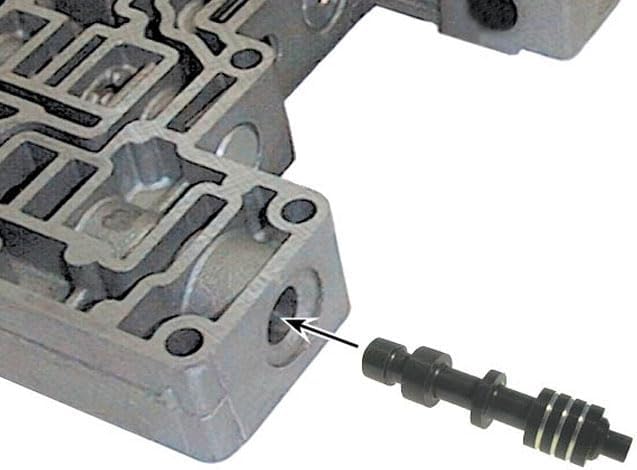
A fluid service is maintenance, not a repair. The classic 4R70W trap is a unit with soft shifts and low line rise that gets a fluid change and comes back in a week. Sonnax documents severe scoring on the EPC end of the pressure regulator valve along with wear in the valve body casting bore. Symptoms include reduced line pressure or low line rise, soft shifts, an erratic buzz, and premature clutch and band failure.
Sonnax's point is that a new valve alone won't fix it if the bore is worn, because the casting can't seal even against a new valve. They recommend a vacuum test to find bore wear you can't see, then reaming the bore for an oversized valve. The OE-style valve part numbers they list are 76948-01 for earlier units and 76948-09 for 1996 and later, with oversized kits 76948-16K and 76948-17K. If line pressure is low with correct fluid at the correct hot level, the valve body is next on the list, not another fluid change.
For more on that side of the unit, see our 4R70W valve body wear guide.
Quick reference
| Item | Spec |
|---|---|
| Fluid | MERCON V (Motorcraft XT-5-QMC / XT-5-5Q3M); also services units originally on MERCON |
| Dry fill | 13.2 L (13.9 qt); 12.1 L (12.8 qt) Crown Victoria Police/Handling Package |
| Hot check temperature | 66-77°C (150-170°F), engine running, in Park, level ground |
| Ambient check band | 10-35°C (50-95°F) |
| Top-off increment | 250 ml (1/2 pint) |
| Severe-service change interval | Every 30,000 miles |
| Additives | Ford says do not use |
4R70W filter kit with pan gasket (FT105, 14-bolt shallow pan)
If you're dropping the pan for a MERCON V service, replace the filter and gasket instead of reusing them. This kit fits the 14-bolt shallow-pan 4R70W. Sold by our sister store, CoreTransmissionParts.
Shop the part for this fix →Need something else? The 4R70W parts collection has pans, gaskets, solenoid kits and rebuild kits.
Need parts for this job?
Our 4R70W parts page carries Motorcraft MERCON V by the case, filter and gasket kits, Sonnax valve body parts, solenoid kits and complete rebuild kits for the F-150, Crown Victoria, Mustang and Explorer units. Checkout is on site.
FAQ
What transmission fluid does a 4R70W take?
Ford specifies MERCON V for the 4R70W. The 2003 F-150 owner guide lists Motorcraft MERCON V, part XT-5-QM, and the current Motorcraft part numbers are XT-5-QMC (quart) and XT-5-5Q3M (5-quart). Early units that originally called for MERCON are also serviced with MERCON V, because Ford made MERCON V backward compatible and ended MERCON licensing in 2007.
How many quarts does a 4R70W hold?
Ford lists 13.2 L (13.9 quarts) as the approximate dry-fill capacity in the F-150 and Crown Victoria, and 12.1 L (12.8 quarts) for the Crown Victoria Police or Handling Package. That is a dry fill with an empty converter and cooler. A pan and filter service takes much less, and the final level is always set with the dipstick hot.
Can I use MERCON LV in a 4R70W?
No. MERCON LV is the specification for later Ford six-speed and ten-speed units, and Ford's spec for the 4R70W is MERCON V. Motorcraft also lists MERCON LV, SP, ULV and Type F applications as places not to use MERCON V, because they are different fluids. Use what the dipstick handle calls for.
How often should 4R70W fluid be changed?
Ford's 2003 maintenance guide only calls for an inspection of the level on the normal schedule for the 4R70W. Under special operating conditions such as towing, long idling or fleet use, dusty roads or off-road driving, Ford calls for a fluid change every 30,000 miles. Most 4R70W vehicles still on the road have seen at least one of those conditions, so 30,000 miles is the practical interval.
Related guides
- AODE Fluid Change Cost
- Ford 4R70W and 4R75W Transmission Problems
- 4R70W vs 4R75W Differences
- AODE vs 4R70W Differences
- 4R70W Valve Body Wear and Fix
- 4R70W Shift Solenoid Symptoms
Sources
- Ford Motor Company, 2003 F-150 Owner Guide, Maintenance and Specifications (refill capacities and lubricant specifications). Backs the 4R70W at 13.2 L (13.9 qt) of Motorcraft MERCON V, part XT-5-QM, and the 4R100 at 16.1/16.7 L on MERCON XT-2-QDX. Ford's own fordservicecontent.com host now blocks direct PDF access (Akamai 403), so this links the Internet Archive's cached copy of the same document. web.archive.org (PDF)
- Ford Motor Company, 2003 Crown Victoria Owner Guide, Maintenance and Specifications. Backs the 13.2 L (13.9 qt) dry fill, the 12.1 L (12.8 qt) Police/Handling Package capacity, the dry-fill and cooler footnote, the dipstick-stamp note, the 20-mile / 150-170°F check procedure, the 50-95°F ambient band, 1/2-pint top-off increments, overfill and overheating warnings, and the no-additives warning. Ford's own fordservicecontent.com host now blocks direct PDF access (Akamai 403), so this links the Internet Archive's cached copy of the same document. web.archive.org (PDF)
- Ford Motor Company, 2003 Scheduled Maintenance Guide (Universal Service Guide). Backs the normal-schedule fluid change list (AX4S, 4F50N, 4R100, 4F27E; inspect level on others) and the 30,000-mile ATF change under towing, extended idling/fleet, dusty and off-road conditions. Ford's own fordservicecontent.com host now blocks direct PDF access (Akamai 403), so this links the Internet Archive's cached copy of the same document. web.archive.org (PDF)
- Ford Customer Service Division, Motorcraft MERCON V Automatic Transmission Fluid Product Data Sheet. Backs license M5091101, viscosities, viscosity index 205, flash point, pour point and density. fcsdchemicalsandlubricants.com (PDF)
- Ford Customer Service Division, Motorcraft MERCON V Automatic Transmission and Power Steering Fluid product details. Backs part numbers XT-5-QMC, XT-5-5Q3M and XT-5-DMC, use in vehicles requiring MERCON V or MERCON, and the do-not-use list (MERCON LV, SP, ULV, Type F, CVT). fcsdchemicalsandlubricants.com
- GEARS Magazine (ATRA), Pat Burrow, "Fluid Matters." Backs the 1987 MERCON release, MERCON V's development for modulated and slipping converter clutches, the revision making MERCON V backward compatible, and the 2007 end of MERCON licensing. gearsmagazine.com
- Sonnax, "Watch Out for 4R70W Pressure Regulator Valve and Casting Wear." Backs EPC-end PR valve scoring and bore wear, the low line rise and soft shift symptoms, the vacuum test, and valve part numbers 76948-01, 76948-09, 76948-16K and 76948-17K. sonnax.com
- Ford Customer Service Division (FCSD), quoted in "Ford Announces More Stringent Specification Replacement for MERCON Automatic Transmission Fluid," Underhood Service, June 19, 2007. Independently backs the core facts of TSB 06-14-4 cited above: MERCON V as the direct replacement for MERCON ATF, the July 1, 2007 end of MERCON production and licensing, and FCSD's statement that it does not recommend any product claiming to be a MERCON equivalent (the no-additives/no-substitute caution). The PDF scan of TSB 06-14-4 previously cited here (v8sho.com) no longer resolves. underhoodservice.com