P1744 is Ford's own wording for a converter clutch that will not hold: torque converter clutch system performance. It is a manufacturer-specific code, which is why the same physical failure on a 4R70W can come back as P1744 on one calibration and P0741 on another. What matters is what the PCM did to earn it. It commanded lockup, watched engine speed against input speed, saw a difference it did not ask for, and stored the result.
That distinction sets the whole diagnosis. This is a measurement, not a circuit fault. Reach for a solenoid or a converter first and you will fix it twice.
Ford's Bypass Converter Applies Backwards From What You Expect
Before any of the causes make sense, you need the circuit. Sonnax's Gregg Nader lays out that Ford used a three-circuit converter on the CD4E, AXOD/E, AX4N, AODE/4R70W and G4/F4EAT: converter impeller in (CI), converter turbine out (CT), and a third circuit called converter bypass (CBY). In CI and CT, flow direction never changes. That is the opposite of a conventional two-path lockup converter, where flow reverses to push the piston into the cover.
From the moment the engine starts, bypass oil is fed between the front cover and the lockup piston, holding the clutch released. To apply the clutch, the PCM commands the TCC solenoid, the bypass valve strokes, and CBY pressure is reduced so the oil trapped between the cover and the piston can exhaust. Because that pressure is varied rather than switched, lockup has three stages: full release, controlled modulated apply, and full apply.
Say it out loud if you came off a 4L60E: on a Ford bypass converter, the clutch applies by taking pressure away. Anything that lets bypass oil sneak back in after the valve strokes gives you a clutch that half applies, slips, heats, and sets P1744. Nader gives the pressure side too: low converter (CT) pressure is the equivalent of low apply pressure and results in TCC slip, and bore wear at the bypass sleeve and plunger, the bypass valve and the converter regulator valve all lower apply pressure while limiting the bypass valve's ability to control bypass oil at all.
Cause 1: Bypass Clutch Control Plunger Valve and Sleeve Wear
This is the first place to look on any high-mileage unit in this family. Sonnax states it plainly: it is common for Ford AODE, 4R70E, 4R70W, 4R75E and 4R75W units to experience TCC shudder, delayed lockup, no lockup or converter codes, and this can often be attributed to wear at the bypass clutch control plunger valve and sleeve in the valve body.
The mechanism is unglamorous. Steel valve, aluminum bore, twenty-five years of cycling every time the truck hits highway speed. The bore goes oval, the valve stops sealing, and bypass oil that was supposed to exhaust leaks back in behind the piston. At light cruise you get shudder. Under load you get outright slip and the code.
There are two Sonnax repairs, and the choice changes how the truck drives:
- 76948-04K has a single .030 in. orifice in the sleeve. Sonnax is upfront that compared to the OE design this can create a more pronounced lockup engagement. You can drill a second orifice to bring feel back, but that plus plate modifications on earlier units adds steps. Pick it when a firmer, quicker apply is what the owner wants.
- 76948-64K has four .063 in. orifices to mimic the OE hydraulic design, so the valve matches OE timing when it strokes to apply. No drilling. Sonnax specifically calls this the better choice on 1996-and-later applications, where engine lugging and harsh TCC apply can occur if the OE calibration is not observed.
Both are drop-in repairs that need no reaming. For a stock F-150, Explorer or Crown Victoria that just wants its lockup back, 76948-64K is the one.
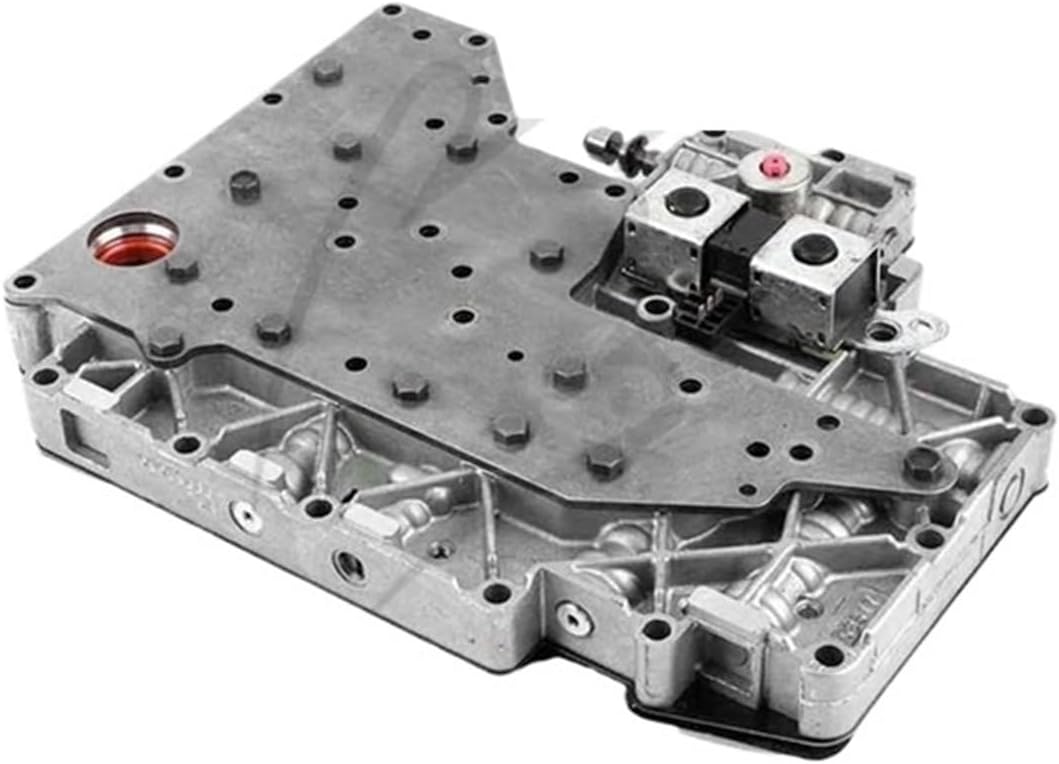
If the bore itself is worn rather than just the sleeve, Sonnax's AODE/4R70W/4R75 critical wear and vacuum test guide ties the bypass clutch control valve (location 110) directly to codes 628, 741, 1741 and 1744, plus no lockup, TCC slip and low cooler flow, and lists the oversized 76948-31 valve for it. The same guide flags the converter pressure limit valve (location 109) for low converter pressure. Sonnax's notes for its oversized 76948-58K limit valve kit explain why that matters here: inboard spool wear bleeds off converter pressure, and debris damage at the outboard spool can stick the valve high or low, with TCC slip, shudder and overheated converters among the symptoms. Vacuum test both bores with the valves at rest before you decide the plunger kit alone will fix it.
Sonnax 76948-64 Bypass Clutch Control Plunger Valve Kit (AODE / 4R70W / 4R75W)
The OE-calibration version of the repair described above: four .063 in. sleeve orifices, drop-in, no reaming and no drilling. This is the part that addresses the wear behind most P1744 complaints on this family.
Get the Sonnax 76948-64 bypass valve kit →Want the firmer .030 in. version or a full valve body instead? Browse the 4R70W parts collection.
Cause 2: The Case Connector, Not the Solenoid
Before you write a solenoid on the repair order, look at what the solenoids are plugged into. Transmission Digest documented a 4R70W job where the hard wire frame and case connector had to be replaced. After the repair, the transmission took off in a higher gear and the MIL came on, with various solenoid codes stored that had not been present before the work.
The cause was an aftermarket sub-standard case connector with two terminals pushed into the connector body so they never made contact with the hard wire frame. One of those was the 12-volt solenoid supply circuit, which is what produced the high gear start. Replacing the hard wire frame and case connector with Ford original equipment parts cleared the codes for good.
Keep that in mind on a P1744 that showed up right after somebody else did solenoid work. The TCC solenoid shares that supply, and a terminal backed out a sixteenth of an inch measures fine on the bench and fails under vibration and heat. Inspect the terminal faces before you order anything.
Cause 3: The Engine Fault That Reads As Transmission Slip
Rolly Alvarez documented a case in Gears magazine, ATRA's technical publication, involving a 2014 Ford E-250 bus. The unit had already been fully overhauled and road tested fine, but once it got hot and then sat, the engine came back with a bad misfire on restart that cleared after a few seconds.
They put the scanner on the misfire counter and watched the window between 35 and 45 mph at full lockup on very light throttle. There it was, and again on takeoff at 4 to 6 mph. No misfire code, no light, because it never crossed the PCM's threshold of time and occurrences. The actual fault was a plastic intake manifold warped between cylinders one and two and six and seven, pulling coolant into the cylinders. It did not show up in the volumetric efficiency test or the power brake test either.
Understand why that matters here. With the clutch locked there is no fluid coupling left to soak up an engine stumble, so every crank speed irregularity goes straight through to the input shaft, and the PCM's slip calculation cannot tell a slipping clutch from a stumbling engine. If your slip trace goes ragged only in the lockup window and only on light throttle, look at the engine before you pull the pan. Alvarez flags a related tip on these vans: the A/C drain hose can leak onto the boot for cylinder four and let spark arc to the head, with the same effect.
Cause 4: Valve Body Wear Beyond the Bypass Valve
While the valve body is off, look wider than the one bore you came for. In that same Gears teardown, the pressure regulator valve bore in the 4R70W valve body was worn out, and Alvarez lists the other issues to check on these valve bodies: flooding solenoids, shift valve spring weakening, and leaking plugs. Low or unstable line pressure starves converter charge, and low charge is low apply pressure by another name.
Sonnax's Bob Warnke frames the consequence: charge pressure purges air from the converter and ensures fluid force between impeller and turbine, and low converter pressure shows up as higher engine stall, low power, poor mileage, turbine blade damage and noise. Most converter failures, he notes, are related to the converter clutch and to overheating. That is also the argument against replacing the converter first: a burned converter on a 4R70W is usually a symptom, and a new one behind a worn bypass valve burns the same way.
Diagnosing P1744 on the Scan Tool
Get the unit to full operating temperature before you judge anything. This failure hides when the fluid is cold and thick.
- Check fluid level and condition hot, on level ground. Low fluid aerates and drops converter charge. Dark fluid that smells burned means the clutch has already been slipping for a while.
- Graph the right PIDs together. Engine RPM, turbine shaft speed, output shaft speed, vehicle speed, transmission fluid temperature, EPC and the TCC command. Any one alone will mislead you. The turbine shaft speed sensor arrived at the start of 2004 production, so on a 1996 to 2003 unit there is no turbine PID and you work from engine RPM against output speed and ratio.
- Cruise steady at 45 to 55 mph on flat road, light throttle. Slip should collapse toward zero when lockup commands and stay there. Thresholds are calibration specific, so watch the shape: does slip drop and hold, or drop partway, hang, and creep back up as temperature climbs?
- Add the misfire counter to that same graph. If slip only goes ragged in the lockup window and the misfire counter moves with it, you are chasing an engine fault.
- Correlate slip with fluid temperature. Clean at 150 F and growing past 200 F points at a hydraulic leak or a worn bore, not a solenoid. Clearance plus thin hot fluid is exactly the customer complaint of "only after half an hour on the highway."
- Tap the brake. Lockup should release immediately. A clutch that will not cancel is a valve stuck toward apply, which is a different code and a different repair.
- Gauge line pressure and EPC before opening anything. Flat EPC with no line rise sends you to pressure regulator bore wear, not to the converter.
- Inspect the case connector and hard wire frame, then test TCC solenoid resistance against the spec for your build year. Values changed across this family's run, so a number pulled from a forum for the wrong year is worse than no number.
Fluid and Refill
Ford's own automatic transmission fluid chart lists the 4R70W, 4R70E and 4R75W/E under MERCON V, part number XT-5-QMC in quart bottles. Do not substitute MERCON LV because it is what the shelf has. LV is the back service fluid for the 6R and TorqShift family, a different set of transmissions entirely, and the chart is explicit that the listed fluids are unique and must be used in the applications recommending them.
The same chart carries a caution worth quoting to any customer who arrives holding a bottle: do not use supplemental transmission fluid additives, treatments or cleaning agents, as they may affect transmission operation and result in damage to internal components. Nothing in a bottle closes a worn valve bore.
Plan on roughly 5 to 6 quarts for a pan and filter service and roughly 13.5 to 14 quarts dry including the converter, confirmed against the workshop manual for the application. Valve body bolts on this family run in the 80 to 100 lb-in range depending on year and location, so use the torque table and sequence for your build. These are aluminum threads and they do not forgive.
The Short Version: A P1744 Checklist
- Verify fluid level and condition hot, and scan for companion codes, engine codes included.
- Road test at temperature with slip, TCC command, fluid temp and the misfire counter on one graph.
- Rule out the engine. A misfire under lockup imitates slip closely and sets no misfire code if it stays under threshold.
- Gauge line pressure and EPC. No line rise means pressure regulator bore wear, not a converter.
- Inspect the case connector and hard wire frame for pushed-out terminals before condemning a solenoid.
- Test TCC solenoid resistance against the correct year spec and confirm command tracks slip on live data.
- Inspect the bypass clutch control plunger valve and sleeve. Sonnax 76948-64K for OE feel on 1996-up, 76948-04K for a firmer apply.
- Check the rest of the valve body while you are in there: pressure regulator bore, shift valve springs, plugs.
- Replace the converter only after the circuit proves tight, then flush and flow check the cooler and refill with MERCON V. No additives.
Worked in that order, most P1744 jobs on a 4R70W are a valve kit, a filter and a connector inspection rather than a converter and an overhaul. The habit worth building is putting the misfire counter on the graph the first time. It costs nothing and it is the difference between a two-hour diagnosis and a two-day one.
FAQ
What is the difference between P1744 and P0741 on a 4R70W?
Both report the same physical problem: the PCM commanded the converter clutch to lock and the clutch did not hold. P0741 is the generic OBD-II wording, and P1744 is Ford's own manufacturer-specific version, which is why you can see either one depending on the model year and calibration. Neither is a wiring code. Both are the computer telling you it measured slip it did not command, so the diagnostic path is identical: prove the hydraulic circuit holds before you buy any part.
Can a misfire set P1744 on a 4R70W?
Yes, and it is the trap that eats whole afternoons. Gears magazine documented a 2014 Ford E-250 with a freshly overhauled 4R70W that ran fine until it got hot, then acted up at 35 to 45 mph under full lockup. Scanning the misfire counter in that exact window found an intermittent misfire from a warped plastic intake manifold pulling coolant into the cylinders. No misfire code ever set, because the fault never crossed the PCM's threshold. Once the clutch is locked there is no fluid coupling to absorb an engine stumble, so the crank speed irregularity feeds straight through to the input shaft and reads as slip.
Will replacing the TCC solenoid fix P1744?
Sometimes, but replace it because it failed a test, not because the code is stored. A dead solenoid circuit normally sets its own electrical code. Check resistance against the spec for your build year, then confirm on live data that the command and the actual slip track each other. Also inspect the case connector and hard wire frame before you condemn a solenoid, because a pushed-out terminal in the connector produces solenoid faults the solenoid itself is not responsible for.
What fluid does a 4R70W take for a P1744 repair?
MERCON V. Ford's own automatic transmission fluid chart lists the 4R70W, 4R70E and 4R75W/E under MERCON V, part number XT-5-QMC in quarts. MERCON LV is not a substitute; it is the back service fluid for the 6R and TorqShift families. The same Ford chart cautions against supplemental transmission fluid additives, treatments and cleaning agents, which is worth repeating because lockup shudder additives sell hard to people staring at this code.
Is it safe to keep driving with P1744?
Getting it to a shop is fine. Living with it is not. A converter clutch that slips instead of clamping converts that slip directly into heat in the fluid, and that heat is what glazes the lining, cooks the fluid and takes the rest of the unit with it. The cheap version of this job is a valve kit and a filter. The expensive version starts after the fluid has been over temperature for a few thousand miles.
Working a 4R70W this week?
Bypass clutch control valve kits, TCC and shift solenoids, valve bodies, filters and full rebuild kits — shipped fast from the USA.
Shop 4R70W parts →Sources
- Sonnax — "Ford Bypass Converter Clutch Circuits," Gregg Nader, September 21, 2003. Backs the three-circuit bypass converter design used on the AODE/4R70W (converter impeller in, converter turbine out, converter bypass), the fact that CI and CT flow direction never reverses, that bypass oil holds the clutch released and the clutch applies when the PCM reduces CBY pressure, the three stages of lockup, that low converter (CT) pressure equals low apply pressure and results in TCC slip, and bore wear at the bypass sleeve and plunger, bypass valve and converter regulator valve as causes. sonnax.com
- Sonnax — "AODE, 4R70W Series Bypass Clutch Control Valve Repair Options: When to Use Sonnax 76948-04K vs. 76948-64K," Tory Royce, December 20, 2023. Backs that TCC shudder, delayed lockup, no lockup and converter codes are common on AODE, 4R70E, 4R70W, 4R75E and 4R75W units and are often attributable to wear at the bypass clutch control plunger valve and sleeve; the single .030 in. orifice in 76948-04K and its more pronounced lockup engagement; the four .063 in. orifices in 76948-64K matching OE timing; the 1996-and-later engine lugging and harsh apply caution; and that both are drop-in repairs requiring no reaming. sonnax.com
- Gears Magazine (ATRA) — "The 4R70W Getting the Shaft," Rolly Alvarez, May 3, 2021. Backs the 2014 Ford E-250 case study used in the misfire section: the misfire found on the scanner between 35 and 45 mph at full lockup on light throttle and again at 4 to 6 mph from takeoff, the absence of any misfire code because the fault never passed the PCM's threshold of time and occurrences, the warped plastic intake manifold between cylinders one and two and six and seven admitting coolant, the fact that it did not show in volumetric efficiency or power brake testing, and the A/C drain hose arcing tip. Also backs the worn 4R70W pressure regulator valve bore and the valve body issues to look for: flooding solenoids, shift valve spring weakening and leaking plugs. gearsmagazine.com
- Transmission Digest — "Ford 4R70W solenoid codes set" (Transmission Tech/Talk). Backs the case connector fault: after replacing the hard wire frame and case connector the transmission took off in a higher gear with the MIL on and solenoid codes that had not been present, caused by an aftermarket sub-standard case connector with two terminals pushed into the connector so they could not contact the hard wire frame, one of them the 12-volt solenoid supply circuit, and resolved by fitting Ford original equipment parts. transmissiondigest.com
- Sonnax — "Hydraulics Fundamentals Part IV: Converter Clutch Control," Bob Warnke, May 3, 2019. Backs the converter circuit definitions (charge, apply, bypass, impeller in, turbine out), that charge pressure purges air from the converter and ensures fluid force between impeller and turbine, that low converter pressure shows up as higher engine stall, low power, poor mileage, turbine blade damage and noise, and that most converter failures are related to the converter clutch and to overheating. sonnax.com
- Ford Customer Service Division — "Automatic Transmission Fluid Chart" (PDF). Backs the MERCON V listing for the 4R70W/4R70E and 4R75W/E, the XT-5-QMC quart part number, MERCON LV being the fluid for the 6R and TorqShift entries rather than this family, the statement that the listed fluids are unique and must be used in the applications recommending them, and the caution that supplemental transmission fluid additives, treatments and cleaning agents may affect transmission operation and result in damage to internal components. fcsdchemicalsandlubricants.com
- Sonnax — "Ford 4R70E, 4R70W, 4R75E, 4R75W, AODE Critical Wear Areas & Vacuum Test Locations" (AODE-4R75E VacTestGuide, PDF). Backs the bypass clutch control valve (location 110) link to codes 628, 741, 1741 and 1744, no lockup, TCC slip and low cooler flow, the oversized 76948-31 valve, and the converter pressure limit valve (location 109) for low converter pressure. sonnax.com (PDF)
- Sonnax — Oversized Converter Limit Valve Kit 76948-58K product notes. Backs inboard spool wear causing converter pressure loss, outboard spool debris damage sticking the valve high or low, and the TCC slip, shudder and overheated converter symptoms. sonnax.com