Ford's C6 and GM's TH400 get compared at every swap meet and on every towing forum, usually by people who have never had either one apart. On paper they look like twins. Both are three-speed, non-lockup, hydraulically controlled automatics with no overdrive. Both went behind big-block V8s, both went into one-ton trucks, and both are still being rebuilt every day. On the bench, they turn out to be built on opposite ideas about where to put the bands and where to put the clutches.
This guide covers the ratios, the apply elements, the band and pressure setup on each, fluid and service specs from the factory books, the failures each one is known for, and how to decide which one to build. Factory Ford and GM manuals, GEARS (ATRA) and Sonnax references are listed at the bottom.

The Short Answer
The two are closer in ratio than most people think, and further apart inside than most people think. The TH400 holds second gear with a multi-disc intermediate clutch working through a one-way sprag, and it uses a band for low and reverse. The C6 does the reverse: it holds second gear with a single intermediate band and handles low and reverse with a multi-disc clutch pack. That one layout difference explains most of what each unit does well, what each one breaks, and what you upgrade when you build it.
| Item | Ford C6 | GM TH400 |
|---|---|---|
| 1st / 2nd / 3rd | 2.46 / 1.46 / 1.00 | 2.48 / 1.48 / 1.00 |
| What holds 2nd | Intermediate band (with forward clutch) | Intermediate clutch through a sprag |
| What holds low/reverse | Low-reverse clutch pack | Rear (low/reverse) band |
| Band adjustment | External adjusting screw on the intermediate band | No external adjuster; rear band set with a selective apply pin |
| Lockup / overdrive | None / none | None / none |
| Late factory fluid | MERCON (early units built for Type F) | DEXRON |
Gear Ratios: Nearly Identical
TCI's OEM ratio table lists the stock C6 at 2.46, 1.46 and 1.00, and the stock TH400 at 2.48, 1.48 and 1.00 [6]. That is a difference of 0.02 in first and second. Nobody will feel it from the driver's seat. Both reverse ratios sit just above 2:1, which means reverse gives less reduction than first on both units. Backing a loaded trailer up a grade is hard on the reverse apply elements of either transmission.
Because third is direct on both, the axle ratio is the final drive at cruise. A truck with 4.10 gears turns the same engine speed at 60 mph behind either transmission, assuming the same tire size. If a customer wants lower cruise rpm, neither unit will do it. That conversation ends at an overdrive swap (E4OD or 4R100 on the Ford side, 4L80E on the GM side), and we have separate comparisons for both below.
The steps between gears matter more than the first-gear number. On both units the 1-2 shift drops engine speed by roughly 40 percent (2.46 to 1.46 is a 1.68 step; 2.48 to 1.48 is 1.68 as well). A big-block that falls off its torque peak after the 1-2 shift will do it behind either transmission. A lower first-gear set from the aftermarket is the cure on either one, and TCI lists wide-ratio sets for both units in the same table [6].
Second Gear: Band vs Clutch
C6: one band does the work
Ford's 1987 light truck shop manual describes the C6 second gear as the forward clutch applied with the intermediate band holding [2]. That band takes the full reaction torque of second gear every time the truck pulls away and upshifts. Its holding power comes from three things: the servo piston area, the line pressure behind it, and the ratio of the apply lever between the servo and the band strut.
That lever ratio is a real tuning tool on the C6. Sonnax lists the OE C6 levers as "E" ratio (1.85:1) and "F" ratio (2.30:1), and sells a non-stock "FF" lever at 2.82:1 for more apply force from a given servo [5]. The same page warns against using the FF lever with H or R code servos because the combination is too aggressive, and notes that the OE cast levers are prone to distortion and cracking compared with a forged replacement [5]. When a C6 slips or flares on the 1-2 shift and the band is not burnt, check lever ratio and servo code before blaming the valve body.
The band is externally adjustable. Ford's procedure is to tighten the adjusting screw to 10 ft-lb, back it off exactly 1-1/2 turns, then hold the screw and torque the locknut to 35-40 ft-lb [2]. Do it on every service. A C6 that has run 60,000 miles with a never-adjusted band is the classic soft 1-2 shift and the classic burnt band.
TH400: a clutch and a sprag
The TH400 holds second with the intermediate clutch pack, and the reaction goes through the intermediate sprag (a one-way clutch), so the 2-3 shift is an overrun with no band release to time. A clutch pack spreads the load over several friction surfaces instead of one band lining, which is a large part of why the TH400 has a reputation for taking abuse in second gear. The TH400 front band only applies in manual second, for engine braking. It is not the second-gear holding element in Drive.
Because the intermediate sprag is doing the holding, a TH400 that drops into neutral or flares hard on the 1-2 shift with good pressure is often a sprag or outer race problem, not a burnt clutch. When the sprag freewheels, the transmission acts like it lost second entirely.
Low and Reverse: Clutch vs Band
Here the layouts flip. The C6 holds manual low and reverse with the multi-disc low-reverse clutch. That pack is a big part of why the C6 survives trailer duty behind a 460 when lighter Ford units do not.
The TH400 holds low and reverse with the rear band. It has no external adjuster. GM sets it at assembly with a selective apply pin: its 1976 light truck overhaul supplement gives a gauge procedure, a 15 ft-lb attaching screw torque and a 25 ft-lb check torque on the lever, and six selective pin lengths [3]. Choose the pin by measurement on the bench. If a used TH400 slips in reverse and manual low but drives fine in Drive, the rear band, apply pin and servo are the first places to look.
Pressures, Endplay and Thrust Loads
GEARS magazine (ATRA) puts maximum TH400 line pressure at about 180 psi, with converter charge pressure of about 60 psi under high load [4]. The same article does the math on rearward thrust: 47 lb from converter charge on the input shaft face plus 152 lb from lube pressure, for 199 lb total on the forward clutch housing [4]. That load ends up on the thrust bearings and the output shaft-to-case thrust washers. In bad cases the case washer spins, tears out its locating tabs and damages the case.
The same article measured TH400 direct clutch housing endplay at typically 0.020 to 0.025 in, with no factory check or adjustment for it [4]. That float lets the housing run out, which damages the sealing ring bore and the center support ring grooves and can lead to direct clutch failure. The fix GEARS describes is a thicker thrust bearing at the hub, using Ford bearing E6DZ7F404A machined to fit [4]. If you build TH400s for towing, that modification is worth doing.
The C6 has its own pressure story. Its line pressure rises with modulator vacuum and kickdown, and a worn boost valve sleeve in the valve body gives low line rise, soft shifts and burnt clutches. Both units use a vacuum modulator, so a cracked vacuum line or a leaking modulator diaphragm causes the same symptoms on either: soft late shifts under load, and on the leaking-diaphragm version, ATF pulled into the intake and blue smoke.
Fluid and Service Specs
C6: Ford's 1996 F-150/250/350 and Bronco owner guide lists the C6 at 12.0 qt (11.4 L) on 4x2 trucks and 13.5 qt (12.8 L) on 4x4s, using Motorcraft MERCON, with a footnote to always use the dipstick to determine the exact fluid requirement [1]. Those are dry-fill numbers. A pan drop takes far less. Early C6 units were built for Type F, and the dipstick and build date tell you which one you have. Do not guess on a 1960s or early 1970s unit.
TH400: GM's 1976 light truck supplement specifies about 7.5 pints (3.75 qt) to refill after a pan drop, topped up to the dipstick mark, with fluid and filter service every 30,000 miles in normal use and every 15,000 miles for hot-weather city driving, commercial use, long idling or towing [3]. If a TH400 truck tows, put it on the 15,000-mile schedule. The rear band and the converter both live on clean fluid.
Master rebuild kits for both units
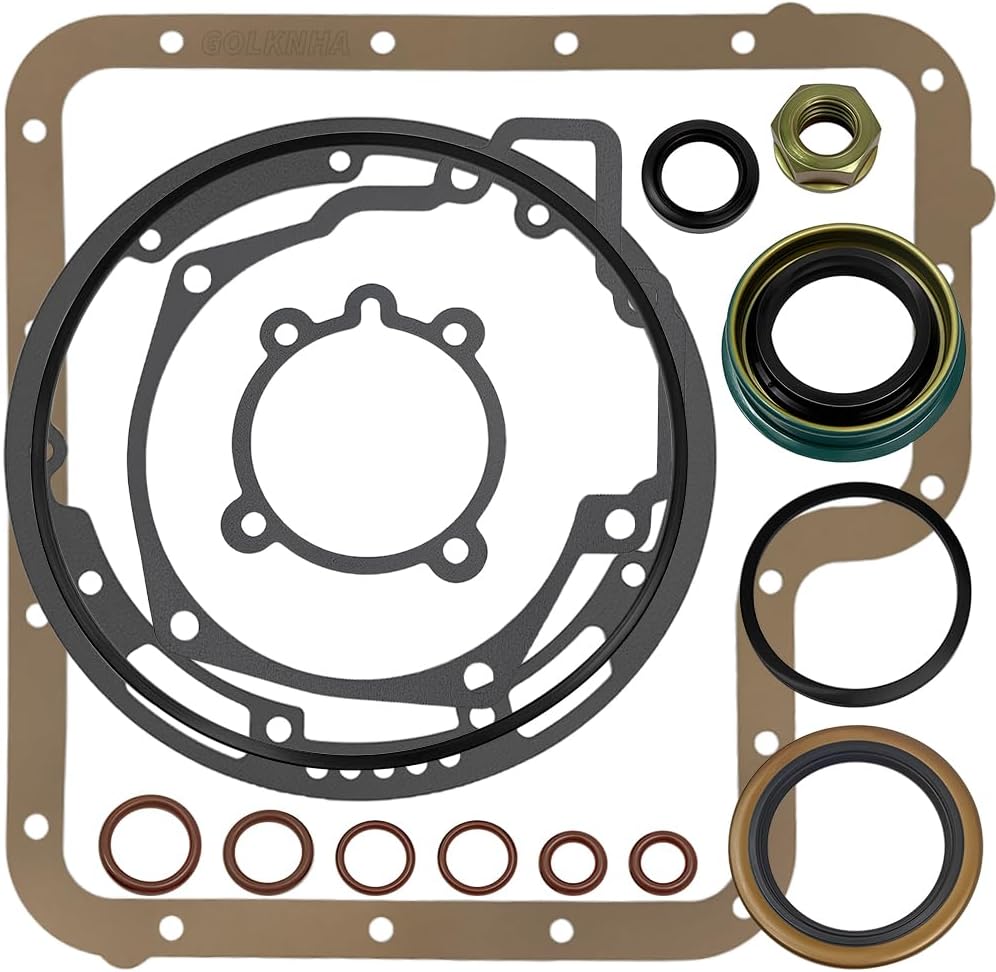
If the unit is already slipping, a pan service will not bring it back. A master kit covers frictions, steels, seals and gaskets for the complete overhaul. Pick the kit for your exact unit; nothing in these kits crosses between Ford and GM.
TH400 master rebuild kit (1965-1990) → C6 master rebuild kit (1966-1996) →Need pumps, bands or valve body parts instead? Browse TH400 parts at Core Transmission Parts →
What Each One Is Known For
- C6, burnt intermediate band and soft 1-2: usually an unadjusted band, a low-ratio lever with a weak servo, or low line rise from the valve body. Fix all three together. A new band alone in a valve body with low pressure burns up again.
- C6, reverse shudder or direct clutch failure: low line rise again. Look at the boost valve and sleeve before you blame the clutch pack.
- C6, pump noise and front seal leaks: worn pump bushing and excess converter hub clearance. Check the hub for a groove when the converter comes out.
- TH400, direct clutch failure and thrust washer damage: direct housing float and rearward thrust as described above [4]. Measure endplay on every rebuild.
- TH400, slipping reverse and manual low: rear band wear or the wrong apply pin [3].
- TH400, broken input shaft or forward hub in high-horsepower builds: the stock parts are the weak link above stock power. The aftermarket sells heavier shafts, hubs and drums for exactly this.
Which One Should You Build?
For most people the answer is whichever one already bolts to the engine. A C6 behind a Ford 460 or a TH400 behind a 454 is a correct, strong combination, and swapping across brands means an adapter, a crossmember, a new driveshaft length and new kickdown hookup. That is a lot of money for a 0.02 ratio difference.
When the build is really about holding power, as in a heavy tow rig or a high-horsepower street car, the TH400's clutch-held second gear and its deep aftermarket give it the edge. A properly built C6 with the right servo and lever combination, a good band and correct line rise will hold a big-block truck all day. The difference is that the C6 needs its band system set up correctly, while the TH400 needs its endplay and thrust surfaces set up correctly. Pick the unit you can set up correctly on your bench.
Need parts for this job?
TH400 master overhaul kits, shift improver kits, modulators and filters, plus C6 valve bodies and reseal kits, all with secure checkout.
Shop TH400 parts →FAQ
Is the C6 or the TH400 stronger?
Both are heavy-duty three-speeds that went behind big-block V8s and into one-ton trucks, so either one is strong when built right. The TH400 holds second gear with a multi-disc clutch and a sprag instead of a single band, and it has a deeper performance aftermarket, so it usually gets the edge at very high torque. A C6 with the correct servo, apply lever and line rise holds a big-block truck reliably.
Do the C6 and TH400 have the same gear ratios?
Almost. The stock C6 runs 2.46, 1.46 and 1.00, and the stock TH400 runs 2.48, 1.48 and 1.00. Neither has overdrive or a lockup converter, so cruise rpm is set entirely by the axle ratio and tire size.
Can I put a TH400 behind a Ford engine?
Yes, but it is a swap, not a bolt-in. It takes a bellhousing adapter, a different crossmember position, a driveshaft built to the new length and a kickdown setup that works with the TH400. Unless the C6 is beyond saving, rebuilding the C6 usually costs less.
What fluid do the C6 and TH400 take?
Late C6 units take MERCON-type fluid. Ford's 1996 F-Series guide lists Motorcraft MERCON at 12.0 quarts for 4x2 and 13.5 quarts for 4x4, but early C6 units were built for Type F, so check the dipstick. The TH400 takes DEXRON-type fluid, and a pan drop takes about 3.75 quarts per GM.
Sources
- Ford Motor Company, 1996 F-150/250/350 and Bronco Owner Guide (archived copy). Backs the C6 refill capacity of 12.0 qt (11.4 L) on 4x2 and 13.5 qt (12.8 L) on 4x4, Motorcraft MERCON as the listed fluid, and the instruction to use the dipstick to determine the exact fluid requirement. web.archive.org (Ford PDF)
- Ford Motor Company, 1987 Bronco, Econoline and F-150 to F-350 Light Truck Shop Manual, Section 17-10 "C6 Automatic Transmission." Backs the intermediate band applied with the forward clutch for second gear and the intermediate band adjustment (10 ft-lb, back off 1-1/2 turns, locknut 35-40 ft-lb). archive.org
- General Motors / Chevrolet Motor Division, 1976 Chevrolet Light Duty Truck Service and Overhaul Manual Supplement (ST-330-76). Backs the Turbo Hydra-Matic 400 rear band apply pin selection procedure (15 ft-lb screw, 25 ft-lb lever check, six selective pins), the 7.5 pint (3.75 qt) pan-drop refill and the 30,000 / 15,000 mile service intervals. 73-87chevytrucks.com (GM PDF)
- GEARS Magazine (ATRA), "Improve Your 400 and 4L80 Rebuilds." Backs the TH400 maximum line pressure of about 180 psi, converter charge of about 60 psi, the 47 + 152 = 199 lb rearward thrust on the forward clutch housing, thrust washer and case damage, direct clutch housing endplay of 0.020-0.025 in with no factory check, and the E6DZ7F404A thrust bearing fix. gearsmagazine.com
- Sonnax, C6 Servo Apply Lever 36916FF. Backs the OE "E" (1.85:1) and "F" (2.30:1) lever ratios, the non-stock "FF" (2.82:1) lever, the warning against FF with H or R code servos, and cast OE levers being prone to distortion and cracking. sonnax.com
- TCI Automotive, "Transmission Gear Ratios" reference table. Backs the OEM C6 ratios of 2.46 / 1.46 / 1.00 and OEM TH400 ratios of 2.48 / 1.48 / 1.00, listed separately from TCI's aftermarket wide-ratio sets. tciauto.com
Shop the TH400 master kit →