Two kinds of shops ask this question. One has a carbureted truck with a tired C6 and is wondering whether an E4OD core from the yard is a smart upgrade. The other has an E4OD that just cooked a converter and wants to know if the old three-speed behind it would have been simpler and more reliable. Both questions have real answers, and they come down to one fact: the E4OD is not a different transmission so much as the C6 with a fourth gear and a computer grafted on, and that graft changes almost everything about how it fails and how you work on it.
Ford built the E4OD to replace the C6 starting in 1989, reusing the C6's core case and front gearset while adding an overdrive planetary and swapping hydraulic control for electronic. The relationship is close enough that a tech who knows the C6 can read an E4OD valve body, and different enough that very little beyond sheet metal and a bellhousing pattern actually interchanges between them.
Side by side, the numbers that count
| Spec | C6 | E4OD |
|---|---|---|
| Production | 1966-1996 | 1989-1998 (replaced by 4R100) |
| Speeds | 3 | 4 (overdrive added) |
| 1st gear | 2.40:1 (2.72:1 wide-ratio) | 2.71:1 |
| 2nd gear | 1.40:1 (1.54:1 wide-ratio) | 1.54:1 |
| 3rd gear | 1.00:1 | 1.00:1 |
| 4th (OD) | — (none) | 0.71:1 |
| Shift/line control | Throttle valve cable and mechanical governor | EEC-IV / PCM, shift solenoids and EPC solenoid |
| Torque converter | No lockup clutch | 3-element converter with lockup clutch |
| Factory fill | Type F (early), Dexron/Mercon-compatible (later) | Mercon |
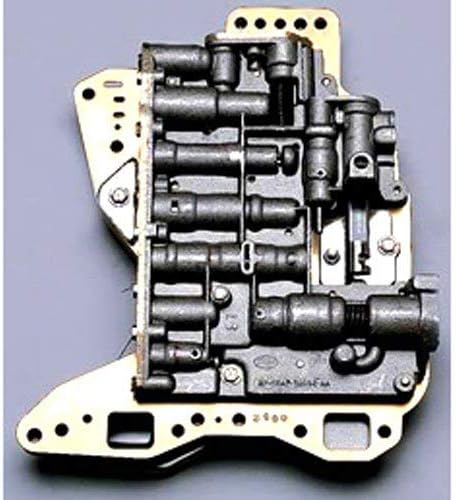
| Valve body | Cast iron, hydraulic | Aluminum, solenoid controlled |
| Marketed as | SelectShift Cruise-O-Matic | Electronic 4-Speed Overdrive |
| Typical applications | F-Series, Bronco, Mustang, Thunderbird, Lincoln | F-Series, Bronco, E-Series, Expedition |
The one-line version: the C6 is an all-hydraulic three-speed with no overdrive and no converter lockup, and the E4OD is that same core transmission with a fourth gear bolted on and a computer doing the job the cable and governor used to do.
Hydraulic versus electronic: the difference that actually matters
This is the split that decides almost every practical question about these two units, more than gear count or torque numbers.
The C6 sets line pressure with a throttle valve linkage tied to engine vacuum or throttle position, and picks shift points with a mechanical governor driven off output shaft speed. There is no module to adapt, no wiring harness to chase, and no sensor to fail. That is exactly why the C6 is still the transmission drag racers reach for when they want a full-manual valve body and a reverse shift pattern: a C6 valve body is a hydraulic circuit you can modify with a drill and a Dremel, and nothing in the control strategy needs to be told you did it.
The E4OD replaced that cable and governor with EEC-IV (later PCM) controlled shift solenoids and an electronic pressure control (EPC) solenoid that regulates line pressure directly from commanded current. That buys real advantages: smoother shift quality across a wider range of conditions, a converter that can lock up to cut slip losses, and a transmission that can be retuned in software instead of by re-indexing a cable. It also means the E4OD does not run at all without a functioning computer, wiring harness, and shift solenoid pack, and that a wiring fault or a sticking solenoid shows up as a transmission complaint even when every mechanical part inside is fine.
Where the E4OD actually came from
Ford did not design the E4OD from a blank sheet. It kept the C6's core case architecture and the same Simpson-type front gearset, then added a fourth, overdrive planetary gearset behind it along with a three-element torque converter carrying a lockup clutch the C6 never had. The result is a case that is longer and heavier than a C6, built to absorb the added gear range and the electronic hardware without giving up the C6's basic strength. When the Power Stroke diesel pushed more torque through the design than the original E4OD calibration could comfortably handle, Ford answered with the 4R100 starting in 1998 rather than a clean-sheet replacement, which tells you how much life Ford still saw in the underlying architecture.
The fluid changed underneath both of them
This is an easy thing to get wrong on an older core. Ford specified its own Type F automatic transmission fluid, designation M2C33, for early C6 production, and Type F is deliberately formulated without the friction modifiers that let a clutch or band slip smoothly into engagement. SAE's own history of Type F development traces the specification through revisions M2C33-B, M2C33-D and M2C33-F as Ford tightened requirements over the life of the spec. Ford phased Type F out through the late 1970s and 1980s as Dexron/Mercon-compatible fluids took over, and by the time the E4OD launched in 1989 the factory fill was Mercon (M2C185-A), a friction-modified fluid built for smooth, slip-controlled engagement, the opposite design intent from Type F. SAE's comparative review of Dexron-III, Dexron-II and Mercon lays out exactly how those friction chemistries differ. Put Type F in a Mercon-spec E4OD, or the reverse, and you are fighting the fluid's own additive package instead of working with it.
How the E4OD actually fails: the cooler bypass valve
If there is one component that explains most "E4OD overheated and the converter is toast" complaints, it is the cooler bypass valve. Sonnax's own technical documentation for the part lays out the mechanism plainly: sticking bypass components, spring relaxation, or a poor checkball seat let the bypass open at a lower cracking pressure than the 70-75 psi it is designed to hold. That drop reduces torque converter clutch apply pressure and starves cooler flow to the radiator and the overdrive section at the same time.
The symptom list on that failure is specific and worth memorizing: TCC slip, soft TCC apply, overheating, low cooler flow, an overheated converter, heat damage in the overdrive area, and EEC-IV trouble codes 1741, 1744 or 1783. None of those symptoms point directly at "cooler bypass valve" on a first guess, which is exactly why so many E4OD units get a new converter and a fresh overdrive section before anyone finds the actual root cause sitting in a worn valve bore. Sonnax's drop-in kit 36605-02K rebuilds the valve, spring and checkball in place, using the original fittings and tube, and restores the 70-75 psi cracking pressure the design calls for.
The C6 has no equivalent failure because it has no lockup clutch and no cooler bypass circuit to wear out. Its weak points are more conventional: the intermediate band and the forward and low-reverse clutch packs under sustained high line pressure, the kind of wear you would expect from any hydraulically controlled three-speed pushed hard for a long time.
The part that actually fixes most E4OD overheating complaints
Before condemning a converter or an overdrive section on heat damage, check the cooler bypass valve. CoreTransmissionParts stocks the E4OD/4R100 cooler line and bypass hardware this failure runs through.
Shop 4R100/E4OD cooler line parts →Interchange: less than it looks like
Because the E4OD shares the C6's case lineage, it is tempting to assume parts swap freely. In practice, very little does:
- Front gearset. Both use a Simpson-type arrangement, but the E4OD's clutch and band hardware is sized and calibrated for the added overdrive section and is not a drop-in for a C6.
- Overdrive section. Exists only on the E4OD. There is nothing on the C6 side to compare it to.
- Valve body. The C6's cast iron hydraulic valve body and the E4OD's solenoid-controlled aluminum valve body are different parts catalogs entirely. Neither bolts in for the other.
- Control. A C6 needs a throttle valve cable and a governor. An E4OD needs a computer, a wiring harness, and shift solenoids, none of which a C6 swap vehicle will already have.
- Torque converter. The E4OD's lockup converter and the C6's non-lockup converter are not interchangeable, and the flexplate has to match whichever one you run.
- Bellhousing. This is the part that actually carries over. Within the same engine family, bellhousing bolt patterns are shared enough that engine swaps are the easy half of a C6-to-E4OD conversion; everything behind the bellhousing is the hard half.
Which one to build
- Carbureted vehicle with no engine computer: C6. The E4OD cannot run without electronic control, and retrofitting that control into a vehicle that never had it is a real project on its own.
- Drag strip or full-manual valve body build: C6. Nothing electronic to fight when you modify the hydraulic circuit.
- Daily-driven tow rig or diesel truck: E4OD (or its 4R100 successor). The overdrive gear and lockup converter earn their keep on the highway, and Ford's own reinforcement path through the 4R100 shows where the factory took the design to handle real diesel torque.
- Core came out of a truck with unexplained overheating or converter damage: check the cooler bypass valve before you condemn anything else on an E4OD.
- Already running an engine computer and want smoother, tunable shifts: E4OD, for the electronic control the C6 cannot offer.
Need parts for this job?
Valve bodies, overhaul kits, sun shells, sprag clutches, cooler bypass hardware and bench tools for both units, shipped from the USA.
Shop E4OD parts →FAQ
Is the E4OD just an electronic version of the C6?
Mostly, but not completely. Ford built the E4OD on the C6's core case architecture and kept the same Simpson-style front gearset, then added a fourth, overdrive planetary gearset behind it and replaced the throttle valve cable and mechanical governor with EEC-IV controlled shift solenoids and an electronic pressure control solenoid. So the lineage is real, but the E4OD is not a C6 with a sensor bolted on. It is a heavier case with an added gear range and a torque converter clutch the C6 never had.
Will C6 parts interchange with an E4OD?
Very little beyond the front half of the case and some Simpson gearset hardware. The E4OD's overdrive planetary, overrun clutch, solenoid body, and electronic valve body have no C6 equivalent, and the C6's throttle valve linkage and governor have no home in an E4OD. Bellhousing bolt patterns carry over within the same engine family, which is the main thing that makes engine swaps easier, but the internals are two different parts catalogs.
What fluid does each transmission use?
Early C6 production called for Ford's Type F fluid, specification M2C33, a friction formulation with no slip-modifying additives so bands and clutches hold with a firmer, more mechanical feel. Ford phased Type F out through the late 1970s and 1980s in favor of Dexron/Mercon-compatible fluids, and by the time the E4OD launched in 1989, Mercon (M2C185-A) was the factory fill. Running Type F in a Mercon-spec E4OD, or vice versa, is the wrong call because the friction modifiers are formulated for opposite behavior.
Why do E4OD transmissions overheat or slip in lockup?
The most common cause is a worn cooler bypass valve. Sonnax documents that sticking bypass components, spring relaxation, or a worn ball seat let the bypass valve open at a lower cracking pressure than the 70-75 psi it is supposed to hold, which drops torque converter clutch apply pressure and reduces cooler and overdrive-section lube flow. The symptoms are TCC slip, soft TCC apply, overheating, low cooler flow, an overheated converter, and heat damage in the overdrive area, often alongside EEC-IV codes 1741, 1744, or 1783.
Which is actually stronger, the C6 or the E4OD?
Stock for stock, the comparison is not simple because Ford never published a single torque ceiling for either unit the way GM did for some of its boxes. In practice, the C6 is the one drag racers still build with full-manual valve bodies and reverse-pattern shift kits because its all-hydraulic control has nothing electronic to fight, while the E4OD and its 4R100 successor saw continuous factory reinforcement to handle the 7.3L Power Stroke's torque. Built correctly, both hold serious power; the honest answer is that they are strong in different ways for different jobs.
Related guides
- 4R100 vs E4OD: what changed when Ford reinforced it
- C6 common problems and fixes
- E4OD common problems and fixes
- C6 identification guide
- E4OD torque converter shudder diagnosis
Shop the part for this fix
C6 valve bodies and manual shift kits, E4OD overhaul kits, sun shells, sprags, and the 4R100/E4OD cooler line hardware this article covers — full catalogs at CoreTransmissionParts.
Shop 4R100/E4OD parts at CoreTransmissionParts →Sources
- SAE International, "Development of Type F Automatic Transmission Fluids," Technical Paper 680037, 1968 — backs the lineage and purpose of Ford's Type F ATF specification (M2C33-B through M2C33-D to M2C33-F), the friction-formulation design intent behind Type F, and its use as Ford's automatic transmission fluid through the era the C6 was introduced. papers.sae.org/680037
- SAE International, "New Developments in Automatic Transmission Fluids," Technical Paper 891194, 1989 — backs the comparison between DEXRON-III, DEXRON-II and MERCON friction chemistries, supporting why a Mercon-spec fluid behaves differently from the earlier Type F formulation. saemobilus.sae.org/content/891194
- Sonnax, "Cooler Bypass Valve Kit" product documentation, part no. 36605-02K, for Ford 4R100/E4OD — backs the cooler bypass valve failure mechanism (sticking components, spring relaxation, poor ball seat allowing the bypass to open below its 70-75 psi design cracking pressure), the resulting symptom list (TCC slip, soft TCC apply, overheating, low cooler flow, overheated converter, overheated OD area), and the associated EEC-IV codes 1741, 1744 and 1783. sonnax.com/parts/2078-cooler-bypass-valve-kit
- Sonnax, Ford C6 unit reference page — backs the C6's production span ('66-and-later fitment) and its band-service parts catalog as a hydraulically controlled unit with no electronic equivalent to the E4OD's solenoid body. sonnax.com/units/119-c6
- Gearstar, "Upgrading Your Ford C6 Transmission for Modern Toughness" — backs the C6's 1966-1996 production run, its stock and wide-ratio gear sets (2.40:1/1.40:1 standard, 2.72:1/1.54:1 wide-ratio, 1.00:1 third), SFI-certified bellhousing compatibility, and its common wear points in the band and clutch packs under sustained load. gearstar.com
- Gearstar, "Here's What You Should Know About Ford E4OD Performance Transmissions" — backs the E4OD's role as the C6's electronically controlled successor, its heavy-duty furnace-brazed lockup torque converter, and the factory-to-aftermarket reinforcement path that carried into the 4R100. gearstar.com