Ford built the C6 from 1966 until 1996, and in that time it went behind FE big-blocks, 385-series 429s and 460s, Windsor and Cleveland small-blocks, the 351M/400 and the IDI diesels, in cars, vans, F-Series trucks and Broncos, two-wheel drive and four-wheel drive. The gear train barely changed. Almost everything bolted to it did. That is why "it's a C6" is not enough information to order a rebuild kit, a filter, a governor or a replacement case.
This guide walks through how to identify a C6 the way a rebuilder does it: confirm it is a C6 at all, read the Ford ID tag, pin down the bellhousing pattern, then check the year-break parts that change what you order. Sources are numbered and listed at the bottom.

Is it a C6? The 30-second check
A C6 is easy to tell from its smaller cousin, the C4, and from the older FMX. The giveaway is the case: on a C6 the bellhousing and main case are one integral aluminum casting [8]. Ford's shop manual notes that the converter housing and the fixed splines that hold the low-reverse clutch steels are both cast integrally into the case [1]. Most C4s use a separate bolt-on bellhousing, and the FMX is a different design altogether.
Ford's own technician training book explains why the C4 and C6 look related: the C4 was released in 1964 for lower-torque engines, and the C6, with the same design of gear train, followed in 1966 for higher-torque engines [2]. The hydraulic controls are very similar, while the FMX uses a different gear train and control system [2]. So if you have a three-speed Ford automatic with a one-piece bell and case, a single intermediate band adjusted from the driver side and a vacuum modulator at the rear of the case, you are looking at a C6.
Some physical numbers help confirm it on the floor. Advance Adapters lists the C6 case at 20.00 in. long and 25.71 in. overall, about 200 lb, with a 31-spline output shaft [7]. The forward ratios are 2.46, 1.46 and 1.00, and reverse is 2.18 [7]. There is no overdrive and no lockup clutch, so a Ford rear-drive automatic with a fourth gear or a lockup converter is something else (usually an AOD or E4OD).
Reading the Ford ID tag
The tag is the single best piece of information you have, and it is easy to lose. Ford's truck shop manual (Section 17-10, the E-Series, F-Series and Bronco C6 chapter) says the identification tag is attached to the intermediate servo lower front cover bolt [1]. That is the round four-bolt cover on the driver side of the case. Look under the head of the lower front bolt for a small stamped aluminum tag.
Ford's Fig. 2 breaks the tag into two lines [1]:
- Line 1, transmission model and build date: a model prefix and suffix such as
PJD-BA, followed by a build date code. Ford's figure labels the month and day positions of that code. - Line 2, assembly part number: the Ford engineering prefix and suffix of the assembly, shown in the example as
E4TP-FB. Ford engineering prefixes follow the usual Ford pattern, where the letter is the decade and the digit is the year of release (E4 is a 1984 release), and the T marks a truck part.
The detail that matters most for parts ordering is the number after the suffix. Ford states that a number after the suffix means internal parts were changed after initial production start-up. Its example: a PGD-BN transmission that has been changed internally reads PGD-BN1. The two units are basically the same, but some service parts are slightly different, and Ford says in bold type that the codes on the tag should be checked when ordering parts or making inquiries about the transmission [1]. If a counter person asks for "the tag," this is why.
One service note while you are in there: Ford torques the intermediate servo cover bolts to 14-20 ft-lb and the pan bolts to 8-12 ft-lb [1]. If you pull the servo bolt to read the tag, put it back to spec, and put the tag back with it so the next person has it.
When the tag is missing, and on a 40-year-old truck it often is, you have to identify the unit by its hardware. The rest of this guide covers that.
Bellhousing patterns: the C6 cases
Because the bellhousing is part of the case, a C6 is locked to one engine family. George Reid's CarTech rebuild book lays out the main patterns [8]:
- FE big-block: a round six-bolt pattern for the 332, 352, 360, 361, 390, 406, 427 and 428.
- 385-series and raised-deck Cleveland: a distinctive six-bolt pattern for the 429 and 460 and for the 351M and 400. Reid notes this case is finned.
- Small-block: built for the 351W and 351C, and it fits any six-bolt 289/302/351W/351C pattern.
- Diesel: a C6 built for the diesel engines in the 1980s, before the E4OD took over starting in 1989.
Transtar's C6 case listings add a useful detail when you are sourcing a replacement case: the early 360/390 round-bell case (1966-1972) takes a screw-in modulator, while the later small-block and big-block "flat top" cases (late 1976-up) use a push-in modulator [3]. If the vacuum modulator threads into the case, you have an early case. If it is retained by a clamp, it is a later one.
Diesel units carry their own tell. Ford's manual explains that on 6.9L diesel trucks the transmission gets its vacuum signal from a Vacuum Regulator Valve (VRV) bolted to the injection pump and fed by an engine-driven vacuum pump, because the diesel has no manifold vacuum [1]. Transmission-to-engine bolts are torqued differently too: 40-50 ft-lb on gas engines and 50-65 ft-lb on the diesel [1].
Year breaks that change what you order
The gear train stayed the same, but a handful of internal changes split the C6 into groups. Transtar's catalog shows where kits and hard parts break [3]:
- Overhaul and master kits: three groups, 1966 to early 1967, 1967 to early 1976, and late 1976-up.
- Forward clutch: late 1976-up forward clutch hubs are listed as 30-spline, in both 4-clutch and 5-clutch versions.
- Input shaft: the late 1971-up shaft has 31 splines at the converter end and 30 at the drum end.
- Output hub to sprag race thrust washer: 2-tang for 1966-1969, 3-tang for 1970-1976.
- Governor: one part for 1966-1976 and another for 1977-up.
- Rear case bushing: no oil groove to the rear for 1966-1994, one groove to the rear for 1995-1996.
The valve body splits too. Sonnax identifies 1976 and earlier C6 valve bodies as the "clicker" style, which takes its own boost valve kit (36941-01K) [4]. Transtar lists separate premium gas and diesel valve bodies for late 1977-up [3]. Gas and diesel valve bodies are not interchangeable as-is, a point both Sonnax and TransGo make [4][6]. A premium unit from the wrong family will bolt on and shift wrong.
2WD vs 4WD: filter, pan and output shaft
Pull the pan and you learn a lot. Transtar lists three C6 filters: two-wheel drive 1966-1974, two-wheel drive 1975-up, and four-wheel drive 1973-up, and the 4WD filter uses its own pickup tube [3]. So a 2WD C6 splits at the 1974/1975 break, and a 4WD unit gets its own filter. The later 2WD pan is listed at 1-7/8 in. deep [3]. If you do not know the year, compare the old filter to the new one before the pan goes back up; for the full procedure see our C6 filter and pan service guide.
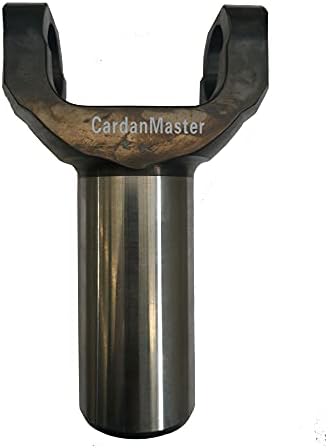
At the back, a 4WD C6 has a short adapter to the transfer case instead of the long 2WD extension housing. Transtar lists adapter gaskets for the 1356, 205 and 208 transfer cases, and two different 4WD output shafts, 15-3/8 in. and 18-1/2 in. long [3]. Measure the old shaft before you order one. A 2WD unit uses the aluminum extension housing and a 31-spline slip yoke [3][7].
Servo codes: the letter on the cover
The intermediate servo cover carries a cast letter, and it matters because the servo piston is sized to the cover. Transtar pairs the pistons by color dot and cover letter: green dot with the L cover, red dot with N, blue dot with P, and a yellow-dot truck piston with the S cover. It also lists a code "R" servo assembly [3].
The servo works through an apply lever, and the lever ratio has to suit the servo. Sonnax sells C6 levers in E (1.85), F (2.30) and a non-stock FF (2.82:1) ratio, and states that the FF lever is not recommended with H or R code servos because the ratio is so aggressive [5]. Its E-ratio lever is a direct replacement for the OE C6AZ-7330-D and is paired with the Sonnax R-ratio servo kit K36528R for mid-1968 and later units [5]. If you are building a used core, write the cover letter down before teardown.
Gas or diesel governor
A gas governor in a diesel C6 is a classic mix-up when cores get swapped around. TransGo's C6 instructions describe the complaint: a diesel truck with no wide-open-throttle 1-2 upshift. The cause can be high modulator or line pressure, a misadjusted injection pump governor, or the wrong (gas) governor inside the transmission [6]. TransGo gives the check: at maximum throttle in Drive at 28 mph, line pressure must not exceed 138 psi. If pressure reads 128-137 psi and there is still no full-throttle 1-2, either the engine is under-revving or the wrong governor is installed [6].
TransGo publishes a diesel governor ID with a "V" groove on the valve, diameters called out at .553 in. and .451 in., and a spring 1.344 in. long with 9-1/2 coils [6]. Diesel units also use a green-stripe adjustable modulator only [6]. If you are building a diesel C6 from a gas core, check both before it goes back in the truck.
A quick ID checklist
- Confirm the one-piece bell and case, single intermediate band and rear modulator. It is a C6.
- Pull the lower front servo cover bolt and read the tag: model prefix, suffix, any number after the suffix, build date [1].
- Match the bellhousing pattern to the engine: FE round, 385/M-block finned, small-block, or diesel [8].
- Screw-in or push-in modulator tells you early or late case [3].
- Note 2WD or 4WD and the year, then pick the filter: 66-74 2WD, 75-up 2WD, or 73-up 4WD [3].
- Read the servo cover letter and match the piston and apply lever [3][5].
- On a diesel, confirm the diesel governor and modulator [6].
Once the unit is identified, the most common failures and their fixes are covered in our C6 common problems guide, and correct fill quantities by application are in C6 fluid type and capacity.
Shop the part for this fix: the right C6 filter for your year
Once you know you have a 1975-up two-wheel-drive unit, CoreTransmissionParts stocks the matching C6 filter for the pan service.
View the 1975-1996 C6 filter at CoreTransmissionPartsOlder unit? Grab the 1966-1974 C6 filter, or the 1976-1996 C6 master rebuild kit for a late unit.
Need parts for this job?
Our parts shop carries a C6 valve body, a 31-spline C6 slip yoke and a C4/C6 bench holding fixture, all on our own checkout. For every Ford fluid spec side by side, see our transmission fluid spec chart.
FAQ
Where is the ID tag on a C6 transmission?
Ford attaches the identification tag to the intermediate servo lower front cover bolt, on the driver side of the case. The first line shows the transmission model prefix and suffix plus a build date code, and the second line shows the assembly part number.
What does the number after the suffix on a C6 tag mean?
Per Ford, a number after the suffix means internal parts were changed after initial production start-up. A PGD-BN unit that was changed internally reads PGD-BN1, and some service parts differ, so give the full code when ordering parts.
How do I tell a C6 from a C4?
The C6 bellhousing and main case are one integral casting, and the C6 was built for higher-torque engines from 1966. Most C4s use a separate bolt-on bellhousing. Both share the same basic gear train design.
How do I identify a C6 without the tag?
Match the bellhousing pattern to the engine family (FE, 385/351M-400, small-block or diesel), check whether the modulator screws in or pushes in, note 2WD or 4WD and the filter style, and read the cast letter on the intermediate servo cover.
Related guides
Sources
- Ford Motor Company, Truck Shop Manual Section 17-10, C6 Automatic Transmission (E-150 to E-350, F-150 to F-350 and Bronco). Backs the ID tag location under the intermediate servo lower front cover bolt, the tag layout (model prefix and suffix, build date code, assembly part number), the post-start-up change number (PGD-BN vs PGD-BN1), the integral converter housing, the 6.9L diesel VRV, and the torque limits (servo cover 14-20 ft-lb, pan 8-12 ft-lb, transmission to engine 40-50 gas and 50-65 diesel). Ford Section 17-10 (PDF)
- Ford Marketing Corporation, The C6 Automatic Transmission technician training book (Forel Publishing reprint, sample pages). Backs the C4 release in 1964 and the C6 release in 1966 for higher-torque engines with the same gear train design, and the FMX's different gear train and controls. forelpublishing.com (PDF)
- Transtar Industries, Ford C6 parts catalog pages (2008). Backs the kit year breaks, the filter groups (2WD 66-74, 2WD 75-up, 4WD 73-up), the 4WD pickup tube and output shaft lengths, the transfer case adapter gaskets, the input shaft splines, the thrust washer tang change, the governor break, the rear case bushing change, early screw-in vs late push-in modulator cases, the gas and diesel valve bodies, and the servo piston color dots and cover letters. Transtar C6 catalog (PDF)
- Sonnax, Ford C6 unit page. Backs the 1976 and earlier "clicker" valve body with its own boost valve kit, and the separate gas and diesel boost valve kits. sonnax.com
- Sonnax, C6 Servo Apply Lever 36916E. Backs the E (1.85), F (2.30) and FF (2.82:1) lever ratios, the warning against the FF lever with H or R code servos, the OE C6AZ-7330-D reference and the mid-1968-later R-ratio servo kit. sonnax.com
- TransGo, SK C6 Shift Kit installation instructions (2011). Backs the diesel no-WOT 1-2 complaint, the 138 psi line pressure limit at 28 mph, the diesel governor ID dimensions and spring, the green-stripe diesel modulator, and the gas vs diesel valve body differences. TransGo SK C6 instructions (PDF)
- Advance Adapters, Ford C6 specifications. Backs the case length, overall length, weight, 31-spline output and the 2.46/1.46/1.00/2.18 ratios. advanceadapters.com
- George Reid, How to Rebuild and Modify Ford C4 and C6 Automatic Transmissions (CarTech), excerpt. Backs the one-piece bellhousing and case, the FE, 385/351M-400, small-block and diesel bellhousing patterns, and the finned big-block case. diyford.com