Ford put the C6 behind its big-blocks and diesels for thirty years, and it is hard to break. Most towing C6 failures we tear down are not broken parts. They are cooked parts: a burned intermediate band, glazed direct clutches, varnish on the valve body and fluid that smells like a campfire.
That tells you where to spend money. Here are the upgrades that matter on a C6 that pulls a trailer, in the order we would do them. Sources are listed at the bottom.
Why a towing C6 runs hot
Three things stack against a C6 with a trailer behind it.
- No lockup clutch. The C6 is a three-speed with an open converter. At 60 mph in third gear the converter is still slipping, and every bit of that slip becomes heat in the fluid. A later lockup transmission can clamp the converter at cruise; a C6 never can.
- The factory cooler lives in the radiator. Hayden's install instructions point out that the original equipment cooler is a water-cooled oil cooler inside the radiator tank, so when extra weight or stop-and-go traffic makes transmission heat, the engine coolant temperature rises with it[5].
- Second gear carries the load. On a hill a loaded C6 drops to second and stays there. Second is held by the intermediate band. A band slipping under that load burns its lining.
Pat Burrow put the general problem plainly in Gears Magazine: without external coolers and larger sumps, the owner has very little ability to bring an automatic transmission's temperature down[6].
Upgrade 1: an auxiliary cooler, sized for the trailer
If you do one thing, do this.
How big
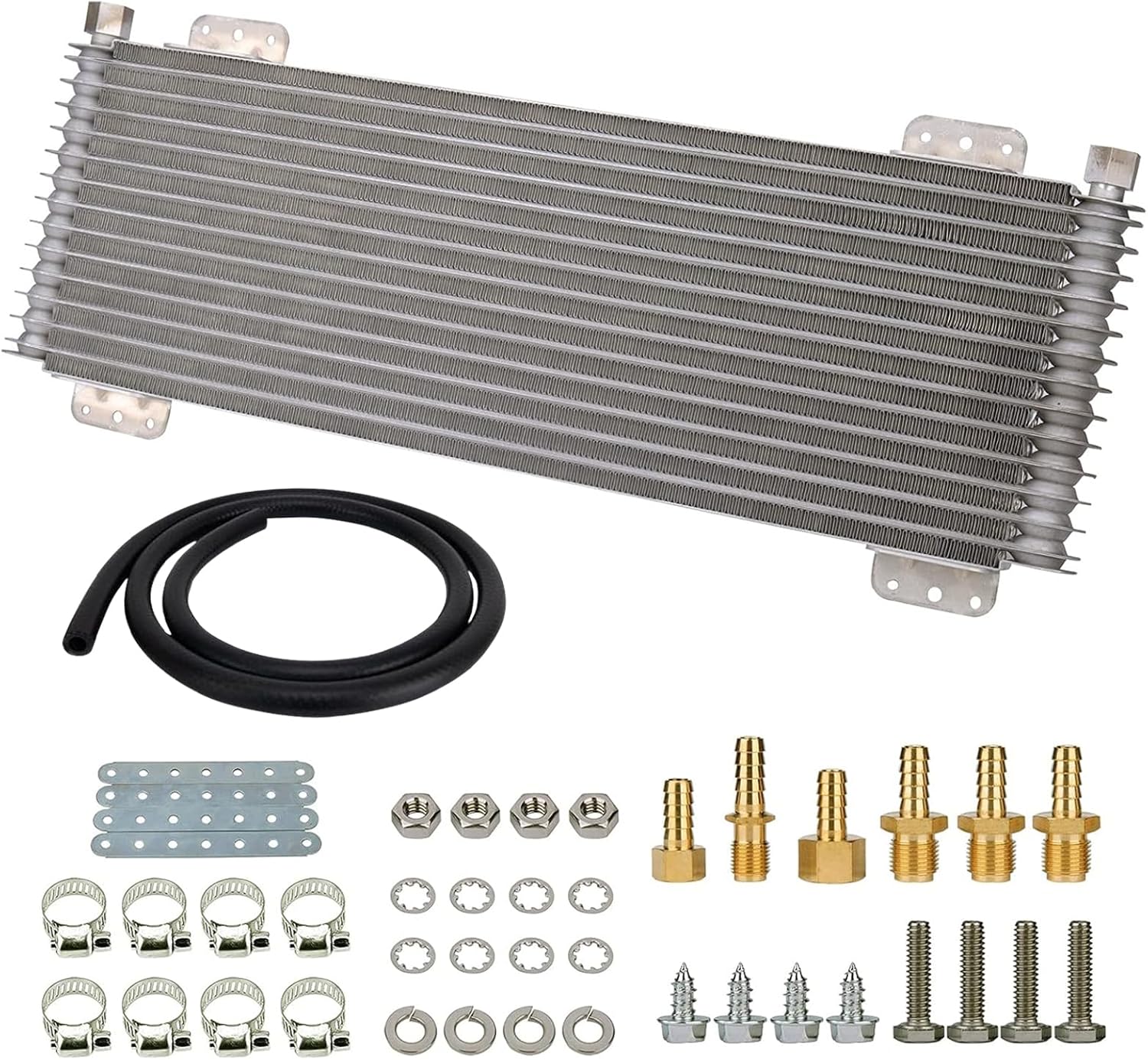
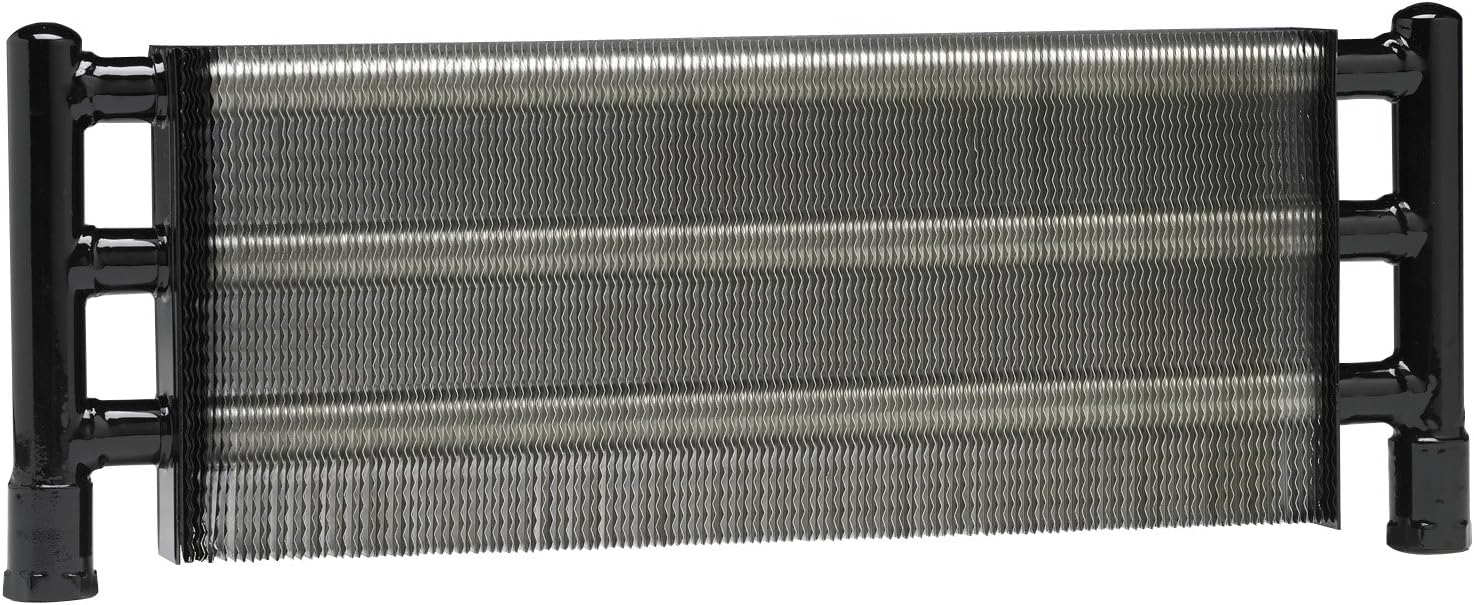
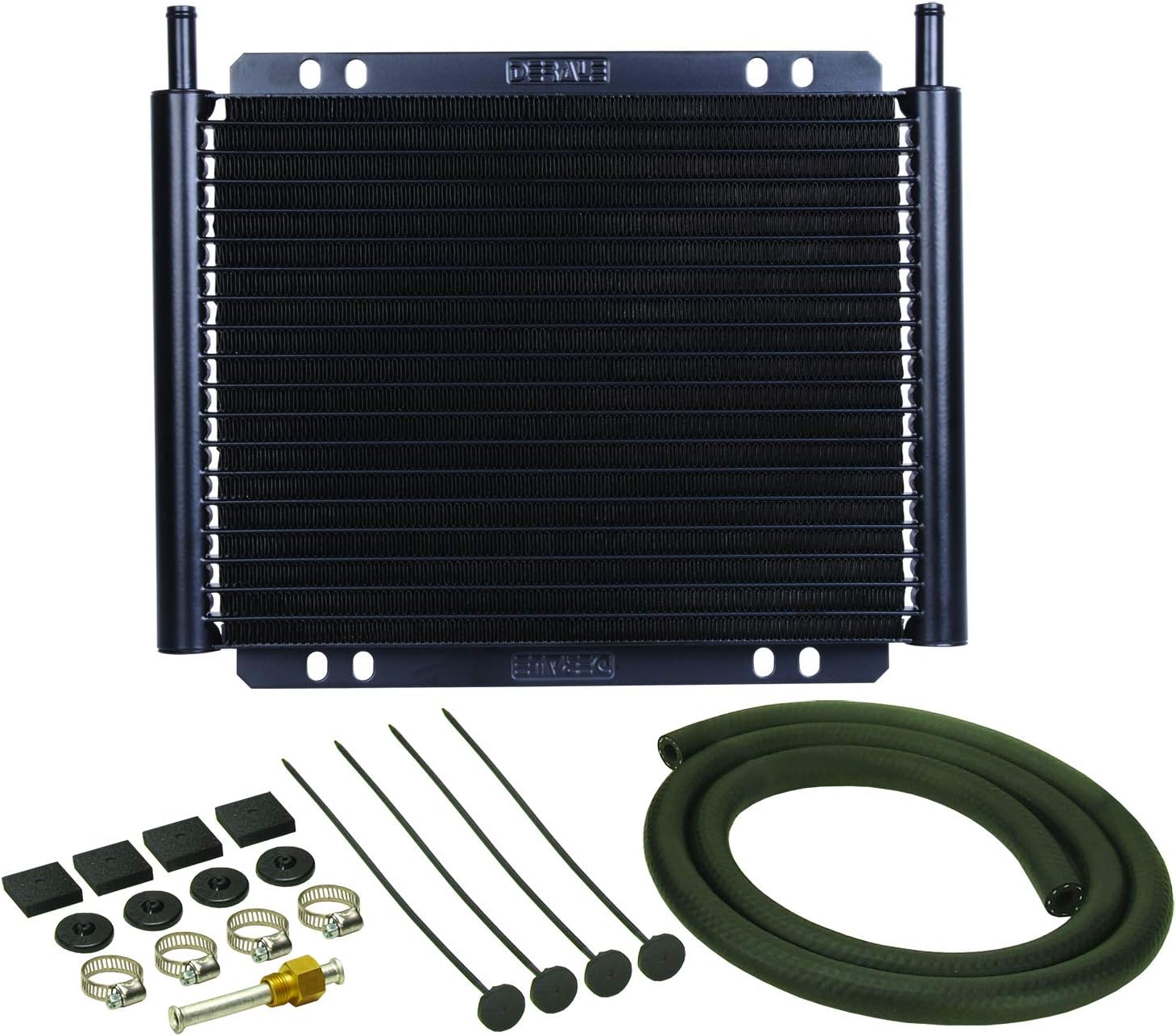
Size the cooler to the combined weight you will move, not the truck by itself. Hayden's catalog rates its Rapid-Cool plate-and-fin coolers by the towing they are built for[4]:
| Hayden Rapid-Cool | Core size | Rated use | GVWR rating |
|---|---|---|---|
| 677 | 3/4 x 7-1/2 x 11 in | Full-size vehicles, towing up to 2,500 lb | 14,000 |
| 678 | 3/4 x 9-1/2 x 11 in | Class C motorhomes, towing up to 5,000 lb | 18,000 |
| 679 | 3/4 x 11-5/8 x 11 in | Class A motorhomes, towing up to 10,000 lb | 22,000 |
Hayden also lists its tube-and-fin 1015 for Class A motorhomes or towing more than 10,000 lb, and says its plate-and-fin design is 33% more efficient than a comparable tube-and-fin cooler[4]. For a C6 truck pulling a camper, a car hauler or a gooseneck, buy the 10,000 lb class or bigger. The price step between cooler sizes is small next to a band and clutch job. In real winter cold, a cooler with a built-in bypass (Hayden sells those too[4]) lets the fluid warm up.
How to plumb it
Hayden's instructions give two ways to hook a cooler up: in series with the radiator cooler, or bypassing the radiator cooler entirely. They recommend in-series[5]. Fluid goes through the radiator tank first, then the add-on cooler, then back to the case.
- Find the return line. Hayden's method: run the engine for two minutes, then feel both steel lines near the radiator. The cooler of the two is the return line[5]. Break that line at the radiator and route it through the new cooler.
- Mount it where air moves. Hayden recommends mounting in front of the radiator and A/C condenser, keeping it away from the crank pulley, fan blades, belts and other moving parts, and keeping at least 3/4 in. between the cooler and the fan in a behind-the-grille position[5].
- Use real transmission cooler hose. Hayden's kit warns against substituting any other hose[5].
- Clean first if the old unit failed. A cooler and lines that carried a burned C6's debris will feed it straight into a fresh unit. Flush them or replace them; our cooler flush guide covers the procedure.
After the install, check for leaks and top off; the new cooler and hoses hold fluid.
Upgrade 2: a thicker pan that stays sealed
Sonnax sells a C6 pan, part 36950-01, that it describes as 25% thicker than OE so it resists warping at the bolt holes[1]. The thin factory flange dishes when the bolts are overtightened and the gasket stops sealing. The Sonnax pan fits 1975-and-later units directly. It can replace the early 1966-1974 tapered pan, but that requires updating to the 1975-later style filter[1].
Whatever pan you run, check the bottom. TransGo's C6 instructions warn that a pan bottom bent upward can press against the filter opening, restrict flow through the filter and damage the transmission, and tell you to flatten it with a mallet[3]. Pans get bent on rocks, jack pads and trailer ramps.
A deep aftermarket pan with a drain plug adds fluid volume and makes the next service cleaner. Once you run one, factory capacity numbers no longer apply; fill to the dipstick. See our C6 fluid type and capacity guide for the check procedure.
Upgrade 3: make the intermediate band hold
This is the internal upgrade that pays off most on a tow rig. Two things set how hard the band clamps: the servo piston area and the apply lever ratio.
The R servo
C6 servos are identified by a letter cast on the cover (our C6 identification guide shows where), and the R servo is the big one. Sonnax's R ratio servo piston kit, K36528R, is described as the largest apply area available for the C6, a design Ford has used since 1969, when it appeared with the 428 Super Cobra Jet[2]. It fits mid-1968 and later units. The Sonnax kit adds two things the factory piece does not have[2]:
- Two selective return springs, so you can tune how quickly the band comes on and releases.
- A no-leak servo pin with one O-ring and one PTFE ring, which lets it seal even in a worn case bore and stops back pressure and leakage.
Sonnax's install note matters: any older servo modification that blocks case passages has to be removed. The exhaust passage and both oil feed passages must stay open[2].
Lever ratio
Sonnax lists three forged C6 apply levers: E ratio 1.85 (the OE C6AZ-7330-D lever), F ratio 2.30 and FF ratio 2.82[1]. A higher ratio multiplies servo force into more band clamp, which firms the 1-2 shift and increases holding. On a towing truck, stacking a high-ratio lever on an R servo makes the 1-2 harsh and shocks the driveline. Sonnax pairs the R servo kit with the E ratio 1.85 lever[2], and that combination is where we start on a tow rig. Go up in ratio only if the band still slips with a correct servo, a good band and correct pressure.
The band itself
If the case is apart, Sonnax's extra-wide C6 band, S026968, is 2-1/4 in. wide with heavy-duty red friction material and fits 1966-later units[1]. More lining area means less heat per square inch on a grade.
Upgrade 4: a calibrated shift kit, not a hot-rod one
A slow, overlapping shift is heat: the band or direct clutch slips while half-applied. A towing shift kit shortens that overlap without making every shift a bang.
TransGo's SK C6 is the one most shops reach for. Its instruction sheet lists what it corrects: soft shifts, early shifts, stacked shifts, skipping second, no max-throttle 1-2 and "bogs down on hill," plus a higher-speed manual low[3]. It also says it is not intended for hot rod shifts[3]. Tuning choices from the sheet[3]:
- 1-2 firmness is set by the accumulator springs. All three springs gives a short, smooth shift; outer and middle gives shorter and firmer; outer only is firm. For towing, all three or outer and middle.
- Throttle modulator valve spring is chosen by measuring the TMV valve (.300, .318 or .338 in.). Gas units with .300 and .318 valves take the brown spring and .338 takes orange; diesels step up one color.
If a unit has normal line pressure but the pressure regulator spring has sagged with age, Sonnax's elevated-pressure main regulator spring, 36946-13, adds about 10 psi over OE baseline and is a drop-in fix for low baseline pressure caused by a fatigued spring[1]. Cranking pressure past stock to cover worn clutches only delays the failure.
Upgrade 5: vacuum, kickdown and band adjustment
These cost almost nothing. A C6 sets line pressure and shift timing from a vacuum modulator, so bad vacuum means soft, late shifts under load.
Gas engines
TransGo's checks[3]: with the engine idling, pull the hose off the modulator. The engine must speed up or idle rough. Then check for trapped vacuum: start the engine, shut it off, wait until it has fully stopped, count to five and pull the hose. Escaping vacuum means a collapsed or carboned hose, a bad brake check valve or a shared reserve canister; run a dedicated line to the manifold.
Diesels
The IDI diesel C6 runs its modulator off a vacuum pump and regulator, and TransGo says it is fussy[3]. Use the green-stripe adjustable modulator only. Normal readings are 14-17 in. of vacuum at closed throttle and less than 5 in. at wide open throttle; the pump must make 20-25 in. of steady vacuum, and the regulator is set to 17 in. with the truck at operating temperature. TransGo's line pressure limit: max throttle in Drive at 28 mph must not exceed 138 psi, or the unit will not make its full-throttle 1-2.
Kickdown and band
On gas units TransGo adjusts the kickdown linkage until you can just get a 3-1 kickdown at 30 mph (diesels: a 3-2 at 20 mph)[3]. Then adjust the intermediate band. TransGo's method: wheels off the ground, transmission in neutral, engine off. Snug the adjustment screw until the output shaft will not turn backward by hand, back it off slowly until the shaft just turns, then loosen 1/4 turn more and lock it[3]. Do it whenever the pan is off.
Upgrade 6: a temperature gauge
A C6 has no sensor and no warning light. A cheap temperature gauge tells you when to back off. B&M's C6 instructions note that automatic transmissions typically run at 150-200°F[7]. Well past that on a long pull, slow down and pull the grade in second rather than lugging in third.
What order to buy it in
- Service and adjust: fluid, filter, band, vacuum and kickdown.
- Auxiliary cooler, plumbed in series, sized for 10,000 lb class or larger if you tow heavy.
- Temperature gauge.
- Thicker or deeper pan at the next service.
- R servo and shift kit when the valve body or servo is apart anyway, or with the next rebuild.
- Extra-wide band and new frictions at rebuild time.
The mistake we see most is the reverse order: a shift kit and a high-ratio lever in a C6 with no cooler and a band that has never been adjusted. Heat first, holding second, shift feel last.
Shop the part for this fix: the C6 R servo kit
The R code intermediate servo piston is the internal upgrade that makes a towing C6 hold second gear on a grade. CoreTransmissionParts stocks it for 1968-up units.
View the C6 R code servo piston kit at CoreTransmissionPartsDoing the valve body too? Grab the C6 shift kit for 1967-up, or browse all C6 parts.
Need parts for this job?
Our parts shop carries heavy-duty add-on transmission coolers, a C6 valve body and C6 rebuild parts, all on our own checkout. Fluid specs: our transmission fluid spec chart.
FAQ
Do I need an auxiliary transmission cooler to tow with a C6?
Yes, for any real trailer. The C6 has no lockup clutch, so the converter slips and makes heat the whole time you are towing, and the factory cooler sits in the radiator tank where it shares heat with the engine coolant. Hayden recommends plumbing an add-on cooler in series with the stock radiator cooler.
What size transmission cooler does a C6 need for towing?
Size it to what you tow, not to the truck alone. Hayden's Rapid-Cool chart puts the 677 at towing up to 2,500 lb, the 678 at up to 5,000 lb and the 679 at up to 10,000 lb. For a heavy trailer, buy at least the 10,000 lb class.
Is the R servo worth it on a towing C6?
Yes. The intermediate band holds second gear, which is where a loaded C6 lives on a grade. Sonnax describes its R ratio servo piston kit as the largest apply area available for the C6, in use since 1969, and it pairs it with the stock E ratio 1.85 apply lever.
Will a shift kit help a C6 tow?
A calibrated kit helps because it firms and shortens the 1-2 and 2-3 shifts, so the band and direct clutch spend less time slipping. TransGo's SK C6 lists soft shifts, stacked shifts, skipping second and bogging down on hills among the problems it corrects, and it states it is not meant for hot rod shifts. It does not replace a cooler.
Related guides
Sources
- Sonnax, Ford C6 unit parts listing. Backs the 36950-01 pan (25% thicker than OE, resists warping at bolt holes, 1975-later fit, early pans need the 1975-later filter), the E 1.85 (OE C6AZ-7330-D), F 2.30 and FF 2.82 apply lever ratios, the S026968 2-1/4 in. extra-wide band with red friction for 1966-later, and the 36946-13 elevated pressure regulator spring (about 10 psi over OE). sonnax.com
- Sonnax, "R" Ratio Servo Piston Kit K36528R. Backs the largest available C6 servo apply area, use since 1969 with the 428 SCJ, mid-1968-later fit, two selective return springs, the O-ring plus PTFE no-leak pin, the requirement to remove passage-blocking servo mods, and the pairing with the 36916E lever. sonnax.com
- TransGo, SK C6 shift kit instructions (rev. 04/04/2011). Backs the list of corrected complaints, the not-for-hot-rod note, accumulator spring firmness selection, TMV spring by valve size, plate hole sizes, diesel boost valve sizes, gas vacuum and trapped-vacuum tests, diesel modulator and vacuum readings, the 138 psi diesel line pressure limit, kickdown adjustment, band adjustment and the bent pan warning. transgo (PDF)
- Hayden Automotive, Transmission, Engine and Power Steering Oil Coolers catalog. Backs the Rapid-Cool 677/678/679 sizes, towing ratings and GVWR ratings, the 1015 rating for over 10,000 lb, the 33% efficiency claim versus tube-and-fin, and the internal bypass cooler line. haydenauto.com (PDF)
- Hayden Automotive, Transmission Oil Cooler Kit Installation Procedure (8P103). Backs the in-radiator OE cooler sharing heat with engine coolant, the recommended in-series hookup, the two-minute return line test, mounting location and fan clearance, and the hose warning. haydenauto.com (PDF)
- Pat Burrow, "Heat Is Still The Enemy!," Gears Magazine (ATRA), January/February 2025. Backs the point that external coolers and larger sumps are the owner's main tools for lowering transmission temperature. gearsmagazine.com
- B&M (Holley), installation instructions for B&M transmissions replacing the Ford C6 (114202/114203). Backs the 150-200°F typical operating temperature. documents.holley.com